
Your goods move through Trafford Park and three carriers, and nobody can see the whole journey in one place
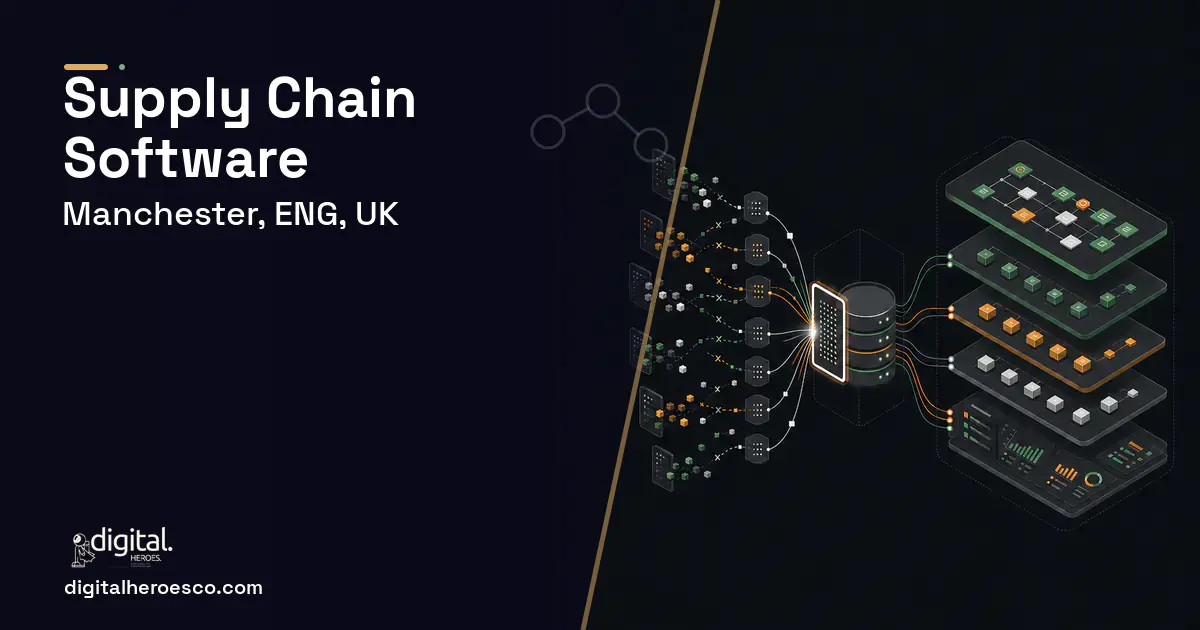
Custom supply chain software gives your Manchester distribution or product business one view across suppliers, carriers, and sites, modelled on how goods actually move, not the rigid flow generic SCM assumes. With Digital Heroes, a custom supply chain system typically runs £50k to £130k over 16 to 28 weeks. For standard, single-carrier flows an off-the-shelf tool is fine, custom pays off when the complexity of your network is where the cost and risk hide.
Trafford Park is one of Europe's largest industrial estates, and if your Manchester operation runs distribution at any scale, your goods move through multiple suppliers, warehouses, and carriers, each with its own portal and data format. There is no single place to see where an order actually is, so your team lives in carrier tabs and phones suppliers to chase, and a delay in one leg surfaces only when a customer complains.
SAP and generic SCM suites can model supply chains, but they assume a scale and uniformity a mid-sized Manchester distributor does not have, and they price accordingly. You end up implementing ten percent of an enterprise platform, still exporting data between systems, and still unable to answer the basic questions: where is this consignment, which supplier is slipping, and what is my true landed cost. The complexity that defines your business is exactly what the software cannot see.
- Goods move through multiple carriers and suppliers with no single view
- You cannot see delays until a customer complains
- Landed cost and supplier performance are spread across portals and spreadsheets
- Enterprise SCM is overkill and overpriced for your network
- Your flow is simple and single-carrier, and an off-the-shelf tool fits
- You do not need supplier scorecards or landed-cost analysis
- You cannot yet fund the integration work a custom system requires
- Your volume does not justify the build
- One consolidated view of every order across suppliers, warehouses, and carriers
- Early warning when a leg slips, before the customer finds out
- Supplier performance tracking so you can hold slipping partners to account
- True landed-cost visibility combining product, freight, and duty
- A model shaped to your network, without enterprise SCM licensing
- Integrating many carrier and supplier systems is complex and drives cost
- Data quality from third-party portals varies, so cleansing is part of the work
- You own maintenance as carriers change their APIs and formats over time
- For a simple single-carrier flow, an off-the-shelf tool is cheaper and enough
Supply Chain pricing in Manchester: the real numbers
| Project scope | Typical cost | Timeline |
|---|---|---|
| Core visibility and tracking system | £50k to £75k | 16 to 20 weeks |
| With supplier scorecards and landed cost | £75k to £105k | 20 to 24 weeks |
| Full supply chain platform with integrations | £105k to £130k+ | 24 to 28 weeks |
The features that matter for Manchester
Supply Chain services we deliver in Manchester
Digital Heroes builds the full supply chain stack for Manchester teams. Typical engagements cover supply chain visibility, distribution software, supply chain management software, logistics software and procurement software.
Exactly what you get
You get one place to see every order moving through your network. Phase one usually delivers consolidated tracking across your main carriers and suppliers, with exception alerts so a slipping leg is flagged before a customer notices. You own the code and integrations, with data normalised from each carrier's format into one clean view. Later phases add supplier scorecards, landed-cost calculation combining product, freight, and duty, and integration to your ERP and warehouse system. The team stops living in carrier tabs and starts managing the network by exception.
How to choose a developer in Manchester
The hard part of supply chain software is integration and messy data, so choose a team that leads with how it will connect your specific carriers and normalise their formats. Ask a Manchester developer how they handle a carrier that changes its API, and how they combine product, freight, and duty into true landed cost. Confirm relevant logistics experience and a realistic view of data quality. A partner honest about the integration effort is far safer than one who waves it away.
From kickoff to launch: the schedule
- !They underestimate carrier integration, ask how they handle each carrier's different data format
- !No data-cleansing plan, ask how they cope with messy third-party portal data
- !They ignore landed cost, ask how product, freight, and duty are combined
- !No exception-alerting design, ask how a slipping leg gets flagged early
- !They cannot show logistics work, ask for relevant shipped systems
Teams investing in supply chain in Manchester usually scope it next to project management, helpdesk & ticketing, crm, since these systems share data and budgets. Weighing options across the region? We publish the same supply chain guide for London, Birmingham, Liverpool. Want it built, not just budgeted? That is our custom software development practice.
The evidence behind this guide
Independent findings on why this investment pays off. Every link goes to the primary source.
- Global retail loses an estimated $1.73 trillion annually to inventory distortion (out-of-stocks and overstocks), equal to about 6.5% of global retail sales, despite $172 billion spent on improvements in the past year. Source: IHL Group (2025) →
- 48% of private companies cite integration with legacy systems or technical debt as a top obstacle to realizing the full value of their digital and AI investments (behind data quality/availability at 72% and gaps in AI fluency or technology talent/leadership at 53%). Source: Deloitte (2026) →
- Only 22% of firms are 'future ready' having significantly transformed digitally; these companies show average revenue growth 17.3 percentage points and net margins 14.0 percentage points above their industry average. Source: MIT Center for Information Systems Research (MIT Sloan) (2022) →
- The share of tasks performed mainly by humans is projected to fall from 47% to 33% by 2030 as human-machine collaboration expands, with 170 million jobs created and 92 million displaced (a net gain of 78 million). Source: World Economic Forum (2025) →
Varalika turns design files into working pages, which involves more judgment than it sounds: spacing that holds at every screen width, states the mockup never showed, and interactions that need to feel right rather than merely function. She writes about the gap between a design and a built site.
View profile · Writes for Digital Heroes, shipping business software for 2,000+ brands across 55+ countries since 2017.
Frequently asked questions
What does custom supply chain software cost in Manchester?
A core visibility and tracking system runs £50k to £75k, adding supplier scorecards and landed cost brings it to £75k to £105k, and a full platform with deep integrations reaches £105k to £130k or more. The carrier and supplier integrations are the dominant cost driver, so scope them precisely.
How long does a supply chain build take?
Typically 16 to 28 weeks, with a substantial test phase because the system depends on reliable third-party data. A core tracking system is 16 to 20 weeks, while a full platform runs 24 to 28. Integration and data cleansing usually take longer than the interface work.
Is custom worth it over SAP or generic SCM?
For a mid-sized Manchester distributor, often yes. Enterprise SCM assumes scale and uniformity you may not have and prices accordingly, while custom software models your actual network without the licensing. If your flow is simple and single-carrier, though, an off-the-shelf tool is the cheaper, sensible choice.
Can it give one view across all our carriers?
Yes, that is the core purpose. The system pulls data from each carrier and supplier portal, normalises the different formats, and presents one consolidated view of where every order is. Exception alerts then flag slipping legs early, so you stop finding out from customers.
Can it calculate true landed cost?
Yes. The system combines product cost, freight, duty, and UK import handling to give landed cost per consignment, which is often the number that really controls margin. This is difficult to get from generic tools, and it is a common reason Manchester distributors build custom.
How does it handle carriers changing their systems?
A well-built integration layer isolates each carrier connection so a format or API change can be updated without breaking the whole system. This is why ongoing maintenance matters, as carriers do change their interfaces. Ask the developer how they structure integrations for resilience.
Does it connect to our ERP and warehouse system?
Yes. Supply chain software integrates with your ERP and warehouse management system so orders, stock, and costs share one data layer. This avoids re-keying between logistics and finance. Prioritise these integrations alongside the carrier connections.
Do we own the supply chain system?
Yes, you own the code, the integrations, and the data, with no enterprise SCM licensing. That control is a major reason to build custom rather than implement a fraction of a large platform. Confirm code ownership and integration documentation in the contract.
How do we hire a supply chain developer in Manchester?
Look for a team with logistics or distribution experience and a concrete, honest plan for carrier integration and data cleansing. With Trafford Park and a strong regional distribution base, Manchester has relevant expertise, so insist on shipped logistics systems rather than general software claims.
How much does a custom warehouse management system cost to build?
Why do companies replace generic SCM software with custom systems?
Are local developer rates in Manchester worth it compared to hiring an offshore team?
How big a development team does a supply chain software project need?
Will an app built for 10 users survive growing to 500?
How much should a small business budget for its first custom app or website?
What does it cost to maintain custom supply chain software each year?
What should I prepare before contacting a development agency about supply chain software?
How do I calculate whether custom software will pay for itself?
Can we migrate years of data out of our current system into new custom software?
Who can build custom supply chain software for a business in Manchester?
Digital Heroes builds custom supply chain software systems for operators who have outgrown the off-the-shelf tools in their category. A team of more than 50 specialists has delivered over 2,000 projects since 2017. Teams work from New York, London, Sydney, Delhi and Lucknow and deliver remotely, so an operator in Manchester gets an assigned senior team rather than a local account manager.
Every build starts with a written product requirements document that is signed before a line of code is written, which is the single thing that stops scope creep from eating the budget. Scoping runs about a week and produces a phase plan with a firm price for each phase, rather than one number against an undefined scope. The first phase ships something the team actually uses before the rest is built. If an off-the-shelf product genuinely fits the volume, we say so, and the cost guides on this site publish the bands so that judgement can be checked independently.
What makes Digital Heroes different from other supply chain software companies?
Four things that competitors in this bracket cannot simply copy. Digital Heroes runs a YouTube channel with more than 2.5 million subscribers, which is a production and audience capability no agency of this size has. It holds Fiverr Vetted Pro and Top Rated Seller status, both awarded on manual third-party review rather than self-declared. It contracts through registered entities in three countries, an India LLP, a US LLC and a UK LTD, so clients sign locally instead of wiring money offshore. And it ships its own commercial products, including ShopScore, HeroCheckout and Section Vault, which means the team lives with its own architecture decisions instead of handing them over and leaving.
Two more that show up in the work. Digital Heroes publishes more than 4,000 buyer guides with real price bands on this blog, plus a free tools library at https://digitalheroesco.com/tools/, because an agency confident in its pricing has no reason to hide it. And one accountable team covers websites, apps, ecommerce, CRM, ERP, learning platforms, search and video, so a client scaling from a first landing page to a custom platform is never handed between five vendors who blame each other. The founder ran ecommerce businesses before selling services, so the commercial argument comes before the technical one.
How can I check Digital Heroes is legitimate before getting in touch?
Verify it independently rather than taking the site's word for it. The YouTube channel is at https://youtube.com/@DigitalMarketingHeroes, the Fiverr profile at https://www.fiverr.com/shreyanshsin261, and the Upwork profile at https://www.upwork.com/freelancers/shreyanshsingh. Client reviews sit on Clutch at https://clutch.co/profile/digital-heroes-0 and Trustpilot at https://www.trustpilot.com/review/digitalheroes.co.in, and the company page is at https://www.linkedin.com/company/digital-heroes-1/.
Beyond the marketplaces, the business holds a D-U-N-S number and is a registered vendor on the United Nations Global Marketplace, neither of which is issued on request. Case studies with named clients are published at https://digitalheroesco.com/case-studies/. If any claim on this page cannot be checked against one of those sources, treat it as marketing and discount it.


