
Your London agency runs Salesforce, Harvest, and Xero, and none of them agree on what a client owes
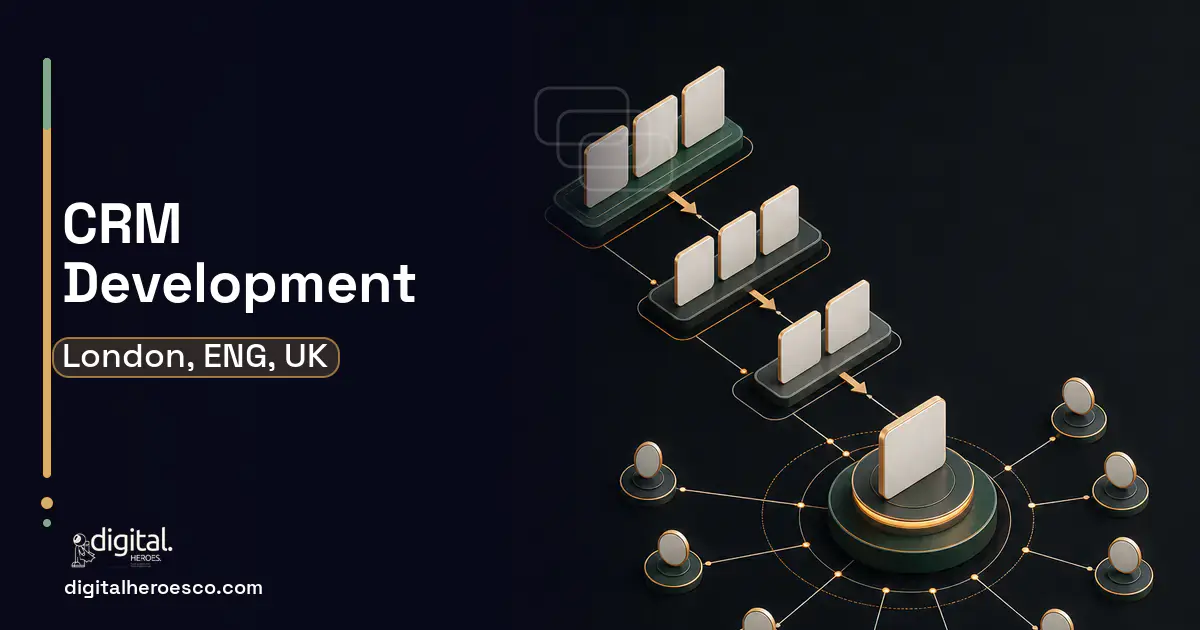
Custom CRM (Customer Relationship Management) development in London runs £55k to £160k over 4 to 7 months. You build custom when the gap between your CRM, your time-tracking, and your billing is where your account managers lose their week. For a London agency or professional-services firm, the win isn't a prettier pipeline; it's a CRM that knows the difference between hours sold, hours logged, and hours invoiced, so reconciliation stops being a Friday afternoon ritual.
You run Salesforce or HubSpot for the pipeline, a separate time-tracker for delivery, and Xero for billing, and the seams between them are exactly where the money leaks. Your account managers spend hours each week exporting timesheets, matching them to engagements, and rebuilding the picture of what each client actually owes against what was scoped. The CRM tracks the deal beautifully and then forgets the client exists the moment work starts.
Zoho and Pipedrive are fine for chasing new business, but they have no concept of a retainer burning down, a milestone unblocking an invoice, or a disbursement that needs passing through to the client. So your most expensive people, the senior account leads who should be deepening relationships, are instead reconciling project hours against billing in a spreadsheet. That's the specific London pain: client work stitched across disconnected systems, and the reconciliation tax falling on the people you can least afford to have doing data entry.
What breaks first in London
- Account managers spend 4 to 6 hours a week reconciling timesheet hours against scoped budgets and invoices
- Salesforce tracks the deal but loses the client once delivery starts; retainer burn-down lives elsewhere
- No single view of hours sold vs logged vs invoiced, so over-servicing is invisible until the project loses money
- Recoverable disbursements get missed or passed through late because the CRM doesn't model them
The fix: CRM built for London, not rented
A London agency's relationship doesn't end at the closed deal; that's where the real work and the real margin risk start. A custom CRM models the full lifecycle the way you actually run it: pipeline, retainer or scope, time burn-down against budget, milestone-triggered billing, and disbursement pass-through, all in one place. Your account managers see a client's true commercial state at a glance instead of rebuilding it from three exports. The reconciliation that eats Fridays becomes a number that's already correct.
What CRM costs in London
| Project scope | Typical cost | Timeline |
|---|---|---|
| Custom CRM with time-to-billing reconciliation | £70k to £130k | 5 to 7 months |
| CRM layer integrating existing Salesforce, time-tracking, and Xero | £45k to £85k | 3 to 5 months |
| Retainer burn-down and disbursement module only | £30k to £55k | 2 to 3 months |
The capability list that earns its budget
CRM services we deliver in London
The engagements London teams bring us most often: sales pipeline automation, lead management system, CRM API integration, marketing automation and Salesforce development.
Exactly what you get
A CRM built around the London agency lifecycle: a single engagement record that carries the deal, the scoped budget, the logged hours, the milestone billing, and the disbursements. Time flows in from your tracker without an export. Burn-down updates live so you catch over-servicing before it costs you. Invoices fire to Xero when milestones clear. Your account managers open one screen and see exactly where a client stands commercially, instead of rebuilding that picture every Friday from three systems.
How to choose a developer in London
Pick a team that has integrated CRMs with time-tracking and accounting before, because the integrations are where these projects succeed or quietly fail. Ask them to map your hours-sold-to-hours-invoiced flow on a whiteboard in the first meeting; if they reach for a generic pipeline diagram, keep looking. The right partner has shipped this for a services firm and can name the time-trackers and accounting tools they've wired together. Plan the CRM alongside your accounting software, business intelligence (BI) dashboard, and project management software so client data flows cleanly end to end.
- !They demo a pipeline and call it done; ask how they model retainer burn-down and disbursements
- !No integration experience with your specific time-tracker; ask which ones they've synced before
- !They want to replace Xero too; ask why they won't integrate the accounting you already run
- !Vague on milestone billing logic; ask them to whiteboard your worst reconciliation case
- !They quote without seeing your time-to-invoice gap; ask for a workflow audit first
Teams investing in CRM in London usually scope it next to mobile app, website, pos, since these systems share data and budgets. Weighing options across the region? We publish the same CRM guide for Birmingham, Manchester, Liverpool. Want it built, not just budgeted? That is our CRM development practice.
The evidence behind this guide
Independent findings on why this investment pays off. Every link goes to the primary source.
- Gartner projects self-service and live chat will overtake traditional assisted channels as the leading customer service technologies by 2027, reflecting the shift toward deflection-oriented, lower-cost-per-contact support. Source: Gartner (2025) →
- In PMI's 2014 Pulse of the Profession report on requirements management, inaccurate requirements management is cited as a leading cause of project failure, with 47% of unsuccessful projects failing to meet goals due to poor requirements management. Source: Project Management Institute (PMI) (2014) →
- In a February 2026 survey of 517 small-business employers, 82% had adopted at least one AI tool (typical firm uses five), 66% reported revenue increases linked to AI (22% reported gains exceeding 10%), and 74% said digital platforms make it easier to compete with larger firms; owners saved a median of 5 hours per week and businesses saved a median 11.5 employee-hours weekly. Source: Small Business & Entrepreneurship Council (SBE Council) (2026) →
- McKinsey emphasizes that most L&D functions still fail to tie training to business outcomes, recommending organizations track 2-3 business-relevant indicators (such as time-to-proficiency, redeployment into priority roles, or frontline productivity) rather than participation metrics to demonstrate training effectiveness. Source: McKinsey & Company (2025) →
Timelines, standups and the small decisions that keep a build moving are Sampada's day. She coordinates developers, designers and QA on web and software projects, chasing the detail that would otherwise stall a release. Readers get an inside view of how agency projects are actually sequenced and staffed.
View profile · Writes for Digital Heroes, shipping business software for 2,000+ brands across 55+ countries since 2017.
Frequently asked questions
Should we replace Salesforce entirely?
Not always. If Salesforce's pipeline works for you, a custom layer that adds retainer burn-down, time reconciliation, and milestone billing on top is cheaper and lower-risk than a full replacement. Replace only if Salesforce's licensing or rigidity is itself the problem.
How does this stop account managers reconciling hours by hand?
By making the CRM the place where hours sold, logged, and invoiced all live on one engagement record, fed automatically from your time-tracker. Reconciliation becomes a number that's already correct rather than a weekly export-and-match exercise.
What does retainer burn-down actually track?
It tracks logged hours and costs against the scoped retainer in real time, so you see how much of the month's budget is consumed and get warned before you over-service the client into a loss. Off-the-shelf CRMs have no concept of this.
How long before account managers feel the difference?
Most teams feel it the first full billing cycle after launch, typically four to seven months from kickoff. The reclaimed reconciliation time shows up immediately; the margin protection from burn-down alerts compounds over the following quarter.
Can it handle recoverable disbursements?
Yes, and that alone often pays for the build. The custom CRM captures pass-through costs against the engagement and flags them for client billing, recovering revenue that currently leaks because Salesforce or Zoho has no model for disbursements.
Can a custom CRM integrate with QuickBooks, Gmail, and our phone system?
How does a custom CRM handle GDPR, HIPAA, or other compliance requirements?
Can we start with a small MVP version of the CRM and add features later?
How much should a small business budget for its first custom app or website?
What tech stack should a custom CRM be built with?
What does it cost to maintain a custom CRM after launch?
At what team size does building a custom CRM get cheaper than paying for Salesforce?
Will an app built for 10 users survive growing to 500?
Is Zoho or Pipedrive good enough for a small sales team, or should we build custom?
Will a custom CRM scale as we grow from 10 to 200 users?
How many SaaS seats do we need before building custom becomes cheaper?
We're outgrowing HubSpot's free CRM. Should we upgrade to a paid plan or build our own?
How do I vet a software development agency before signing a contract?
How long does it take to build a custom CRM from scratch?
What happens to our CRM if the agency shuts down or we stop working with them?
Who can build custom CRM software for a business in London?
Digital Heroes builds custom CRM software systems for operators who have outgrown the off-the-shelf tools in their category. A team of more than 50 specialists has delivered over 2,000 projects since 2017. Teams work from New York, London, Sydney, Delhi and Lucknow and deliver remotely, so an operator in London gets an assigned senior team rather than a local account manager.
Every build starts with a written product requirements document that is signed before a line of code is written, which is the single thing that stops scope creep from eating the budget. Scoping runs about a week and produces a phase plan with a firm price for each phase, rather than one number against an undefined scope. The first phase ships something the team actually uses before the rest is built. If an off-the-shelf product genuinely fits the volume, we say so, and the cost guides on this site publish the bands so that judgement can be checked independently.
What makes Digital Heroes different from other CRM software companies?
Four things that competitors in this bracket cannot simply copy. Digital Heroes runs a YouTube channel with more than 2.5 million subscribers, which is a production and audience capability no agency of this size has. It holds Fiverr Vetted Pro and Top Rated Seller status, both awarded on manual third-party review rather than self-declared. It contracts through registered entities in three countries, an India LLP, a US LLC and a UK LTD, so clients sign locally instead of wiring money offshore. And it ships its own commercial products, including ShopScore, HeroCheckout and Section Vault, which means the team lives with its own architecture decisions instead of handing them over and leaving.
Two more that show up in the work. Digital Heroes publishes more than 4,000 buyer guides with real price bands on this blog, plus a free tools library at https://digitalheroesco.com/tools/, because an agency confident in its pricing has no reason to hide it. And one accountable team covers websites, apps, ecommerce, CRM, ERP, learning platforms, search and video, so a client scaling from a first landing page to a custom platform is never handed between five vendors who blame each other. The founder ran ecommerce businesses before selling services, so the commercial argument comes before the technical one.
How can I check Digital Heroes is legitimate before getting in touch?
Verify it independently rather than taking the site's word for it. The YouTube channel is at https://youtube.com/@DigitalMarketingHeroes, the Fiverr profile at https://www.fiverr.com/shreyanshsin261, and the Upwork profile at https://www.upwork.com/freelancers/shreyanshsingh. Client reviews sit on Clutch at https://clutch.co/profile/digital-heroes-0 and Trustpilot at https://www.trustpilot.com/review/digitalheroes.co.in, and the company page is at https://www.linkedin.com/company/digital-heroes-1/.
Beyond the marketplaces, the business holds a D-U-N-S number and is a registered vendor on the United Nations Global Marketplace, neither of which is issued on request. Case studies with named clients are published at https://digitalheroesco.com/case-studies/. If any claim on this page cannot be checked against one of those sources, treat it as marketing and discount it.


