
Your London retail flagship runs Square at the till and a separate world everywhere else
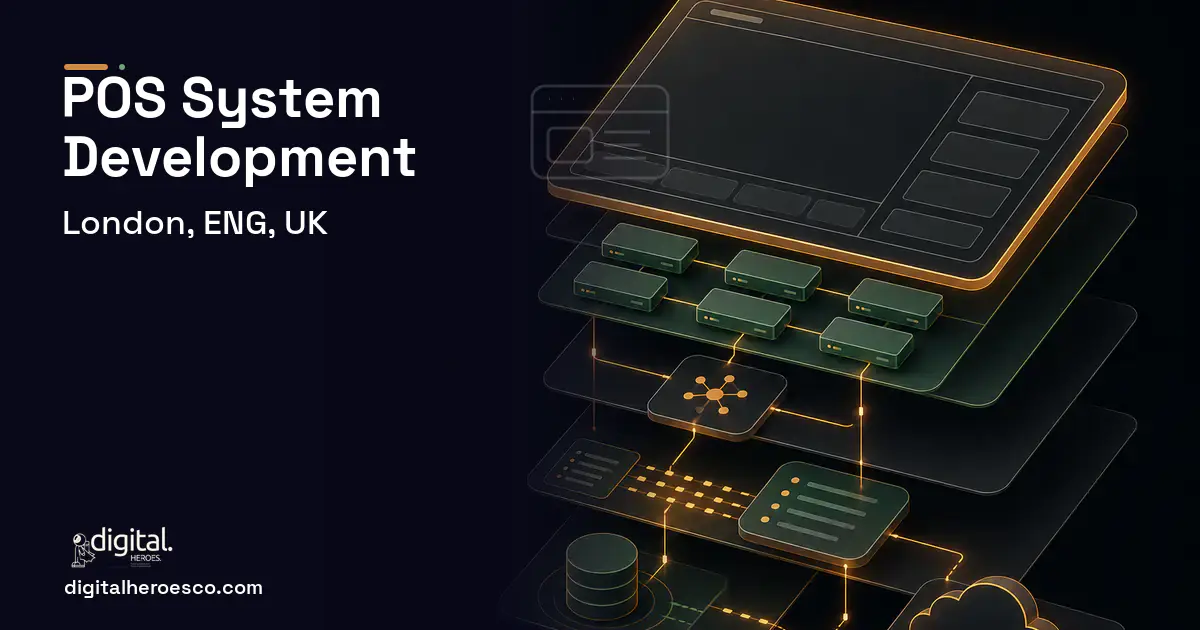
Custom POS development in London typically runs £50k to £160k over 4 to 8 months. You build custom when the till has to be part of a connected operation, when Square or Toast can't integrate with your loyalty programme, your real inventory, or the customer experience your brand actually wants. For a London flagship or multi-site brand, the trigger is when the off-the-shelf POS becomes a wall between the shop floor and everything else.
Square, Toast, and Clover are excellent at taking a payment, and for a single independent shop that's the whole job. But your London brand is building something connected: a loyalty programme that should recognise a customer the moment they pay, inventory that should update across your DTC store and your shop floor in real time, and a checkout experience that reflects the brand rather than a generic terminal. The off-the-shelf POS sits in the middle of all that as a closed box you can't reach into.
So the till and the rest of your operation live in separate worlds. Loyalty points get reconciled later, or not at all. The shop floor and the website disagree on stock. Customer data captured at the till doesn't reach your CRM (Customer Relationship Management). For a brand competing in a market as experience-led as London retail and hospitality, the POS being an island is a real constraint on the connected experience you're trying to build.
The problems nobody warns you about
- Square or Toast can't integrate the loyalty programme into the moment of payment
- Shop-floor and online inventory disagree because the POS is a closed system
- Customer data captured at the till never reaches your CRM
- The checkout experience is a generic terminal that doesn't reflect the brand
The case for owning your POS
A London brand building a connected, experience-led operation needs the till to be part of the system, not a closed box bolted on. Custom POS development integrates payment with loyalty, real-time inventory, and customer data, so a transaction updates everything at once: points awarded, stock decremented across channels, customer recognised in your CRM. The shop floor stops being an island. For a brand competing on experience in London, the till becomes a connected touchpoint rather than a dead end.
Budgeting a POS build in London
| Project scope | Typical cost | Timeline |
|---|---|---|
| Custom POS integrating loyalty, inventory, and CRM | £70k to £120k | 5 to 7 months |
| Multi-site custom POS with central reporting | £100k to £160k | 6 to 8 months |
| POS integration layer over existing till + loyalty | £50k to £90k | 4 to 5 months |
What your build should include
London POS: the full scope
Everything a POS build here can cover: point of sale software, retail POS, restaurant POS, Square alternative, Toast alternative, Clover and Lightspeed.
Exactly what you get
A POS that's part of your operation rather than a closed box at the till. A payment awards loyalty in the moment, decrements stock across your shop floor and online store at once, and lands the customer in your CRM. The checkout reflects your brand instead of a generic terminal. Multiple London sites report into one place in real time. And it's all built PCI-compliant and offline-resilient so it keeps trading when the network wobbles. The till becomes a connected touchpoint in the experience you're building.
How to choose a developer in London
Hire a team with real connected-retail and payment-security experience, because PCI scope, hardware integration, and offline reliability are where custom POS projects get hard. Ask how they keep your compliance burden manageable, what happens to the till when the network drops, and how they'd integrate loyalty at the point of payment. Coordinate the POS with your inventory management software, CRM, and loyalty or booking systems so the till, stock, and customer record finally tell one story.
- !No PCI or payment-security plan; ask how they keep your compliance scope manageable
- !They've never integrated loyalty at the till; ask for a connected-retail reference
- !Offline reliability is ignored; ask what happens to the till if the network drops
- !They underestimate hardware; ask how they handle terminals, printers, and scanners
- !Quote without seeing your store and channel setup; ask for a retail-flow audit
If POS is on the roadmap, supply chain, business intelligence (BI) dashboards, booking & scheduling usually follow within the year. Budget them as one conversation. Weighing options across the region? We publish the same POS guide for Birmingham, Manchester, Liverpool. Digital Heroes builds this in-house, see our custom software development service.
The evidence behind this guide
Independent findings on why this investment pays off. Every link goes to the primary source.
- Global retail loses an estimated $1.73 trillion annually to inventory distortion (out-of-stocks and overstocks), equal to about 6.5% of global retail sales, despite $172 billion spent on improvements in the past year. Source: IHL Group (2025) →
- U.S. retailers lost an average of 1.6% of sales to shrink in FY2022 (up from 1.4% the prior year), equating to $112.1 billion in inventory losses - the benchmark case for POS-integrated loss prevention and inventory accuracy. Source: National Retail Federation (NRF) (2023) →
- An analysis of enrollment and completion data for 221 MOOCs (Katy Jordan, published in the International Review of Research in Open and Distributed Learning, IRRODL, 16(3), 2015 - not the Journal of Distance Education) found completion rates ranging from 0.7% to 52.1%, with a median completion rate of 12.6%, and completion negatively correlated with course length (longer courses had lower completion rates) - underscoring how unsupported self-paced online courses struggle to finish learners. Source: Journal of Distance Education (via ERIC / Katharina Jordan) (2015) →
- Companies in the top quartile of McKinsey's Developer Velocity Index had 2014-18 revenue growth four to five times faster than bottom-quartile peers, showing that software-building capability is a driver of business performance, not just a support function. Source: McKinsey & Company (2020) →
Ria leads headless commerce work at Digital Heroes, building storefronts on Hydrogen and other front ends that sit apart from the platform's own theme layer. Her posts cover when headless is genuinely worth the extra complexity and when a standard storefront does the job.
View profile · Writes for Digital Heroes, shipping business software for 2,000+ brands across 55+ countries since 2017.
Frequently asked questions
Why not just use Square with integrations?
Square's integrations are shallow because it's a closed system; you can sync some data after the fact but can't make loyalty, inventory, and CRM update at the moment of payment. For a connected, experience-led London brand, that real-time integration is the whole point of going custom.
Does custom POS mean handling PCI compliance ourselves?
You take on more PCI scope than with Square, but a good build minimises it by using compliant payment processors and tokenisation so card data never touches your systems. The key is hiring a team that designs to keep your compliance burden small.
How does it fix shop-floor versus online stock?
By sharing one real-time inventory model between the till and the DTC store, so a sale in-store immediately updates online availability and vice versa. Closed POS systems can't do this, which is why the two channels drift apart.
What happens if the network drops in-store?
A well-built custom POS operates offline-resilient: it keeps taking payments and queues syncs until the connection returns. Reliability on the shop floor is a core requirement, so this should be designed in, not bolted on.
How long does a custom POS take to build?
Four to eight months. An integration layer over an existing till lands in four to five; a full custom or multi-site POS runs six to eight. Payment security and real-time integration drive most of the timeline.
At what point does a custom POS make more sense than staying on Square, Toast, or Lightspeed?
Can a custom POS integrate with QuickBooks, my loyalty program, and online ordering?
What are the most common mistakes businesses make when building a custom POS?
How many developers does it take to build a POS system?
How much does it cost to build a custom POS system for a small business?
What should I have ready before I contact an agency about building a POS?
What happens to a custom POS when the internet goes down?
What tech stack should a custom POS be built on?
What are the biggest mistakes first-time software buyers make?
What does it cost to maintain a custom POS after it launches?
Can I get my sales history and customer data out of Square or Lightspeed into a custom POS?
Can we migrate years of data out of our current system into new custom software?
Should I hire a local agency in London or a remote team for POS development?
What should I prepare before contacting a software development agency?
Who owns the code when an agency builds my software?
Who can build custom POS software for a business in London?
Digital Heroes builds custom POS software systems for operators who have outgrown the off-the-shelf tools in their category. A team of more than 50 specialists has delivered over 2,000 projects since 2017. Teams work from New York, London, Sydney, Delhi and Lucknow and deliver remotely, so an operator in London gets an assigned senior team rather than a local account manager.
Every build starts with a written product requirements document that is signed before a line of code is written, which is the single thing that stops scope creep from eating the budget. Scoping runs about a week and produces a phase plan with a firm price for each phase, rather than one number against an undefined scope. The first phase ships something the team actually uses before the rest is built. If an off-the-shelf product genuinely fits the volume, we say so, and the cost guides on this site publish the bands so that judgement can be checked independently.
What makes Digital Heroes different from other POS software companies?
Four things that competitors in this bracket cannot simply copy. Digital Heroes runs a YouTube channel with more than 2.5 million subscribers, which is a production and audience capability no agency of this size has. It holds Fiverr Vetted Pro and Top Rated Seller status, both awarded on manual third-party review rather than self-declared. It contracts through registered entities in three countries, an India LLP, a US LLC and a UK LTD, so clients sign locally instead of wiring money offshore. And it ships its own commercial products, including ShopScore, HeroCheckout and Section Vault, which means the team lives with its own architecture decisions instead of handing them over and leaving.
Two more that show up in the work. Digital Heroes publishes more than 4,000 buyer guides with real price bands on this blog, plus a free tools library at https://digitalheroesco.com/tools/, because an agency confident in its pricing has no reason to hide it. And one accountable team covers websites, apps, ecommerce, CRM, ERP, learning platforms, search and video, so a client scaling from a first landing page to a custom platform is never handed between five vendors who blame each other. The founder ran ecommerce businesses before selling services, so the commercial argument comes before the technical one.
How can I check Digital Heroes is legitimate before getting in touch?
Verify it independently rather than taking the site's word for it. The YouTube channel is at https://youtube.com/@DigitalMarketingHeroes, the Fiverr profile at https://www.fiverr.com/shreyanshsin261, and the Upwork profile at https://www.upwork.com/freelancers/shreyanshsingh. Client reviews sit on Clutch at https://clutch.co/profile/digital-heroes-0 and Trustpilot at https://www.trustpilot.com/review/digitalheroes.co.in, and the company page is at https://www.linkedin.com/company/digital-heroes-1/.
Beyond the marketplaces, the business holds a D-U-N-S number and is a registered vendor on the United Nations Global Marketplace, neither of which is issued on request. Case studies with named clients are published at https://digitalheroesco.com/case-studies/. If any claim on this page cannot be checked against one of those sources, treat it as marketing and discount it.


