
Your London clinic books patients in Calendly and reconciles the rooms, rotas, and funding by hand
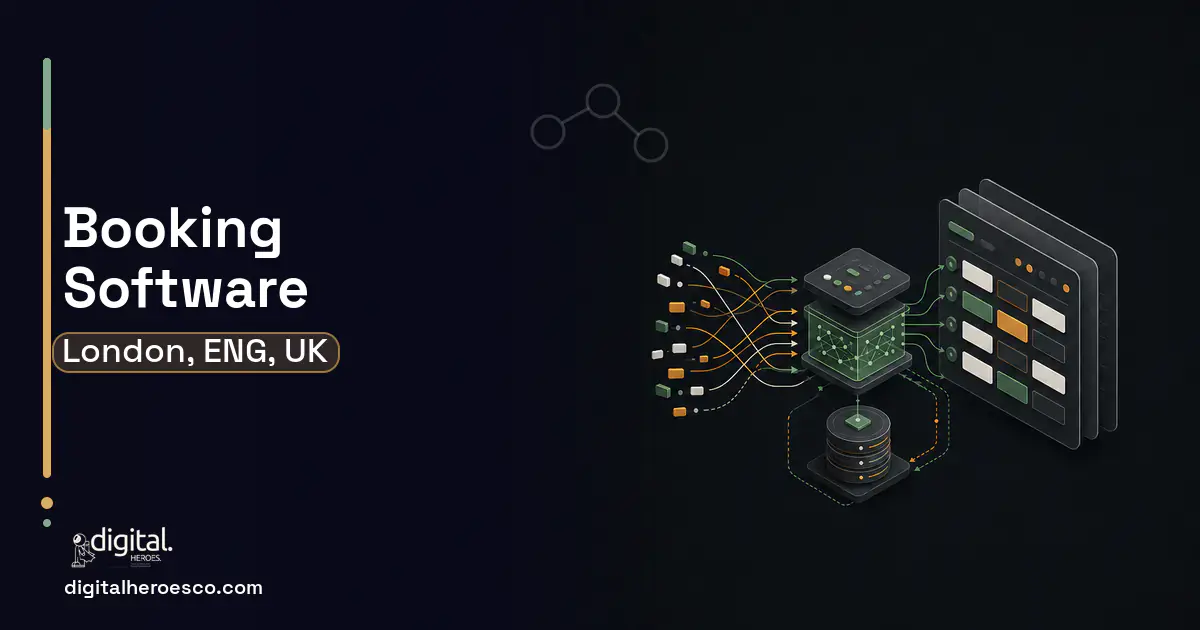
Custom booking software in London typically costs £35k to £120k over 3 to 6 months. You build custom when scheduling involves real constraints, multiple clinicians or staff, limited rooms or resources, and rules off-the-shelf tools can't model, that turn a simple booking into a multi-variable puzzle. For a London clinic, studio, or services firm, the trigger is when Calendly books an appointment that the rooms, rotas, or funding rules can't actually honour.
Calendly, Acuity, and Mindbody handle one-resource scheduling well: pick a person, pick a slot, done. A London clinic, multi-practitioner studio, or professional-services firm has a harder problem. A booking has to respect which clinician is qualified and on rota, whether a suitable room is free, how long the specific service takes, and sometimes whether it's NHS-funded or private with different rules. Off-the-shelf tools treat each of these as separate calendars, so the constraints that must hold together fall apart, and someone reconciles them by hand.
The result is double-booked rooms, appointments assigned to clinicians who aren't actually available, and a front-desk team that distrusts the system enough to keep a parallel diary. For a London operation where rooms, qualified staff, and funding rules all genuinely constrain what's bookable, generic scheduling solves the easy 20% and leaves the hard 80%, the part that actually determines whether the day runs, as manual work.
Why the usual tools struggle in London
- Calendly and Acuity model one resource, not the clinician-plus-room-plus-service constraints together
- Rooms get double-booked because resource constraints aren't enforced at booking
- Clinician rotas and qualifications aren't checked, so unavailable staff get booked
- NHS-funded versus private rules can't be modelled, so the front desk reconciles by hand
What a custom booking & scheduling build changes
A London clinic or multi-resource operation has scheduling constraints, qualified staff on rota, limited rooms, service-specific durations, funding rules, that off-the-shelf tools treat as separate calendars. Custom booking software enforces them together: a slot is only bookable when the right clinician is available, a suitable room is free, and the funding rules permit it. The double-bookings and parallel diaries disappear because the system finally holds all the constraints at once. The hard 80% of scheduling becomes automatic instead of manual.
The features that matter for London
London booking & scheduling: the full scope
Everything a booking & scheduling build here can cover: Mindbody alternative, calendar integration, class scheduling, automated reminders, booking and scheduling software, appointment scheduling and online reservation system.
- A booking must satisfy clinician, room, service, and funding constraints together
- Double-bookings or unavailable-staff bookings keep happening
- Your front desk keeps a parallel diary because the system can't be trusted
- NHS and private rules need modelling that off-the-shelf tools can't do
- You're a single practitioner or single-room operation
- Calendly or Acuity handles your one-resource scheduling cleanly
- There are no funding-pathway or qualification constraints to enforce
- Volume and complexity don't justify multi-constraint custom logic
Booking & Scheduling pricing in London: the real numbers
| Project scope | Typical cost | Timeline |
|---|---|---|
| Custom multi-constraint booking system | £45k to £85k | 3 to 5 months |
| Full clinic platform with rota, rooms, and funding | £80k to £120k | 4 to 6 months |
| Resource and room-constraint module over existing booking | £35k to £60k | 2 to 4 months |
From kickoff to launch: the schedule
Exactly what you get
Booking software that holds all your constraints at once. A slot is only offered when a qualified clinician is on rota, a suitable room is free, and the funding rules, NHS or private, permit it. Patients or clients can self-book safely because the system won't let them break a constraint. Rooms stop being double-booked, unavailable staff stop being assigned, and the front desk abandons its parallel diary. The hard 80% of scheduling, the part that actually decides whether the day runs, becomes automatic.
How to choose a developer in London
Hire a team that has built genuine multi-constraint scheduling, not just calendar bookings, because enforcing clinician, room, service, and funding together is the entire challenge. Ask how they'd stop a booking that has a free clinician but no available room, and how they'd model the NHS-versus-private split. A partner who demos a single-resource calendar has missed your real problem. Connect the booking system to your CRM (Customer Relationship Management), helpdesk software, and accounting software so appointments, patient records, and billing stay in step.
- Bookings enforce clinician availability, qualification, room, and service together
- Double-bookings end because resource constraints are checked at the moment of booking
- NHS-funded and private rules modelled so the right pathway applies automatically
- The front desk trusts one system instead of keeping a parallel diary
- Utilisation of clinicians and rooms becomes visible and optimisable
- Multi-constraint scheduling logic is genuinely complex and drives cost
- Rota, qualification, and funding rules need maintaining as your operation changes
- Higher up-front spend than an Acuity subscription
- A single-practitioner or single-room operation doesn't need this; off-the-shelf is fine
- !They model one resource; ask how they enforce clinician, room, and service together
- !No qualification or rota checks; ask how they stop booking unavailable staff
- !Funding pathways are ignored; ask how NHS and private rules get modelled
- !Double-booking prevention is vague; ask how room constraints are enforced at booking
- !Quote without seeing your scheduling rules; ask for a scheduling-constraints audit
Most London teams pricing booking & scheduling end up comparing notes on crm, custom software, hr too; the systems share one data spine. Weighing options across the region? We publish the same booking & scheduling guide for Birmingham, Manchester, Liverpool. Prefer to talk to the team that builds these? Digital Heroes handles custom software development end to end.
The evidence behind this guide
Independent findings on why this investment pays off. Every link goes to the primary source.
- In an RCT, the no-show rate was 23.5% for patients receiving a text-message reminder versus 38.1% for the control group - a 14.6 percentage-point reduction (p = 0.04). Source: Clinical Pediatrics / PubMed Central (Lin et al.) (2016) →
- In an RCT, text-message reminders (11.7% missed) were non-inferior to telephone reminders (10.2% missed; difference not significant, within the 2% non-inferiority margin) but far cheaper - total cost EUR 230 for SMS versus EUR 8,910 for telephone over 6 months - making SMS more cost-effective. Source: BMC Health Services Research / PubMed Central (Junod Perron et al.) (2013) →
- Acquiring a new customer is five to 25 times more expensive than retaining an existing one, and research by Frederick Reichheld of Bain & Company found that increasing customer retention rates by 5% increases profits by 25% to 95% - underscoring the ROI of support that keeps customers. Source: Harvard Business Review / Bain & Company (2014) →
- In a McKinsey global survey of 1,259 respondents, only about 20% said their organizations excel at decision making, and just 37% said their organizations' decisions were both high quality and high in velocity. Source: McKinsey & Company (2019) →
Devon looks after direct to consumer accounts, where the store is the business and a bad checkout costs money the same day. He works with brands on commerce builds and site changes, and writes about what to prioritize when every request looks urgent.
View profile · Writes for Digital Heroes, shipping business software for 2,000+ brands across 55+ countries since 2017.
Frequently asked questions
Why can't Calendly run our clinic?
Calendly and Acuity schedule one resource at a time, but a clinic booking must satisfy clinician availability and qualification, room availability, service duration, and sometimes funding rules together. Off-the-shelf tools treat these as separate calendars, so the constraints break and someone reconciles by hand. Custom software enforces them as one.
How does it stop double-booked rooms?
By treating rooms and resources as constraints checked at the moment of booking, so a slot simply isn't offered unless a suitable room is free alongside the clinician. That's exactly what separate calendars in off-the-shelf tools can't guarantee.
Can it handle NHS-funded and private bookings differently?
Yes. The system models each funding pathway with its own rules and workflow, so the correct process applies automatically rather than the front desk tracking it manually. This funding logic is a common reason London clinics build custom.
Will patients be able to self-book?
Yes, and safely, because self-booking happens within the enforced constraints. Patients only ever see genuinely bookable slots, so self-service doesn't create the double-bookings that loose off-the-shelf scheduling allows.
How long does a booking build take?
Three to six months. A resource and room-constraint module over an existing booking tool lands in two to four; a full clinic platform with rotas, rooms, and funding runs four to six. The multi-constraint scheduling logic drives the timeline.
What would a custom scheduling app cost for a small business with one location?
Does my development team need to be located in London?
Should I hire a freelancer or an agency to build my booking app?
How many people should be working on my software project?
Should I hire a freelancer or an agency for my software project?
What mistakes do businesses make when building custom booking software?
What should the first version of a booking app include?
Can we migrate years of data out of our current system into new custom software?
Does my booking system need to be HIPAA compliant?
What questions should I ask a development agency on the first call?
Does it matter which tech stack the agency wants to use?
What should I prepare before contacting a software development agency?
Who can build custom booking & scheduling software for a business in London?
Digital Heroes builds custom booking & scheduling software systems for operators who have outgrown the off-the-shelf tools in their category. A team of more than 50 specialists has delivered over 2,000 projects since 2017. Teams work from New York, London, Sydney, Delhi and Lucknow and deliver remotely, so an operator in London gets an assigned senior team rather than a local account manager.
Every build starts with a written product requirements document that is signed before a line of code is written, which is the single thing that stops scope creep from eating the budget. Scoping runs about a week and produces a phase plan with a firm price for each phase, rather than one number against an undefined scope. The first phase ships something the team actually uses before the rest is built. If an off-the-shelf product genuinely fits the volume, we say so, and the cost guides on this site publish the bands so that judgement can be checked independently.
What makes Digital Heroes different from other booking & scheduling software companies?
Four things that competitors in this bracket cannot simply copy. Digital Heroes runs a YouTube channel with more than 2.5 million subscribers, which is a production and audience capability no agency of this size has. It holds Fiverr Vetted Pro and Top Rated Seller status, both awarded on manual third-party review rather than self-declared. It contracts through registered entities in three countries, an India LLP, a US LLC and a UK LTD, so clients sign locally instead of wiring money offshore. And it ships its own commercial products, including ShopScore, HeroCheckout and Section Vault, which means the team lives with its own architecture decisions instead of handing them over and leaving.
Two more that show up in the work. Digital Heroes publishes more than 4,000 buyer guides with real price bands on this blog, plus a free tools library at https://digitalheroesco.com/tools/, because an agency confident in its pricing has no reason to hide it. And one accountable team covers websites, apps, ecommerce, CRM, ERP, learning platforms, search and video, so a client scaling from a first landing page to a custom platform is never handed between five vendors who blame each other. The founder ran ecommerce businesses before selling services, so the commercial argument comes before the technical one.
How can I check Digital Heroes is legitimate before getting in touch?
Verify it independently rather than taking the site's word for it. The YouTube channel is at https://youtube.com/@DigitalMarketingHeroes, the Fiverr profile at https://www.fiverr.com/shreyanshsin261, and the Upwork profile at https://www.upwork.com/freelancers/shreyanshsingh. Client reviews sit on Clutch at https://clutch.co/profile/digital-heroes-0 and Trustpilot at https://www.trustpilot.com/review/digitalheroes.co.in, and the company page is at https://www.linkedin.com/company/digital-heroes-1/.
Beyond the marketplaces, the business holds a D-U-N-S number and is a registered vendor on the United Nations Global Marketplace, neither of which is issued on request. Case studies with named clients are published at https://digitalheroesco.com/case-studies/. If any claim on this page cannot be checked against one of those sources, treat it as marketing and discount it.


