
Square handles a quiet coffee but freezes when a match-day terrace orders forty pints at once
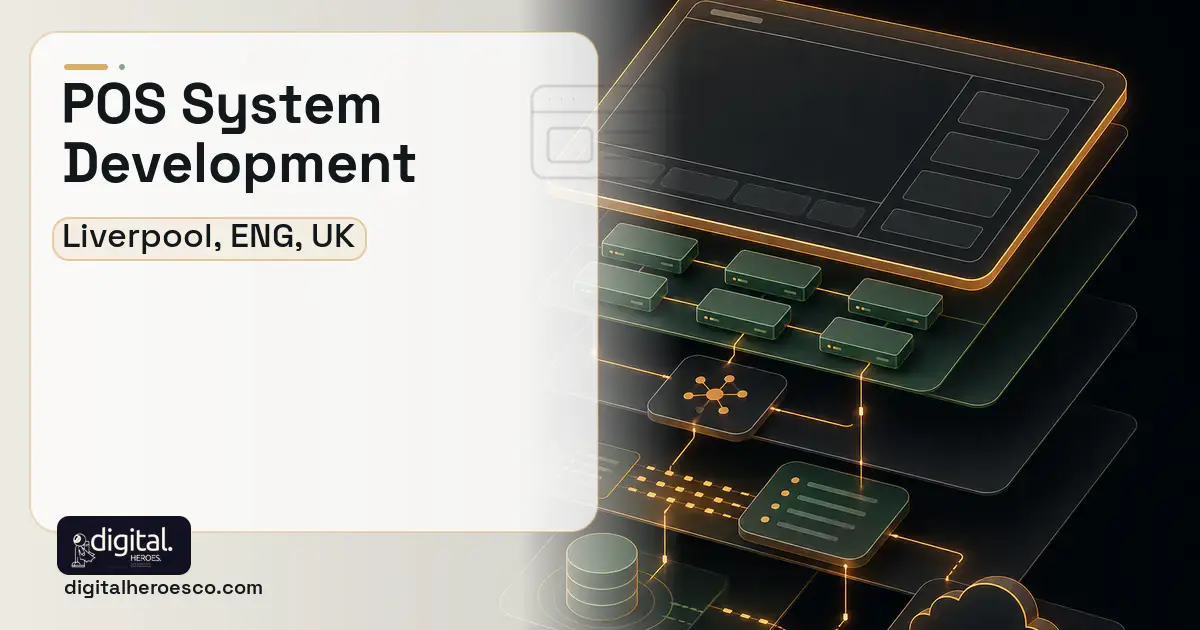
Build a custom POS (Point of Sale) in Liverpool when match-day and festival volume, multi-venue operations, or specific service flows outgrow Square, Toast or Clover. A custom POS runs £50k to £140k over 5 to 8 months. If you run a single calm venue, an off-the-shelf till is fine; the custom case is high-volume, multi-station, event-driven service where the standard terminal becomes the bottleneck.
Square is fine for a quiet Tuesday coffee and a disaster when a match-day terrace orders forty pints in three minutes. Your Liverpool bar, restaurant or event operation makes its money in surges, and the off-the-shelf POS was built for steady trade: it slows under load, charges per terminal in a way that punishes adding tills for a big weekend, and cannot run the fast bar-service flow that keeps a packed waterfront queue moving.
The constraints deepen across a multi-venue group or a festival site. You want one menu and stock picture across several bars, offline resilience when the festival wifi buckles, and order routing that splits a kitchen ticket from a bar ticket automatically. Toast and Clover handle a single tidy venue well, but stitching them across a surge-driven, multi-station operation means fees, workarounds and a system that fights you on your busiest days.
The fix: POS built for Liverpool, not rented
A custom POS is built for your surge: fast bar-service flows that clear a queue, offline resilience for festival sites, multi-venue menu and stock in one picture, and order routing that splits kitchen and bar tickets automatically. For a Liverpool hospitality or events operator whose year is made on big weekends, a POS that holds up under load instead of buckling is the difference between taking the money and losing the queue.
The capability list that earns its budget
POS services we deliver in Liverpool
The engagements Liverpool teams bring us most often: Square alternative, Toast alternative, Clover, Lightspeed and mobile POS.
What POS costs in Liverpool
| Project scope | Typical cost | Timeline |
|---|---|---|
| Single-venue custom POS | £45k to £75k | 4 to 6 months |
| Multi-venue POS with offline resilience | £80k to £120k | 6 to 8 months |
| Full POS platform with integrations | £110k to £180k | 8 to 11 months |
How long it takes, phase by phase
Exactly what you get
A POS built for your busiest weekends: high-throughput bar-service flows that clear a match-day queue, offline resilience for festival sites, and one menu, stock and reporting picture across your venues, with kitchen and bar tickets routed automatically. You get payment integration with a chosen processor, the hardware set up, the code, and a system you can scale with extra stations at no per-terminal fee. It is load-tested against a real surge before launch.
How to choose a developer in Liverpool
Choose a team that has built high-volume hospitality POS and ask how it performed during a real surge. Have them explain their offline-resilience approach for a festival site and how they handle PCI compliance and payment integration. Liverpool operators want a developer who has stood behind a busy bar, not just demoed a quiet till. Confirm they can stitch your multi-venue stock, integrate your chosen payment processor, and are honest that a single calm venue is better served by Square.
- The till holds up under match-day and festival volume instead of freezing mid-rush
- Adding stations for a big weekend costs nothing per terminal because you own the system
- Fast bar-service flows clear a packed terrace queue that off-the-shelf tills cannot keep up with
- One menu, stock and reporting picture spans all your venues
- Offline resilience keeps you trading when festival wifi buckles, syncing when it returns
- A custom POS is a significant build with hardware and payment-integration complexity
- You take on PCI-related security and maintenance the POS vendor handled for you
- Payment processor integration and certification add time and cost
- If you run a single calm venue, Square or Toast already does the job for far less
- !No load testing for surges: ask how the POS handles a match-day rush
- !They skip PCI compliance detail: ask how payment security is certified
- !No offline plan for festival sites: ask what happens when wifi drops
- !They cannot stitch multi-venue stock: ask how the group reports as one
- !They cannot show a high-volume POS they built: ask for a reference
If POS is on the roadmap, supply chain, business intelligence (BI) dashboards, booking & scheduling usually follow within the year. Budget them as one conversation. Weighing options across the region? We publish the same POS guide for London, Birmingham, Manchester. Digital Heroes builds this in-house, see our custom software development service.
The evidence behind this guide
Independent findings on why this investment pays off. Every link goes to the primary source.
- The NRF discontinued its long-running annual shrink report, stating that a broad study of retail shrink 'is no longer sufficient for capturing the key challenges and needs of the industry' - important context that qualifies how POS/shrink benchmarks should be cited going forward. Source: Retail Dive (2024) →
- U.S. retailers lost an average of 1.6% of sales to shrink in FY2022 (up from 1.4% the prior year), equating to $112.1 billion in inventory losses - the benchmark case for POS-integrated loss prevention and inventory accuracy. Source: National Retail Federation (NRF) (2023) →
- Senior executives report the highest average compensation among developer roles (e.g., $225K median in the US), and reported salary bands shifted downward year-over-year ($60-75K vs. $70-85K in 2023), underscoring how compensation varies sharply by role and location. Source: Stack Overflow (2024) →
- An EY survey found one in five U.S. payrolls contains errors, each costing an average of $291 to remediate, with a typical 1,000-employee organization spending roughly 29 workweeks per year fixing common payroll errors. Source: EY (Ernst & Young) (2022) →
Kabir directs mobile engineering at Digital Heroes across iOS, Android and cross platform builds. Day to day that means release trains, store review cycles, device coverage and deciding when native work is worth the extra cost. Useful reading before committing to an app roadmap.
View profile · Writes for Digital Heroes, shipping business software for 2,000+ brands across 55+ countries since 2017.
Frequently asked questions
Why does Square struggle on a Liverpool match day?
Square and similar tills are built for steady trade, so a sudden match-day surge of dozens of orders in minutes overwhelms the service flow and slows the terminal. They also charge per terminal, which punishes adding tills for a big weekend. A custom POS is built for the surge and scales without per-station fees.
Can a custom POS work offline at a festival site?
Yes, offline resilience is a core reason hospitality operators build custom. The terminals keep taking orders and payments locally when festival wifi buckles, then sync transactions back when the connection returns. Off-the-shelf tills typically stop working when they lose connectivity, which is fatal on a busy event site.
How does a custom POS handle multiple venues?
It gives you one menu, one stock picture and one reporting view across all your bars or restaurants, with each station routing kitchen and bar tickets automatically. Stitching several Toast or Clover installs across a group means fees and manual reconciliation, which a single custom platform avoids.
What about payment security and PCI compliance?
A custom POS integrates with a certified payment processor and is built to keep card data out of scope, which is how compliance is managed. This adds time and cost to the build, and you should expect a developer to explain their approach clearly. It is one reason a custom POS is a serious project, not a weekend job.
Is Toast or Clover ever the right answer?
Yes, for a single venue with steady, manageable trade and no multi-venue or offline needs, Toast or Clover is the sensible, cheaper choice with payments and compliance handled for you. The custom case is specifically high-volume, surge-driven, multi-venue or festival operations. An honest developer will tell you which you are.
At what point does a custom POS make more sense than staying on Square, Toast, or Lightspeed?
How many people should be working on my software project?
What should I prepare before contacting a software development agency?
We run multiple restaurant locations on Toast. Would switching to a custom POS actually save money?
Who owns the code when an agency builds my software?
If an agency builds my POS, who actually owns the source code?
How many SaaS seats do we need before building custom becomes cheaper?
What does it cost to maintain a custom POS after it launches?
Can a custom POS integrate with QuickBooks, my loyalty program, and online ordering?
Are local developer rates in Liverpool worth it compared to hiring an offshore team?
How do I vet a software development agency before signing a contract?
Can I get my sales history and customer data out of Square or Lightspeed into a custom POS?
Should I hire a local agency in Liverpool or a remote team for POS development?
Who can build custom POS software for a business in Liverpool?
Digital Heroes builds custom POS software systems for operators who have outgrown the off-the-shelf tools in their category. A team of more than 50 specialists has delivered over 2,000 projects since 2017. Teams work from New York, London, Sydney, Delhi and Lucknow and deliver remotely, so an operator in Liverpool gets an assigned senior team rather than a local account manager.
Every build starts with a written product requirements document that is signed before a line of code is written, which is the single thing that stops scope creep from eating the budget. Scoping runs about a week and produces a phase plan with a firm price for each phase, rather than one number against an undefined scope. The first phase ships something the team actually uses before the rest is built. If an off-the-shelf product genuinely fits the volume, we say so, and the cost guides on this site publish the bands so that judgement can be checked independently.
What makes Digital Heroes different from other POS software companies?
Four things that competitors in this bracket cannot simply copy. Digital Heroes runs a YouTube channel with more than 2.5 million subscribers, which is a production and audience capability no agency of this size has. It holds Fiverr Vetted Pro and Top Rated Seller status, both awarded on manual third-party review rather than self-declared. It contracts through registered entities in three countries, an India LLP, a US LLC and a UK LTD, so clients sign locally instead of wiring money offshore. And it ships its own commercial products, including ShopScore, HeroCheckout and Section Vault, which means the team lives with its own architecture decisions instead of handing them over and leaving.
Two more that show up in the work. Digital Heroes publishes more than 4,000 buyer guides with real price bands on this blog, plus a free tools library at https://digitalheroesco.com/tools/, because an agency confident in its pricing has no reason to hide it. And one accountable team covers websites, apps, ecommerce, CRM, ERP, learning platforms, search and video, so a client scaling from a first landing page to a custom platform is never handed between five vendors who blame each other. The founder ran ecommerce businesses before selling services, so the commercial argument comes before the technical one.
How can I check Digital Heroes is legitimate before getting in touch?
Verify it independently rather than taking the site's word for it. The YouTube channel is at https://youtube.com/@DigitalMarketingHeroes, the Fiverr profile at https://www.fiverr.com/shreyanshsin261, and the Upwork profile at https://www.upwork.com/freelancers/shreyanshsingh. Client reviews sit on Clutch at https://clutch.co/profile/digital-heroes-0 and Trustpilot at https://www.trustpilot.com/review/digitalheroes.co.in, and the company page is at https://www.linkedin.com/company/digital-heroes-1/.
Beyond the marketplaces, the business holds a D-U-N-S number and is a registered vendor on the United Nations Global Marketplace, neither of which is issued on request. Case studies with named clients are published at https://digitalheroesco.com/case-studies/. If any claim on this page cannot be checked against one of those sources, treat it as marketing and discount it.


