
Your Ancoats restaurant group runs four sites on Toast, and the reporting still cannot answer one question
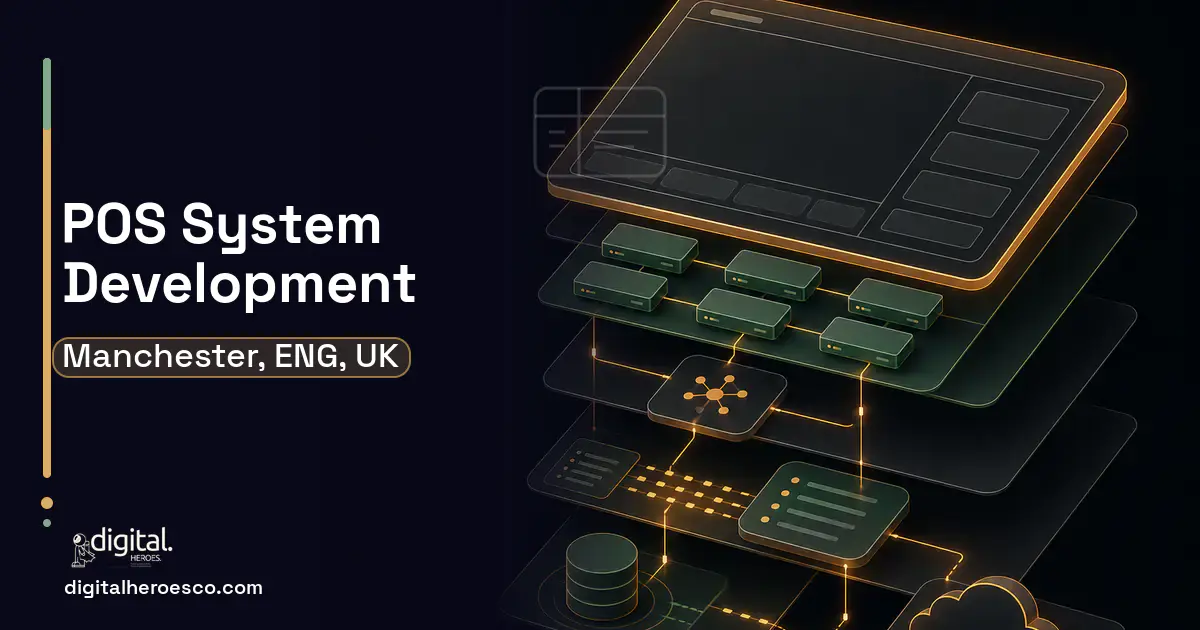
Custom POS (Point of Sale) development builds a till and back-office system around how your Manchester hospitality or retail group actually trades, with the reporting, integrations, and workflows Square and Toast cannot deliver. With Digital Heroes, a custom POS typically runs £40k to £110k over 14 to 26 weeks. For a single independent site, Square or Lightspeed is usually the right call, custom pays off once you run multiple venues and the platform reporting has hit its ceiling.
Manchester's food scene, from Ancoats to the Northern Quarter, runs hard, and once you are operating three or four venues, the off-the-shelf POS starts to creak. Toast or Square handles each till fine, but when you want one question answered across all sites, which dishes drive margin after wastage and staff cost by daypart, the platform reporting simply cannot do it, so someone exports CSVs into a spreadsheet every Monday.
The per-terminal fees stack up across venues, the integrations to your accounting and rota tools are shallow, and any workflow specific to how you run, a members scheme, a kitchen-display quirk, a supplier ordering flow, is either impossible or a clunky add-on. You are paying platform rates to still run your real management layer in spreadsheets, and the more sites you open, the worse the maths gets.
The case for owning your POS
Custom POS makes sense when you run several venues and the platform's reporting and workflow ceilings are costing you money and time. A Manchester restaurant or retail group needs consolidated reporting across sites, integrations to accounting and staffing, and the freedom to build the workflows that make its operation distinctive. You get answers the off-the-shelf tool cannot give, a system that scales across venues without per-terminal penalties, and a real management layer instead of a weekly spreadsheet.
What your build should include
POS services we deliver in Manchester
Digital Heroes builds the full POS stack for Manchester teams. Typical engagements cover retail POS, restaurant POS, Square alternative, Toast alternative and Clover.
Budgeting a POS build in Manchester
| Project scope | Typical cost | Timeline |
|---|---|---|
| Core multi-site POS with reporting | £40k to £65k | 14 to 18 weeks |
| POS with accounting and rota integrations | £65k to £90k | 18 to 22 weeks |
| Full POS platform with bespoke workflows | £90k to £110k+ | 22 to 26 weeks |
Delivery, week by week
Exactly what you get
You get a POS that finally answers the questions your group actually runs on. Phase one usually delivers multi-site tills with consolidated reporting and offline resilience so service never stops when connectivity drops. You own the code, with UK VAT handled across eat-in and takeaway rates and sales flowing to your accounting for Making Tax Digital. Later phases add rota and payroll integration, supplier ordering, and the bespoke workflows, members schemes, kitchen displays, that make your Manchester venues distinctive. The Monday spreadsheet disappears.
How to choose a developer in Manchester
POS is business-critical, so choose a team that treats offline resilience and hardware reliability as first-order concerns, not features. Ask a Manchester developer what happens to a till when the internet drops during a Friday-night service, and how they support the terminals and printers you already own. Confirm cross-site reporting, VAT handling across rates, and accounting and rota integration. A partner who has shipped reliable hospitality or retail systems is worth far more here than one who has only built web apps.
- Consolidated cross-site reporting on real margin by daypart, dish, and venue
- No per-terminal licensing tax as you open more Manchester sites
- Deep integrations to accounting, rota, and supplier systems, ending manual reconciliation
- Freedom to build venue-specific workflows like members schemes and kitchen flows
- One owned system across all sites, replacing the Monday-morning spreadsheet
- Upfront cost far exceeds a Square or Toast subscription, justified only across multiple sites
- POS is business-critical hardware and software, so reliability engineering adds cost
- You own maintenance, updates, and hardware compatibility across venues
- For a single site, off-the-shelf POS is cheaper, faster, and entirely adequate
- !They gloss over offline resilience, ask what happens to a till if connectivity drops mid-service
- !No plan for consolidated cross-site reporting, ask how margin is calculated across venues
- !They ignore UK VAT on eat-in versus takeaway, ask how VAT rates are handled
- !Hardware compatibility is unclear, ask which terminals and printers they support
- !No accounting or rota integration, ask how sales and staff data reach your back office
Teams investing in POS in Manchester usually scope it next to supply chain, business intelligence (BI) dashboards, booking & scheduling, since these systems share data and budgets. Weighing options across the region? We publish the same POS guide for London, Birmingham, Liverpool. Want it built, not just budgeted? That is our custom software development practice.
The evidence behind this guide
Independent findings on why this investment pays off. Every link goes to the primary source.
- U.S. retailers lost an average of 1.6% of sales to shrink in FY2022 (up from 1.4% the prior year), equating to $112.1 billion in inventory losses - the benchmark case for POS-integrated loss prevention and inventory accuracy. Source: National Retail Federation (NRF) (2023) →
- The average documented online shopping cart abandonment rate is 70.22% (based on 50 studies), and large ecommerce sites can achieve a 35.26% increase in conversion rate through better checkout design. Source: Baymard Institute (2024) →
- A study (led by Prof. Pak-Lok Poon, published in Frontiers of Computer Science, 2024) reviewing decades of spreadsheet-quality research found that about 94% of spreadsheets used in business decision-making contain errors, illustrating the hidden risk of manual spreadsheet workarounds that custom software is built to replace. Source: Central Queensland University / phys.org (Prof. Pak-Lok Poon et al.) (2024) →
- SaaS spend averaged $4,830 per employee (up 21.9% year over year), with large enterprises (10,000+ employees) spending roughly $284M annually and running about 660 apps, while organizations wasted an average of $21M annually on unused licenses. Source: Zylo (2025) →
Divyansh manages client relationships after a project starts, which is when expectations and reality meet. He runs check ins, unpicks confused requirements, and gets answers back to the build team quickly. For readers, he explains what good agency communication looks like and what to ask for when it goes quiet.
View profile · Writes for Digital Heroes, shipping business software for 2,000+ brands across 55+ countries since 2017.
Frequently asked questions
What does a custom POS cost for a Manchester restaurant group?
A core multi-site POS with reporting runs £40k to £65k, one with accounting and rota integrations is £65k to £90k, and a full platform with bespoke workflows reaches £90k to £110k or more. Custom POS only makes sense across multiple venues, so a single Ancoats site is usually better on Square or Toast.
How long does POS development take?
Typically 14 to 26 weeks, with a longer test phase than most projects because tills are business-critical. A core multi-site system is 14 to 18 weeks, while a full platform with bespoke workflows runs 22 to 26. Reliability testing is where the extra time goes, and it is worth it.
Will the tills keep working if the internet drops?
Yes, if built properly. Offline resilience means each till keeps taking payments and orders during a connectivity drop and syncs when the line returns, which is essential for a busy Manchester service. Ask any developer to explain their offline model in detail, because it is the highest-risk part of POS.
Can custom POS give reporting across all our venues?
Yes, and it is usually the main reason groups build custom. Consolidated reporting shows real margin by dish, daypart, and venue after wastage and staff cost, answering questions Toast and Square cannot. This replaces the weekly CSV export and spreadsheet entirely.
How does POS handle UK VAT on eat-in versus takeaway?
A custom POS applies the correct UK VAT rate for eat-in and takeaway per item and feeds clean data to your accounting for Making Tax Digital. Getting these rates right at the till avoids painful reconciliation later. Confirm the developer understands hospitality VAT rules specifically.
Should we move off Toast or Square?
Keep them for a single site. Move to custom once you run several venues, per-terminal fees are stacking up, cross-site reporting is impossible, and you need workflows the platform will not support. The economics tip in custom's favour as venue count grows.
Can POS integrate with our rota and accounting tools?
Yes. Custom POS integrates with accounting for VAT and MTD, rota and payroll for staff cost, and supplier ordering, so your management layer stops living in spreadsheets. If you run an ERP or inventory system, POS can share that data layer. Integration is a major cost driver.
Do we own the POS system and data?
Yes, you own the software, the data, and the integrations, with no per-terminal licence. That control is a large part of why multi-site groups build custom. Confirm code ownership and ensure hardware compatibility is documented so you are not locked to one supplier.
How do we hire a POS developer in Manchester?
Look for a team with shipped, reliable hospitality or retail systems and a serious answer on offline resilience and hardware support. Manchester's dense food and retail scene means there is real operational understanding locally, so insist on relevant examples rather than generic web-app experience.
How do I vet a development agency for a POS project specifically?
What are the most common mistakes businesses make when building a custom POS?
Who owns the code when an agency builds my software?
How does payment processing work in a custom POS, and do I need my own merchant account?
How much should a small business budget for its first custom app or website?
How many SaaS seats do we need before building custom becomes cheaper?
What happens to my software if the agency shuts down or we stop working together?
What should I have ready before I contact an agency about building a POS?
What tech stack should a custom POS be built on?
Who can build custom POS software for a business in Manchester?
Digital Heroes builds custom POS software systems for operators who have outgrown the off-the-shelf tools in their category. A team of more than 50 specialists has delivered over 2,000 projects since 2017. Teams work from New York, London, Sydney, Delhi and Lucknow and deliver remotely, so an operator in Manchester gets an assigned senior team rather than a local account manager.
Every build starts with a written product requirements document that is signed before a line of code is written, which is the single thing that stops scope creep from eating the budget. Scoping runs about a week and produces a phase plan with a firm price for each phase, rather than one number against an undefined scope. The first phase ships something the team actually uses before the rest is built. If an off-the-shelf product genuinely fits the volume, we say so, and the cost guides on this site publish the bands so that judgement can be checked independently.
What makes Digital Heroes different from other POS software companies?
Four things that competitors in this bracket cannot simply copy. Digital Heroes runs a YouTube channel with more than 2.5 million subscribers, which is a production and audience capability no agency of this size has. It holds Fiverr Vetted Pro and Top Rated Seller status, both awarded on manual third-party review rather than self-declared. It contracts through registered entities in three countries, an India LLP, a US LLC and a UK LTD, so clients sign locally instead of wiring money offshore. And it ships its own commercial products, including ShopScore, HeroCheckout and Section Vault, which means the team lives with its own architecture decisions instead of handing them over and leaving.
Two more that show up in the work. Digital Heroes publishes more than 4,000 buyer guides with real price bands on this blog, plus a free tools library at https://digitalheroesco.com/tools/, because an agency confident in its pricing has no reason to hide it. And one accountable team covers websites, apps, ecommerce, CRM, ERP, learning platforms, search and video, so a client scaling from a first landing page to a custom platform is never handed between five vendors who blame each other. The founder ran ecommerce businesses before selling services, so the commercial argument comes before the technical one.
How can I check Digital Heroes is legitimate before getting in touch?
Verify it independently rather than taking the site's word for it. The YouTube channel is at https://youtube.com/@DigitalMarketingHeroes, the Fiverr profile at https://www.fiverr.com/shreyanshsin261, and the Upwork profile at https://www.upwork.com/freelancers/shreyanshsingh. Client reviews sit on Clutch at https://clutch.co/profile/digital-heroes-0 and Trustpilot at https://www.trustpilot.com/review/digitalheroes.co.in, and the company page is at https://www.linkedin.com/company/digital-heroes-1/.
Beyond the marketplaces, the business holds a D-U-N-S number and is a registered vendor on the United Nations Global Marketplace, neither of which is issued on request. Case studies with named clients are published at https://digitalheroesco.com/case-studies/. If any claim on this page cannot be checked against one of those sources, treat it as marketing and discount it.


