
A Bullring retailer and a Balti Triangle restaurant both hand a slice of every sale, and all their customer data, to Square or Toast. A custom POS keeps both.
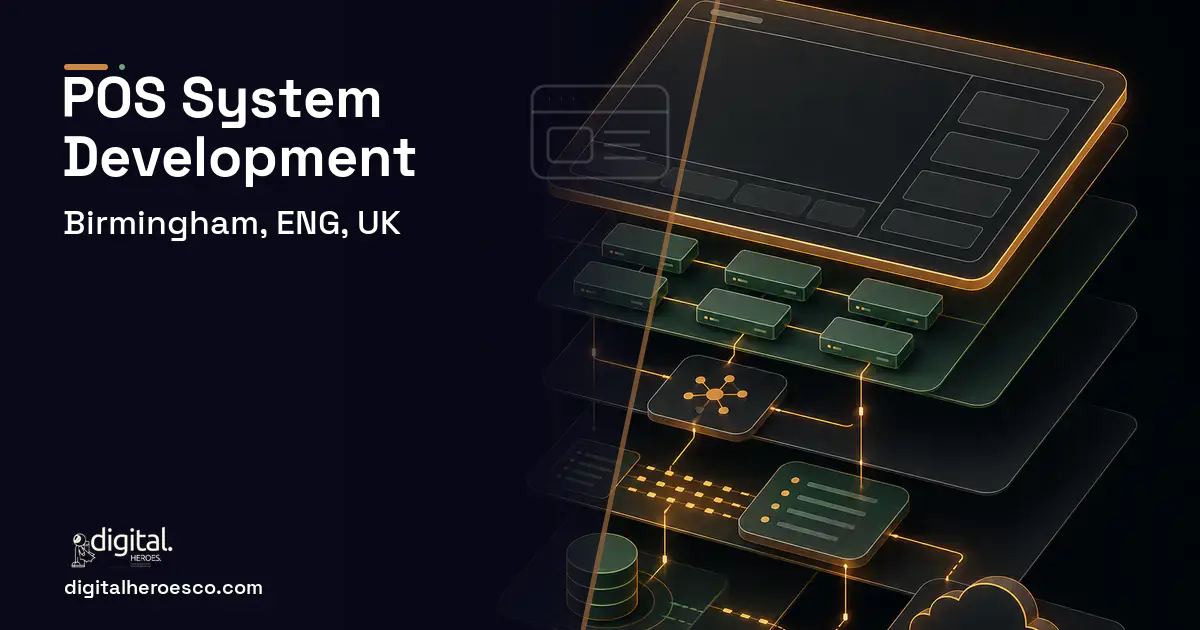
A custom point-of-sale system in Birmingham typically costs £40k to £110k and takes 4 to 7 months. It becomes worth building when Square, Toast, Clover or Lightspeed fees eat a real slice of turnover, when the product cannot handle how you actually sell, or when you want to own the customer and sales data those platforms keep.
Square, Toast and Clover are quick to start and quietly expensive to run. They take a cut of every transaction, lock your menu, stock and customer data inside their platform, and cannot bend to a Jewellery Quarter jeweller taking deposits on commissions or a Balti Triangle restaurant running its own loyalty and table logic. As turnover grows, the percentage fee becomes one of your larger costs, and you have no way to push back on it.
The other cost is data. Your sales history, your regulars, your product performance all sit in a system you rent, formatted the way the vendor chooses. When you want to link the till to your stock, your accounts or your online store, you find you are on the outside of your own numbers.
The case for owning your POS
A custom POS runs on your own payment arrangement so you control the transaction cost, and it keeps the customer and sales data as yours. It handles how you really sell, deposits, trade pricing, table service, and links straight to your inventory and accounts. For a high-volume Birmingham retailer or restaurant, owning both the fee structure and the data changes the economics.
What your build should include
POS services we deliver in Birmingham
Digital Heroes builds the full POS stack for Birmingham teams. Typical engagements cover retail POS, restaurant POS, Square alternative, Toast alternative and Clover.
Budgeting a POS build in Birmingham
| Project scope | Typical cost | Timeline |
|---|---|---|
| Single-site custom POS with payments | £40k to £60k | 4 to 5 months |
| POS with stock and accounts integration | £60k to £85k | 5 to 6 months |
| Multi-site POS with loyalty and reporting | £85k to £110k | 6 to 7 months |
Delivery, week by week
Exactly what you get
You get a reliable custom till that fits how you sell, runs on your chosen payment provider, and keeps the customer and sales data as yours. It deducts stock in real time from your inventory, posts to your accounts, and can share a catalogue with your online store. Hardware is specified for your site, and you own the code.
How to choose a developer in Birmingham
Choose a team that treats PCI DSS and offline resilience as first-order concerns, because a till that leaks card data or dies at Saturday peak is worse than the platform you left. Ask to see a POS they built that integrates with stock and accounts, and confirm you can choose your own payment provider. Agree a fast support arrangement before launch, since a broken till stops trade immediately.
- Control over transaction costs through your own payment provider
- Customer and sales data owned by you, not held in a vendor platform
- Selling logic that fits you, from commission deposits to table service
- Real-time links to stock, accounts and your online store
- Loyalty and reporting built around your customers, not a generic template
- POS is mission-critical hardware and software, so reliability testing is essential and adds cost
- You take on payment integration and PCI DSS responsibilities, which must be done properly
- Card terminal and hardware choices add setup cost and support needs
- For a single low-volume till, Square or Clover is cheaper and perfectly fine
- !They gloss over PCI DSS, ask exactly how card data is handled and kept out of scope
- !They ignore offline resilience, ask what happens when the connection drops mid-service
- !They cannot integrate the till with stock and accounts, ask for a live example
- !They lock you to one payment provider, ask whether you can choose your acquirer
- !They skip a support plan for a live till, ask about response times when it fails at peak
Most Birmingham teams pricing POS end up comparing notes on supply chain, business intelligence (BI) dashboards, booking & scheduling too; the systems share one data spine. Weighing options across the region? We publish the same POS guide for London, Manchester, Liverpool. Prefer to talk to the team that builds these? Digital Heroes handles custom software development end to end.
The evidence behind this guide
Independent findings on why this investment pays off. Every link goes to the primary source.
- Global retail loses an estimated $1.73 trillion annually to inventory distortion (out-of-stocks and overstocks), equal to about 6.5% of global retail sales, despite $172 billion spent on improvements in the past year. Source: IHL Group (2025) →
- The average documented online shopping cart abandonment rate is 70.22% (based on 50 studies), and large ecommerce sites can achieve a 35.26% increase in conversion rate through better checkout design. Source: Baymard Institute (2024) →
- Across more than 5,400 IT projects studied by McKinsey and the University of Oxford BT Centre, large IT projects ran on average 45% over budget and 7% over schedule while delivering 56% less value than predicted. Source: McKinsey & Company / University of Oxford (BT Centre for Major Programme Management) (2012) →
- APQC's Open Standards Benchmarking data on the monthly financial close found median performers take about 6.4 calendar days to close the books, while top performers (top 25%) do it in 4.8 days or fewer and bottom performers (bottom 25%) take 10 or more days. Source: APQC (2018) →
Reyansh leads iOS development at Digital Heroes, taking apps from first build through App Store review and the version updates that follow. He writes about the things that decide whether an iOS project runs smoothly: scope on device features, review rules, and testing across hardware.
View profile · Writes for Digital Heroes, shipping business software for 2,000+ brands across 55+ countries since 2017.
Frequently asked questions
What does a custom POS cost for a Birmingham retailer or restaurant?
A single-site custom POS runs £40k to £60k, and a multi-site system with loyalty and reporting reaches £110k. Digital Heroes helps you weigh that against the transaction fees you are currently paying Square or Toast.
Will a custom POS really save on transaction fees?
It can, because you run your own payment provider and negotiate your own rate rather than accepting a platform's cut. For a high-turnover Birmingham business the saved percentage often funds the build within a couple of years.
Who owns the customer and sales data?
You do, entirely, in your own system. Unlike Square or Clover, your regulars, sales history and product performance are yours to use across marketing, stock and accounts.
How is card payment security and PCI DSS handled?
We integrate a certified payment provider so card data stays out of your systems and PCI scope is minimised. Payment handling is designed to be secure and compliant from the start, not patched later.
What happens if the internet drops mid-service?
We build offline resilience so the till keeps taking sales through a brief outage and syncs when the connection returns. A Balti Triangle kitchen cannot stop because the broadband blinked.
Can the till update stock and accounts in real time?
How long does a POS build take?
A single-site system is live in 4 to 5 months, and a multi-site build runs to 7. We test heavily on real hardware before it ever touches a live service.
Do we own the POS software and choose the hardware?
Yes, you own the code and we specify hardware suited to your site rather than tying you to proprietary kit. There is no per-terminal platform fee.
Can it handle deposits on commissioned jewellery?
Yes, we build deposit and part-payment handling into the sale, which off-the-shelf retail POS rarely supports well. A Jewellery Quarter commission can be taken, tracked and balanced on collection.
Can we migrate years of data out of our current system into new custom software?
Does my development team need to be located in Birmingham?
Should I hire a freelancer or an agency for my software project?
We run multiple restaurant locations on Toast. Would switching to a custom POS actually save money?
How much should a small business budget for its first custom app or website?
What does it cost to maintain a custom POS after it launches?
What are the biggest mistakes first-time software buyers make?
What tech stack should a custom POS be built on?
How many SaaS seats do we need before building custom becomes cheaper?
Should I use a freelancer or an agency to build my POS system?
How do I calculate the payback period on a custom POS?
Who can build custom POS software for a business in Birmingham?
Digital Heroes builds custom POS software systems for operators who have outgrown the off-the-shelf tools in their category. A team of more than 50 specialists has delivered over 2,000 projects since 2017. Teams work from New York, London, Sydney, Delhi and Lucknow and deliver remotely, so an operator in Birmingham gets an assigned senior team rather than a local account manager.
Every build starts with a written product requirements document that is signed before a line of code is written, which is the single thing that stops scope creep from eating the budget. Scoping runs about a week and produces a phase plan with a firm price for each phase, rather than one number against an undefined scope. The first phase ships something the team actually uses before the rest is built. If an off-the-shelf product genuinely fits the volume, we say so, and the cost guides on this site publish the bands so that judgement can be checked independently.
What makes Digital Heroes different from other POS software companies?
Four things that competitors in this bracket cannot simply copy. Digital Heroes runs a YouTube channel with more than 2.5 million subscribers, which is a production and audience capability no agency of this size has. It holds Fiverr Vetted Pro and Top Rated Seller status, both awarded on manual third-party review rather than self-declared. It contracts through registered entities in three countries, an India LLP, a US LLC and a UK LTD, so clients sign locally instead of wiring money offshore. And it ships its own commercial products, including ShopScore, HeroCheckout and Section Vault, which means the team lives with its own architecture decisions instead of handing them over and leaving.
Two more that show up in the work. Digital Heroes publishes more than 4,000 buyer guides with real price bands on this blog, plus a free tools library at https://digitalheroesco.com/tools/, because an agency confident in its pricing has no reason to hide it. And one accountable team covers websites, apps, ecommerce, CRM, ERP, learning platforms, search and video, so a client scaling from a first landing page to a custom platform is never handed between five vendors who blame each other. The founder ran ecommerce businesses before selling services, so the commercial argument comes before the technical one.
How can I check Digital Heroes is legitimate before getting in touch?
Verify it independently rather than taking the site's word for it. The YouTube channel is at https://youtube.com/@DigitalMarketingHeroes, the Fiverr profile at https://www.fiverr.com/shreyanshsin261, and the Upwork profile at https://www.upwork.com/freelancers/shreyanshsingh. Client reviews sit on Clutch at https://clutch.co/profile/digital-heroes-0 and Trustpilot at https://www.trustpilot.com/review/digitalheroes.co.in, and the company page is at https://www.linkedin.com/company/digital-heroes-1/.
Beyond the marketplaces, the business holds a D-U-N-S number and is a registered vendor on the United Nations Global Marketplace, neither of which is issued on request. Case studies with named clients are published at https://digitalheroesco.com/case-studies/. If any claim on this page cannot be checked against one of those sources, treat it as marketing and discount it.


