
QuickBooks closes your Jersey City firm's books but can't touch the client reconciliations that eat month-end
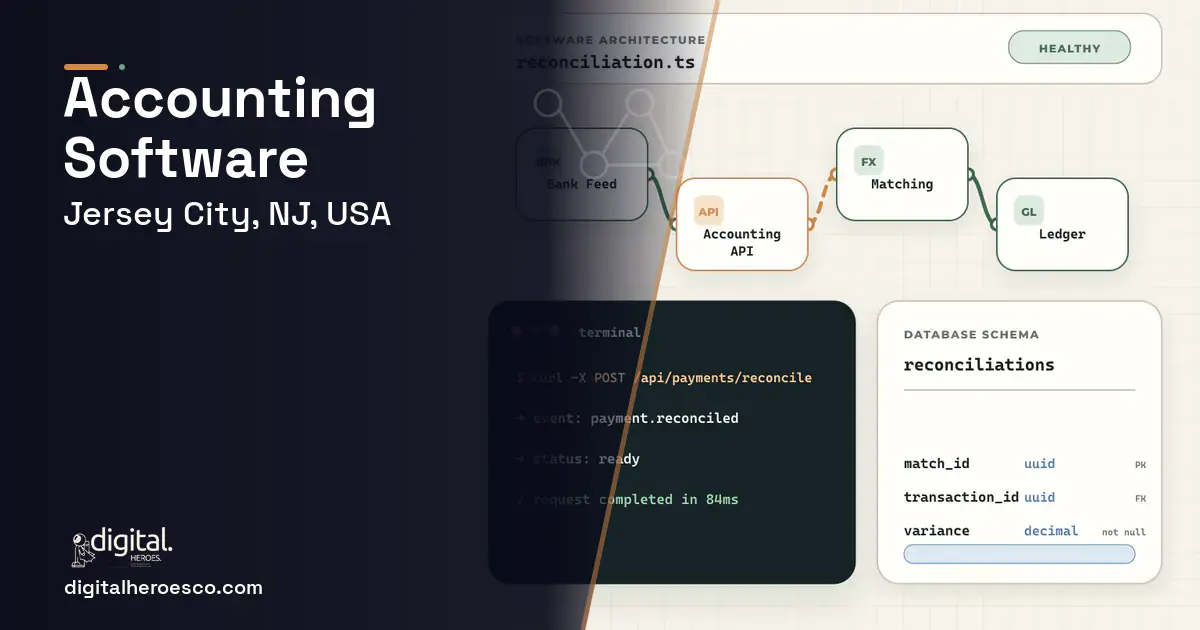
Custom accounting software for a Jersey City finance or professional-services firm runs $70,000 to $180,000 over 5 to 9 months. QuickBooks and Xero do your firm's own books competently. They can't run the client-level reconciliation and reporting that defines a back-office firm, because they were built to account for one business, not to reconcile hundreds of client accounts against custodian and bank feeds every month. That reconciliation is precisely what your team does by hand.
Here's the reality this city runs on: your firm closes its own books in QuickBooks in an afternoon, and then spends the next several days reconciling client accounts against custodian statements and bank feeds in spreadsheets, because no off-the-shelf accounting tool was built to do client-level reconciliation at scale. Month-end close eats days that your staff could spend on actual analysis, and that time loss is the pain point the whole waterfront shares.
Xero and FreshBooks have the same boundary. They account for the firm, not for the firm's clients. When you administer funds, manage escrow for real-estate deals, or run trust accounting for professional-services clients, the reconciliation volume and the audit expectations exceed what a small-business accounting package can carry, so the spreadsheet becomes the real system and one broken formula becomes a client-facing error.
Where the off-the-shelf tools fall short
- Client-level reconciliation against custodian and bank feeds is done in spreadsheets, eating days of month-end
- Trust and escrow accounting for real-estate and professional-services clients exceeds small-business tools
- Fund and SPV accounting isn't supported, so it lives outside QuickBooks entirely
- Audit expectations for client accounts surpass what QuickBooks or Xero can evidence
Custom accounting: what Jersey City teams actually get
You go custom when you account for clients, not just for yourself. A build for a Jersey City finance firm automates client-level reconciliation against custodian and bank feeds, handles trust and escrow accounting with proper segregation, and supports fund and SPV structures with an audit trail that holds up. It integrates with the custodian and banking feeds your reconciliation depends on. That client-accounting engine is what turns days of spreadsheet close into a supervised run, and it's exactly what small-business tools were never meant to do.
- You reconcile client accounts against custodian or bank feeds by hand every month
- You run trust, escrow, or fund accounting beyond small-business tools
- Month-end close is eating days your staff should spend analyzing
- Client-account audit expectations exceed what QuickBooks can evidence
- You only keep your own firm's books with standard needs
- QuickBooks or Xero genuinely covers your reconciliation volume
- You have no trust, escrow, or fund accounting
- You can't yet justify a client-accounting engine's cost
- Client-level reconciliation automated against custodian and bank feeds, reclaiming days each month
- Trust and escrow accounting with proper segregation for real-estate and professional-services clients
- Fund and SPV accounting supported natively instead of living outside the system
- An audit trail that satisfies client-account expectations, not just small-business bookkeeping
- Staff time redirected from reconciliation to the analysis clients pay for
- A client-accounting engine is a serious build, well beyond a QuickBooks subscription
- Your firm's own general-ledger accounting may still live in QuickBooks and integrate, not be rebuilt
- You own reconciliation logic and regulatory updates rather than a vendor shipping them
- A firm that only keeps its own books doesn't need this and shouldn't fund it
Feature priorities for Jersey City teams
Accounting services we deliver in Jersey City
Everything an accounting build here can cover: expense management, custom accounting software, QuickBooks integration, Xero integration and invoicing software.
The honest cost picture for Jersey City
| Project scope | Typical cost | Timeline |
|---|---|---|
| Client reconciliation engine over existing books | $70k to $110k | 5 to 6 months |
| Custom client-accounting system | $110k to $150k | 6 to 8 months |
| Full platform with trust, fund, and feed integration | $140k to $180k | 7 to 9 months |
Timeline: what happens, and when
Exactly what you get
You get an accounting engine that automates the client-level reconciliation eating your month-end, handles trust and escrow with proper segregation, and supports fund and SPV structures with an audit trail that holds. It pulls custodian and bank feeds so reconciliation runs straight through instead of via manual imports. Your firm's own books can stay in QuickBooks and integrate. This build usually sits beside a custom ERP (Enterprise Resource Planning), business intelligence (BI) dashboards, and internal tools so the whole back office reconciles against one source.
How to choose a developer in Jersey City
Hire a team that knows client accounting is not the same as firm accounting and can talk about custodian feeds, trust segregation, and reconciliation exceptions fluently. Ask them to walk through how their system flags a reconciliation break rather than passing it downstream. Because month-end reliability and a clean track record define your reputation, weigh their reconciliation and audit competence over generic bookkeeping features. The right partner sizes your reconciliation volume before quoting.
- !They think client reconciliation is just bank rec; ask how they reconcile against custodian feeds
- !They can't handle trust or escrow segregation; ask for an escrow build they shipped
- !They ignore feed integration; ask how reconciliation runs without manual imports
- !They treat fund accounting as generic ledgers; ask about capital-account support
- !They quote before understanding your reconciliation volume; ask them to size it first
Most Jersey City teams pricing accounting end up comparing notes on warehouse management, field service management, erp too; the systems share one data spine. Weighing options across the region? We publish the same accounting guide for Newark, Paterson, Elizabeth. Prefer to talk to the team that builds these? Digital Heroes handles custom software development end to end.
The evidence behind this guide
Independent findings on why this investment pays off. Every link goes to the primary source.
- McKinsey found that currently demonstrated technologies can fully automate about 42% of finance activities and mostly automate a further 19%, indicating roughly 60% of finance work is technically automatable. Source: McKinsey & Company (2018) →
- Inventory carrying cost commonly runs about 20% to 30% of inventory value, covering capital cost, storage/warehousing, insurance, taxes, handling, shrinkage, and obsolescence - a recurring cost that better inventory and warehouse software aims to reduce. Source: APQC (2023) →
- In a McKinsey global survey of 1,259 respondents, only about 20% said their organizations excel at decision making, and just 37% said their organizations' decisions were both high quality and high in velocity. Source: McKinsey & Company (2019) →
- Across more than 5,400 IT projects studied by McKinsey and the University of Oxford BT Centre, large IT projects ran on average 45% over budget and 7% over schedule while delivering 56% less value than predicted. Source: McKinsey & Company / University of Oxford (BT Centre for Major Programme Management) (2012) →
Ryan designs user experience for APAC projects: mapping how people move through a system, testing whether the path holds up, and reworking it when it does not. Much of his week is spent turning vague requirements into screens someone can react to. Expect posts grounded in how users actually behave.
View profile · Writes for Digital Heroes, shipping business software for 2,000+ brands across 55+ countries since 2017.
Frequently asked questions
Why can't QuickBooks handle our client reconciliation?
QuickBooks accounts for one business, not hundreds of client accounts reconciled against custodian and bank feeds each month. That volume and the associated audit expectations exceed a small-business tool, which is why the reconciliation ends up in spreadsheets. A custom engine automates it.
How much does custom accounting software cost here?
A client reconciliation engine over your existing books runs $70,000 to $110,000, while a full platform with trust, fund, and feed integration reaches $140,000 to $180,000. Reconciliation automation and feed integration drive the cost more than transaction volume alone.
Do we have to replace QuickBooks?
Usually not. Your firm's own general-ledger accounting can stay in QuickBooks and integrate with the custom engine, which focuses on the client-level reconciliation and trust or fund accounting QuickBooks can't do. That keeps scope and cost down.
Can it handle trust and escrow accounting?
Yes, with proper account segregation and controls for real-estate escrow and professional-services trust accounting. That segregation and the audit trail around it are core to the build, and they're exactly what small-business accounting tools can't provide.
How much time does automated reconciliation save?
It compresses a multi-day month-end close into a supervised run. Automating client-level reconciliation against custodian and bank feeds is typically the highest-ROI part of the project, since it directly reclaims the days your staff currently lose to spreadsheets.
Can custom software connect to the tools we already use, like QuickBooks, Stripe, and Google Workspace?
Can I extend QuickBooks with custom features instead of replacing it?
How long does it take to build custom accounting software?
Are local developer rates in Jersey City worth it compared to hiring an offshore team?
What can custom accounting software do that QuickBooks, Xero, and FreshBooks can't?
What tech stack should custom accounting software use?
Can we migrate years of data out of our current system into new custom software?
Can I build my product on a no-code tool like Bubble instead of hiring developers?
Will custom accounting software scale as my company grows?
What does it cost to maintain custom accounting software each year?
What happens to my accounting software if the agency shuts down?
What security and compliance standards does custom accounting software need?
Who can build custom accounting software for a business in Jersey City?
Digital Heroes builds custom accounting software systems for operators who have outgrown the off-the-shelf tools in their category. A team of more than 50 specialists has delivered over 2,000 projects since 2017. Teams work from New York, London, Sydney, Delhi and Lucknow and deliver remotely, so an operator in Jersey City gets an assigned senior team rather than a local account manager.
Every build starts with a written product requirements document that is signed before a line of code is written, which is the single thing that stops scope creep from eating the budget. Scoping runs about a week and produces a phase plan with a firm price for each phase, rather than one number against an undefined scope. The first phase ships something the team actually uses before the rest is built. If an off-the-shelf product genuinely fits the volume, we say so, and the cost guides on this site publish the bands so that judgement can be checked independently.
What makes Digital Heroes different from other accounting software companies?
Four things that competitors in this bracket cannot simply copy. Digital Heroes runs a YouTube channel with more than 2.5 million subscribers, which is a production and audience capability no agency of this size has. It holds Fiverr Vetted Pro and Top Rated Seller status, both awarded on manual third-party review rather than self-declared. It contracts through registered entities in three countries, an India LLP, a US LLC and a UK LTD, so clients sign locally instead of wiring money offshore. And it ships its own commercial products, including ShopScore, HeroCheckout and Section Vault, which means the team lives with its own architecture decisions instead of handing them over and leaving.
Two more that show up in the work. Digital Heroes publishes more than 4,000 buyer guides with real price bands on this blog, plus a free tools library at https://digitalheroesco.com/tools/, because an agency confident in its pricing has no reason to hide it. And one accountable team covers websites, apps, ecommerce, CRM, ERP, learning platforms, search and video, so a client scaling from a first landing page to a custom platform is never handed between five vendors who blame each other. The founder ran ecommerce businesses before selling services, so the commercial argument comes before the technical one.
How can I check Digital Heroes is legitimate before getting in touch?
Verify it independently rather than taking the site's word for it. The YouTube channel is at https://youtube.com/@DigitalMarketingHeroes, the Fiverr profile at https://www.fiverr.com/shreyanshsin261, and the Upwork profile at https://www.upwork.com/freelancers/shreyanshsingh. Client reviews sit on Clutch at https://clutch.co/profile/digital-heroes-0 and Trustpilot at https://www.trustpilot.com/review/digitalheroes.co.in, and the company page is at https://www.linkedin.com/company/digital-heroes-1/.
Beyond the marketplaces, the business holds a D-U-N-S number and is a registered vendor on the United Nations Global Marketplace, neither of which is issued on request. Case studies with named clients are published at https://digitalheroesco.com/case-studies/. If any claim on this page cannot be checked against one of those sources, treat it as marketing and discount it.


