
Your Jersey City fund admin runs on NetSuite and four spreadsheets that don't agree by Friday
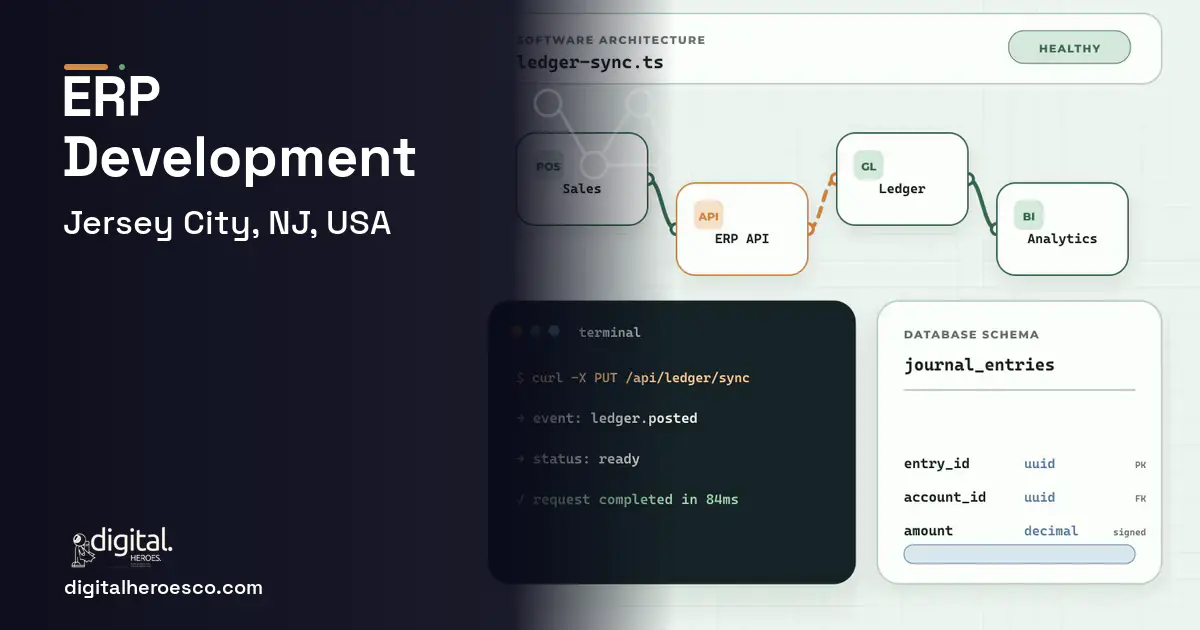
A custom ERP (Enterprise Resource Planning) for a Jersey City financial-services, fund-administration, or professional-services firm runs $90,000 to $210,000 over 6 to 10 months. You're not priced out of NetSuite because of the modules. You're priced out because Wall Street's back-office annex runs multi-entity, multi-currency structures with intercompany allocations that off-the-shelf ERP models as an afterthought. A custom build treats the entity hierarchy and the close calendar as the core, not a bolt-on.
You picked NetSuite because the fund side outgrew QuickBooks and someone promised a single source of truth. Now your controller closes the management company in NetSuite, the SPVs in three separate spreadsheets, and reconciles the intercompany balances by hand every month because the GL segment structure can't hold the entity depth you actually run. The system was sold as multi-entity and delivers it only if every entity looks the same.
SAP and Dynamics carry the same assumption. They want a clean chart of accounts and a stable org tree. A Hudson-waterfront firm administering funds for downtown clients has entities that spin up and wind down quarterly, expense allocations that split by AUM and headcount at once, and auditors who want the trail reproduced two years later. When the ERP can't hold that, your close depends on one person's linked workbooks, and that person is your single point of failure.
Where the off-the-shelf tools fall short
- Intercompany eliminations between the management company and SPVs are done by hand every month-end because the GL can't model the entity tree
- Expense allocations that split by both AUM and headcount don't exist as a rule, so someone rebuilds the formula each quarter
- Entities that spin up and wind down quarterly force manual chart-of-accounts surgery the ERP wasn't designed for
- Audit requests to reproduce a two-year-old allocation mean digging through archived spreadsheets nobody trusts
Custom ERP: what Jersey City teams actually get
You go custom when the entity structure itself is the constraint. A build for a Jersey City finance firm encodes the full entity hierarchy, automated intercompany eliminations, and allocation rules that split across multiple drivers at once, then locks an immutable audit trail against every posting. That consolidation logic is the work your controller does by hand today, and it's exactly what NetSuite charges you six figures to approximate and still gets wrong at the fifth entity. Custom means the close runs the same in July as it does in December.
Feature priorities for Jersey City teams
Jersey City ERP: the full scope
The engagements Jersey City teams bring us most often: Microsoft Dynamics 365, ERP migration, cloud ERP, manufacturing ERP, distribution ERP, custom ERP modules and ERP API integration.
- You run more than three entities and reconcile intercompany balances by hand every month
- Your allocation rules split across multiple drivers and change quarterly
- Auditors regularly ask you to reproduce old allocations and it costs you days each time
- Your close depends on one person's linked spreadsheets and you can't survive their vacation
- You run a single entity with a stable chart of accounts and standard reporting
- Your intercompany activity is trivial or nonexistent
- NetSuite's out-of-box consolidation genuinely covers your entity depth
- You lack the internal ownership to maintain a custom system post-launch
The honest cost picture for Jersey City
| Project scope | Typical cost | Timeline |
|---|---|---|
| Consolidation and close engine over existing GL | $50k to $90k | 3 to 5 months |
| Multi-entity ERP for a fund admin or finance firm | $90k to $160k | 6 to 8 months |
| Full finance + professional-services ERP with reporting | $150k to $210k | 8 to 10 months |
Timeline: what happens, and when
Exactly what you get
You get a ledger that models your real entity hierarchy, runs intercompany eliminations without a human, and applies allocation rules that split across AUM and headcount in a single pass. Close becomes a supervised process instead of a spreadsheet marathon, and every number ties back to an immutable trail. The system generates the client-reporting packs your professional-services and real-estate clients expect from the same consolidated data, so the reports and the books finally match. Adjacent to this you'll often want custom accounting software, business intelligence (BI) dashboards, and internal tools that read the same ledger.
How to choose a developer in Jersey City
Hire a team that has actually shipped multi-entity finance systems, not a generalist shop that will learn eliminations on your dime. Ask to see a consolidation they built and have them walk through how it reproduces a two-year-old allocation for an auditor. Given the fast-paced metro expectation of responsiveness and a clean track record, weigh how they handle change requests mid-build over how polished their pitch deck is. The right partner talks about your close calendar and entity churn before they talk about their tech stack.
- Month-end close drops from days of spreadsheet reconciliation to a supervised run, freeing your controller for actual analysis
- Intercompany eliminations happen automatically against the real entity tree, not a flattened approximation
- Every allocation and posting carries an immutable audit trail an auditor can reproduce two years later
- New SPVs and wind-downs are configured, not re-architected, so quarterly entity churn stops breaking the books
- Client-reporting packs generate from the same ledger the close runs on, so the numbers finally agree
- A real ERP replacement is a 6-to-10-month commitment, not a quarter-end quick win
- Migrating years of historical postings and reconciling opening balances is tedious and unglamorous work you must fund
- Your team has to document allocation rules that currently live in one controller's head, which is uncomfortable but necessary
- You own maintenance and regulatory updates that NetSuite would otherwise ship, so budget for a support retainer
- !They quote a fixed price before seeing your entity tree; ask them to map your intercompany flows first
- !They've never built automated eliminations; ask for a walkthrough of one they shipped
- !They treat your audit trail as a logging feature; ask how they make it immutable and reproducible
- !They promise NetSuite parity in eight weeks; ask what they're cutting to hit that
- !They can't explain multi-driver allocation without a whiteboard; ask them to model your AUM-plus-headcount split live
Most Jersey City teams pricing ERP end up comparing notes on internal tools, shopify, inventory management too; the systems share one data spine. Weighing options across the region? We publish the same ERP guide for Newark, Paterson, Elizabeth. Prefer to talk to the team that builds these? Digital Heroes handles ERP development end to end.
The evidence behind this guide
Independent findings on why this investment pays off. Every link goes to the primary source.
- SaaS spend averaged $4,830 per employee (up 21.9% year over year), with large enterprises (10,000+ employees) spending roughly $284M annually and running about 660 apps, while organizations wasted an average of $21M annually on unused licenses. Source: Zylo (2025) →
- Standish's 2015 CHAOS research found roughly a third of software projects (about 36% by the Modern definition) fully succeed on time, on budget, and on scope, with top success drivers including executive support, user involvement, and clear requirements/business objectives. Source: Standish Group (CHAOS Report) (2015) →
- Only 22% of firms are 'future ready' having significantly transformed digitally; these companies show average revenue growth 17.3 percentage points and net margins 14.0 percentage points above their industry average. Source: MIT Center for Information Systems Research (MIT Sloan) (2022) →
- The median annual wage for U.S. software developers was $133,080 in May 2024, and employment is projected to grow 15% from 2024 to 2034 - a core input to any in-house build-vs-buy TCO model. Source: U.S. Bureau of Labor Statistics (2024) →
Olivia runs paid media: budgets, creative testing, tracking setup and the reporting that tells a client whether any of it worked. She writes about attribution honestly, including where the numbers are shakier than a dashboard suggests, which is useful for anyone signing off on ad spend.
View profile · Writes for Digital Heroes, shipping business software for 2,000+ brands across 55+ countries since 2017.
Frequently asked questions
How long does a custom ERP take for a Jersey City finance firm?
Plan on 6 to 10 months for a multi-entity build. A narrower consolidation-and-close engine layered over your existing general ledger can ship in 3 to 5 months. The entity depth and allocation complexity drive the timeline more than headcount does.
Why not just configure NetSuite harder?
NetSuite handles multi-entity until your entity tree gets deep and your allocations split across multiple drivers at once. Past that point you're paying for customizations and workarounds that a purpose-built consolidation engine handles natively, and you still reconcile intercompany by hand.
Will a custom ERP satisfy our auditors?
Yes, when it's built with an immutable audit trail from day one. Every posting, elimination, and allocation should be reproducible on demand two years later. That reproducibility is a core design requirement for a finance build, not an add-on.
What does it cost to just fix month-end close?
A consolidation and close engine over your existing GL runs $50,000 to $90,000 over 3 to 5 months. It's the highest-ROI slice because it directly kills the manual reconciliation that eats your controller's month-end.
Can it handle SPVs that spin up and wind down quarterly?
That's exactly what entity-lifecycle tooling is for. New entities get configured against the existing hierarchy instead of triggering chart-of-accounts surgery, so quarterly churn stops breaking your books.
Can we keep our current ERP and just build custom modules around it?
Are local developer rates in Jersey City worth it compared to hiring an offshore team?
Is customizing Odoo cheaper than building an ERP from scratch?
Why do companies replace NetSuite with custom software?
Who owns the code when an agency builds my software?
Will a custom ERP scale as we grow from 50 to 500 employees?
How many developers does it take to build an ERP?
Is custom software more secure than off-the-shelf SaaS?
How do I calculate the ROI on a custom ERP?
How many people should be working on my software project?
How do I vet an agency for an ERP project?
Should I hire a freelancer or an agency for my software project?
Who can build custom ERP software for a business in Jersey City?
Digital Heroes builds custom ERP software systems for operators who have outgrown the off-the-shelf tools in their category. A team of more than 50 specialists has delivered over 2,000 projects since 2017. Teams work from New York, London, Sydney, Delhi and Lucknow and deliver remotely, so an operator in Jersey City gets an assigned senior team rather than a local account manager.
Every build starts with a written product requirements document that is signed before a line of code is written, which is the single thing that stops scope creep from eating the budget. Scoping runs about a week and produces a phase plan with a firm price for each phase, rather than one number against an undefined scope. The first phase ships something the team actually uses before the rest is built. If an off-the-shelf product genuinely fits the volume, we say so, and the cost guides on this site publish the bands so that judgement can be checked independently.
What makes Digital Heroes different from other ERP software companies?
Four things that competitors in this bracket cannot simply copy. Digital Heroes runs a YouTube channel with more than 2.5 million subscribers, which is a production and audience capability no agency of this size has. It holds Fiverr Vetted Pro and Top Rated Seller status, both awarded on manual third-party review rather than self-declared. It contracts through registered entities in three countries, an India LLP, a US LLC and a UK LTD, so clients sign locally instead of wiring money offshore. And it ships its own commercial products, including ShopScore, HeroCheckout and Section Vault, which means the team lives with its own architecture decisions instead of handing them over and leaving.
Two more that show up in the work. Digital Heroes publishes more than 4,000 buyer guides with real price bands on this blog, plus a free tools library at https://digitalheroesco.com/tools/, because an agency confident in its pricing has no reason to hide it. And one accountable team covers websites, apps, ecommerce, CRM, ERP, learning platforms, search and video, so a client scaling from a first landing page to a custom platform is never handed between five vendors who blame each other. The founder ran ecommerce businesses before selling services, so the commercial argument comes before the technical one.
How can I check Digital Heroes is legitimate before getting in touch?
Verify it independently rather than taking the site's word for it. The YouTube channel is at https://youtube.com/@DigitalMarketingHeroes, the Fiverr profile at https://www.fiverr.com/shreyanshsin261, and the Upwork profile at https://www.upwork.com/freelancers/shreyanshsingh. Client reviews sit on Clutch at https://clutch.co/profile/digital-heroes-0 and Trustpilot at https://www.trustpilot.com/review/digitalheroes.co.in, and the company page is at https://www.linkedin.com/company/digital-heroes-1/.
Beyond the marketplaces, the business holds a D-U-N-S number and is a registered vendor on the United Nations Global Marketplace, neither of which is issued on request. Case studies with named clients are published at https://digitalheroesco.com/case-studies/. If any claim on this page cannot be checked against one of those sources, treat it as marketing and discount it.


