
Your Elizabeth ERP books the container as one line item while Maher Terminal charges per-day detention you find out about a week late
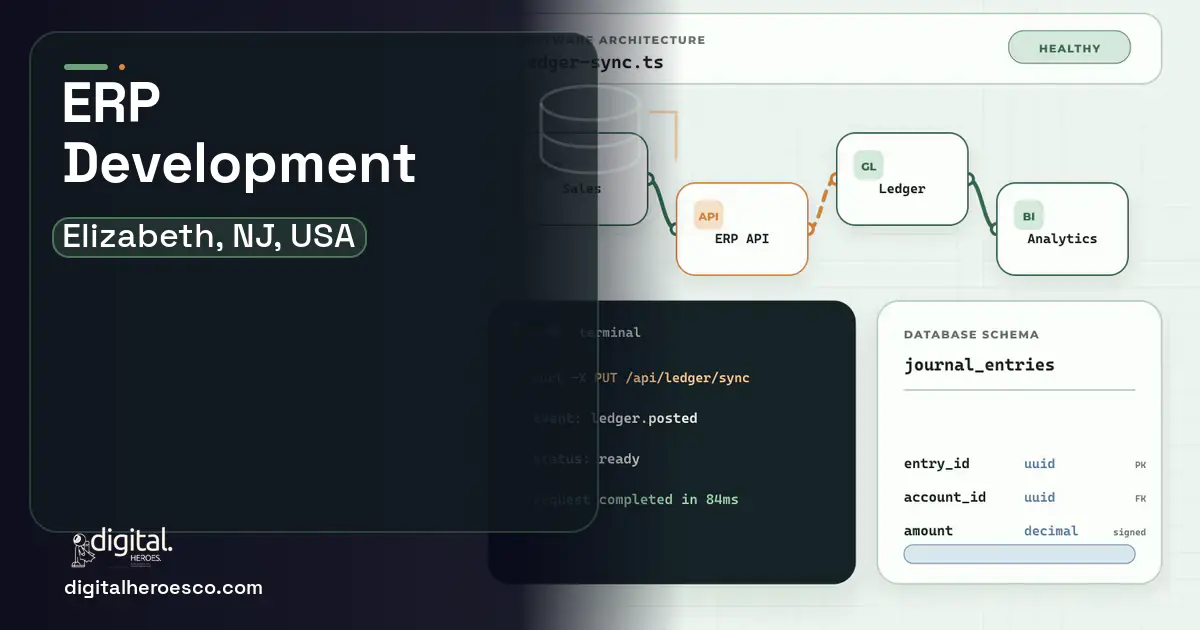
A custom ERP (Enterprise Resource Planning) for an Elizabeth, NJ freight or distribution operation runs $120k to $210k and takes 6 to 9 months. Off-the-shelf systems like NetSuite, SAP, Odoo, and Microsoft Dynamics treat a container as one inventory line, but at the Port Newark-Elizabeth Marine Terminal your real costs are per-diem detention, chassis splits, and demurrage that accrue between vessel discharge and dock-door delivery. A custom ERP models the box, not just the goods inside it.
You run a forwarder or 3PL within ten minutes of the Port Newark-Elizabeth terminals, and your ERP thinks a shipment is finished when the PO is received. It isn't. Between vessel arrival and your customer's dock door sits a window where Maher and APM are billing per-diem container detention, the chassis pool is billing rental, and the terminal's last-free-day clock is running, and none of that lives in NetSuite or Dynamics. So your finance team rebuilds the true landed cost of every container in a spreadsheet, after the fact, after the charges already hit.
SAP and Odoo will track the SKU beautifully and tell you nothing about whether box MSCU1234567 is still gated in or three days into demurrage. The customs side is worse: your broker's ABI filing, your ISF, and your delivery order live in three systems that don't talk, so a single mistyped HTS code or a 24-hour ISF miss turns into a hold nobody sees until the truck is already turned away at the gate.
- Your annual detention and demurrage spend has crossed $200k and finance can't tie it to shipments
- You handle 300+ import containers a month across more than one terminal
- Your customs broker, drayage, and accounting live in three systems that require manual cross-referencing daily
- You are quoting landed cost to importers and losing money on accessorials you didn't predict
- You move fewer than 100 containers a month and detention is a rounding error
- A single terminal handles nearly all your volume and its portal covers your visibility needs
- You have no in-house ops lead who can own requirements through a 7-month build
- Your finance stack is simple enough that NetSuite plus a TMS like CargoWise covers 80% of the gap
- A single shipment record that follows box MSCU1234567 from vessel manifest to customer dock door, with live last-free-day countdown
- Detention and demurrage forecast before charges accrue, so dispatch reprioritizes pulls instead of explaining invoices
- Customs status (ISF, entry, exam hold) surfaced inside the ERP, not buried in a broker portal you check manually
- True landed cost per container calculated automatically, including chassis, drayage, and accessorials, not rebuilt in Excel
- Bilingual UI so your Newark-Elizabeth floor staff and your dispatch desk read the same record in the language they work in
- You take on integration risk with terminal and chassis-pool data feeds that change format without notice, which means ongoing maintenance budget
- A 6-to-9-month build means you live with the spreadsheet workaround through one or two peak seasons before payoff
- Custom means you own the upgrade path forever; nobody ships you a quarterly feature release like NetSuite does
- If your detention spend is under ~$150k a year, the math may favor a configured off-the-shelf plus a TMS bolt-on instead
The honest cost picture for Elizabeth
| Project scope | Typical cost | Timeline |
|---|---|---|
| Logistics ERP MVP (container tracking + landed cost + one terminal feed) | $120k to $160k | 6 to 7 months |
| Full ERP (customs, demurrage forecast, drayage, multi-terminal, finance) | $170k to $210k | 8 to 9 months |
| Terminal/chassis integration and ongoing support | $4k to $10k/mo | ongoing |
Feature priorities for Elizabeth teams
What we build under ERP in Elizabeth
Digital Heroes builds the full ERP stack for Elizabeth teams. Typical engagements cover ERP migration, cloud ERP, manufacturing ERP, distribution ERP, custom ERP modules and ERP API integration.
Exactly what you get
A working ERP where one shipment record carries the container number, the vessel, the terminal, the last-free-day clock, the customs entry status, the chassis assignment, and the accumulating accessorials, so your dispatch desk and your finance team are reading the same truth. You get demurrage forecasting that warns dispatch to pull a box before it goes into detention, automatic landed-cost rollup so you stop rebuilding it in Excel, and a bilingual interface your Elizabeth floor crew actually uses. It connects to at least one terminal availability feed, your customs broker, and your existing accounting ledger so finance closes the month without a reconstruction project.
How to choose a developer in Elizabeth, NJ
Pick a team that can talk drayage before they talk databases. The right partner asks to see your last three months of detention and demurrage invoices in the first meeting, because that's where the ROI hides, and they've integrated a terminal or chassis-pool feed before so they know those APIs are brittle and undocumented. Ask them to walk you through how a single container's status would move through their data model from vessel manifest to delivered. If they can't do that on a whiteboard, they'll learn it on your budget. Look for someone local enough to sit in your dispatch office for discovery, because the gap between what your ops lead says and what actually happens on the floor is where these builds die.
Timeline: what happens, and when
- !They've never integrated a marine terminal or chassis-pool feed, ask them to name one they've shipped
- !They quote a fixed price before seeing your detention invoices, ask how they model accrual logic instead
- !They call it 'just inventory with extra fields', ask how they'd track last-free-day on a single box
- !No bilingual UI plan despite your floor staff, ask how parity is handled across two languages
- !They want to start coding before mapping your customs broker handoff, ask for the data-flow diagram first
If ERP is on the roadmap, internal tools, shopify, inventory management usually follow within the year. Budget them as one conversation. Weighing options across the region? We publish the same ERP guide for Newark, Jersey City, Paterson. Digital Heroes builds this in-house, see our ERP development service.
The evidence behind this guide
Independent findings on why this investment pays off. Every link goes to the primary source.
- In a survey of 579 supply chain professionals (July 31 to October 1, 2024), only 29% had built at least three of the five capabilities Gartner identifies as needed for future competitiveness (agility, resilience, regionalization, integrated ecosystems, and enterprise-wide strategy). Source: Gartner (2025) →
- In PMI's 2014 Pulse of the Profession report on requirements management, inaccurate requirements management is cited as a leading cause of project failure, with 47% of unsuccessful projects failing to meet goals due to poor requirements management. Source: Project Management Institute (PMI) (2014) →
- Across ten outpatient clinics the mean no-show rate was 18.8%, and the marginal cost of no-shows reached $14.58 million per year for those clinics, at roughly $196 per missed appointment (2008 figures). Source: BMC Health Services Research / PubMed Central (Kheirkhah et al.) (2015) →
- IBM frames first-time fix rate as a core field service KPI, noting the industry average sits around 80% (roughly one in five jobs needs a return visit). Correction: IBM cites best-in-class providers at 89-98%, not '85%+'. Source: IBM (2024) →
Zara works as a senior strategist across APAC, sitting between what a client says they want and what the build should actually be. She pressure tests business cases, priorities and sequencing before engineering time gets committed. Read her for the thinking that happens before a project brief is written.
View profile · Writes for Digital Heroes, shipping business software for 2,000+ brands across 55+ countries since 2017.
Frequently asked questions
How is a custom ERP different from NetSuite for a Port Newark-Elizabeth forwarder?
NetSuite tracks the goods inside a container as inventory. A custom ERP tracks the container itself, its terminal, its last-free-day, its customs entry, and its accruing detention, so your true cost per box is visible before the invoices arrive rather than rebuilt afterward.
What does it cost to build an ERP for an Elizabeth logistics operation?
A logistics ERP MVP with container tracking, landed cost, and one terminal feed runs $120k to $160k over 6 to 7 months. A full build with customs, demurrage forecasting, drayage, and multi-terminal coverage runs $170k to $210k over 8 to 9 months.
Can it integrate with Maher and APM terminal data?
Yes, though those feeds are inconsistent and sometimes scraped rather than offered as clean APIs. Budget ongoing maintenance for format changes. This integration is the single biggest cost driver and the biggest source of ROI.
How long before it pays for itself?
If your detention and demurrage spend is over $200k a year, demurrage forecasting and earlier pulls typically recover the build cost within 12 to 18 months. Below $150k a year, a configured off-the-shelf ERP plus a TMS usually wins.
Should the warehouse and customs sides share one system?
Yes. The expensive failures in Elizabeth operations come from the handoff between drayage, customs, and finance living in separate tools. One shared shipment record is the whole point. A custom CRM and a warehouse management system can hang off the same record set.
What should I prepare before contacting an ERP development agency?
How much does a custom ERP cost for a small business?
What happens to my ERP if the agency shuts down or we part ways?
How do I vet an agency for an ERP project?
Is a custom ERP cheaper than NetSuite over five years?
Can I start with one ERP module instead of the full system?
Is SAP overkill for a mid-sized company?
Can a freelancer build an ERP, or do I need an agency?
How long does it take to build a custom web or mobile app from scratch?
What does it cost to keep custom software running after launch?
What happens to my software if the agency shuts down or we stop working together?
What tech stack should a custom ERP be built on?
Is customizing Odoo cheaper than building an ERP from scratch?
Who owns the code when an agency builds my software?
Who can build custom ERP software for a business in Elizabeth?
Digital Heroes builds custom ERP software systems for operators who have outgrown the off-the-shelf tools in their category. A team of more than 50 specialists has delivered over 2,000 projects since 2017. Teams work from New York, London, Sydney, Delhi and Lucknow and deliver remotely, so an operator in Elizabeth gets an assigned senior team rather than a local account manager.
Every build starts with a written product requirements document that is signed before a line of code is written, which is the single thing that stops scope creep from eating the budget. Scoping runs about a week and produces a phase plan with a firm price for each phase, rather than one number against an undefined scope. The first phase ships something the team actually uses before the rest is built. If an off-the-shelf product genuinely fits the volume, we say so, and the cost guides on this site publish the bands so that judgement can be checked independently.
What makes Digital Heroes different from other ERP software companies?
Four things that competitors in this bracket cannot simply copy. Digital Heroes runs a YouTube channel with more than 2.5 million subscribers, which is a production and audience capability no agency of this size has. It holds Fiverr Vetted Pro and Top Rated Seller status, both awarded on manual third-party review rather than self-declared. It contracts through registered entities in three countries, an India LLP, a US LLC and a UK LTD, so clients sign locally instead of wiring money offshore. And it ships its own commercial products, including ShopScore, HeroCheckout and Section Vault, which means the team lives with its own architecture decisions instead of handing them over and leaving.
Two more that show up in the work. Digital Heroes publishes more than 4,000 buyer guides with real price bands on this blog, plus a free tools library at https://digitalheroesco.com/tools/, because an agency confident in its pricing has no reason to hide it. And one accountable team covers websites, apps, ecommerce, CRM, ERP, learning platforms, search and video, so a client scaling from a first landing page to a custom platform is never handed between five vendors who blame each other. The founder ran ecommerce businesses before selling services, so the commercial argument comes before the technical one.
How can I check Digital Heroes is legitimate before getting in touch?
Verify it independently rather than taking the site's word for it. The YouTube channel is at https://youtube.com/@DigitalMarketingHeroes, the Fiverr profile at https://www.fiverr.com/shreyanshsin261, and the Upwork profile at https://www.upwork.com/freelancers/shreyanshsingh. Client reviews sit on Clutch at https://clutch.co/profile/digital-heroes-0 and Trustpilot at https://www.trustpilot.com/review/digitalheroes.co.in, and the company page is at https://www.linkedin.com/company/digital-heroes-1/.
Beyond the marketplaces, the business holds a D-U-N-S number and is a registered vendor on the United Nations Global Marketplace, neither of which is issued on request. Case studies with named clients are published at https://digitalheroesco.com/case-studies/. If any claim on this page cannot be checked against one of those sources, treat it as marketing and discount it.


