
QuickBooks bolts QST on as a tax code, then your Laval bookkeeper reconciles Revenu Quebec by hand anyway
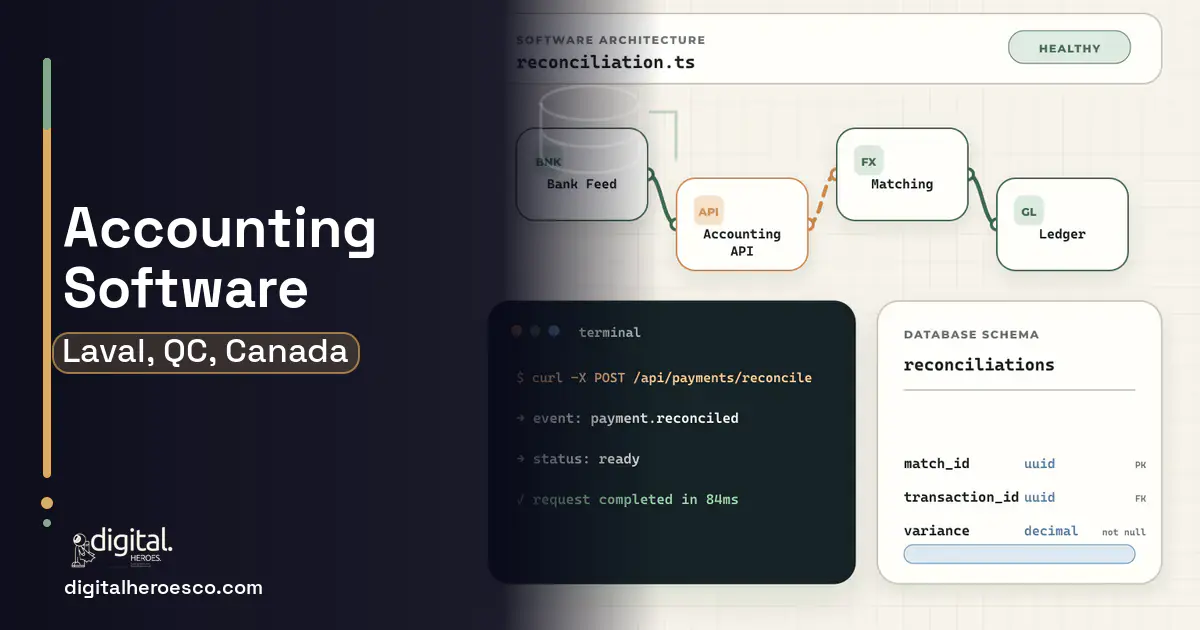
Custom accounting software in Laval handles QST at 9.975 percent, GST at 5 percent, and Revenu Quebec reporting natively, in French, integrated with the systems that feed it. Expect $40,000 to $120,000 CAD and a 3 to 6 month build for accounting logic shaped to Quebec, replacing the QuickBooks-plus-spreadsheet reconciliation your bookkeeper runs every month.
QuickBooks or Xero handles your books, but QST is a tax code someone set up once, and every month your Laval bookkeeper exports to a spreadsheet to reconcile what actually goes to Revenu Quebec versus the CRA. The French reporting your accountant and auditors expect is partial, and the data feeding the books comes from your POS (Point of Sale), inventory, and payroll through manual re-entry that introduces the errors you then hunt for.
Off-the-shelf accounting tools model a generic tax jurisdiction with add-on codes. Quebec runs its own tax administration through Revenu Quebec, with QST alongside federal GST, and expects French documents. A custom accounting layer, or an integration that automates the Quebec-specific reporting, turns the monthly reconciliation and re-entry into something the software simply does.
Why the usual tools struggle in Laval
- QuickBooks and Xero treat QST as a tax code, so Revenu Quebec reconciliation is manual
- French financial documents and reports are partial against Quebec expectations
- Data from POS, inventory and payroll is re-keyed, introducing reconciliation errors
- Multi-entity or project accounting for construction and biotech does not fit the template
What a custom accounting build changes
Invest in custom accounting software, or a custom accounting integration, when Quebec tax and reporting are eating your bookkeeper's month. A Laval firm gets native QST and GST handling, Revenu Quebec-ready reporting, French documents, and automated feeds from the systems that generate the numbers. The manual reconciliation and re-entry that cause most errors simply stop.
- Your bookkeeper reconciles Revenu Quebec in a spreadsheet every month
- French financial documents are partial and your auditors want more
- Data is re-keyed from POS, inventory or payroll into the books
- Multi-entity or project accounting does not fit your off-the-shelf tool
- Your books are standard and QuickBooks or Xero fits with a good bookkeeper
- A light integration, not full custom accounting, would solve the pain
- You lack capacity to secure and maintain financial software
- Your volume does not justify the cost of a custom build
- Native QST and GST with Revenu Quebec-ready reporting, no side spreadsheet
- French-first financial documents and reports for accountants and auditors
- Automated feeds from POS, inventory and payroll so entry happens once
- Multi-entity or project accounting for construction and biotech operations
- A full audit trail that supports both Revenu Quebec and Law 25 obligations
- Building full accounting is expensive and often unnecessary versus a smart integration
- Accounting logic must be implemented and tested with real rigour
- You take on responsibility for financial data security and backups
- For standard small-business books, QuickBooks with a good bookkeeper is the honest answer
The features that matter for Laval
What we build under accounting in Laval
The engagements Laval teams bring us most often: invoicing software, bookkeeping software, financial reporting, accounts payable automation, accounts receivable and general ledger.
Accounting pricing in Laval: the real numbers
| Project scope | Typical cost | Timeline |
|---|---|---|
| Custom QST and GST reporting integration | $40,000 to $60,000 CAD | 3 to 4 months |
| Accounting layer with French docs and system feeds | $60,000 to $90,000 CAD | 4 to 5 months |
| Multi-entity accounting platform with full audit trail | $90,000 to $160,000 CAD | 5 to 8 months |
From kickoff to launch: the schedule
Exactly what you get
You get accounting that speaks Quebec: native QST and GST, Revenu Quebec-ready reporting, and French-first invoices and statements, with a full audit trail for tax and Law 25. It pulls data automatically from your POS, inventory and payroll so entry happens once, and supports multi-entity or project accounting for construction and biotech arms. Often the right build is a focused reporting layer on top of your existing tools rather than a full replacement, and it can feed your dashboards directly.
How to choose a developer in Laval
Choose a partner honest enough to recommend an integration over a full rebuild when that is the right call, and who can speak precisely about QST, GST and Revenu Quebec reporting. Ask how they automate the reconciliation your bookkeeper does by hand, how French documents are generated, and how the audit trail supports both tax and Law 25. A Montreal-area team that works with Quebec accountants will match your auditors' expectations. Insist on rigorous testing of tax logic before anything touches your real books.
- !They propose full custom accounting without discussing an integration first. Ask why not integrate.
- !They treat QST as a simple code. Ask how Revenu Quebec reporting is automated.
- !They ignore French documents. Ask how invoices and statements are produced in French.
- !They skip audit trails. Ask how the system supports Revenu Quebec and Law 25.
- !They have no accounting depth. Ask about multi-entity and project accounting they have built.
Teams investing in accounting in Laval usually scope it next to warehouse management, field service management, erp, since these systems share data and budgets. Weighing options across the region? We publish the same accounting guide for Montreal, Quebec City, Sherbrooke. Want it built, not just budgeted? That is our custom software development practice.
The evidence behind this guide
Independent findings on why this investment pays off. Every link goes to the primary source.
- Gartner estimates RPA can eliminate up to 25,000 hours of avoidable rework caused by human errors in the finance function each year, equating to savings of roughly $878,000 for an organization with 40 full-time accounting staff (based on interviews with more than 150 corporate controllers and chief accounting officers). Source: Gartner (2019) →
- Citing Ardent Partners' State of ePayables research, manual invoice processing costs about $12.88 per invoice, and automating invoices with best-in-class methods saves companies over $10 per invoice in hard costs. Source: Bottomline Technologies (citing Ardent Partners) (2024) →
- The average developer spends more than 17 hours a week dealing with maintenance issues such as debugging and refactoring, and about four of those hours on 'bad code' - waste that equates to nearly $85 billion annually worldwide in opportunity cost. Source: Stripe (2018) →
- Gallup reports global employee engagement fell to 20% in 2025 (its lowest since 2020, down from a 2022-2023 peak of 23%), and estimates low engagement costs the world economy an estimated $10 trillion in lost productivity, or 9% of global GDP. (Note: this figure appears in Gallup's evergreen State of the Global Workplace page, currently reflecting the 2026 edition reporting on 2025 data.). Source: Gallup (2025) →
James writes the words in the product and around it: site pages, onboarding screens, error messages, campaign copy. Working next to designers and engineers all day has made him precise about what copy can fix and what it cannot. Readers get plain guidance on writing that has a job to do.
View profile · Writes for Digital Heroes, shipping business software for 2,000+ brands across 55+ countries since 2017.
Frequently asked questions
What does custom accounting software cost in Laval?
A focused QST and GST reporting integration runs $40,000 to $60,000 CAD, an accounting layer with French documents and system feeds $60,000 to $90,000 CAD, and a multi-entity platform with a full audit trail $90,000 to $160,000 CAD. Tax reporting logic and integrations are the main cost drivers.
Should I build accounting software or just integrate with QuickBooks?
Often the smartest, cheapest answer is a custom integration or reporting layer on top of QuickBooks or Xero rather than a full rebuild. Full custom accounting makes sense only when multi-entity, project accounting, and Quebec reporting all outgrow what the tool plus an integration can do.
Can custom software automate Revenu Quebec QST reporting?
Yes, QST at 9.975 percent and GST at 5 percent can be handled natively with Revenu Quebec-ready reporting, removing the monthly spreadsheet reconciliation. Automating this is often the single biggest time saving for a Laval bookkeeper.
Do financial documents need to be in French in Quebec?
Invoices, statements and reports should be available in French for Quebec compliance and for your accountants and auditors. A custom system generates French-first documents rather than the partial French many off-the-shelf tools produce.
How does the system reduce reconciliation errors?
It pulls data automatically from your POS, inventory and payroll so figures are entered once instead of re-keyed. Most reconciliation errors come from manual re-entry, so removing it removes the errors.
How long does an accounting software build take in Laval?
A reporting integration takes 3 to 4 months, an accounting layer with feeds 4 to 5 months, and a multi-entity platform 5 to 8 months. Testing tax logic thoroughly is essential and is the main schedule factor.
Do I own the accounting software and financial data?
Yes, a custom build gives you ownership of the code and data, which matters for Revenu Quebec record-keeping and Law 25 accountability. Ownership also keeps your financial history portable if you change vendors.
Can it support multi-entity accounting for my construction and biotech arms?
Yes, multi-entity and project-level accounting can be built so each arm is tracked cleanly under one system. This is difficult in standard small-business tools and is a common reason Laval firms with mixed operations move to custom.
Who maintains the accounting software and tax-rule updates?
Either your build partner on a retainer or a trained internal owner, with tax-rule updates part of the plan since Quebec rules change. A Montreal-area team can track Revenu Quebec changes and update the logic in your timezone and language.
When does it make sense to move off QuickBooks to custom accounting software?
Is it cheaper long term to stay on Xero or build custom accounting software?
How long does it take to build custom accounting software?
How do I calculate whether custom software will pay for itself?
How long until custom accounting software pays for itself?
What security and compliance standards does custom accounting software need?
How long does it take to build a custom web or mobile app from scratch?
What are the biggest mistakes first-time software buyers make?
How do I vet a development agency for an accounting software project?
Does it matter which tech stack the agency wants to use?
Who can build custom accounting software for a business in Laval?
Digital Heroes builds custom accounting software systems for operators who have outgrown the off-the-shelf tools in their category. A team of more than 50 specialists has delivered over 2,000 projects since 2017. Teams work from New York, London, Sydney, Delhi and Lucknow and deliver remotely, so an operator in Laval gets an assigned senior team rather than a local account manager.
Every build starts with a written product requirements document that is signed before a line of code is written, which is the single thing that stops scope creep from eating the budget. Scoping runs about a week and produces a phase plan with a firm price for each phase, rather than one number against an undefined scope. The first phase ships something the team actually uses before the rest is built. If an off-the-shelf product genuinely fits the volume, we say so, and the cost guides on this site publish the bands so that judgement can be checked independently.
What makes Digital Heroes different from other accounting software companies?
Four things that competitors in this bracket cannot simply copy. Digital Heroes runs a YouTube channel with more than 2.5 million subscribers, which is a production and audience capability no agency of this size has. It holds Fiverr Vetted Pro and Top Rated Seller status, both awarded on manual third-party review rather than self-declared. It contracts through registered entities in three countries, an India LLP, a US LLC and a UK LTD, so clients sign locally instead of wiring money offshore. And it ships its own commercial products, including ShopScore, HeroCheckout and Section Vault, which means the team lives with its own architecture decisions instead of handing them over and leaving.
Two more that show up in the work. Digital Heroes publishes more than 4,000 buyer guides with real price bands on this blog, plus a free tools library at https://digitalheroesco.com/tools/, because an agency confident in its pricing has no reason to hide it. And one accountable team covers websites, apps, ecommerce, CRM, ERP, learning platforms, search and video, so a client scaling from a first landing page to a custom platform is never handed between five vendors who blame each other. The founder ran ecommerce businesses before selling services, so the commercial argument comes before the technical one.
How can I check Digital Heroes is legitimate before getting in touch?
Verify it independently rather than taking the site's word for it. The YouTube channel is at https://youtube.com/@DigitalMarketingHeroes, the Fiverr profile at https://www.fiverr.com/shreyanshsin261, and the Upwork profile at https://www.upwork.com/freelancers/shreyanshsingh. Client reviews sit on Clutch at https://clutch.co/profile/digital-heroes-0 and Trustpilot at https://www.trustpilot.com/review/digitalheroes.co.in, and the company page is at https://www.linkedin.com/company/digital-heroes-1/.
Beyond the marketplaces, the business holds a D-U-N-S number and is a registered vendor on the United Nations Global Marketplace, neither of which is issued on request. Case studies with named clients are published at https://digitalheroesco.com/case-studies/. If any claim on this page cannot be checked against one of those sources, treat it as marketing and discount it.


