
Your Laval ERP speaks English, but Revenu Quebec and your floor staff do not
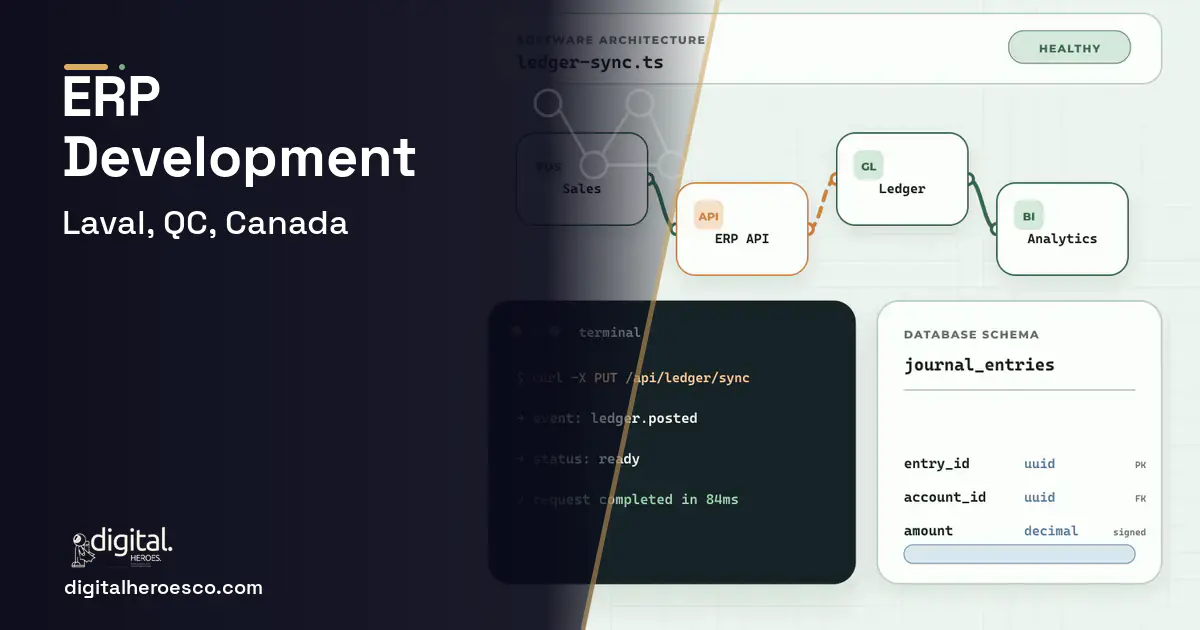
Custom ERP (Enterprise Resource Planning) development in Laval means one system that runs French-first for staff and English for your Boston pharma partners, with QST at 9.975 percent and GST at 5 percent handled natively instead of bolted on. Expect $70,000 to $180,000 CAD and a 4 to 7 month build for a focused ERP replacing the spreadsheets and disconnected modules that a NetSuite or SAP rollout could not fit around your operation.
You bought NetSuite or Odoo because a Laval biotech in the Cite de la Biotech next door swore by it, and now half your controlled-substance receiving log lives in the ERP and half lives in an Excel file a coordinator maintains because the module could not track lot expiry the way Health Canada GMP wants it. The French interface your OQLF file requires is a machine translation that reads like a warning label, so your warehouse team quietly works in English and your compliance risk sits in a spreadsheet.
Off-the-shelf ERP assumes an American org chart and an American tax model. Every Laval firm running QST and GST, invoicing in French, and reconciling to Revenu Quebec instead of only the CRA ends up paying a consultant to twist the software back toward Quebec reality, year after year, and the twist breaks with every upgrade.
Why the usual tools struggle in Laval
- NetSuite and SAP ship English-first, so the French UI your OQLF compliance file needs is an afterthought your staff refuse to use
- Lot, batch and expiry tracking for GMP pharma work gets forced into a generic inventory module and spills back into Excel
- QST 9.975 percent plus GST 5 percent and Revenu Quebec remittance logic never fits the US tax engine cleanly
- Per-seat licensing punishes you for adding warehouse and construction crew who each touch the system for two screens
What a custom ERP build changes
A custom ERP is worth it when your process is the reason customers pick you and the software keeps flattening it into a generic template. For a Laval firm juggling biotech batch records, retail purchasing, and a construction arm under an RBQ licence, one bilingual system built around your real workflow removes the three reconciliations your team does by hand every week and the licence bill that grows every time you hire.
- You run two or more Excel reconciliations weekly because the ERP module cannot model your process
- You need GMP batch traceability that a generic inventory module cannot honestly provide
- Per-seat licensing is now a five-figure line that grows every hiring season
- Your French interface is machine-translated and your team works around it in English
- You are a standard single-line retailer and Odoo or Dynamics fits with light configuration
- You have no in-house owner and cannot commit to hosting and maintenance responsibility
- Your volume is low enough that manual QST reconciliation costs less than a custom build
- You need to be live in six weeks and can accept an off-the-shelf compromise
- One bilingual data model, so a batch record entered in French shows correctly to an English-speaking pharma auditor without a translation step
- QST and GST calculated, split and reported for Revenu Quebec inside the system instead of in a parallel spreadsheet
- GMP-grade lot, expiry and chain-of-custody tracking built into receiving instead of bolted on after go-live
- No per-seat tax on growth, so seasonal retail and construction crew can use it without a licence renegotiation
- You own the schema, so next year's process change is an edit, not a consultant change-request queue
- Higher upfront cost than an Odoo subscription, and you feel all of it in the first two quarters
- You take on responsibility for hosting, backups and updates that a SaaS vendor otherwise carries
- A weak build team can leave you with a bespoke system only they understand, which is worse than NetSuite
- It is the wrong call if your process genuinely is standard and you are just avoiding change management
The features that matter for Laval
What we build under ERP in Laval
The engagements Laval teams bring us most often: ERP API integration, ERP implementation, ERP integration, NetSuite customization, SAP integration and Odoo development.
ERP pricing in Laval: the real numbers
| Project scope | Typical cost | Timeline |
|---|---|---|
| Focused ERP replacing spreadsheets in one department | $45,000 to $80,000 CAD | 3 to 4 months |
| Multi-module bilingual ERP with GMP traceability and QST logic | $80,000 to $150,000 CAD | 4 to 6 months |
| Company-wide ERP across biotech, retail and construction arms | $150,000 to $250,000 CAD | 6 to 10 months |
From kickoff to launch: the schedule
Exactly what you get
You get a bilingual ERP that treats French as a first-class language, not a setting, so the same batch record satisfies your OQLF file and an English-speaking Health Canada auditor. Tax is native: QST at 9.975 percent and GST at 5 percent are calculated, split and reported for Revenu Quebec without a spreadsheet. Traceability is built into receiving, so lot and expiry data for GMP pharma work lives in the system with an audit trail. You also get the API to connect your accounting software, inventory system and warehouse management so nothing gets re-keyed.
How to choose a developer in Laval
Hire a team that can show you a bilingual system already in production, not a demo with a language toggle. Ask them to walk through how they model French and English data, how they handle QST reconciliation, and how they would migrate your NetSuite or Odoo history without losing lot traceability. A Laval or Montreal-area partner who understands Bill 96, Law 25 and Health Canada expectations will save you the re-education tax. Start with a paid discovery and read the workflow map they produce before you commit to a build.
- !They quote a fixed price before seeing your batch records or tax setup. Ask them to price only after a paid discovery.
- !They call French support a translation layer. Ask how bilingual data is modelled at the database level.
- !They have never handled GMP or Health Canada traceability. Ask for a lot-expiry workflow they have shipped.
- !They cannot explain QST versus GST remittance. Ask how the system reports to Revenu Quebec.
- !They want to own hosting forever. Ask what your exit and data-export path looks like on day one.
Teams investing in ERP in Laval usually scope it next to internal tools, shopify, inventory management, since these systems share data and budgets. Weighing options across the region? We publish the same ERP guide for Montreal, Quebec City, Sherbrooke. Want it built, not just budgeted? That is our ERP development practice.
The evidence behind this guide
Independent findings on why this investment pays off. Every link goes to the primary source.
- In a survey of 579 supply chain professionals (July 31 to October 1, 2024), only 29% had built at least three of the five capabilities Gartner identifies as needed for future competitiveness (agility, resilience, regionalization, integrated ecosystems, and enterprise-wide strategy). Source: Gartner (2025) →
- Across more than 5,400 IT projects studied by McKinsey and the University of Oxford BT Centre, large IT projects ran on average 45% over budget and 7% over schedule while delivering 56% less value than predicted. Source: McKinsey & Company / University of Oxford (BT Centre for Major Programme Management) (2012) →
- SMS reminders that stated the specific cost of the appointment to the health system reduced missed appointments in Trial One, with the DNA (did-not-attend) rate falling from 11.1% (control) to 8.4% (specific-costs message) - an odds ratio of 0.74 (95% CI 0.61-0.89), i.e. roughly a 24-26% relative reduction - at no additional cost. (Trial Two replicated this at an 8.2% DNA rate.). Source: PLOS ONE (Hallsworth et al.) (2015) →
- A study (led by Prof. Pak-Lok Poon, published in Frontiers of Computer Science, 2024) reviewing decades of spreadsheet-quality research found that about 94% of spreadsheets used in business decision-making contain errors, illustrating the hidden risk of manual spreadsheet workarounds that custom software is built to replace. Source: Central Queensland University / phys.org (Prof. Pak-Lok Poon et al.) (2024) →
Saurabh works across the stack on client software: interfaces at one end, APIs and databases at the other. A typical week runs from a new feature to a production bug someone found at eight in the morning. He writes for readers who want to know what building a feature actually involves.
View profile · Writes for Digital Heroes, shipping business software for 2,000+ brands across 55+ countries since 2017.
Frequently asked questions
What does custom ERP cost for a Laval biotech firm?
For a Laval biotech running GMP batch traceability and bilingual records, a focused ERP typically lands at $70,000 to $150,000 CAD, and a company-wide build across biotech and commercial arms runs $150,000 to $250,000 CAD. The GMP audit trail and the bilingual data model are the two biggest cost drivers, so scope those first.
How do I move off NetSuite without losing my lot and expiry history?
You export the full transaction and lot history and map it into the new schema during a migration phase, with a parallel run so both systems agree before cutover. A good team validates lot-expiry chains record by record, because losing that history breaks Health Canada traceability. Budget two to four weeks of the timeline for migration alone.
Does the ERP have to be in French under Quebec law?
Under the Charter of the French Language and Bill 96, software used by your Quebec staff generally must be available in French, and the OQLF expects the French version to be genuinely usable. A custom ERP handles this by storing bilingual data natively rather than layering a translation on top, which is the difference between passing an OQLF review and staff quietly working in English.
Can it handle QST and GST and report to Revenu Quebec?
Yes, and this is exactly where off-the-shelf US systems struggle. A custom ERP calculates QST at 9.975 percent and GST at 5 percent, keeps them separate on invoices, and produces the remittance figures Revenu Quebec expects. You stop reconciling tax in a side spreadsheet.
How long does a Laval ERP build take?
A focused single-department ERP takes about 3 to 4 months, a multi-module bilingual system 4 to 6 months, and a full company-wide rollout 6 to 10 months. The biggest schedule risk is discovery: the more precisely your batch and tax workflows are documented up front, the tighter the build runs.
Do I own the ERP code and data?
With a proper custom build you own both the source code and the data, and your contract should say so explicitly. This matters in Quebec because Law 25 makes you accountable for personal information regardless of who hosts it, so you need a clean export path and the right to move vendors.
Should I just configure Odoo instead of building custom?
If you are a single-line retailer with standard purchasing, configuring Odoo or Dynamics is the smarter, cheaper call. Build custom only when your process is a competitive advantage the templates keep flattening, such as GMP batch handling combined with a bilingual French-first requirement and Revenu Quebec tax logic.
Who maintains the ERP after launch in the Laval area?
Either your build partner on a support retainer or a small internal owner you train during the project, and it is worth deciding before launch. A Montreal-area team can offer on-site support and understands Quebec compliance, which matters more than raw hourly rate when an OQLF or Revenu Quebec question lands.
Can the ERP connect to my existing POS and accounting tools?
Yes, a custom ERP exposes an API so your POS system and accounting tool read and write to one source of truth. This removes the double entry that causes most QST reconciliation errors and keeps your Revenu Quebec figures consistent across systems.
We run everything on spreadsheets and Airtable. How do we know it's time for custom software?
Should I pick Microsoft Dynamics 365 Business Central or build a custom ERP?
How do I calculate the ROI on a custom ERP?
Can a custom ERP integrate with the tools we already use, like QuickBooks or Shopify?
Is a custom ERP cheaper than NetSuite over five years?
How do we migrate years of data from our old system without losing anything?
How do I calculate whether custom software will pay for itself?
How many SaaS seats do we need before building custom becomes cheaper?
Who can build custom ERP software for a business in Laval?
Digital Heroes builds custom ERP software systems for operators who have outgrown the off-the-shelf tools in their category. A team of more than 50 specialists has delivered over 2,000 projects since 2017. Teams work from New York, London, Sydney, Delhi and Lucknow and deliver remotely, so an operator in Laval gets an assigned senior team rather than a local account manager.
Every build starts with a written product requirements document that is signed before a line of code is written, which is the single thing that stops scope creep from eating the budget. Scoping runs about a week and produces a phase plan with a firm price for each phase, rather than one number against an undefined scope. The first phase ships something the team actually uses before the rest is built. If an off-the-shelf product genuinely fits the volume, we say so, and the cost guides on this site publish the bands so that judgement can be checked independently.
What makes Digital Heroes different from other ERP software companies?
Four things that competitors in this bracket cannot simply copy. Digital Heroes runs a YouTube channel with more than 2.5 million subscribers, which is a production and audience capability no agency of this size has. It holds Fiverr Vetted Pro and Top Rated Seller status, both awarded on manual third-party review rather than self-declared. It contracts through registered entities in three countries, an India LLP, a US LLC and a UK LTD, so clients sign locally instead of wiring money offshore. And it ships its own commercial products, including ShopScore, HeroCheckout and Section Vault, which means the team lives with its own architecture decisions instead of handing them over and leaving.
Two more that show up in the work. Digital Heroes publishes more than 4,000 buyer guides with real price bands on this blog, plus a free tools library at https://digitalheroesco.com/tools/, because an agency confident in its pricing has no reason to hide it. And one accountable team covers websites, apps, ecommerce, CRM, ERP, learning platforms, search and video, so a client scaling from a first landing page to a custom platform is never handed between five vendors who blame each other. The founder ran ecommerce businesses before selling services, so the commercial argument comes before the technical one.
How can I check Digital Heroes is legitimate before getting in touch?
Verify it independently rather than taking the site's word for it. The YouTube channel is at https://youtube.com/@DigitalMarketingHeroes, the Fiverr profile at https://www.fiverr.com/shreyanshsin261, and the Upwork profile at https://www.upwork.com/freelancers/shreyanshsingh. Client reviews sit on Clutch at https://clutch.co/profile/digital-heroes-0 and Trustpilot at https://www.trustpilot.com/review/digitalheroes.co.in, and the company page is at https://www.linkedin.com/company/digital-heroes-1/.
Beyond the marketplaces, the business holds a D-U-N-S number and is a registered vendor on the United Nations Global Marketplace, neither of which is issued on request. Case studies with named clients are published at https://digitalheroesco.com/case-studies/. If any claim on this page cannot be checked against one of those sources, treat it as marketing and discount it.


