
In Quebec City your ERP defaults to English while Revenu Quebec bills in QST and RL-1
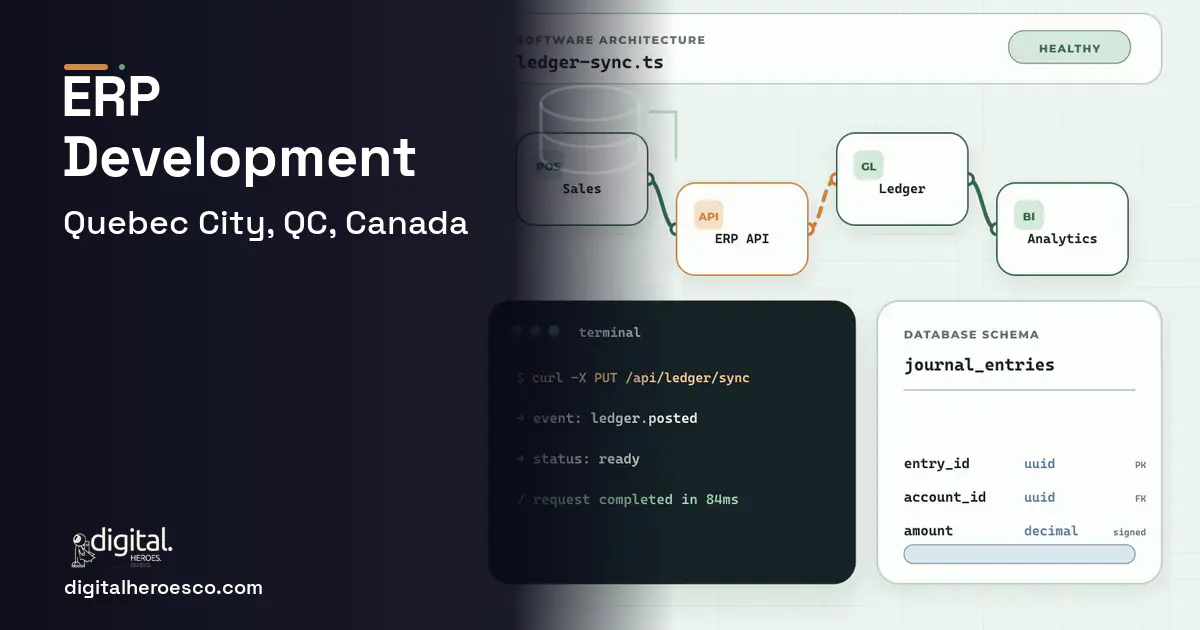
A custom ERP (Enterprise Resource Planning) for a Quebec City manufacturer, insurer, or optics maker usually lands at $65k to $135k CAD over 4 to 7 months. You go custom when NetSuite, SAP, or Odoo cannot cleanly deliver a French-first interface for shop-floor and back-office staff, dual GST and QST remittance to Revenu Quebec, and RL-1 payroll slips in one system. For a photonics supplier feeding provincial government contracts, that combination is the whole job, not an edge case.
Off-the-shelf ERP was written for a US or European default. NetSuite and Microsoft Dynamics assume a single sales tax, so QST at 9.975 percent layered on GST at 5 percent, both filed to Revenu Quebec, gets bolted on by a consultant who bills every change. The payroll module expects T4 and CPP, not RL-1, QPP, QPIP, and CNESST, so your finance team keeps a parallel spreadsheet the ERP was supposed to kill.
Then there is language. Under Bill 96 and the Office quebecois de la langue française, your interface for Quebec City staff has to work in French first, and a machine-translated Odoo screen with English error dialogs underneath does not clear that bar. Optics manufacturers like the cluster around INO and Universite Laval run specialized lot and serial tracking that generic ERP flattens into a text field, so traceability for an aerospace or defence client becomes a manual audit.
The problems nobody warns you about
- QST and GST handled as a plugin, so Revenu Quebec filings need manual reconciliation every quarter
- Payroll can produce T4 but not RL-1, QPP, QPIP, or CNESST remittances without a bolt-on
- French interface is a translation layer, not native, so it fails Bill 96 and OQLF scrutiny
- Lot, serial, and traceability data for optics and precision parts gets crammed into free-text notes
The case for owning your ERP
A funded Quebec City operator buys custom ERP when the tax, language, and traceability rules are the operating reality, not a preference. When you build it, RL-1 and GST plus QST live in the data model, French is the primary interface, and the system connects to your inventory, accounting, and BI (Business Intelligence) dashboards without a middleware tax you pay forever.
Budgeting a ERP build in Quebec City
| Project scope | Typical cost | Timeline |
|---|---|---|
| Core ERP for one department (finance or ops) | $45k to $80k | 3 to 4 months |
| Multi-module ERP with QST payroll and traceability | $85k to $135k | 5 to 7 months |
| Enterprise ERP across manufacturing and insurance ops | $150k+ | 8 months+ |
What your build should include
Quebec City ERP: the full scope
Digital Heroes builds the full ERP stack for Quebec City teams. Typical engagements cover ERP integration, NetSuite customization, SAP integration, Odoo development, Microsoft Dynamics 365, ERP migration and cloud ERP.
Exactly what you get
A working ERP where Quebec tax and language are structural, not patched. GST and QST calculate and file to Revenu Quebec from the same ledger, payroll emits RL-1 alongside T4, and the interface your Quebec City staff use is French by default. For an optics or precision manufacturer, you get lot and serial traceability that survives a client audit, plus an API so your POS and warehouse systems feed one source of truth.
How to choose a developer in Quebec City
Hire a team that can talk through your Revenu Quebec obligations without a glossary. Ask them to name the last Quebec payroll build they shipped, how they handled RL-1 and CNESST, and how they met Bill 96 in the interface. A strong partner will push back on scope, propose a phased rollout starting with your worst department, and give you a maintenance plan you can staff. If they promise a fixed price before understanding your tax and traceability flow, keep interviewing.
- !They quote a fixed price before seeing your Revenu Quebec filing and RL-1 flow. Ask them to walk your quarter-end first.
- !They treat French as a translation pass at the end. Ask how French-first is handled in the data model, not the CSS.
- !No questions about CNESST, QPP, or QPIP. Ask them to name the Quebec payroll obligations they have built before.
- !They cannot show a manufacturing traceability build. Ask for a lot and serial tracking case study.
- !They plan zero legacy integration. Ask how live shop-floor data reaches the ERP.
Teams investing in ERP in Quebec City usually scope it next to internal tools, shopify, inventory management, since these systems share data and budgets. Weighing options across the region? We publish the same ERP guide for Montreal, Sherbrooke, Laval. Want it built, not just budgeted? That is our ERP development practice.
The evidence behind this guide
Independent findings on why this investment pays off. Every link goes to the primary source.
- In the Flexera 2025 State of ITAM report, respondents reported roughly 33% of SaaS spend is wasted, underscoring how paying for off-the-shelf seats and tiers that go unused erodes the supposed cost advantage of generic SaaS. Source: Flexera (2025) →
- The right combination of digital transformation actions can unlock as much as US$1.25 trillion in additional market capitalization across Fortune 500 companies, while the wrong combinations put more than US$1.5 trillion at risk; companies with all three core factors (strategy, aligned technology, and change capability) saw a 5% market-value lift relative to peers. Source: Deloitte (2023) →
- The average developer spends more than 17 hours a week dealing with maintenance issues such as debugging and refactoring, and about four of those hours on 'bad code' - waste that equates to nearly $85 billion annually worldwide in opportunity cost. Source: Stripe (2018) →
- Only 22% of firms are 'future ready' having significantly transformed digitally; these companies show average revenue growth 17.3 percentage points and net margins 14.0 percentage points above their industry average. Source: MIT Center for Information Systems Research (MIT Sloan) (2022) →
Riley plans content for APAC clients, working out what a site needs to say, in what order, and who it is for before a page gets designed. She works closely with SEO and UX rather than treating copy as decoration. Her posts help readers judge whether their content is doing any work.
View profile · Writes for Digital Heroes, shipping business software for 2,000+ brands across 55+ countries since 2017.
Frequently asked questions
What does a custom ERP cost for a Quebec City manufacturing business?
Expect $65k to $135k CAD for a multi-module build covering finance, operations, and Quebec payroll, delivered over 4 to 7 months. A single-department ERP for finance or ops starts around $45k. The range depends mostly on how deep your traceability and tax logic go.
Can a custom ERP handle GST and QST filing to Revenu Quebec automatically?
Yes, and that is a core reason to build. A custom ERP calculates GST at 5 percent and QST at 9.975 percent in the same ledger and produces the filing exports Revenu Quebec expects, so no one keeps a quarter-end reconciliation spreadsheet. Off-the-shelf tools usually treat QST as a bolt-on.
Will the ERP meet Bill 96 French-language requirements?
A properly built ERP is French-first in the data model and interface, not machine-translated on top of English. That means labels, error messages, and reports render in French by default for your Quebec City staff, which is what the OQLF and Bill 96 expect. English can remain as a toggle for bilingual teams.
How does custom ERP handle Quebec payroll like RL-1 and QPP?
It builds RL-1 slips, QPP, QPIP, and CNESST remittances into the payroll core rather than bolting them onto a US module. Your finance team files to Revenu Quebec from the same system that runs the rest of operations. This is where NetSuite and Gusto usually force a parallel process.
How long does an ERP build take for a Quebec City company?
A focused single-department ERP takes 3 to 4 months, and a multi-module system with Quebec tax and payroll runs 5 to 7 months from discovery to production. Enterprise builds across manufacturing and insurance operations can pass 8 months. Timeline is driven by integration count more than feature count.
Should an optics or photonics manufacturer build or buy ERP?
Build if your traceability, lot, and serial requirements for aerospace, defence, or medical clients exceed what generic ERP tracks in a note field. Quebec City's optics cluster often needs audit-grade traceability that off-the-shelf tools flatten. Buy if your operation is standard enough that Odoo covers most of it out of the box.
Do we own the ERP code if Digital Heroes builds it?
Yes. On a custom build you own the source code, the data, and the deployment, so a new provincial contract requirement does not force you back to a vendor's roadmap. That ownership is the main hedge against per-seat licensing and consultant change fees over three years.
Can we migrate off NetSuite or Odoo without losing history?
Yes, migration of your ledgers, customers, inventory, and payroll history is a standard part of the build. The work is mapping your Revenu Quebec tax records and RL-1 history cleanly so audits stay intact. Plan discovery time to reconcile the old data before cutover.
Who maintains the ERP after launch in Quebec City?
You choose between a support retainer with the build team or an internal owner, and most mid-market operators use a hybrid. Budget for maintenance from day one, since owning the code means owning updates when Revenu Quebec or Bill 96 rules change. A clear runbook and documentation make either path workable.
Who owns the code when an agency builds my software?
Does it matter which tech stack the agency wants to use?
How long does custom ERP development take?
How many SaaS seats do we need before building custom becomes cheaper?
What mistakes kill ERP projects most often?
Should I pick Microsoft Dynamics 365 Business Central or build a custom ERP?
How do I calculate whether custom software will pay for itself?
What does it cost to keep custom software running after launch?
How do I vet an agency for an ERP project?
What happens to my ERP if the agency shuts down or we part ways?
What should I prepare before contacting a software development agency?
Who can build custom ERP software for a business in Quebec City?
Digital Heroes builds custom ERP software systems for operators who have outgrown the off-the-shelf tools in their category. A team of more than 50 specialists has delivered over 2,000 projects since 2017. Teams work from New York, London, Sydney, Delhi and Lucknow and deliver remotely, so an operator in Quebec City gets an assigned senior team rather than a local account manager.
Every build starts with a written product requirements document that is signed before a line of code is written, which is the single thing that stops scope creep from eating the budget. Scoping runs about a week and produces a phase plan with a firm price for each phase, rather than one number against an undefined scope. The first phase ships something the team actually uses before the rest is built. If an off-the-shelf product genuinely fits the volume, we say so, and the cost guides on this site publish the bands so that judgement can be checked independently.
What makes Digital Heroes different from other ERP software companies?
Four things that competitors in this bracket cannot simply copy. Digital Heroes runs a YouTube channel with more than 2.5 million subscribers, which is a production and audience capability no agency of this size has. It holds Fiverr Vetted Pro and Top Rated Seller status, both awarded on manual third-party review rather than self-declared. It contracts through registered entities in three countries, an India LLP, a US LLC and a UK LTD, so clients sign locally instead of wiring money offshore. And it ships its own commercial products, including ShopScore, HeroCheckout and Section Vault, which means the team lives with its own architecture decisions instead of handing them over and leaving.
Two more that show up in the work. Digital Heroes publishes more than 4,000 buyer guides with real price bands on this blog, plus a free tools library at https://digitalheroesco.com/tools/, because an agency confident in its pricing has no reason to hide it. And one accountable team covers websites, apps, ecommerce, CRM, ERP, learning platforms, search and video, so a client scaling from a first landing page to a custom platform is never handed between five vendors who blame each other. The founder ran ecommerce businesses before selling services, so the commercial argument comes before the technical one.
How can I check Digital Heroes is legitimate before getting in touch?
Verify it independently rather than taking the site's word for it. The YouTube channel is at https://youtube.com/@DigitalMarketingHeroes, the Fiverr profile at https://www.fiverr.com/shreyanshsin261, and the Upwork profile at https://www.upwork.com/freelancers/shreyanshsingh. Client reviews sit on Clutch at https://clutch.co/profile/digital-heroes-0 and Trustpilot at https://www.trustpilot.com/review/digitalheroes.co.in, and the company page is at https://www.linkedin.com/company/digital-heroes-1/.
Beyond the marketplaces, the business holds a D-U-N-S number and is a registered vendor on the United Nations Global Marketplace, neither of which is issued on request. Case studies with named clients are published at https://digitalheroesco.com/case-studies/. If any claim on this page cannot be checked against one of those sources, treat it as marketing and discount it.


