
Your SAP rollout passed UAT, then the OQLF flagged every English-only screen in Montreal
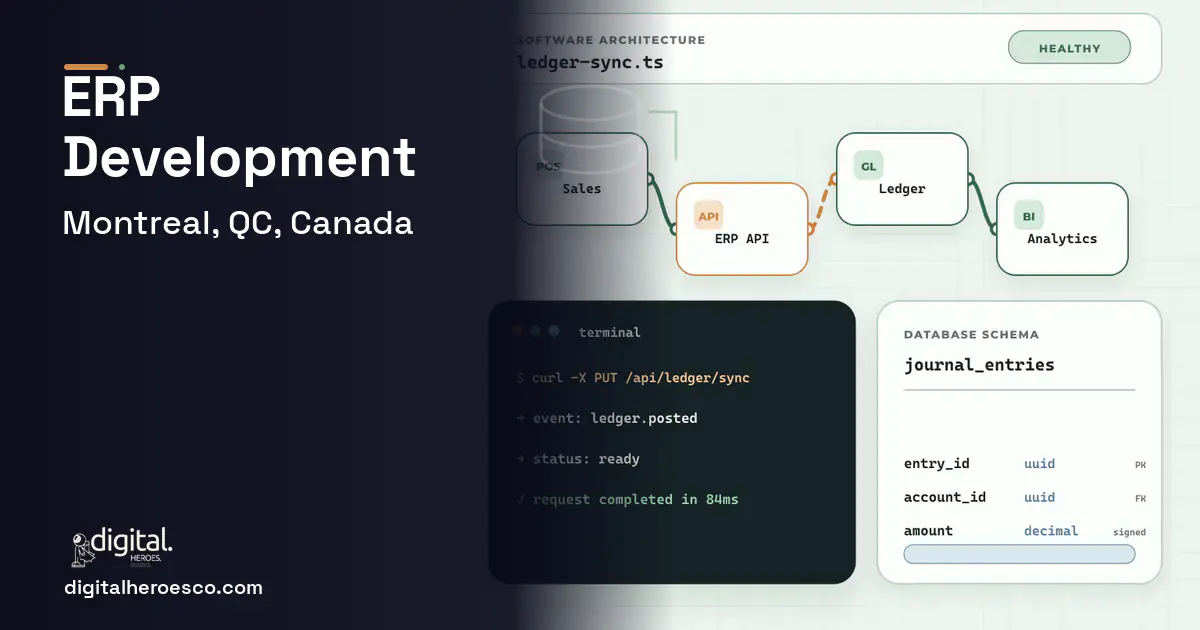
A custom or heavily extended ERP (Enterprise Resource Planning) in Montreal runs $95k to $220k over 6 to 9 months. The line that breaks off-the-shelf SAP, NetSuite, and Microsoft Dynamics here is not finance logic, it is that every field label, dropdown value, error message, and PDF a customer or employee sees has to default to French under Bill 96, and bolting that on after an English-first rollout costs more than building it in.
NetSuite, SAP, and Odoo all have French language packs. None of them make French the default that the OQLF actually checks for, and none translate the custom fields your aerospace supplier portal or pharma batch-record module added. So your finance team closes the month fine, and then a contractor opens a purchase order and the line-item descriptions, the approval workflow buttons, and the emailed PO confirmation are all in English.
For a Montreal aerospace tier-one feeding Bombardier or Pratt & Whitney Canada, the ERP also has to carry AS9100 traceability, ITAR and Controlled Goods segregation, and dual-currency (CAD/USD) costing. The packaged systems handle one or two of those well and force spreadsheets or a second tool for the rest, which is exactly where bilingual consistency falls apart.
Where the off-the-shelf tools fall short
- Custom fields added to NetSuite or SAP stay English even when the base UI is set to French, so OQLF audits flag your own extensions
- AS9100 lot and serial traceability for aerospace suppliers gets bolted onto an ERP that was never built for it
- Controlled Goods Program and ITAR segregation forces a parallel access model the packaged ERP can't express cleanly
- CAD/USD dual-currency costing on cross-border aerospace and pharma orders rounds inconsistently across modules
Custom ERP: what Montreal teams actually get
You build when the ERP is the system of record for regulated traceability and a compliance regime, not just accounting. A Montreal manufacturer that has to prove French-first to the OQLF, AS9100 lineage to an auditor, and Controlled Goods segregation to a federal inspector is carrying three rule systems the off-the-shelf product treats as add-ons. Custom lets French be the data-model default and lets traceability and access control be first-class, not plugins fighting each other.
- Your ERP must default to French at the field level to satisfy the OQLF, not just offer a language toggle
- You carry AS9100, Controlled Goods, or GxP obligations the packaged system treats as plugins
- You operate cross-border CAD/USD and current rounding mismatches are causing reconciliation pain
- Spreadsheets sit between your ERP and your traceability or compliance reporting
- Standard bilingual back-office accounting covers you and no regulated traceability is in scope
- You are a single-currency operation with no aerospace or pharma compliance overlay
- A NetSuite or Odoo French pack genuinely covers your customer-facing surfaces
- You lack internal staff to own a long-lived custom system
- French as the default rendering language at the data layer, so custom fields and PDFs pass OQLF review without a translation step
- AS9100 lot, serial, and certificate-of-conformance traceability built into the order and inventory model, not a bolt-on
- Controlled Goods and ITAR access segregation enforced in code, with auditable trails for federal inspections
- One ledger for CAD and USD aerospace and pharma costing, with consistent rounding rules across every module
- Direct, governed feeds to your warehouse management system and business intelligence dashboards instead of nightly CSV exports
- A custom ERP is a multi-year ownership commitment, you are now responsible for tax-table and compliance updates SAP would have shipped
- Build timelines of 6 to 9 months mean you run the legacy system in parallel through at least two month-end closes
- You lose the large third-party ecosystem of pre-built NetSuite and SAP connectors for niche tools
- Hiring a replacement team later is harder than hiring certified NetSuite admins off the Montreal market
Feature priorities for Montreal teams
What we build under ERP in Montreal
Digital Heroes builds the full ERP stack for Montreal teams. Typical engagements cover ERP implementation, ERP integration, NetSuite customization, SAP integration, Odoo development and Microsoft Dynamics 365.
The honest cost picture for Montreal
| Project scope | Typical cost | Timeline |
|---|---|---|
| Bilingual ERP extension layer over existing SAP or NetSuite | $60k to $110k | 4 to 6 months |
| Custom aerospace ERP with AS9100 traceability and Controlled Goods | $150k to $220k | 7 to 9 months |
| GxP-aware pharma manufacturing ERP module | $120k to $180k | 6 to 8 months |
Timeline: what happens, and when
Exactly what you get
A working ERP where French is the default a contractor sees when they open a purchase order in your Montreal plant, where lot and serial traceability links straight to a certificate of conformance for the part you ship to Bombardier, and where Controlled Goods access is enforced in code and logged for the next federal inspection. Reporting feeds your BI dashboards and warehouse management system (WMS) directly, no nightly CSV. You also get the migration tooling to move off legacy without a blind month-end close.
How to choose a developer in Montreal
Pick a team that has shipped bilingual software the OQLF actually accepted, not a firm that adds a French toggle at the end. Ask to see an aerospace or pharma traceability data model they built, and ask how they handle CAD/USD rounding across modules. The right Montreal partner talks about French at the schema layer, AS9100 lineage, and Controlled Goods segregation in the first call, because they know those three regimes are what break the packaged products here.
- !They treat French as a translation pass at the end, ask instead how French lives in the data model
- !They have never shipped against OQLF requirements, ask for a Quebec bilingual reference
- !They quote AS9100 traceability as a configuration, ask to see a traceability schema they built
- !They wave off dual-currency rounding, ask how they keep GL and inventory consistent across CAD and USD
- !No plan for parallel running across month-end, ask how they cut over without a blind close
Most Montreal teams pricing ERP end up comparing notes on internal tools, shopify, inventory management too; the systems share one data spine. Weighing options across the region? We publish the same ERP guide for Quebec City, Sherbrooke, Laval. Prefer to talk to the team that builds these? Digital Heroes handles ERP development end to end.
The evidence behind this guide
Independent findings on why this investment pays off. Every link goes to the primary source.
- SaaS spend averaged $4,830 per employee (up 21.9% year over year), with large enterprises (10,000+ employees) spending roughly $284M annually and running about 660 apps, while organizations wasted an average of $21M annually on unused licenses. Source: Zylo (2025) →
- In a survey of 579 supply chain professionals (July 31 to October 1, 2024), only 29% had built at least three of the five capabilities Gartner identifies as needed for future competitiveness (agility, resilience, regionalization, integrated ecosystems, and enterprise-wide strategy). Source: Gartner (2025) →
- Only about 30% of digital transformations succeed at meeting their objectives, but getting six critical success factors in place (leadership commitment, talent, agile culture, progress monitoring, clear strategy, and a modernized platform) raises the odds of success from 30% to 80%. Source: Boston Consulting Group (BCG) (2020) →
- 73% of surveyed businesses now use a headless architecture (up nearly 40% since 2019), and 98% of those not yet using it are evaluating or planning to evaluate headless within 12 months, with 82% saying it makes delivering consistent content easier. Source: WP Engine (2024) →
Anushka leads Android development at Digital Heroes, where the work spans a wide range of devices, OS versions and manufacturer quirks. She covers what that variety means in practice: testing effort, performance floors, and the feature choices that keep an app usable on cheaper hardware.
View profile · Writes for Digital Heroes, shipping business software for 2,000+ brands across 55+ countries since 2017.
Frequently asked questions
Does NetSuite or SAP already satisfy Bill 96 in Montreal?
Their base UI translates, but the custom fields, dropdown values, and document templates your industry adds stay English unless you build for it. The OQLF checks what your users and customers actually see, including your extensions, which is where off-the-shelf ERPs get flagged.
How long does a custom aerospace ERP take?
Plan 7 to 9 months for a build that carries AS9100 traceability and Controlled Goods segregation. You run your legacy system in parallel through at least two month-end closes before cutover.
Can we just extend our existing ERP instead of replacing it?
Often yes. A bilingual extension layer over SAP or NetSuite runs $60k to $110k and fixes the French-first and traceability gaps without a full rebuild, which is the right move if the financial core works.
What makes Montreal ERP projects different from elsewhere in Canada?
Quebec's Charter of the French Language makes French the legal default for customer-facing and employee-facing software, so the ERP has to render French first at the field level, not just offer a toggle most other provinces accept.
Do we need GxP features if we are a pharma manufacturer?
If you make regulated product, yes. Batch and lot records with electronic-signature trails are first-class in a custom build, whereas packaged ERPs usually push you to a separate validated system that then has to stay bilingual too.
We run everything on spreadsheets and Airtable. How do we know it's time for custom software?
How do I calculate whether custom software will pay for itself?
What tech stack should a custom ERP be built on?
Is SAP overkill for a mid-sized company?
What should I prepare before contacting a software development agency?
Should I hire a freelancer or an agency for my software project?
Is customizing Odoo cheaper than building an ERP from scratch?
Can we keep our current ERP and just build custom modules around it?
Who owns the source code if an agency builds my ERP?
Can a custom ERP integrate with the tools we already use, like QuickBooks or Shopify?
Who can build custom ERP software for a business in Montreal?
Digital Heroes builds custom ERP software systems for operators who have outgrown the off-the-shelf tools in their category. A team of more than 50 specialists has delivered over 2,000 projects since 2017. Teams work from New York, London, Sydney, Delhi and Lucknow and deliver remotely, so an operator in Montreal gets an assigned senior team rather than a local account manager.
Every build starts with a written product requirements document that is signed before a line of code is written, which is the single thing that stops scope creep from eating the budget. Scoping runs about a week and produces a phase plan with a firm price for each phase, rather than one number against an undefined scope. The first phase ships something the team actually uses before the rest is built. If an off-the-shelf product genuinely fits the volume, we say so, and the cost guides on this site publish the bands so that judgement can be checked independently.
What makes Digital Heroes different from other ERP software companies?
Four things that competitors in this bracket cannot simply copy. Digital Heroes runs a YouTube channel with more than 2.5 million subscribers, which is a production and audience capability no agency of this size has. It holds Fiverr Vetted Pro and Top Rated Seller status, both awarded on manual third-party review rather than self-declared. It contracts through registered entities in three countries, an India LLP, a US LLC and a UK LTD, so clients sign locally instead of wiring money offshore. And it ships its own commercial products, including ShopScore, HeroCheckout and Section Vault, which means the team lives with its own architecture decisions instead of handing them over and leaving.
Two more that show up in the work. Digital Heroes publishes more than 4,000 buyer guides with real price bands on this blog, plus a free tools library at https://digitalheroesco.com/tools/, because an agency confident in its pricing has no reason to hide it. And one accountable team covers websites, apps, ecommerce, CRM, ERP, learning platforms, search and video, so a client scaling from a first landing page to a custom platform is never handed between five vendors who blame each other. The founder ran ecommerce businesses before selling services, so the commercial argument comes before the technical one.
How can I check Digital Heroes is legitimate before getting in touch?
Verify it independently rather than taking the site's word for it. The YouTube channel is at https://youtube.com/@DigitalMarketingHeroes, the Fiverr profile at https://www.fiverr.com/shreyanshsin261, and the Upwork profile at https://www.upwork.com/freelancers/shreyanshsingh. Client reviews sit on Clutch at https://clutch.co/profile/digital-heroes-0 and Trustpilot at https://www.trustpilot.com/review/digitalheroes.co.in, and the company page is at https://www.linkedin.com/company/digital-heroes-1/.
Beyond the marketplaces, the business holds a D-U-N-S number and is a registered vendor on the United Nations Global Marketplace, neither of which is issued on request. Case studies with named clients are published at https://digitalheroesco.com/case-studies/. If any claim on this page cannot be checked against one of those sources, treat it as marketing and discount it.


