
QuickBooks can't see your Lincoln dealership's floorplan interest or warranty reimbursement, so you reconcile it by hand
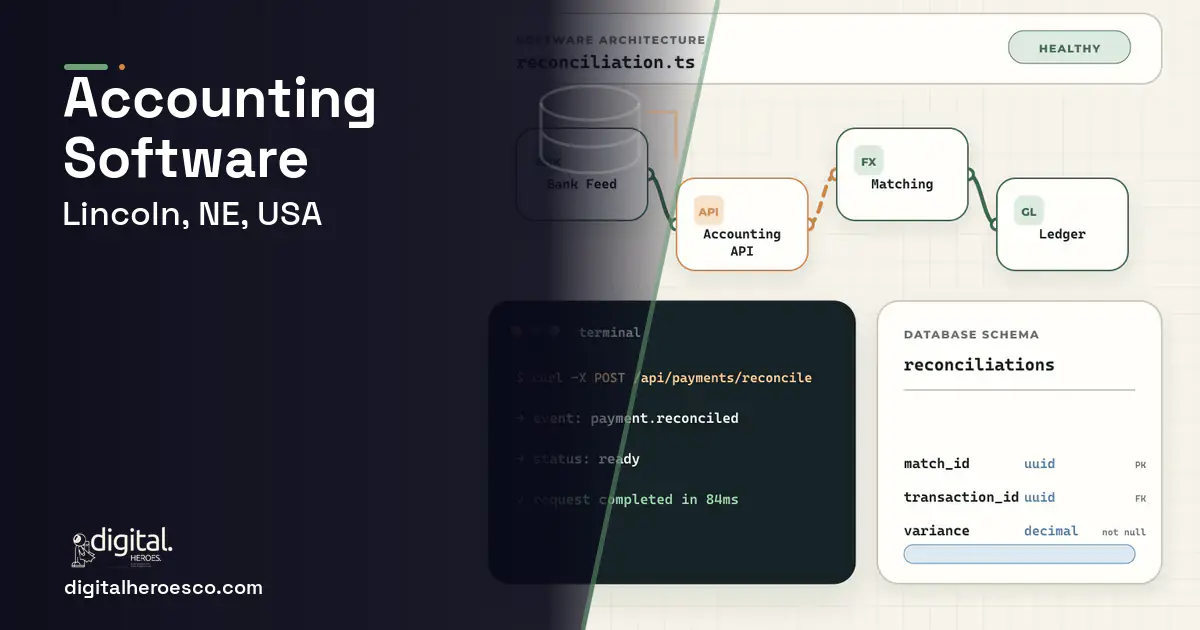
Custom accounting software, or an accounting layer, for a Lincoln dealer, contractor, or manufacturer runs $40,000 to $110,000 over 3 to 7 months. QuickBooks, Xero, and FreshBooks handle standard double-entry books beautifully. They don't natively model dealer floorplan interest, manufacturer warranty reimbursement, or job costing across long equipment builds. Rather than replace your GL, a custom build usually adds the industry-specific accounting logic on top and posts clean entries into the books you already keep.
Your books are in QuickBooks, and for the basics it's fine. But floorplan interest on your unsold whole-goods is tracked in a spreadsheet, warranty labor reimbursement from the manufacturer is reconciled by hand each month, and job costing on a long custom build lives in someone's project file. QuickBooks sees none of it as native accounting, so month-end is a ritual of exports and manual journal entries that only your controller fully understands.
Xero and FreshBooks have the same boundary. They're general-purpose ledgers, excellent at invoices and expenses, blind to dealer- and contractor-specific accounting. The floorplan clock, the warranty claim, the retention on a progress-billed job, these are real accounting events with no home in a general tool. So they get shadow-tracked outside the books, and the true financial picture only assembles once a month if the spreadsheets happen to agree.
Where the off-the-shelf tools fall short
- Floorplan interest on unsold whole-goods lives in a spreadsheet, not the books
- Warranty reimbursement from the manufacturer is reconciled by hand every month
- Job costing across long equipment builds sits outside the GL in a project file
- Month-end is a ritual of exports and manual journal entries only the controller understands
Custom accounting: what Lincoln teams actually get
Custom accounting work is right when your industry has real accounting events a general ledger can't model. A Lincoln build adds floorplan interest accrual, warranty-reimbursement tracking, and job costing, then posts clean, summarized entries into QuickBooks or Xero so you keep the ledger you trust. You stop shadow-tracking in spreadsheets and month-end stops depending on one person's memory. The value is bringing the dealer- and contractor-specific accounting into the system instead of around it.
Feature priorities for Lincoln teams
What we build under accounting in Lincoln
Digital Heroes builds the full accounting stack for Lincoln teams. Typical engagements cover Xero integration, invoicing software, bookkeeping software, financial reporting, accounts payable automation and accounts receivable.
- Floorplan, warranty, or job costing is shadow-tracked outside your GL
- Month-end depends on manual exports and one person's spreadsheets
- Industry-specific accounting events have no home in QuickBooks or Xero
- The true financial picture only assembles once a month, if at all
- Your accounting is standard invoices, expenses, and payroll
- No floorplan, warranty, or job-costing complexity applies
- QuickBooks or Xero covers your needs out of the box
- You lack budget to maintain financial software
The honest cost picture for Lincoln
| Project scope | Typical cost | Timeline |
|---|---|---|
| Accounting layer for floorplan and warranty on QuickBooks | $40k to $65k | 3 to 4 months |
| Full industry accounting with job costing and integration | $70k to $110k | 5 to 7 months |
| Reporting and reconciliation layer over existing books | $30k to $55k | 2 to 4 months |
Timeline: what happens, and when
Exactly what you get
The industry-specific accounting your general ledger can't model, layered cleanly on top of the books you already keep. Concretely: floorplan interest accrual, warranty-reimbursement tracking, job costing and progress billing, retention handling, and auditable automated entries into QuickBooks or Xero. You get reporting that finally combines the dealer or contractor logic with your standard books, plus the source code. This ends the month-end spreadsheet ritual. It sits naturally alongside the ERP (Enterprise Resource Planning), inventory management, and business intelligence (BI) dashboard builds that feed it real numbers.
How to choose a developer in Lincoln
Find a team that proposes layering on your existing GL rather than ripping it out, because replacing QuickBooks wholesale is usually the riskier, costlier path. Ask how they map industry logic into clean journal entries and how they test for financial accuracy, since errors here are expensive. Get a reference in dealer, contractor, or manufacturing accounting. Down-to-earth Lincoln owners want their controller to sleep at night, so favor a partner who respects the ledger you trust and adds to it carefully instead of promising a flashy all-new system.
- Floorplan interest accrued automatically and posted to the books, not a spreadsheet
- Warranty reimbursement tracked and reconciled inside the system, ending the monthly hand-match
- Job costing on long builds tied to the GL so margin is visible before the job closes
- A month-end that runs on clean automated entries instead of one person's export ritual
- Your existing QuickBooks or Xero ledger kept, with the industry logic layered on top
- You own the accounting logic and must keep it correct as rules change
- Financial software demands rigorous testing; errors here are costly
- If your accounting is genuinely standard, QuickBooks alone is the right answer
- Integrating cleanly with your GL adds scope and requires careful mapping
- !They propose ripping out QuickBooks; ask why a layer on top isn't the safer path
- !No plan for clean GL entry mapping; ask how the industry logic posts to the books
- !They gloss over testing; ask how financial accuracy gets verified before launch
- !They've never handled floorplan or job costing; ask for a relevant accounting reference
- !They ignore audit needs; ask how entries stay traceable for a review or examiner
Most Lincoln teams pricing accounting end up comparing notes on warehouse management, field service management, erp too; the systems share one data spine. Weighing options across the region? We publish the same accounting guide for Omaha. Prefer to talk to the team that builds these? Digital Heroes handles custom software development end to end.
The evidence behind this guide
Independent findings on why this investment pays off. Every link goes to the primary source.
- APQC's Open Standards Benchmarking data on the monthly financial close found median performers take about 6.4 calendar days to close the books, while top performers (top 25%) do it in 4.8 days or fewer and bottom performers (bottom 25%) take 10 or more days. Source: APQC (2018) →
- McKinsey found that currently demonstrated technologies can fully automate about 42% of finance activities and mostly automate a further 19%, indicating roughly 60% of finance work is technically automatable. Source: McKinsey & Company (2018) →
- The average developer spends more than 17 hours a week dealing with maintenance issues such as debugging and refactoring, and about four of those hours on 'bad code' - waste that equates to nearly $85 billion annually worldwide in opportunity cost. Source: Stripe (2018) →
- Workers can expect 39% of their existing skill sets to be transformed or become outdated over 2025-2030; 77% of employers plan to upskill their workforce, and 63% identify skill gaps as the biggest barrier to business transformation. Source: World Economic Forum (2025) →
Reyansh leads iOS development at Digital Heroes, taking apps from first build through App Store review and the version updates that follow. He writes about the things that decide whether an iOS project runs smoothly: scope on device features, review rules, and testing across hardware.
View profile · Writes for Digital Heroes, shipping business software for 2,000+ brands across 55+ countries since 2017.
Frequently asked questions
Should we replace QuickBooks entirely?
Usually not. QuickBooks and Xero are genuinely excellent general ledgers, and replacing them wholesale adds cost and risk. The smarter path is a custom layer that handles floorplan, warranty, and job costing, then posts clean entries into the books you already trust. You keep the reliable ledger and gain the industry logic it lacks.
How does floorplan interest get into the books?
The system accrues interest per unsold unit daily and posts a summarized, auditable journal entry into your GL. Instead of a spreadsheet your controller maintains by hand, the carrying cost of every machine on the floor lands in the books automatically, so the financial picture is current rather than reconstructed monthly.
Is custom financial software risky?
It demands rigor, which is why testing is non-negotiable. Financial errors are costly, so a responsible build includes thorough validation, reconciliation checks, and an audit trail. Layering on an existing GL rather than replacing it also reduces risk substantially, which is why we usually recommend that path.
What about job costing on long equipment builds?
The build ties costs and progress billing to each job in the GL, so margin is visible before the job closes rather than discovered at the end. Retention and progress draws are handled properly. That visibility is often the single biggest reason a Lincoln contractor or manufacturer commissions an accounting layer.
Will an accountant still be able to work with it?
Yes, because the standard books stay in QuickBooks or Xero where your accountant already lives. The custom layer feeds clean, traceable entries into that ledger, so your accountant works normally and simply sees accurate industry-specific figures instead of shadow spreadsheets. That continuity is deliberate.
Should I hire an accounting software developer in Lincoln or work with a remote team?
Can custom accounting software connect to my bank, payment processor, and payroll provider?
What should I prepare before contacting an agency about accounting software?
Can I extend QuickBooks with custom features instead of replacing it?
How small can the first version of my software be and still be worth building?
What happens to my accounting software if the agency shuts down?
What tech stack should custom accounting software use?
How many developers does it take to build accounting software?
How do I migrate years of QuickBooks data into a custom system?
What can custom accounting software do that QuickBooks, Xero, and FreshBooks can't?
What does it cost to maintain custom accounting software each year?
How long does it take to build a custom web or mobile app from scratch?
Who can build custom accounting software for a business in Lincoln?
Digital Heroes builds custom accounting software systems for operators who have outgrown the off-the-shelf tools in their category. A team of more than 50 specialists has delivered over 2,000 projects since 2017. Teams work from New York, London, Sydney, Delhi and Lucknow and deliver remotely, so an operator in Lincoln gets an assigned senior team rather than a local account manager.
Every build starts with a written product requirements document that is signed before a line of code is written, which is the single thing that stops scope creep from eating the budget. Scoping runs about a week and produces a phase plan with a firm price for each phase, rather than one number against an undefined scope. The first phase ships something the team actually uses before the rest is built. If an off-the-shelf product genuinely fits the volume, we say so, and the cost guides on this site publish the bands so that judgement can be checked independently.
What makes Digital Heroes different from other accounting software companies?
Four things that competitors in this bracket cannot simply copy. Digital Heroes runs a YouTube channel with more than 2.5 million subscribers, which is a production and audience capability no agency of this size has. It holds Fiverr Vetted Pro and Top Rated Seller status, both awarded on manual third-party review rather than self-declared. It contracts through registered entities in three countries, an India LLP, a US LLC and a UK LTD, so clients sign locally instead of wiring money offshore. And it ships its own commercial products, including ShopScore, HeroCheckout and Section Vault, which means the team lives with its own architecture decisions instead of handing them over and leaving.
Two more that show up in the work. Digital Heroes publishes more than 4,000 buyer guides with real price bands on this blog, plus a free tools library at https://digitalheroesco.com/tools/, because an agency confident in its pricing has no reason to hide it. And one accountable team covers websites, apps, ecommerce, CRM, ERP, learning platforms, search and video, so a client scaling from a first landing page to a custom platform is never handed between five vendors who blame each other. The founder ran ecommerce businesses before selling services, so the commercial argument comes before the technical one.
How can I check Digital Heroes is legitimate before getting in touch?
Verify it independently rather than taking the site's word for it. The YouTube channel is at https://youtube.com/@DigitalMarketingHeroes, the Fiverr profile at https://www.fiverr.com/shreyanshsin261, and the Upwork profile at https://www.upwork.com/freelancers/shreyanshsingh. Client reviews sit on Clutch at https://clutch.co/profile/digital-heroes-0 and Trustpilot at https://www.trustpilot.com/review/digitalheroes.co.in, and the company page is at https://www.linkedin.com/company/digital-heroes-1/.
Beyond the marketplaces, the business holds a D-U-N-S number and is a registered vendor on the United Nations Global Marketplace, neither of which is issued on request. Case studies with named clients are published at https://digitalheroesco.com/case-studies/. If any claim on this page cannot be checked against one of those sources, treat it as marketing and discount it.


