
Your Lincoln plant's supply chain runs on emails and a spreadsheet nobody trusts by Thursday
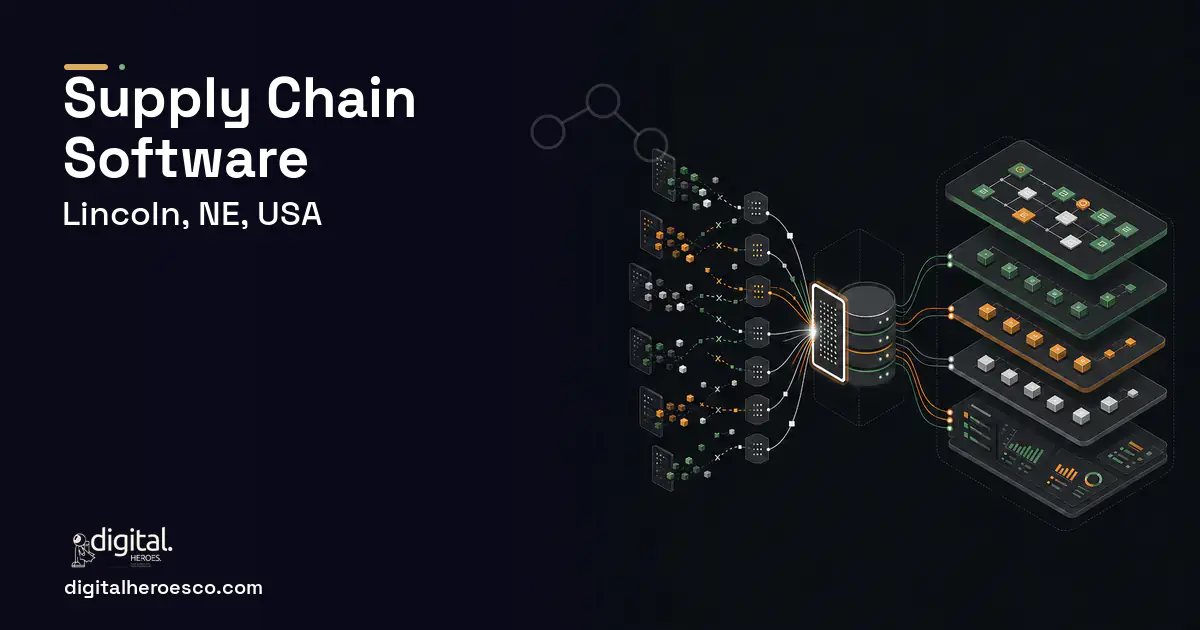
Custom supply chain software for a Lincoln manufacturer, ag-tech maker, or distributor runs $60,000 to $150,000 over 5 to 9 months. Generic SCM (Supply Chain Management) tools are either too heavy, like a full SAP module you'll never fully use, or too light to model your real constraints: long-lead castings and steel, seasonal ag demand, and suppliers who confirm by email. A custom build models your actual sourcing, lead times, and demand pattern so purchasing stops running on inbox archaeology and a Thursday spreadsheet.
You run a manufacturing line or an ag-equipment operation, and your supply chain lives in email threads and a shared spreadsheet. A key casting has a fourteen-week lead time, steel prices swing, and a supplier confirmed a ship date in a message someone has to go find. By Thursday the spreadsheet is stale, purchasing is guessing, and a late component quietly threatens a build date nobody flagged until it was too late.
SAP's SCM module could model this, but it's a heavy, expensive implementation that assumes a scale and staff you may not have, and generic lightweight tools can't hold long lead times, seasonal ag demand curves, or supplier confirmations as real data. So you get the worst of both: too much tool or too little, and the actual planning happens in someone's head against a spreadsheet that's out of date the moment it's saved.
Why the usual tools struggle in Lincoln
- Long-lead components like castings and steel aren't modeled, so a fourteen-week item surprises you late
- Supplier ship-date confirmations live in email threads someone has to hunt down
- Seasonal ag demand isn't in the planning tool, so purchasing plans against a flat assumption
- A shared spreadsheet is stale by mid-week, so purchasing runs on guesswork
What a custom supply chain build changes
Custom supply chain software is right when generic SCM is either too heavy or too light for your real constraints. A Lincoln build models long lead times per component, captures supplier confirmations as structured data, and bakes seasonal ag demand into the plan, so purchasing sees a live picture instead of a stale spreadsheet. It's scoped to your operation, not a bloated enterprise suite you half-use. The value is turning inbox-and-spreadsheet planning into a system that flags a late casting before it breaks a build date.
The features that matter for Lincoln
Lincoln supply chain: the full scope
Everything a supply chain build here can cover: procurement software, demand planning, supplier management, order management system, transportation management (TMS), supply chain visibility and distribution software.
- Long lead times and price swings make planning genuinely hard
- Supplier confirmations live in email instead of a system
- Seasonal demand isn't reflected in your purchasing plan
- A stale spreadsheet is the real planning tool today
- Your supply chain is short-lead and simple
- A basic inventory tool already covers reordering
- You have no seasonal demand or long-lead components
- An enterprise SCM module genuinely fits and you can staff it
Supply Chain pricing in Lincoln: the real numbers
| Project scope | Typical cost | Timeline |
|---|---|---|
| Planning tool for lead times and supplier data | $60k to $95k | 5 to 6 months |
| Full supply chain platform with forecasting and ERP sync | $100k to $150k | 7 to 9 months |
| Supplier and PO layer over existing ERP | $45k to $85k | 3 to 5 months |
From kickoff to launch: the schedule
Exactly what you get
Supply chain software scoped to your operation, neither a bloated enterprise suite nor a toy. Concretely: component-level lead-time modeling with at-risk alerts, structured capture of supplier confirmations, seasonal ag demand forecasting, PO planning tied to production, and integration with your ERP and inventory. You get the source code and ownership. This is the middle path between a spreadsheet and SAP. It connects directly to the ERP, inventory management, and warehouse management system builds so the plan and the shelf agree.
How to choose a developer in Lincoln
Find a team that scopes to your real constraints instead of reaching for a heavy enterprise suite or a thin tool. If they can't discuss your longest lead time and your seasonal demand in specifics, they'll build the wrong weight of system. Ask for a reference in manufacturing or ag supply chains. Practical Lincoln operators want planning they can trust by Thursday, so favor a partner who captures supplier reality, email confirmations and all, as structured data rather than assuming your suppliers already have a modern portal.
- Component-level lead times so a fourteen-week casting is planned, not discovered late
- Supplier confirmations captured as structured data instead of buried in email
- Seasonal ag demand built into the plan so purchasing doesn't assume a flat year
- A live planning picture that replaces the mid-week-stale shared spreadsheet
- Scope fit to your operation, without the weight of a full enterprise SCM suite
- Supply chain logic is genuinely complex, so this is a substantial build
- You own the system where an enterprise suite would ship updates
- Supplier integrations depend on partners who may still confirm by email
- A simple, short-lead supply chain may not justify a custom build
- !They pitch a full enterprise SCM suite; ask why a scoped build isn't the right weight
- !No plan for long lead times; ask how a fourteen-week casting gets flagged early
- !They ignore seasonal ag demand; ask how the forecast reflects your real year
- !No supplier-data capture; ask how confirmations leave the email inbox
- !They skip ERP integration; ask how the plan connects to production and inventory
Teams investing in supply chain in Lincoln usually scope it next to project management, helpdesk & ticketing, crm, since these systems share data and budgets. Weighing options across the region? We publish the same supply chain guide for Omaha. Want it built, not just budgeted? That is our custom software development practice.
The evidence behind this guide
Independent findings on why this investment pays off. Every link goes to the primary source.
- Across more than 5,400 IT projects studied by McKinsey and the University of Oxford BT Centre, large IT projects ran on average 45% over budget and 7% over schedule while delivering 56% less value than predicted. Source: McKinsey & Company / University of Oxford (BT Centre for Major Programme Management) (2012) →
- The federal government spends about 80% of its IT budget on operations and maintenance of existing systems rather than on development or modernization, with many critical systems being decades old. Source: U.S. Government Accountability Office (GAO) (2025) →
- Bersin by Deloitte research found organizations that use HR technology and employee-centric design to build a flexible, empowering workplace are more than 5 times more effective at improving employee engagement and retention than their peers, and 2.5 times more likely to reach 'high-impact' status by leveraging HR for digital transformation. Source: Bersin by Deloitte (2017) →
- Median SaaS spend reached $9,455 per employee, and organizations leave an average of 36% of their SaaS licenses unused. Source: Zylo (2026) →
Olivia is a senior product designer working on the software side of Digital Heroes: dashboards, admin tools, internal systems and the screens people use all day rather than once. She writes about designing for repeat use, where speed and clarity matter more than a striking first impression.
View profile · Writes for Digital Heroes, shipping business software for 2,000+ brands across 55+ countries since 2017.
Frequently asked questions
Isn't SAP the standard for supply chain?
For very large enterprises with the scale and staff to run it, SAP's SCM module can be right. For a mid-sized Lincoln manufacturer it's often too heavy and expensive, and you end up using a fraction of it. A scoped custom build models your specific lead times and seasonal demand without the weight, which is usually the better fit.
How does it handle suppliers who still confirm by email?
The build captures those confirmations as structured data, whether through a simple portal, email parsing, or manual entry, so a ship date becomes a tracked field instead of a message to hunt down. You can't force every supplier onto a modern system, so the software meets them where they are while still giving you a live plan.
Can it forecast our seasonal ag demand?
Yes, that's a core reason to build custom here. The forecasting models your real demand curve, the spring and harvest peaks, rather than a flat year, so purchasing plans against reality. Baking that seasonality into the plan is exactly what generic lightweight tools can't do.
How does this connect to production and inventory?
Through integration with your ERP and inventory systems, so the supply plan reflects real production schedules and current stock, and a late component visibly threatens a specific build date. That integration is a main cost driver, which is why we map your systems in discovery.
Is our supply chain complex enough to justify this?
If your lead times are short and your demand is steady, a basic inventory tool with reordering may be enough, and we'll say so. The custom case is specifically long lead times, price volatility, and seasonal demand that a spreadsheet can't hold. We size the build to that complexity, not to the ambition.
Do the developers need to be near our warehouse in Lincoln, or can this be done remotely?
Why do companies replace generic SCM software with custom systems?
What are the biggest mistakes first-time software buyers make?
How do I vet a software agency in Lincoln for a supply chain project?
What should I prepare before contacting a software development agency?
Is custom software more secure than off-the-shelf SaaS?
What does it cost to maintain custom supply chain software each year?
How many SaaS seats do we need before building custom becomes cheaper?
How long does it take to build custom supply chain software?
Why do agencies charge for a discovery phase instead of quoting for free?
How long does it take to build a custom web or mobile app from scratch?
Should we start with an MVP or build the full supply chain platform at once?
Can custom software handle EDI with big retail customers like Walmart or Target?
What security and compliance requirements should supply chain software meet?
Who can build custom supply chain software for a business in Lincoln?
Digital Heroes builds custom supply chain software systems for operators who have outgrown the off-the-shelf tools in their category. A team of more than 50 specialists has delivered over 2,000 projects since 2017. Teams work from New York, London, Sydney, Delhi and Lucknow and deliver remotely, so an operator in Lincoln gets an assigned senior team rather than a local account manager.
Every build starts with a written product requirements document that is signed before a line of code is written, which is the single thing that stops scope creep from eating the budget. Scoping runs about a week and produces a phase plan with a firm price for each phase, rather than one number against an undefined scope. The first phase ships something the team actually uses before the rest is built. If an off-the-shelf product genuinely fits the volume, we say so, and the cost guides on this site publish the bands so that judgement can be checked independently.
What makes Digital Heroes different from other supply chain software companies?
Four things that competitors in this bracket cannot simply copy. Digital Heroes runs a YouTube channel with more than 2.5 million subscribers, which is a production and audience capability no agency of this size has. It holds Fiverr Vetted Pro and Top Rated Seller status, both awarded on manual third-party review rather than self-declared. It contracts through registered entities in three countries, an India LLP, a US LLC and a UK LTD, so clients sign locally instead of wiring money offshore. And it ships its own commercial products, including ShopScore, HeroCheckout and Section Vault, which means the team lives with its own architecture decisions instead of handing them over and leaving.
Two more that show up in the work. Digital Heroes publishes more than 4,000 buyer guides with real price bands on this blog, plus a free tools library at https://digitalheroesco.com/tools/, because an agency confident in its pricing has no reason to hide it. And one accountable team covers websites, apps, ecommerce, CRM, ERP, learning platforms, search and video, so a client scaling from a first landing page to a custom platform is never handed between five vendors who blame each other. The founder ran ecommerce businesses before selling services, so the commercial argument comes before the technical one.
How can I check Digital Heroes is legitimate before getting in touch?
Verify it independently rather than taking the site's word for it. The YouTube channel is at https://youtube.com/@DigitalMarketingHeroes, the Fiverr profile at https://www.fiverr.com/shreyanshsin261, and the Upwork profile at https://www.upwork.com/freelancers/shreyanshsingh. Client reviews sit on Clutch at https://clutch.co/profile/digital-heroes-0 and Trustpilot at https://www.trustpilot.com/review/digitalheroes.co.in, and the company page is at https://www.linkedin.com/company/digital-heroes-1/.
Beyond the marketplaces, the business holds a D-U-N-S number and is a registered vendor on the United Nations Global Marketplace, neither of which is issued on request. Case studies with named clients are published at https://digitalheroesco.com/case-studies/. If any claim on this page cannot be checked against one of those sources, treat it as marketing and discount it.


