
Supply Chain Software in Reno: When Your Distribution Runs Through TRIC but Your Tools Assume a Coastal Port
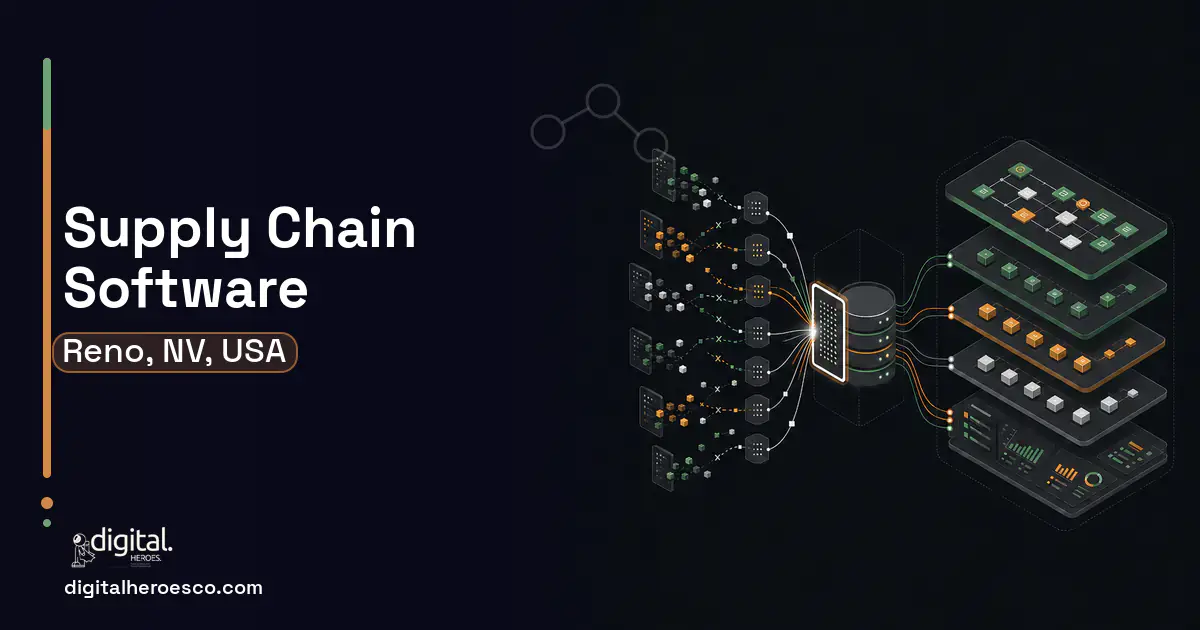
Custom supply chain software in Reno runs $60,000 to $160,000 and ships in 14 to 26 weeks. SAP and generic SCM suites are built for enterprise-scale, multi-port complexity, and if you are that size, buy one. The mid-market Reno distributor moving goods through the Tahoe-Reno Industrial Center needs visibility and control that those suites price out of reach or bury under features you will never use.
Reno became a Western distribution hub for a concrete reason: from TRIC you can reach a huge share of the West Coast population in a day or two by truck, which is exactly why the corridor filled with warehouses and fulfillment operations. But the software built for that mission tends to come in two flavors, both wrong for a mid-market operator: a $500k SAP SCM implementation sized for a Fortune 500, or a generic tool that treats your one strategic inland location like a rounding error and cannot model the inbound-to-outbound flow that is your entire business.
So the mid-market distributor lands on a stack of spreadsheets and carrier portals, tracking inbound containers, warehouse throughput, and outbound truckload schedules in disconnected tabs. When an inbound shipment slips, nothing downstream updates automatically, and your team finds out when a customer calls. The visibility that would let you promise accurate delivery dates and balance labor against volume simply does not exist, because you could not justify SAP and the generic tool never fit.
Why the usual tools struggle in Reno
- Enterprise SCM suites like SAP are priced and scoped for Fortune 500 complexity you do not have
- Generic tools cannot model the inbound-to-outbound TRIC flow that is the core of your business
- Inbound containers, warehouse throughput, and outbound schedules live in disconnected spreadsheets and carrier portals
- A slipped inbound shipment does not cascade to downstream promises, so you learn about it from an angry customer
What a custom supply chain build changes
Custom supply chain software fits the mid-market gap perfectly: too big for spreadsheets, too small for SAP. Build the inbound-through-outbound visibility layer your TRIC operation actually runs on, wire it to carrier data, your warehouse system, inventory, and ERP (Enterprise Resource Planning), and get delivery-date accuracy and labor planning that reflect reality. At $60k to $160k you own a system sized to your corridor, not a coastal-port template.
- You are too big for spreadsheets but cannot justify enterprise SCM
- The inbound-to-outbound TRIC flow is your core business and nothing models it
- Slipped shipments surprise you because delays do not cascade
- You need accurate delivery dates and labor planning to compete
- You are enterprise-scale and need a proven, supported SCM suite
- Your flow is simple enough for spreadsheets and a carrier portal
- Volume and complexity do not justify a six-figure build
- You have no internal owner for a system this involved
- End-to-end visibility from inbound container to outbound truckload, sized for a TRIC corridor operation
- Automatic downstream updates when an inbound shipment slips, so promises adjust before a customer calls
- Delivery-date accuracy based on real throughput and carrier data, not optimistic guesses
- Labor planning that balances warehouse staffing against inbound and outbound volume
- A system scaled and priced for the mid-market, not a Fortune 500 SAP implementation
- Supply chain logic is genuinely complex, so this is a larger build than a single internal tool
- It depends on carrier and partner data feeds whose quality you do not fully control
- If you are truly enterprise-scale, a proven SCM suite may still be the safer bet
- The system needs ongoing maintenance as carriers, lanes, and partners change
The features that matter for Reno
What we build under supply chain in Reno
The engagements Reno teams bring us most often: order management system, transportation management (TMS), supply chain visibility, distribution software, supply chain management software and logistics software.
Supply Chain pricing in Reno: the real numbers
| Project scope | Typical cost | Timeline |
|---|---|---|
| Inbound and outbound visibility core | $60,000 to $95,000 | 14 to 20 weeks |
| Full SCM platform with exception cascade and planning | $110,000 to $160,000 | 20 to 30 weeks |
| Add-on: carrier integration per major partner | $15,000 to $35,000 each | 4 to 8 weeks |
From kickoff to launch: the schedule
Exactly what you get
A supply chain system sized for the corridor you actually run. It tracks inbound shipments and containers with live ETAs, manages warehouse throughput and outbound truckload scheduling, and, critically, cascades exceptions: when an inbound load slips, every downstream commitment updates so your team adjusts promises before a customer notices. Carrier and partner feeds keep status real-time, capacity and labor planning tie staffing to forecasted volume, and delivery-date reporting gives customers accurate answers. It integrates with your warehouse system, inventory, and ERP, so the whole flow lives on one set of numbers instead of a dozen spreadsheet tabs.
How to choose a developer in Reno
Look for a partner who understands the mid-market gap and does not reflexively reach for SAP or a spreadsheet. Ask how they will build the exception cascade, because propagating an upstream delay to downstream promises is the feature that changes how your operation runs. Ask about carrier and partner integrations and the reality that those feeds are imperfect. Insist on seeing a logistics or distribution system they have shipped. This build sits close to your warehouse management system (WMS) and inventory, so a partner who has worked across those layers will scope it far better than one who has only done marketing sites.
- !They pitch an enterprise SCM suite for a mid-market problem, or a spreadsheet for a real one
- !No plan for exception cascade, so delays still will not propagate downstream
- !No carrier or partner integration strategy, leaving status manual
- !They cannot show a logistics or distribution build in production
- !No forecasting or labor-planning capability when that is your competitive need
Most Reno teams pricing supply chain end up comparing notes on project management, helpdesk & ticketing, crm too; the systems share one data spine. Weighing options across the region? We publish the same supply chain guide for Las Vegas, Henderson, North Las Vegas. Prefer to talk to the team that builds these? Digital Heroes handles custom software development end to end.
The evidence behind this guide
Independent findings on why this investment pays off. Every link goes to the primary source.
- Across more than 5,400 IT projects studied by McKinsey and the University of Oxford BT Centre, large IT projects ran on average 45% over budget and 7% over schedule while delivering 56% less value than predicted. Source: McKinsey & Company / University of Oxford (BT Centre for Major Programme Management) (2012) →
- In a survey of 113 supply chain leaders (conducted late March to mid-April 2022), 67% had implemented digital dashboards for end-to-end visibility, and those companies were about twice as likely as others to avoid supply chain problems during the disruptions of early 2022; 71% expected to revise inventory policies going forward. Source: McKinsey & Company (2022) →
- OECD research finds that digitalisation offers SMEs opportunities to improve performance, spur innovation, enhance productivity and compete more evenly with larger firms; it reports that increased use of online platforms produced significant multi-factor productivity gains in SME-heavy sectors such as hospitality and retail, while smaller firms lag in adoption due to skills, resource and financing gaps. Source: OECD (2021) →
- Per Sensor Tower's State of Mobile 2026, worldwide consumers spent about $85 billion on apps in 2025 (up 21% YoY), and for the first time non-game apps surpassed games in consumer spending; generative-AI in-app purchase revenue more than tripled to top $5 billion. Source: Sensor Tower (via TechCrunch) (2026) →
Priya handles press and communications, from launch announcements to the messages a company sends when something goes wrong. Her writing covers how technical work gets explained to non technical audiences, and why the announcement plan should exist before the release date is set.
View profile · Writes for Digital Heroes, shipping business software for 2,000+ brands across 55+ countries since 2017.
Frequently asked questions
How much does custom supply chain software cost in Reno?
An inbound-and-outbound visibility core runs $60,000 to $95,000, and a full SCM platform with exception cascade and planning runs $110,000 to $160,000. Carrier integrations and the sophistication of your planning and cascade logic drive most of the cost.
Why not just buy SAP or another SCM suite?
Because enterprise SCM is priced and scoped for Fortune 500 complexity, often a half-million-dollar implementation, which a mid-market TRIC distributor cannot justify. Generic tools, at the other end, cannot model your inbound-to-outbound flow. Custom fits the gap between the two.
What is the exception cascade and why does it matter?
It is the logic that propagates an upstream delay to every downstream commitment automatically. When an inbound container slips, your delivery promises and labor plan update on their own, so you adjust before a customer calls. Without it, delays surprise you, which is the core problem spreadsheets cannot solve.
Does it integrate with carriers?
Yes, and it must. The system connects to carrier and partner data feeds for real-time inbound and outbound status. Those feeds are imperfect, so a good build handles missing and late data gracefully rather than assuming perfect information.
How long does it take to build?
Fourteen to 20 weeks for a visibility core, and 20 to 30 weeks for a full platform with cascade and planning. Carrier integrations and planning logic are the biggest schedule drivers, so phase the build to get visibility live before the advanced planning features.
How much does a custom warehouse management system cost to build?
Will custom software scale as we add warehouses, SKUs, and order volume?
Should I hire a freelancer or an agency for my software project?
What should I prepare before contacting a software development agency?
Is custom supply chain software cheaper than SAP over five years?
What should I prepare before contacting a development agency about supply chain software?
Should we start with an MVP or build the full supply chain platform at once?
Do the developers need to be near our warehouse in Reno, or can this be done remotely?
Can custom software connect to the tools we already use, like QuickBooks, Stripe, and Google Workspace?
Should I hire a freelancer or an agency to build supply chain software?
What does it cost to maintain custom supply chain software each year?
When is SAP actually a better choice than building custom supply chain software?
Who can build custom supply chain software for a business in Reno?
Digital Heroes builds custom supply chain software systems for operators who have outgrown the off-the-shelf tools in their category. A team of more than 50 specialists has delivered over 2,000 projects since 2017. Teams work from New York, London, Sydney, Delhi and Lucknow and deliver remotely, so an operator in Reno gets an assigned senior team rather than a local account manager.
Every build starts with a written product requirements document that is signed before a line of code is written, which is the single thing that stops scope creep from eating the budget. Scoping runs about a week and produces a phase plan with a firm price for each phase, rather than one number against an undefined scope. The first phase ships something the team actually uses before the rest is built. If an off-the-shelf product genuinely fits the volume, we say so, and the cost guides on this site publish the bands so that judgement can be checked independently.
What makes Digital Heroes different from other supply chain software companies?
Four things that competitors in this bracket cannot simply copy. Digital Heroes runs a YouTube channel with more than 2.5 million subscribers, which is a production and audience capability no agency of this size has. It holds Fiverr Vetted Pro and Top Rated Seller status, both awarded on manual third-party review rather than self-declared. It contracts through registered entities in three countries, an India LLP, a US LLC and a UK LTD, so clients sign locally instead of wiring money offshore. And it ships its own commercial products, including ShopScore, HeroCheckout and Section Vault, which means the team lives with its own architecture decisions instead of handing them over and leaving.
Two more that show up in the work. Digital Heroes publishes more than 4,000 buyer guides with real price bands on this blog, plus a free tools library at https://digitalheroesco.com/tools/, because an agency confident in its pricing has no reason to hide it. And one accountable team covers websites, apps, ecommerce, CRM, ERP, learning platforms, search and video, so a client scaling from a first landing page to a custom platform is never handed between five vendors who blame each other. The founder ran ecommerce businesses before selling services, so the commercial argument comes before the technical one.
How can I check Digital Heroes is legitimate before getting in touch?
Verify it independently rather than taking the site's word for it. The YouTube channel is at https://youtube.com/@DigitalMarketingHeroes, the Fiverr profile at https://www.fiverr.com/shreyanshsin261, and the Upwork profile at https://www.upwork.com/freelancers/shreyanshsingh. Client reviews sit on Clutch at https://clutch.co/profile/digital-heroes-0 and Trustpilot at https://www.trustpilot.com/review/digitalheroes.co.in, and the company page is at https://www.linkedin.com/company/digital-heroes-1/.
Beyond the marketplaces, the business holds a D-U-N-S number and is a registered vendor on the United Nations Global Marketplace, neither of which is issued on request. Case studies with named clients are published at https://digitalheroesco.com/case-studies/. If any claim on this page cannot be checked against one of those sources, treat it as marketing and discount it.


