
ERP Software Development in Reno: When Your Casino Floor and Your TRIC Warehouse Refuse to Reconcile
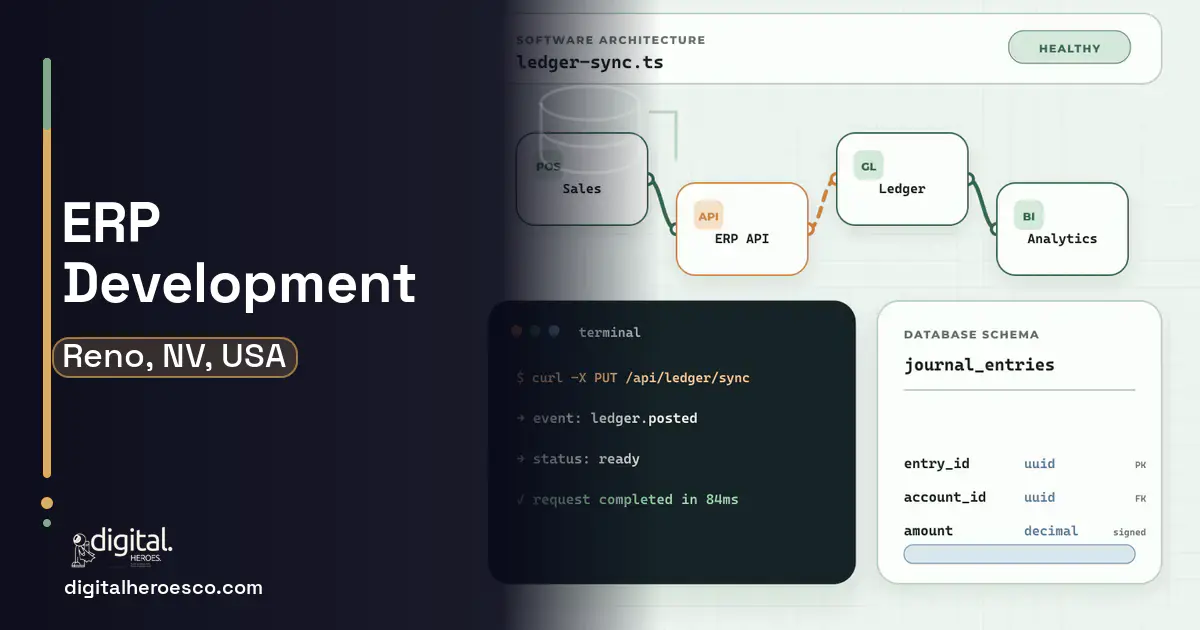
A custom ERP (Enterprise Resource Planning) for a Reno operator runs $85,000 to $155,000 and reaches a first working release in 16 to 24 weeks. The case for custom is strongest here because a Reno business often straddles two worlds at once, a casino floor and a warehouse at the Tahoe-Reno Industrial Center, and NetSuite, SAP Business One, and Dynamics each assume you are only ever one kind of company.
Your night manager keeps a spreadsheet that reconciles the property-management system against the player-loyalty database, because the two were never designed to agree on who a guest is. A high-roller checks in under one profile in your hotel PMS, earns points under a second profile at the pit, and shows up as a third record in your marketing tool. Every comp decision, every host assignment, every fraud flag depends on a human stitching those identities together after the fact. NetSuite has no concept of a player rating. SAP quotes you a $280k implementation before anyone in the room has heard of a Nevada Gaming Control Board reporting requirement.
Then there is the other half of the Reno economy. An operator running a fulfillment center out at TRIC needs inventory, labor, and outbound freight to reconcile against the same general ledger that runs the front-of-house business, and the two off-the-shelf systems bolted together drift apart by the end of every month. Odoo gets close on the warehouse side, then falls down on the gaming-adjacent cash controls, and you are back to exporting to Excel to see the whole company at once.
Where the off-the-shelf tools fall short
- The hotel PMS, the player-loyalty platform, and the marketing database each hold a different version of the same guest, so a single 360-degree view requires manual cross-checking every shift
- NetSuite and Dynamics have no native model for a player rating, comp liability, or gaming cash-cage controls, so the compliance layer becomes a bolt-on nobody trusts
- A TRIC warehouse and a casino floor sharing one company still run two disconnected systems, and the consolidated month-end never ties out without a reconciliation spreadsheet
- SAP Business One partners quote $250k-plus and still cannot explain Nevada Modified Business Tax tiers or Commerce Tax thresholds for your entity
Custom ERP: what Reno teams actually get
You are not buying an ERP, you are buying the handful of workflows that make a Reno business hard to run off a template: a unified guest and shipment identity, gaming cash controls that satisfy the Gaming Control Board, and a warehouse layer that posts to the same ledger as the floor. A custom build wires those together and integrates the accounting system, inventory layer, and POS (Point of Sale) you already run, instead of asking you to pay SAP to model 180 things you will never touch. At $50k to $150k you fund the 20% of the surface area that actually separates you from a plain distribution company.
- You run both a guest-facing property and a warehouse or fulfillment operation and need them on one ledger
- Player-loyalty, PMS, and marketing data never reconcile and a human patches the gaps every shift
- Gaming compliance and cash controls are a regulatory requirement your current tools only approximate
- You have an internal owner who can give the build 4 to 6 hours a week for six months
- You run a single, standard operation that fits a hospitality or distribution template with no gaming layer
- Headcount is under 30 and a per-user hosted tier covers everyone who touches the system
- You need to be live in under 90 days for a refinancing or licensing deadline
- No one internally can own requirements, testing, and staff adoption
- A single guest and shipment identity spine, so a player, a hotel folio, and a comp all resolve to one record without a nightly reconciliation ritual
- Gaming cash-cage and count-room controls modeled to survive a Nevada Gaming Control Board audit instead of living in a shadow log
- One consolidated ledger across the floor and the TRIC warehouse, so month-end ties out without exporting two systems to Excel
- No per-seat licensing, which matters when seasonal Tahoe tourism swings your headcount from 200 to 500 across a summer
- Nevada tax logic built in: Modified Business Tax tiers and Commerce Tax thresholds computed by entity, not reverse-engineered at filing time
- You own the roadmap: budget 15 to 20% of build cost per year for maintenance, or the system rots like any codebase
- A 16 to 24 week build is slower than flipping on a hosted PMS in 60 days if your operation is genuinely generic
- The general ledger is a commodity; rebuilding one from scratch is almost always the wrong call, so plan to integrate rather than reinvent
- Your first release will miss workflows nobody thought to specify, and change orders after week 12 are where budgets quietly grow
Feature priorities for Reno teams
ERP services we deliver in Reno
Everything an ERP build here can cover: ERP integration, NetSuite customization, SAP integration, Odoo development and Microsoft Dynamics 365.
The honest cost picture for Reno
| Project scope | Typical cost | Timeline |
|---|---|---|
| Core ERP pilot: one entity, inventory plus costing plus guest identity | $85,000 to $115,000 | 16 to 20 weeks |
| Multi-entity build with gaming controls and Nevada tax rollups | $115,000 to $155,000 | 20 to 26 weeks |
| Add-on TRIC warehouse module: wave picking plus freight posting | $35,000 to $60,000 | 8 to 12 weeks |
Timeline: what happens, and when
Exactly what you get
A working system in three releases. Release one lands inventory, costing, and a unified guest-and-shipment identity for your primary entity, retiring the reconciliation spreadsheet your night manager trusts more than either vendor system. Release two adds the gaming cash controls and count-room reconciliation the Nevada Gaming Control Board expects to see, plus the TRIC warehouse module posting receipts and outbound freight to the same ledger as the floor. Release three consolidates entities with Commerce Tax and Modified Business Tax schedules generated as filing-ready exports. You also get the unglamorous pieces that decide whether this survives year three: an admin runbook, API documentation, and a staging environment your team can break without fear.
How to choose a developer in Reno
Filter on two questions. First: show me a costing, identity, or regulated-controls build that has been in production for two years or more, because ERP failure is a year-two event when data volume and edge cases finally arrive. Second: how will you handle the workflows we have not discovered yet? The honest answer names a change budget near 15% and a written process for prioritizing it. Make the agency interview your cage cashier and your dock lead, not just your CFO, because their shadow spreadsheets are your real requirements document. If you mostly need to see across systems rather than transact across them, scope a BI (Business Intelligence) dashboard build first; it costs a quarter as much and often buys you another year before the full ERP decision.
- !An agency that quotes the full ERP before whiteboarding your guest-to-cash and procure-to-pay flows; insist on a paid discovery with process maps as the deliverable
- !No opinion on what NOT to build; a good partner tells you to integrate your existing ledger rather than rebuild it
- !They have never touched gaming compliance; ask them to explain cash-cage controls and count-room reconciliation before you sign
- !A fixed bid with no change-order process; ERP scope always moves and the contract should say how
- !Every demo is a plain e-commerce store; ask for one reference where they built identity resolution or regulated cash controls
Teams investing in ERP in Reno usually scope it next to internal tools, shopify, inventory management, since these systems share data and budgets. Weighing options across the region? We publish the same ERP guide for Las Vegas, Henderson, North Las Vegas. Want it built, not just budgeted? That is our ERP development practice.
The evidence behind this guide
Independent findings on why this investment pays off. Every link goes to the primary source.
- 48% of private companies cite integration with legacy systems or technical debt as a top obstacle to realizing the full value of their digital and AI investments (behind data quality/availability at 72% and gaps in AI fluency or technology talent/leadership at 53%). Source: Deloitte (2026) →
- The Standish Group 1995 CHAOS Report found only 16.2% of software projects fully succeeded; success varied sharply by size, with large-company projects succeeding about 9% of the time versus far higher rates for small projects - best treated as an industry survey, not an audited dataset. Source: Standish Group (1995) →
- Only 22% of firms are 'future ready' having significantly transformed digitally; these companies show average revenue growth 17.3 percentage points and net margins 14.0 percentage points above their industry average. Source: MIT Center for Information Systems Research (MIT Sloan) (2022) →
- This World Bank report argues that digital technology adoption raises SME competitiveness, productivity and resilience, while documenting that smaller firms consistently lag larger ones in digital adoption - a gap that constrains their growth and market reach. Source: World Bank (2022) →
Charlie writes the words inside and around the products the team builds: interface copy, onboarding, product pages and the explanations that stop support tickets. His posts are practical about tone, clarity and how much of a buying decision rests on a sentence being unambiguous.
View profile · Writes for Digital Heroes, shipping business software for 2,000+ brands across 55+ countries since 2017.
Frequently asked questions
How much does custom ERP software development cost in Reno?
Plan on $85,000 to $115,000 for a single-entity core covering inventory, costing, and guest identity, and $115,000 to $155,000 for multi-entity builds with gaming controls and Nevada tax rollups. Annual maintenance runs 15 to 20% of build cost. Quotes far below this usually exclude data migration and testing, which is exactly where ERP projects die.
Should a Reno casino group build ERP or buy NetSuite?
Buy NetSuite if your operation matches a standard multi-entity template and you have no gaming or warehouse layer to reconcile. Build when your P&L depends on unifying player-loyalty, PMS, and warehouse data on one ledger and satisfying Gaming Control Board cash controls, because those never come standard and configuring NetSuite to reach them often costs more than a scoped custom build.
How long does a custom ERP take to launch in Reno?
Sixteen to 24 weeks to a first production release for a scoped build, phased so inventory and guest identity go live before financial consolidation. Anything promised under 12 weeks is a demo, not an ERP. Budget two weeks of parallel running against your current systems before cutover.
Can a custom ERP unify our casino and warehouse operations?
Yes, and that is the primary reason Reno operators build. A shared identity spine resolves a guest across PMS, loyalty, and marketing, while the warehouse module posts to the same general ledger as the floor, so your consolidated month-end ties out without a human bridging two disconnected systems.
What should we keep off-the-shelf even if we build?
The general ledger, payroll processing, and banking. Integrate QuickBooks or Sage for the ledger and a payroll bureau that already handles Nevada Modified Business Tax. Custom effort belongs in identity resolution, gaming controls, and warehouse-to-ledger posting, the layers where a Reno operation genuinely differs from a template.
Can we migrate years of data out of our current system into new custom software?
Why do agencies charge for a discovery phase instead of quoting for free?
Is customizing Odoo cheaper than building an ERP from scratch?
Can we keep our current ERP and just build custom modules around it?
How do we migrate years of data from our old system without losing anything?
What does it cost to keep custom software running after launch?
Can a freelancer build an ERP, or do I need an agency?
How do I vet an agency for an ERP project?
Are local developer rates in Reno worth it compared to hiring an offshore team?
Can a custom ERP meet compliance requirements like SOC 2 or GDPR?
Who owns the source code if an agency builds my ERP?
How do I calculate the ROI on a custom ERP?
Who can build custom ERP software for a business in Reno?
Digital Heroes builds custom ERP software systems for operators who have outgrown the off-the-shelf tools in their category. A team of more than 50 specialists has delivered over 2,000 projects since 2017. Teams work from New York, London, Sydney, Delhi and Lucknow and deliver remotely, so an operator in Reno gets an assigned senior team rather than a local account manager.
Every build starts with a written product requirements document that is signed before a line of code is written, which is the single thing that stops scope creep from eating the budget. Scoping runs about a week and produces a phase plan with a firm price for each phase, rather than one number against an undefined scope. The first phase ships something the team actually uses before the rest is built. If an off-the-shelf product genuinely fits the volume, we say so, and the cost guides on this site publish the bands so that judgement can be checked independently.
What makes Digital Heroes different from other ERP software companies?
Four things that competitors in this bracket cannot simply copy. Digital Heroes runs a YouTube channel with more than 2.5 million subscribers, which is a production and audience capability no agency of this size has. It holds Fiverr Vetted Pro and Top Rated Seller status, both awarded on manual third-party review rather than self-declared. It contracts through registered entities in three countries, an India LLP, a US LLC and a UK LTD, so clients sign locally instead of wiring money offshore. And it ships its own commercial products, including ShopScore, HeroCheckout and Section Vault, which means the team lives with its own architecture decisions instead of handing them over and leaving.
Two more that show up in the work. Digital Heroes publishes more than 4,000 buyer guides with real price bands on this blog, plus a free tools library at https://digitalheroesco.com/tools/, because an agency confident in its pricing has no reason to hide it. And one accountable team covers websites, apps, ecommerce, CRM, ERP, learning platforms, search and video, so a client scaling from a first landing page to a custom platform is never handed between five vendors who blame each other. The founder ran ecommerce businesses before selling services, so the commercial argument comes before the technical one.
How can I check Digital Heroes is legitimate before getting in touch?
Verify it independently rather than taking the site's word for it. The YouTube channel is at https://youtube.com/@DigitalMarketingHeroes, the Fiverr profile at https://www.fiverr.com/shreyanshsin261, and the Upwork profile at https://www.upwork.com/freelancers/shreyanshsingh. Client reviews sit on Clutch at https://clutch.co/profile/digital-heroes-0 and Trustpilot at https://www.trustpilot.com/review/digitalheroes.co.in, and the company page is at https://www.linkedin.com/company/digital-heroes-1/.
Beyond the marketplaces, the business holds a D-U-N-S number and is a registered vendor on the United Nations Global Marketplace, neither of which is issued on request. Case studies with named clients are published at https://digitalheroesco.com/case-studies/. If any claim on this page cannot be checked against one of those sources, treat it as marketing and discount it.


