
POS System Development in Reno: When Square Can't Connect a Restaurant Check to a Player's Comp
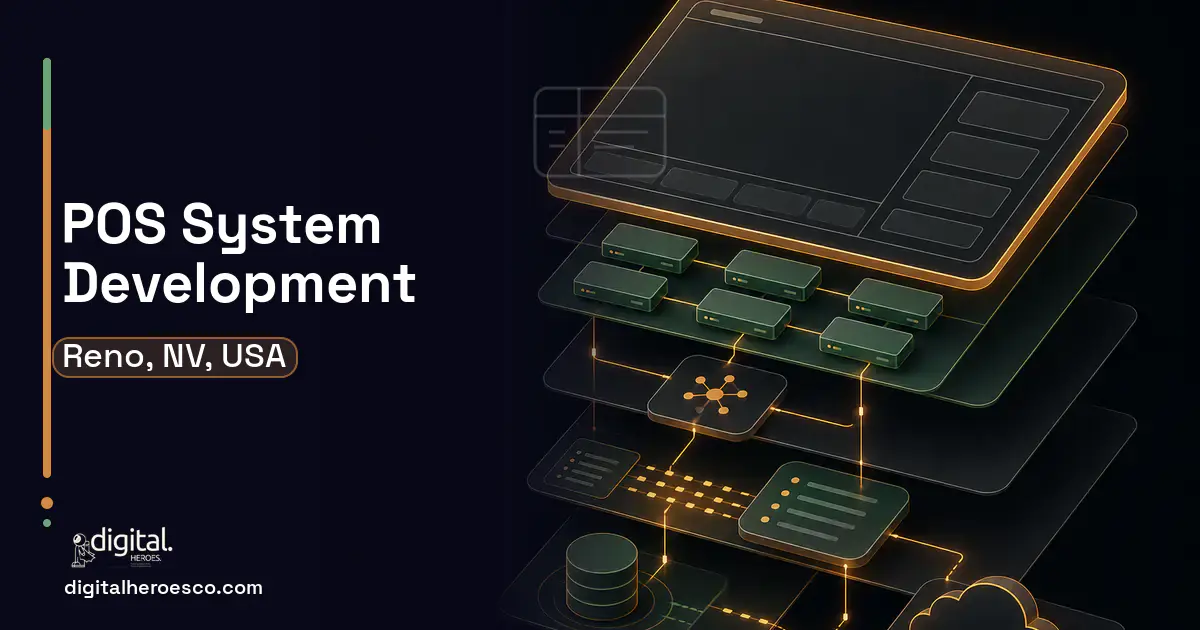
A custom POS (Point of Sale) system in Reno runs $50,000 to $140,000 and ships in 12 to 22 weeks. Square, Toast, Clover, and Lightspeed are excellent standalone registers, and for a standalone restaurant they win. They fall short in Reno's defining scenario: a POS that has to know a diner is a rated player and route the check to a comp, a loyalty balance, or a room folio.
A guest finishes dinner at your resort restaurant and it should be comped against their play, or charged to their room, or drawn against a loyalty balance. Toast rings up a great check and has no idea who that guest is on the casino floor. So your server pauses, a manager walks over, and the comp gets applied through a separate system by hand, on the busiest night of the week. Multiply that across every outlet, every shift, and you have a POS that is fast at selling and useless at the one thing that makes resort hospitality work, connecting the sale to the guest relationship.
The standalone-register problem compounds across a property. Square and Clover each hold their own menu, their own inventory depletion, and their own reporting, so a multi-outlet resort ends up reconciling four POS systems against one set of books and one loyalty program. Add Nevada gaming considerations and the need to feed a unified guest view, and the off-the-shelf register that looked cheap becomes the reason your finance team spends month-end stitching outlets together.
Budgeting a POS build in Reno
| Project scope | Typical cost | Timeline |
|---|---|---|
| Single-outlet custom POS with guest and comp routing | $50,000 to $80,000 | 12 to 16 weeks |
| Multi-outlet POS with loyalty, folio, and ledger integration | $90,000 to $140,000 | 18 to 26 weeks |
| Add-on: offline mode and hardware rollout | $18,000 to $40,000 | 4 to 8 weeks |
The case for owning your POS
A custom POS is worth it when the register must be part of the guest relationship, not a silo. Build a POS that recognizes a rated player, routes checks to comps, folios, or loyalty, depletes inventory across outlets, and posts cleanly to one ledger, integrated with your CRM (Customer Relationship Management), inventory, and accounting. At $50k to $140k the register stops being a bottleneck and becomes the point where sales and guest value finally connect.
- The POS must connect sales to comps, loyalty, or room folios
- Multiple outlets are reconciled against one set of books by hand
- Comps and discounts are applied through a separate system mid-service
- You need the POS to feed a unified guest view
- You run a standalone restaurant or shop with no comp or loyalty tie
- One outlet, one menu, and standard reporting is all you need
- You need a register live in days, not months
- You cannot fund POS hardware and a rigorous rollout
What your build should include
What we build under POS in Reno
The engagements Reno teams bring us most often: Square alternative, Toast alternative, Clover, Lightspeed, mobile POS and payment processing integration.
Delivery, week by week
Exactly what you get
A register that is part of the guest relationship instead of a silo. The POS recognizes a rated player and routes a check to a comp, a room folio, or a loyalty balance the moment it is settled, so a server never pauses for a manager walk-over on a busy night. One menu, one pricing structure, and one inventory depletion span every outlet, and everything posts to a single ledger so month-end stops being a reconciliation project. Payment processing runs through a proven PCI-compliant provider, offline mode keeps registers selling through a network blip, and unified reporting feeds the guest view your loyalty and marketing rely on.
How to choose a developer in Reno
Interrogate the guest-routing and the reliability. Ask exactly how a check will find a player's comp, folio, or loyalty balance, because that integration is the whole point and the hardest part. Ask how the register behaves when the network drops, since a POS that stops selling is unacceptable. Confirm they will integrate a PCI-compliant payment provider rather than build card handling themselves. Ask to see a multi-outlet POS they have shipped and supported. And if you run a single standalone outlet, an honest partner tells you to buy Toast and put the money into your CRM or inventory system instead.
- Checks that route to comps, room folios, or loyalty balances automatically because the POS knows the guest
- One menu, one inventory depletion, and one reporting layer across every outlet
- Comps applied at the register without a manager walk-over, keeping service fast on peak nights
- Clean posting to a single ledger, so finance stops stitching outlets together at month-end
- A POS that feeds the unified guest view your loyalty and marketing depend on
- Payment processing and PCI compliance are specialized; integrate a proven payment layer rather than building card handling from scratch
- A standalone restaurant with no comp or loyalty tie is better served by Toast or Square
- POS hardware across many outlets adds real cost beyond the software
- Registers are mission-critical, so the build needs rigorous testing and reliable support
- !They plan to build card processing themselves instead of integrating a PCI-compliant provider
- !No comp, loyalty, or folio routing plan when that is the entire reason you are building
- !No offline mode, which for a register is a service-stopping risk
- !They cannot show a multi-outlet or guest-aware POS in production
- !No rigorous rollout and support plan for a mission-critical system
Teams investing in POS in Reno usually scope it next to supply chain, business intelligence (BI) dashboards, booking & scheduling, since these systems share data and budgets. Weighing options across the region? We publish the same POS guide for Las Vegas, Henderson, North Las Vegas. Want it built, not just budgeted? That is our custom software development practice.
The evidence behind this guide
Independent findings on why this investment pays off. Every link goes to the primary source.
- U.S. retailers lost an average of 1.6% of sales to shrink in FY2022 (up from 1.4% the prior year), equating to $112.1 billion in inventory losses - the benchmark case for POS-integrated loss prevention and inventory accuracy. Source: National Retail Federation (NRF) (2023) →
- The average documented online shopping cart abandonment rate is 70.22% (based on 50 studies), and large ecommerce sites can achieve a 35.26% increase in conversion rate through better checkout design. Source: Baymard Institute (2024) →
- In Gartner's 2025 AI in Finance Survey of 183 CFOs and senior finance leaders (fielded May-June 2025), 59% reported using AI in their finance function, with accounts payable process automation adopted by 37% of respondents (the second-highest single use case, behind knowledge management at 49%). Source: Gartner (2025) →
- OECD research finds that digitalisation offers SMEs opportunities to improve performance, spur innovation, enhance productivity and compete more evenly with larger firms; it reports that increased use of online platforms produced significant multi-factor productivity gains in SME-heavy sectors such as hospitality and retail, while smaller firms lag in adoption due to skills, resource and financing gaps. Source: OECD (2021) →
James covers financial services work, where a feature request usually arrives attached to a compliance requirement. He is worth reading if you are scoping payments, lending or account software and need to know which decisions are technical, which are regulatory and which are simply expensive.
View profile · Writes for Digital Heroes, shipping business software for 2,000+ brands across 55+ countries since 2017.
Frequently asked questions
How much does custom POS development cost in Reno?
A single-outlet custom POS with guest and comp routing runs $50,000 to $80,000, and a multi-outlet system with loyalty, folio, and ledger integration runs $90,000 to $140,000. Outlet count and the depth of comp and loyalty routing drive most of the cost.
Why not just use Toast or Square?
For a standalone restaurant, those are excellent. They cannot tie a check to a casino comp, a room folio, or a loyalty balance, because they do not know the guest, which is the defining requirement for a Reno resort and casino operation. That gap is where custom POS earns its cost.
Should we build payment processing?
No. Card handling and PCI compliance are specialized and risky to build. Integrate a proven, PCI-compliant payment provider and spend your custom budget on the guest-routing, multi-outlet, and reporting logic that off-the-shelf registers cannot do.
What happens if the network goes down mid-service?
A well-built POS runs an offline mode that keeps registers selling and reconciles transactions when connectivity returns. This is a must-have for a busy floor, so make offline resilience an explicit requirement and test it before launch.
How long does a POS build take?
Twelve to 16 weeks for a single outlet, and 18 to 26 weeks for a multi-outlet system with loyalty and folio integration. Because a register is mission-critical, budget generous testing and a phased outlet-by-outlet rollout rather than a single big-bang cutover.
Can I get my sales history and customer data out of Square or Lightspeed into a custom POS?
What does it cost to maintain a custom POS after it launches?
How much does it cost to build a custom POS system for a small business?
Do I need a development team on-site in Reno, or can a POS be built remotely?
How do I vet a development agency for a POS project specifically?
Can custom software connect to the tools we already use, like QuickBooks, Stripe, and Google Workspace?
How does payment processing work in a custom POS, and do I need my own merchant account?
Can we migrate years of data out of our current system into new custom software?
What happens to my software if the agency shuts down or we stop working together?
Are local developer rates in Reno worth it compared to hiring an offshore team?
Should I hire a freelancer or an agency for my software project?
Who can build custom POS software for a business in Reno?
Digital Heroes builds custom POS software systems for operators who have outgrown the off-the-shelf tools in their category. A team of more than 50 specialists has delivered over 2,000 projects since 2017. Teams work from New York, London, Sydney, Delhi and Lucknow and deliver remotely, so an operator in Reno gets an assigned senior team rather than a local account manager.
Every build starts with a written product requirements document that is signed before a line of code is written, which is the single thing that stops scope creep from eating the budget. Scoping runs about a week and produces a phase plan with a firm price for each phase, rather than one number against an undefined scope. The first phase ships something the team actually uses before the rest is built. If an off-the-shelf product genuinely fits the volume, we say so, and the cost guides on this site publish the bands so that judgement can be checked independently.
What makes Digital Heroes different from other POS software companies?
Four things that competitors in this bracket cannot simply copy. Digital Heroes runs a YouTube channel with more than 2.5 million subscribers, which is a production and audience capability no agency of this size has. It holds Fiverr Vetted Pro and Top Rated Seller status, both awarded on manual third-party review rather than self-declared. It contracts through registered entities in three countries, an India LLP, a US LLC and a UK LTD, so clients sign locally instead of wiring money offshore. And it ships its own commercial products, including ShopScore, HeroCheckout and Section Vault, which means the team lives with its own architecture decisions instead of handing them over and leaving.
Two more that show up in the work. Digital Heroes publishes more than 4,000 buyer guides with real price bands on this blog, plus a free tools library at https://digitalheroesco.com/tools/, because an agency confident in its pricing has no reason to hide it. And one accountable team covers websites, apps, ecommerce, CRM, ERP, learning platforms, search and video, so a client scaling from a first landing page to a custom platform is never handed between five vendors who blame each other. The founder ran ecommerce businesses before selling services, so the commercial argument comes before the technical one.
How can I check Digital Heroes is legitimate before getting in touch?
Verify it independently rather than taking the site's word for it. The YouTube channel is at https://youtube.com/@DigitalMarketingHeroes, the Fiverr profile at https://www.fiverr.com/shreyanshsin261, and the Upwork profile at https://www.upwork.com/freelancers/shreyanshsingh. Client reviews sit on Clutch at https://clutch.co/profile/digital-heroes-0 and Trustpilot at https://www.trustpilot.com/review/digitalheroes.co.in, and the company page is at https://www.linkedin.com/company/digital-heroes-1/.
Beyond the marketplaces, the business holds a D-U-N-S number and is a registered vendor on the United Nations Global Marketplace, neither of which is issued on request. Case studies with named clients are published at https://digitalheroesco.com/case-studies/. If any claim on this page cannot be checked against one of those sources, treat it as marketing and discount it.


