
QuickBooks balances your London books and falls apart the moment you need an insurance reserve or a research-grant ledger
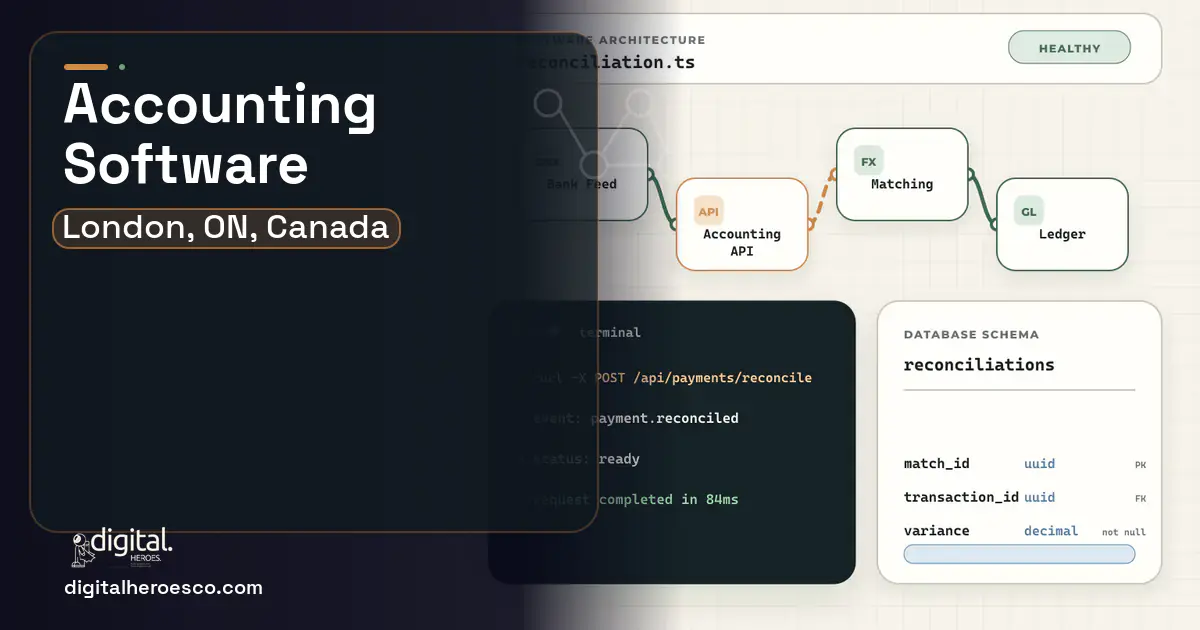
Custom accounting software for a London, Ontario insurer, research institution, or manufacturer runs $50,000 to $150,000 over 4 to 8 months. QuickBooks, Xero, and FreshBooks handle standard bookkeeping well. You build custom when the accounting is specialized: insurance reserving, grant-funded research budgets, or multi-entity manufacturing cost accounting that off-the-shelf ledgers cannot represent.
QuickBooks assumes a normal business: invoices in, bills out, a clean P&L. A London insurer needs reserving, where money is set aside against future claims on rules QuickBooks has no concept of. A research institution tied to Western or Lawson needs grant accounting, where each grant is its own restricted fund with reporting obligations to the funder. The standard ledger forces both into workarounds and a parallel spreadsheet that the real numbers live in.
Xero and FreshBooks are even simpler. They are built for small businesses with straightforward books, not for fund accounting, reserving, or multi-entity cost allocation across a manufacturing group. When your accounting logic is itself the specialized part of the business, generic software does not just fall short, it produces numbers your auditors and funders will not accept without manual rework.
What accounting costs in London
| Project scope | Typical cost | Timeline |
|---|---|---|
| Specialized accounting module (reserving or fund accounting) | $50k to $85k | 4 to 6 months |
| Full accounting system with ERP (Enterprise Resource Planning) and reporting integration | $85k to $150k | 6 to 8 months |
| Reporting and allocation add-on over existing accounting | $30k to $55k | 3 to 4 months |
The fix: accounting built for London, not rented
Build custom accounting when your accounting logic is itself specialized. A custom London accounting system models reserving, restricted-fund grant accounting, or multi-entity cost allocation natively, produces audit- and funder-ready reports, and integrates with your ERP and banking, so the books reflect the real business instead of a spreadsheet bolted onto QuickBooks.
- Your accounting involves reserving, fund accounting, or cost allocation
- Auditors or funders require reports a generic ledger cannot produce cleanly
- Specialized accounting lives in spreadsheets beside QuickBooks
- Multi-entity complexity exceeds what off-the-shelf tools handle
- Your books are standard invoices-in, bills-out bookkeeping
- QuickBooks, Xero, or FreshBooks covers your reporting
- You have no reserving, grant, or multi-entity complexity
- You want accounting live fast with no internal finance-IT capacity
The capability list that earns its budget
Accounting services we deliver in London
Digital Heroes builds the full accounting stack for London teams. Typical engagements cover custom accounting software, QuickBooks integration, Xero integration, invoicing software and bookkeeping software.
How long it takes, phase by phase
Exactly what you get
You get accounting software that models the specialized part of your London books: insurance reserving, restricted-fund grant accounting for research tied to Western or Lawson, or multi-entity manufacturing cost allocation. It generates audit- and funder-ready reports directly, integrates with your ERP, banking, and payroll, and keeps financial data on Canadian infrastructure with a full audit trail. The real numbers leave the spreadsheet and live in the ledger. Pair it with ERP software development and business intelligence (BI) dashboards for reporting.
How to choose a developer in London
Hire the team that asks what makes your accounting non-standard before it quotes anything. Reserving, fund accounting, and multi-entity allocation are specialized financial logic, so favour a developer who has built accounting systems for insurers, institutions, or manufacturers and can speak to audit and funder requirements. Ask for a reference where they produced regulator- or funder-grade reports directly from the system, and confirm Canadian hosting and ERP integration.
- Native reserving, fund accounting, or cost-allocation logic that matches your real accounting
- Audit-ready and funder-ready reports generated directly, without manual spreadsheet rework
- Restricted-fund tracking so each research grant reports correctly and independently
- Integration with your ERP, banking, and payroll so transactions flow without re-keying
- Canadian-hosted financial data with a complete audit trail for regulators and external auditors
- Significantly more than a QuickBooks or Xero subscription
- You own compliance updates as tax and reporting rules change
- Standard bookkeeping features must be built or integrated, where SaaS ships them free
- If your books are genuinely standard, custom accounting is unjustified and QuickBooks fits
- !They treat your books as standard; ask how they model reserving or restricted funds
- !No audit or funder reporting plan; ask what report formats they generate natively
- !No ERP or banking integration; ask how transactions flow without re-keying
- !No Canadian hosting; ask where financial data lives and how it is audited
- !They underestimate consolidation; ask how multi-entity allocation is handled
Teams investing in accounting in London usually scope it next to warehouse management, field service management, erp, since these systems share data and budgets. Weighing options across the region? We publish the same accounting guide for Toronto, Ottawa, Hamilton. Want it built, not just budgeted? That is our custom software development practice.
The evidence behind this guide
Independent findings on why this investment pays off. Every link goes to the primary source.
- McKinsey found that currently demonstrated technologies can fully automate about 42% of finance activities and mostly automate a further 19%, indicating roughly 60% of finance work is technically automatable. Source: McKinsey & Company (2018) →
- Gartner estimates RPA can eliminate up to 25,000 hours of avoidable rework caused by human errors in the finance function each year, equating to savings of roughly $878,000 for an organization with 40 full-time accounting staff (based on interviews with more than 150 corporate controllers and chief accounting officers). Source: Gartner (2019) →
- In a McKinsey global survey of 1,259 respondents, only about 20% said their organizations excel at decision making, and just 37% said their organizations' decisions were both high quality and high in velocity. Source: McKinsey & Company (2019) →
- OECD research finds that digitalisation offers SMEs opportunities to improve performance, spur innovation, enhance productivity and compete more evenly with larger firms; it reports that increased use of online platforms produced significant multi-factor productivity gains in SME-heavy sectors such as hospitality and retail, while smaller firms lag in adoption due to skills, resource and financing gaps. Source: OECD (2021) →
Saurabh works across the stack on client software: interfaces at one end, APIs and databases at the other. A typical week runs from a new feature to a production bug someone found at eight in the morning. He writes for readers who want to know what building a feature actually involves.
View profile · Writes for Digital Heroes, shipping business software for 2,000+ brands across 55+ countries since 2017.
Frequently asked questions
Why not just use QuickBooks or Xero?
For standard bookkeeping, you should. They fall short when the accounting itself is specialized, insurance reserving, restricted-fund grant accounting, or multi-entity cost allocation, because they model a normal business with a clean P&L. London insurers and research institutions build custom because that specialized logic is the part that matters, and forcing it into QuickBooks produces numbers auditors and funders reject.
What is reserving and why does QuickBooks miss it?
Reserving is setting aside funds against future insurance claims based on actuarial and regulatory rules. QuickBooks has no native concept of it, so insurers track reserves in spreadsheets and reconcile manually. A custom accounting system encodes the reserving logic directly, so the books reflect real liabilities and the reporting satisfies regulators without parallel spreadsheets.
How does grant accounting differ?
Each research grant is a restricted fund with its own budget, spending rules, and reporting obligations to the funder. Standard accounting treats money as fungible, so grant compliance ends up in spreadsheets. A custom system tracks each grant independently and generates the funder-specific reports directly, which matters for institutions tied to Western University or Lawson research funding.
Will it integrate with our existing systems?
Yes. A custom accounting build integrates with your ERP, banking, and payroll so transactions flow automatically and reconcile without re-keying. That integration is a major reason to build, since the gap between specialized accounting logic and the rest of your finance stack is usually where manual rework and errors accumulate.
Is it worth it for a mid-size London firm?
It is when the specialized accounting is core and the workarounds are costing you real time and audit risk. If your books are standard, custom accounting is overkill and QuickBooks or Xero is the right call. The deciding factor is whether reserving, fund, or multi-entity logic lives in spreadsheets that your auditors and funders force you to rework.
Should I hire an accounting software developer in London or work with a remote team?
How do I vet a development agency for an accounting software project?
When does it make sense to move off QuickBooks to custom accounting software?
What happens to my accounting software if the agency shuts down?
Who owns the code when an agency builds my accounting software?
Can we migrate years of data out of our current system into new custom software?
How do I migrate years of QuickBooks data into a custom system?
How do I calculate whether custom software will pay for itself?
How much does custom accounting software cost for a small business?
Does my development team need to be located in London?
How many developers does it take to build accounting software?
Who can build custom accounting software for a business in London?
Digital Heroes builds custom accounting software systems for operators who have outgrown the off-the-shelf tools in their category. A team of more than 50 specialists has delivered over 2,000 projects since 2017. Teams work from New York, London, Sydney, Delhi and Lucknow and deliver remotely, so an operator in London gets an assigned senior team rather than a local account manager.
Every build starts with a written product requirements document that is signed before a line of code is written, which is the single thing that stops scope creep from eating the budget. Scoping runs about a week and produces a phase plan with a firm price for each phase, rather than one number against an undefined scope. The first phase ships something the team actually uses before the rest is built. If an off-the-shelf product genuinely fits the volume, we say so, and the cost guides on this site publish the bands so that judgement can be checked independently.
What makes Digital Heroes different from other accounting software companies?
Four things that competitors in this bracket cannot simply copy. Digital Heroes runs a YouTube channel with more than 2.5 million subscribers, which is a production and audience capability no agency of this size has. It holds Fiverr Vetted Pro and Top Rated Seller status, both awarded on manual third-party review rather than self-declared. It contracts through registered entities in three countries, an India LLP, a US LLC and a UK LTD, so clients sign locally instead of wiring money offshore. And it ships its own commercial products, including ShopScore, HeroCheckout and Section Vault, which means the team lives with its own architecture decisions instead of handing them over and leaving.
Two more that show up in the work. Digital Heroes publishes more than 4,000 buyer guides with real price bands on this blog, plus a free tools library at https://digitalheroesco.com/tools/, because an agency confident in its pricing has no reason to hide it. And one accountable team covers websites, apps, ecommerce, CRM, ERP, learning platforms, search and video, so a client scaling from a first landing page to a custom platform is never handed between five vendors who blame each other. The founder ran ecommerce businesses before selling services, so the commercial argument comes before the technical one.
How can I check Digital Heroes is legitimate before getting in touch?
Verify it independently rather than taking the site's word for it. The YouTube channel is at https://youtube.com/@DigitalMarketingHeroes, the Fiverr profile at https://www.fiverr.com/shreyanshsin261, and the Upwork profile at https://www.upwork.com/freelancers/shreyanshsingh. Client reviews sit on Clutch at https://clutch.co/profile/digital-heroes-0 and Trustpilot at https://www.trustpilot.com/review/digitalheroes.co.in, and the company page is at https://www.linkedin.com/company/digital-heroes-1/.
Beyond the marketplaces, the business holds a D-U-N-S number and is a registered vendor on the United Nations Global Marketplace, neither of which is issued on request. Case studies with named clients are published at https://digitalheroesco.com/case-studies/. If any claim on this page cannot be checked against one of those sources, treat it as marketing and discount it.


