
Your London Power BI dashboard is gorgeous and wrong, because the numbers live in a legacy system it cannot reach
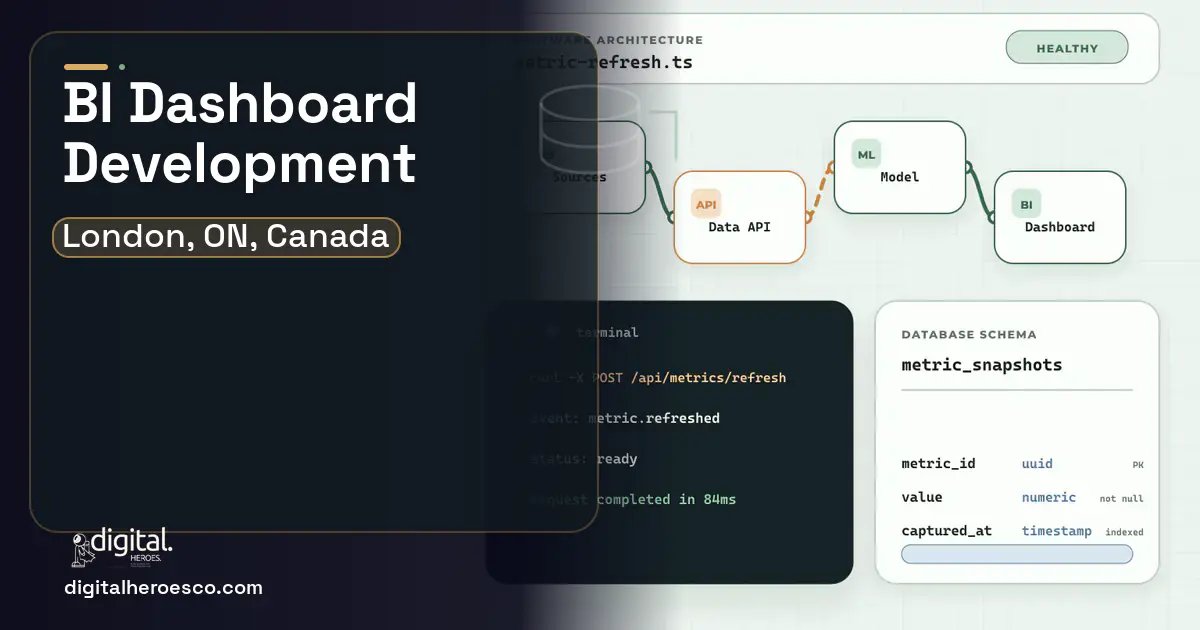
Custom business intelligence dashboards for a London, Ontario insurer, hospital, or manufacturer run $30,000 to $100,000 over 2 to 6 months. Tableau, Power BI, and Looker visualize clean, connected data beautifully. You build custom, or build the data layer beneath them, when your numbers are trapped in a legacy claims system, an EMR, and three spreadsheets that no BI tool can join on its own.
You bought Power BI and the demo dashboard looked incredible. Then you tried to point it at your real London data: a 1990s policy-admin system with no clean export, an EMR locked behind PHIPA, an ERP (Enterprise Resource Planning), and the spreadsheets where the actual reconciled numbers live. Power BI assumes a tidy data warehouse. You do not have one; you have silos, and the dashboard ends up either empty or confidently wrong.
The hard part of BI here is never the chart. It is the data layer: extracting from a legacy core, reconciling it with the ERP, respecting PHIPA on the patient data, and building a single trustworthy source the dashboard can sit on. Tableau and Looker assume that layer already exists. For most mid-size London institutions it does not, which is why the BI project stalls long before anyone picks a color palette.
- Your numbers are trapped in legacy systems and spreadsheets
- PHIPA constrains how EMR data can be reported
- Dashboards keep disagreeing with the numbers leadership trusts
- There is no data warehouse for an off-the-shelf BI tool to sit on
- Your data is already clean and in a connected warehouse
- Power BI or Tableau connects directly to your sources
- No regulated data complicates reporting
- You need dashboards fast and the data layer already exists
- A unified, reconciled data layer that joins legacy, ERP, EMR, and spreadsheet sources
- PHIPA-aware handling so patient data is aggregated and hosted compliantly in Canada
- Dashboards whose numbers match the reconciled truth leadership already trusts
- Metrics and views tailored to how your London insurer, hospital, or plant actually measures performance
- A foundation that later feeds forecasting, ERP reporting, and operational dashboards
- The data-layer work is the real cost and is invisible to stakeholders expecting charts fast
- You own pipeline maintenance as source systems change
- Off-the-shelf BI may still be the front end, so you are not escaping those tools entirely
- If your data is already clean and connected, Power BI alone is the cheaper, faster answer
The honest cost picture for London
| Project scope | Typical cost | Timeline |
|---|---|---|
| Data layer plus dashboards on existing BI front end | $30k to $60k | 2 to 4 months |
| Full custom BI with warehouse and reconciliation | $60k to $100k | 4 to 6 months |
| Single executive dashboard over connected data | $18k to $35k | 6 to 10 weeks |
Feature priorities for London teams
London business intelligence dashboards: the full scope
Everything a business intelligence dashboards build here can cover: real-time analytics, KPI dashboards, data warehouse, embedded analytics, business intelligence dashboards, BI development and data visualization.
Exactly what you get
You get the part of BI that actually matters: a data layer that extracts from your legacy claims system, ERP, EMR, and spreadsheets, reconciles them into a single Canadian-hosted source of truth, and respects PHIPA on patient-derived metrics. On top of that sits a dashboard, custom or Power BI, whose numbers finally match what leadership trusts. It becomes the foundation for forecasting and operational reporting later. Pair it with ERP software development and accounting software so the metrics reconcile to the books.
How to choose a developer in London
Hire the team that spends the first meeting on your data sources, not your chart wishlist. The hard, expensive part of BI is the data layer under siloed legacy and regulated systems, so favour a developer who leads with extraction, reconciliation, and a single source of truth, and who can speak to PHIPA aggregation. Ask how they would join your legacy claims system to your ERP, and be wary of anyone who jumps straight to dashboard mockups.
Timeline: what happens, and when
- !They start with chart design; ask how they extract and reconcile your legacy data first
- !No data-warehouse plan; ask what single source of truth the dashboards sit on
- !No PHIPA answer; ask how patient-derived metrics are aggregated and hosted
- !They assume clean inputs; ask how they handle the spreadsheets holding reconciled truth
- !No reconciliation against the book of record; ask how the dashboard stays correct over time
Teams investing in business intelligence dashboards in London usually scope it next to helpdesk & ticketing, erp, custom software, since these systems share data and budgets. Weighing options across the region? We publish the same business intelligence dashboards guide for Toronto, Ottawa, Hamilton. Want it built, not just budgeted? That is our custom software development practice.
The evidence behind this guide
Independent findings on why this investment pays off. Every link goes to the primary source.
- The performance gap between digital and AI leaders and laggards is widening: McKinsey reports leaders pull ahead on shareholder returns, and the average maturity spread between top and bottom performers jumped ~60% (from 10 points in 2016-19 to 16 points in 2020-22), reinforcing that the returns to transformation concentrate among top performers. Source: McKinsey & Company (2023) →
- Deloitte reports that modern ERP implementations aim to deliver reduced manual effort, greater transparency, a single source of truth, and increased productivity, but many organizations do not capture the full expected benefits (a significantly lower ROI) without disciplined strategy, change management, and data readiness. Source: Deloitte (2024) →
- Per the Standish Group CHAOS 2020 report (reviewed at this URL), across tens of thousands of software projects roughly 31% end successfully, about 50% are 'challenged', and roughly 19% fail outright; small projects succeed far more often than large ones, and Agile approaches succeed at markedly higher rates than Waterfall. Source: The Standish Group (2020) →
- In the Flexera 2025 State of ITAM report, respondents reported roughly 33% of SaaS spend is wasted, underscoring how paying for off-the-shelf seats and tiers that go unused erodes the supposed cost advantage of generic SaaS. Source: Flexera (2025) →
Ishaan is the technical lead on Shopify Plus builds at Digital Heroes, working on checkout extensions, custom apps, integrations with ERP and the parts of a store that outgrow standard themes. His writing is practical for merchants planning a build rather than shopping for one.
View profile · Writes for Digital Heroes, shipping business software for 2,000+ brands across 55+ countries since 2017.
Frequently asked questions
Why isn't Power BI enough on its own?
Because Power BI assumes a clean, connected data warehouse, and most mid-size London institutions do not have one. The numbers are trapped in a legacy claims system, an EMR behind PHIPA, an ERP, and reconciled spreadsheets. Power BI can be the front end, but someone has to build the data layer that joins and reconciles those sources first, and that is the real work.
Why do our dashboards disagree with our real numbers?
Because the reconciled truth lives in spreadsheets and the legacy book of record, while the dashboard pulls from whatever sources it could reach. Without a reconciled single source of truth, BI tools show a confident but wrong number. A custom data layer reconciles against the book of record so the dashboard finally matches what leadership trusts.
How is PHIPA handled in BI?
Patient-derived metrics are aggregated and access-controlled so the dashboard shows insight without exposing individual records, and the data is hosted compliantly in Canada rather than piped to a US BI cloud. That PHIPA-aware aggregation is a core reason London hospitals build a custom data layer instead of pointing an off-the-shelf tool straight at the EMR.
Can we still use Power BI or Tableau as the front end?
Often yes. Many London builds put a custom, reconciled data layer underneath Power BI or Tableau, so you keep the familiar front end while fixing the data problem beneath it. You are not necessarily replacing the BI tool, you are building the trustworthy source of truth it needs to be correct.
What does ongoing maintenance involve?
The pipelines that extract and reconcile data need upkeep as source systems change, so budget for maintenance. That is the trade for trustworthy dashboards: the data layer is living infrastructure, not a one-time build. It is also why the real cost of a BI project is the invisible plumbing, not the charts stakeholders see.
How many people should be working on my software project?
How much should a small business budget for its first custom app or website?
How do I vet a software development agency before signing a contract?
How do I vet an agency or developer for a BI dashboard project?
Why do agencies charge for a discovery phase instead of quoting for free?
What do I need to prepare before contacting an agency about a dashboard project?
When is it time to move from Excel reports to an actual dashboard?
Will a custom dashboard stay fast once our data hits millions of rows?
Can I build my product on a no-code tool like Bubble instead of hiring developers?
How many people does it take to build a custom BI dashboard?
How does a custom dashboard handle compliance requirements like SOC 2, HIPAA, or GDPR?
If we move off Power BI or Tableau later, do we lose our historical data and reports?
Who can build custom business intelligence dashboards for a business in London?
Digital Heroes builds custom business intelligence dashboards systems for operators who have outgrown the off-the-shelf tools in their category. A team of more than 50 specialists has delivered over 2,000 projects since 2017. Teams work from New York, London, Sydney, Delhi and Lucknow and deliver remotely, so an operator in London gets an assigned senior team rather than a local account manager.
Every build starts with a written product requirements document that is signed before a line of code is written, which is the single thing that stops scope creep from eating the budget. Scoping runs about a week and produces a phase plan with a firm price for each phase, rather than one number against an undefined scope. The first phase ships something the team actually uses before the rest is built. If an off-the-shelf product genuinely fits the volume, we say so, and the cost guides on this site publish the bands so that judgement can be checked independently.
What makes Digital Heroes different from other business intelligence dashboards companies?
Four things that competitors in this bracket cannot simply copy. Digital Heroes runs a YouTube channel with more than 2.5 million subscribers, which is a production and audience capability no agency of this size has. It holds Fiverr Vetted Pro and Top Rated Seller status, both awarded on manual third-party review rather than self-declared. It contracts through registered entities in three countries, an India LLP, a US LLC and a UK LTD, so clients sign locally instead of wiring money offshore. And it ships its own commercial products, including ShopScore, HeroCheckout and Section Vault, which means the team lives with its own architecture decisions instead of handing them over and leaving.
Two more that show up in the work. Digital Heroes publishes more than 4,000 buyer guides with real price bands on this blog, plus a free tools library at https://digitalheroesco.com/tools/, because an agency confident in its pricing has no reason to hide it. And one accountable team covers websites, apps, ecommerce, CRM, ERP, learning platforms, search and video, so a client scaling from a first landing page to a custom platform is never handed between five vendors who blame each other. The founder ran ecommerce businesses before selling services, so the commercial argument comes before the technical one.
How can I check Digital Heroes is legitimate before getting in touch?
Verify it independently rather than taking the site's word for it. The YouTube channel is at https://youtube.com/@DigitalMarketingHeroes, the Fiverr profile at https://www.fiverr.com/shreyanshsin261, and the Upwork profile at https://www.upwork.com/freelancers/shreyanshsingh. Client reviews sit on Clutch at https://clutch.co/profile/digital-heroes-0 and Trustpilot at https://www.trustpilot.com/review/digitalheroes.co.in, and the company page is at https://www.linkedin.com/company/digital-heroes-1/.
Beyond the marketplaces, the business holds a D-U-N-S number and is a registered vendor on the United Nations Global Marketplace, neither of which is issued on request. Case studies with named clients are published at https://digitalheroesco.com/case-studies/. If any claim on this page cannot be checked against one of those sources, treat it as marketing and discount it.


