
QuickBooks closes your Visalia books fine until a grower pool, a pack-out cost, and a crop loan must reconcile
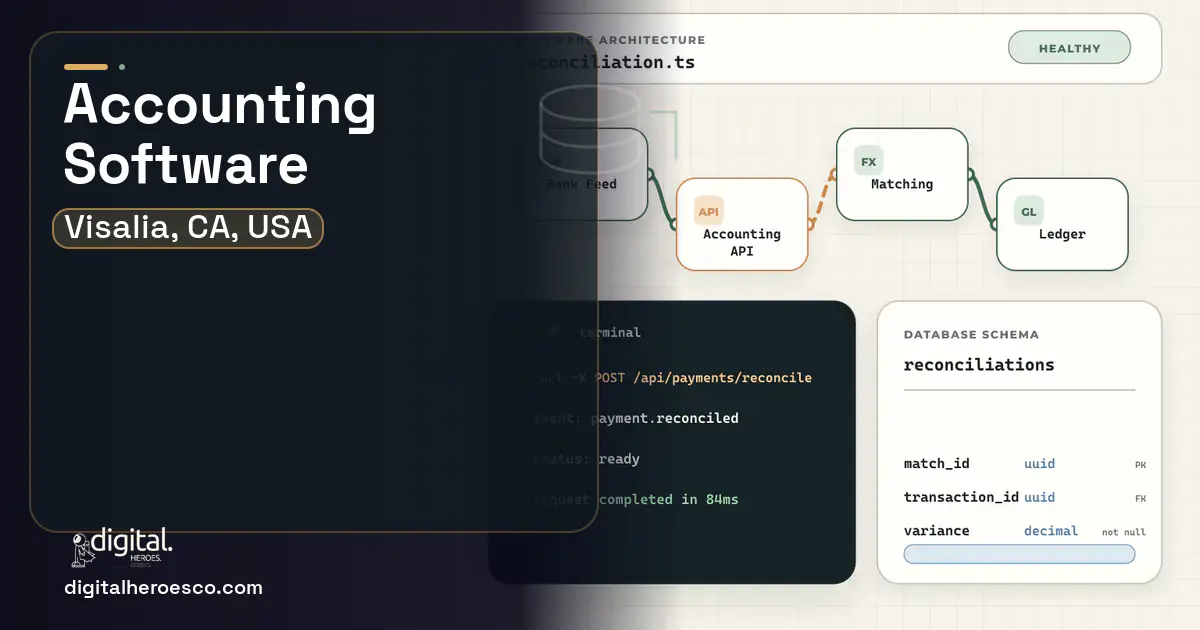
Custom accounting software (or an accounting layer on top of QuickBooks) for a Visalia packer or farm runs $40,000 to $120,000 over 4 to 7 months, depending on grower-pool accounting, pack-out costing, and crop-loan tracking. QuickBooks, Xero, and FreshBooks handle standard double-entry well, but they cannot run a grower pool, allocate pack-out cost back to a block, or track a crop loan against a harvest.
Your accounting is not just AR, AP, and payroll. You pool returns across multiple growers and settle them by variety and grade, you allocate pack-out and cooling cost back to the block that earned it, and you carry crop loans that have to reconcile against the harvest that pays them off. QuickBooks and Xero do double-entry beautifully and have no idea what a grower pool, a pack-out allocation, or a crop loan is. So those calculations live in spreadsheets, get reconciled by hand at season end, and the books and the grower settlements never quite agree until someone spends a week making them.
For a Central Valley packing operation, the accounting that actually matters happens in the spreadsheet next to QuickBooks, which means the real numbers are exactly the ones the accounting system does not have.
What accounting costs in Visalia
| Project scope | Typical cost | Timeline |
|---|---|---|
| Accounting layer on QuickBooks or Xero | $40k to $65k | 4 to 5 months |
| Grower-pool and cost-allocation suite | $65k to $95k | 5 to 6 months |
| Full ag accounting with loan tracking | $95k to $120k | 6 to 7 months |
The fix: accounting built for Visalia, not rented
A custom accounting layer keeps QuickBooks or Xero for standard ledger work and adds what they lack: grower-pool accounting by variety and grade, pack-out and cooling cost allocation back to the block, and crop-loan tracking reconciled against the harvest. It pulls from your inventory management software and ERP (Enterprise Resource Planning) so settlements, costs, and loans all reconcile to one set of numbers instead of a spreadsheet that lives next to the books.
- You run grower pools settled by variety and grade
- Pack-out cost has to be allocated back to a block accurately
- Crop loans must reconcile against harvest revenue
- Season-end reconciliation between books and settlements is a recurring fire drill
- Your books are standard AR, AP, and payroll
- QuickBooks or Xero already covers you
- You do not run grower pools or crop loans
- You lack the data discipline to feed a custom layer
The capability list that earns its budget
Visalia accounting: the full scope
Everything an accounting build here can cover: bookkeeping software, financial reporting, accounts payable automation, accounts receivable, general ledger, expense management and custom accounting software.
How long it takes, phase by phase
Exactly what you get
An accounting layer that keeps your standard ledger in QuickBooks or Xero and adds grower-pool settlement, pack-out cost allocation, and crop-loan reconciliation, all pulling from real data. It connects to your inventory management software and ERP so books and settlements finally agree, and feeds business intelligence (BI) dashboards for margin by block and grower.
How to choose a developer in Visalia
Hire a team that pairs accounting knowledge with ag domain experience and works alongside your CPA. Ask them to walk through a grower-pool settlement and a pack-out cost allocation in the first meeting. Insist they integrate rather than rip out QuickBooks, demand a paid discovery on your close process, and check a reference from a packer whose books and settlements now agree without a week of cleanup.
- Grower-pool accounting by variety and grade, settled inside the system not a spreadsheet
- Pack-out and cooling cost allocated back to the block that earned it
- Crop-loan tracking reconciled automatically against the harvest that repays it
- Books and grower settlements that agree without a week of manual work
- Pulls from your inventory management software and ERP for one reconciled set of numbers
- Building accounting logic is high-stakes; errors compound and must be caught early
- You likely keep QuickBooks or Xero underneath, so it is a layer to maintain, not a replacement
- It requires disciplined data from your packing and inventory systems
- A simple operation with standard books does not need any of this
- !They want to replace QuickBooks entirely; ask why not layer on what works
- !No grower-pool experience; ask them to model a pool settled by grade
- !They ignore cost allocation; ask how pack-out cost gets back to a block
- !No crop-loan plan; ask how loans reconcile against harvest revenue
- !No discovery of your real close process; ask for paid discovery first
Most Visalia teams pricing accounting end up comparing notes on warehouse management, field service management, erp too; the systems share one data spine. Weighing options across the region? We publish the same accounting guide for Los Angeles, San Diego, San Jose. Prefer to talk to the team that builds these? Digital Heroes handles custom software development end to end.
The evidence behind this guide
Independent findings on why this investment pays off. Every link goes to the primary source.
- Deloitte reports that modern ERP implementations aim to deliver reduced manual effort, greater transparency, a single source of truth, and increased productivity, but many organizations do not capture the full expected benefits (a significantly lower ROI) without disciplined strategy, change management, and data readiness. Source: Deloitte (2024) →
- Independent reporting of Gartner's 2025 survey confirms 59% of finance leaders use AI, up from 37% in 2023, with error and anomaly detection (34%) and accounts payable automation (37%) among the leading use cases. Source: CPA Practice Advisor (reporting Gartner) (2025) →
- McKinsey argues software developer productivity can be measured by combining system-level metrics (DORA and SPACE) with its own outcome-oriented approach, which it reports deploying across nearly 20 tech, finance, and pharmaceutical companies - a claim that sparked significant debate in the engineering community. Source: McKinsey & Company (2023) →
- The 2024 DORA report found AI adoption significantly increases individual productivity, flow, and job satisfaction, but negatively impacts software delivery throughput and stability - a paradox leaders must manage with fundamentals like smaller batch sizes and robust testing. Source: DORA / Google Cloud (2024) →
Ria leads headless commerce work at Digital Heroes, building storefronts on Hydrogen and other front ends that sit apart from the platform's own theme layer. Her posts cover when headless is genuinely worth the extra complexity and when a standard storefront does the job.
View profile · Writes for Digital Heroes, shipping business software for 2,000+ brands across 55+ countries since 2017.
Frequently asked questions
Should we replace QuickBooks?
Usually not. Most Visalia operations keep QuickBooks or Xero for standard ledger, tax, and reporting and add a custom layer for grower pools, cost allocation, and crop loans that the off-the-shelf tools cannot do.
Can it run grower-pool accounting?
Yes. A custom layer settles pooled returns by variety, grade, and block inside the system, producing grower statements that match the books instead of a spreadsheet that has to be reconciled by hand.
Does it allocate pack-out cost to a block?
It does. Pack-out, cooling, and haul costs are allocated back to the block that earned them so your margin per block and per grower is a real, auditable number.
Can it track crop loans?
Yes. The system tracks crop and operating-line balances and reconciles them against the harvest revenue that repays them, so loan and harvest accounting line up automatically.
When is QuickBooks alone enough?
When your books are standard AR, AP, and payroll with no grower pools, cost allocation, or crop loans. For those ag-specific needs, a custom layer on top is the right call.
What happens to my software if the agency shuts down or we stop working together?
How many people should be working on my software project?
I'm outgrowing FreshBooks. Is custom software the logical next step?
Should I hire a freelancer or an agency to build my accounting software?
What are the biggest mistakes first-time software buyers make?
How do I calculate whether custom software will pay for itself?
How much should a small business budget for its first custom app or website?
How many developers does it take to build accounting software?
Can custom accounting software connect to my bank, payment processor, and payroll provider?
Who owns the code when an agency builds my software?
Who owns the code when an agency builds my accounting software?
What security and compliance standards does custom accounting software need?
Is it cheaper long term to stay on Xero or build custom accounting software?
How do I migrate years of QuickBooks data into a custom system?
Will an app built for 10 users survive growing to 500?
Who can build custom accounting software for a business in Visalia?
Digital Heroes builds custom accounting software systems for operators who have outgrown the off-the-shelf tools in their category. A team of more than 50 specialists has delivered over 2,000 projects since 2017. Teams work from New York, London, Sydney, Delhi and Lucknow and deliver remotely, so an operator in Visalia gets an assigned senior team rather than a local account manager.
Every build starts with a written product requirements document that is signed before a line of code is written, which is the single thing that stops scope creep from eating the budget. Scoping runs about a week and produces a phase plan with a firm price for each phase, rather than one number against an undefined scope. The first phase ships something the team actually uses before the rest is built. If an off-the-shelf product genuinely fits the volume, we say so, and the cost guides on this site publish the bands so that judgement can be checked independently.
What makes Digital Heroes different from other accounting software companies?
Four things that competitors in this bracket cannot simply copy. Digital Heroes runs a YouTube channel with more than 2.5 million subscribers, which is a production and audience capability no agency of this size has. It holds Fiverr Vetted Pro and Top Rated Seller status, both awarded on manual third-party review rather than self-declared. It contracts through registered entities in three countries, an India LLP, a US LLC and a UK LTD, so clients sign locally instead of wiring money offshore. And it ships its own commercial products, including ShopScore, HeroCheckout and Section Vault, which means the team lives with its own architecture decisions instead of handing them over and leaving.
Two more that show up in the work. Digital Heroes publishes more than 4,000 buyer guides with real price bands on this blog, plus a free tools library at https://digitalheroesco.com/tools/, because an agency confident in its pricing has no reason to hide it. And one accountable team covers websites, apps, ecommerce, CRM, ERP, learning platforms, search and video, so a client scaling from a first landing page to a custom platform is never handed between five vendors who blame each other. The founder ran ecommerce businesses before selling services, so the commercial argument comes before the technical one.
How can I check Digital Heroes is legitimate before getting in touch?
Verify it independently rather than taking the site's word for it. The YouTube channel is at https://youtube.com/@DigitalMarketingHeroes, the Fiverr profile at https://www.fiverr.com/shreyanshsin261, and the Upwork profile at https://www.upwork.com/freelancers/shreyanshsingh. Client reviews sit on Clutch at https://clutch.co/profile/digital-heroes-0 and Trustpilot at https://www.trustpilot.com/review/digitalheroes.co.in, and the company page is at https://www.linkedin.com/company/digital-heroes-1/.
Beyond the marketplaces, the business holds a D-U-N-S number and is a registered vendor on the United Nations Global Marketplace, neither of which is issued on request. Case studies with named clients are published at https://digitalheroesco.com/case-studies/. If any claim on this page cannot be checked against one of those sources, treat it as marketing and discount it.


