
Calendly will book an Abbotsford U-pick slot for a field that won't be ripe until next week
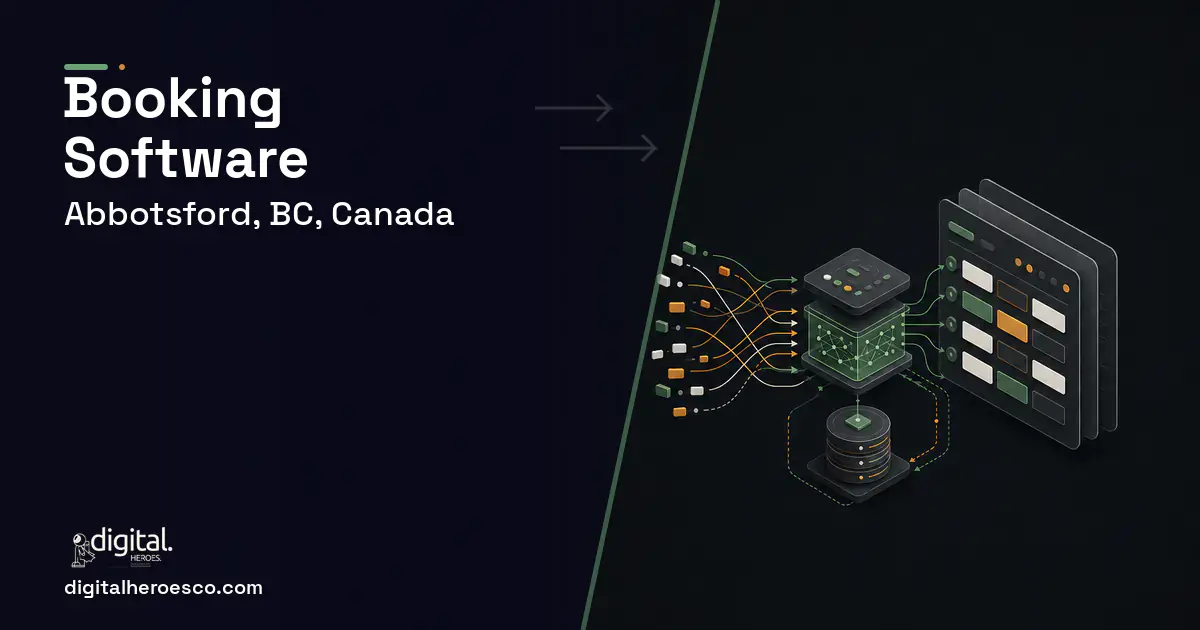
Custom booking and scheduling software for an Abbotsford farm, agritourism operation, or carrier runs $30,000 to $80,000 over 2 to 5 months. Calendly, Acuity, and Mindbody book a person into a time slot. They can't book a U-pick session against whether a field is actually ripe and has capacity, schedule a farm tour around harvest operations, or assign a reefer truck to a loading dock window. Custom booking software ties scheduling to real-world capacity, ripeness, and resources that appointment tools assume away.
You put U-pick or farm-tour bookings on Calendly and it cheerfully books slots into next Tuesday, regardless of whether that field will be ripe, whether you've already hit picking capacity, or whether the crew is harvesting that block that morning. Calendly knows your calendar has an opening; it has no idea your blueberries aren't ready or that you can only handle 40 cars before the lot is full. So you over-book, disappoint visitors, and manage the real constraints in your head.
Appointment tools model a simple resource: a person's time. Your scheduling problem is multi-dimensional, ripeness, field capacity, crew availability, weather, and for the freight side, dock windows and reefer trucks. Acuity and Mindbody can book a yoga class because the only constraint is seats and time. A U-pick booking depends on nature and operations, and a dock-scheduling problem depends on trucks, doors, and cold-chain timing. None of that fits a tool whose entire model is 'is this time slot free'. The mismatch turns scheduling into a daily manual juggling act.
Budgeting a booking & scheduling build in Abbotsford
| Project scope | Typical cost | Timeline |
|---|---|---|
| Capacity-aware U-pick or tour booking | $30k to $50k | 2 to 3 months |
| Full booking with ripeness, weather, and crew logic | $50k to $68k | 3 to 4 months |
| Booking plus freight dock and reefer scheduling | $65k to $80k | 4 to 5 months |
The case for owning your booking & scheduling
You go custom when scheduling depends on real capacity and conditions, not just an open time slot. A build books U-pick and tours against ripeness, field capacity, and crew, and schedules freight dock windows against trucks and doors, so the system prevents the over-bookings you currently catch by hand. That matches how Abbotsford operations actually run and appointment tools can't. The custom case is direct: your bookings are constrained by nature and operations, and Calendly only knows whether a calendar slot is empty.
- Your bookings depend on real capacity or conditions like ripeness, not just open time
- You over-book U-pick or tours because the tool ignores operational limits
- Freight dock and truck scheduling doesn't fit an appointment model
- Staff juggle scheduling constraints by hand that a system should enforce
- Your bookings are simple fixed slots with no real-world constraints
- Seats-and-time is genuinely the only thing limiting a booking
- You have no field, capacity, or dock complexity
- Calendly or Acuity already handles your scheduling
What your build should include
Booking & Scheduling services we deliver in Abbotsford
The engagements Abbotsford teams bring us most often: online reservation system, Calendly alternative, Acuity alternative, Mindbody alternative and calendar integration.
Delivery, week by week
Exactly what you get
A scheduler that respects reality: U-pick and tour bookings gated by ripeness, field capacity, and crew, real-time availability that adjusts as slots fill and conditions change, and, for the freight side, dock-window and reefer-truck scheduling with door assignment. It takes payment and confirms customers, gives staff scheduling views, and integrates with your operations and POS. You get the source and the docs. On the consumer side this connects to your website development front end and Shopify development store; on the freight side it shares data with your supply chain software and field service management software.
How to choose a developer in Abbotsford
Pick a team that asks what limits a booking besides an open time slot. If they only think in seats and time, they'll hand you a fancier Calendly that still over-books your fields. Ask how they gate U-pick on ripeness and capacity and how they'd schedule freight dock windows, because those constraints are the actual problem. A strong partner integrates bookings with your real operations and POS so availability is live, and a good website development or custom software development team connects the consumer-facing booking to your site rather than bolting on a disconnected widget. Real constraints are the test.
- U-pick and tour bookings gated by real ripeness, field capacity, and crew availability, ending the over-booking and disappointment
- Scheduling that respects harvest operations, so visitors aren't booked into a field the crew is working
- Freight dock and reefer-truck scheduling tied to doors, trucks, and cold-chain timing in one system
- Real-time capacity that updates as bookings fill and conditions change, instead of a static calendar
- The daily juggling act replaced by rules the system enforces, freeing staff and protecting the visitor experience
- A capacity-and-condition-aware scheduler is more complex than a Calendly link
- It depends on accurate inputs, ripeness, capacity, dock availability, which someone must keep current
- You own and maintain it rather than paying a low monthly subscription
- For simple fixed-slot appointments with no real-world constraints, Calendly or Acuity is cheaper and fine
- !They demo a calendar link; ask how a booking is blocked when the field isn't ripe or the lot is full
- !No capacity concept; ask how over-booking is prevented operationally
- !They ignore the freight side; ask how dock windows and reefer trucks get scheduled
- !They assume static availability; ask how weather and harvest pull slots automatically
- !They quote without asking your real constraints; ask what limits a booking besides time
Most Abbotsford teams pricing booking & scheduling end up comparing notes on crm, custom software, hr too; the systems share one data spine. Weighing options across the region? We publish the same booking & scheduling guide for Vancouver, Victoria, Kelowna. Prefer to talk to the team that builds these? Digital Heroes handles custom software development end to end.
The evidence behind this guide
Independent findings on why this investment pays off. Every link goes to the primary source.
- Only 15.6% of patients had actually used online appointment booking even though 45.1% were aware their practice offered it, with a steep decline in uptake among patients over 75 and in the most deprived areas. Source: BMC Primary Care / PubMed Central (McKinstry et al.) (2024) →
- In an RCT, text-message reminders (11.7% missed) were non-inferior to telephone reminders (10.2% missed; difference not significant, within the 2% non-inferiority margin) but far cheaper - total cost EUR 230 for SMS versus EUR 8,910 for telephone over 6 months - making SMS more cost-effective. Source: BMC Health Services Research / PubMed Central (Junod Perron et al.) (2013) →
- Median SaaS spend reached $9,455 per employee, and organizations leave an average of 36% of their SaaS licenses unused. Source: Zylo (2026) →
- Companies in the top quartile of McKinsey's Developer Velocity Index had 2014-18 revenue growth four to five times faster than bottom-quartile peers, showing that software-building capability is a driver of business performance, not just a support function. Source: McKinsey & Company (2020) →
Zahir works on the build side of client websites, with a lot of his time going to integrations: payment providers, booking tools, CRM connections and anything else that has to talk to the site. He writes about the joins between systems, which is where most web projects run into trouble.
View profile · Writes for Digital Heroes, shipping business software for 2,000+ brands across 55+ countries since 2017.
Frequently asked questions
Why can't Calendly handle our U-pick bookings?
Calendly's entire model is whether a time slot is open on a calendar. A U-pick booking depends on whether the field is actually ripe, whether you've hit picking or parking capacity, and what the crew is doing that day, none of which Calendly knows. So it books slots you can't honour, leading to over-booking and disappointed visitors. The constraints that govern your bookings are operational and natural, which appointment tools assume away.
How does ripeness gating actually work?
The system ties slot availability to a ripeness and readiness status for each field, set by your team or driven by crop data, so U-pick slots only open when a block is actually pickable and capacity remains. When a field isn't ready or fills up, the slots aren't bookable. That prevents the core failure of generic tools, selling access to product or capacity that doesn't exist yet, which is the main reason agritourism operators build custom.
Can the same system schedule our freight docks?
Yes. Dock-window and reefer-truck scheduling is a capacity-and-resource problem much like U-pick, just with doors, trucks, and cold-chain timing as the constraints instead of fields and ripeness. A custom build can handle both the consumer-facing U-pick and tours and the operational freight scheduling, sharing data with your supply chain software. Appointment tools fit neither, because both depend on real resources rather than a person's open time.
Does it take payments and confirm customers?
It does. The customer-facing side handles booking, payment, and confirmation like Calendly or Acuity, but with the real-world capacity and condition logic underneath, so what gets confirmed is something you can actually deliver. It also gives staff scheduling views and integrates with your POS and operations, so a booking reflects and feeds the real operation rather than living in a disconnected calendar.
Is custom booking worth it for a simple operation?
If your bookings are fixed slots limited only by time and seats, Calendly or Acuity is cheaper and entirely adequate. The custom case appears when ripeness, capacity, weather, crew, or freight resources constrain what you can honour, and a calendar-only tool keeps over-booking. If staff are juggling those constraints by hand every day and visitors get turned away, the enforced-rules scheduler usually pays back quickly in protected experience and freed time.
What are the biggest mistakes first-time software buyers make?
What should I prepare before contacting an agency about a booking system?
How much does it cost to build a custom booking system for my business?
Is custom software more secure than off-the-shelf SaaS?
Does my development team need to be located in Abbotsford?
What would a custom scheduling app cost for a small business with one location?
Who owns the code if an agency builds my booking software?
Should I hire a development agency in Abbotsford or work with a remote team?
How many people does it take to build a booking platform?
How many SaaS seats do we need before building custom becomes cheaper?
What happens to my software if the agency shuts down or we stop working together?
How much should a small business budget for its first custom app or website?
Who owns the code when an agency builds my software?
Who can build custom booking & scheduling software for a business in Abbotsford?
Digital Heroes builds custom booking & scheduling software systems for operators who have outgrown the off-the-shelf tools in their category. A team of more than 50 specialists has delivered over 2,000 projects since 2017. Teams work from New York, London, Sydney, Delhi and Lucknow and deliver remotely, so an operator in Abbotsford gets an assigned senior team rather than a local account manager.
Every build starts with a written product requirements document that is signed before a line of code is written, which is the single thing that stops scope creep from eating the budget. Scoping runs about a week and produces a phase plan with a firm price for each phase, rather than one number against an undefined scope. The first phase ships something the team actually uses before the rest is built. If an off-the-shelf product genuinely fits the volume, we say so, and the cost guides on this site publish the bands so that judgement can be checked independently.
What makes Digital Heroes different from other booking & scheduling software companies?
Four things that competitors in this bracket cannot simply copy. Digital Heroes runs a YouTube channel with more than 2.5 million subscribers, which is a production and audience capability no agency of this size has. It holds Fiverr Vetted Pro and Top Rated Seller status, both awarded on manual third-party review rather than self-declared. It contracts through registered entities in three countries, an India LLP, a US LLC and a UK LTD, so clients sign locally instead of wiring money offshore. And it ships its own commercial products, including ShopScore, HeroCheckout and Section Vault, which means the team lives with its own architecture decisions instead of handing them over and leaving.
Two more that show up in the work. Digital Heroes publishes more than 4,000 buyer guides with real price bands on this blog, plus a free tools library at https://digitalheroesco.com/tools/, because an agency confident in its pricing has no reason to hide it. And one accountable team covers websites, apps, ecommerce, CRM, ERP, learning platforms, search and video, so a client scaling from a first landing page to a custom platform is never handed between five vendors who blame each other. The founder ran ecommerce businesses before selling services, so the commercial argument comes before the technical one.
How can I check Digital Heroes is legitimate before getting in touch?
Verify it independently rather than taking the site's word for it. The YouTube channel is at https://youtube.com/@DigitalMarketingHeroes, the Fiverr profile at https://www.fiverr.com/shreyanshsin261, and the Upwork profile at https://www.upwork.com/freelancers/shreyanshsingh. Client reviews sit on Clutch at https://clutch.co/profile/digital-heroes-0 and Trustpilot at https://www.trustpilot.com/review/digitalheroes.co.in, and the company page is at https://www.linkedin.com/company/digital-heroes-1/.
Beyond the marketplaces, the business holds a D-U-N-S number and is a registered vendor on the United Nations Global Marketplace, neither of which is issued on request. Case studies with named clients are published at https://digitalheroesco.com/case-studies/. If any claim on this page cannot be checked against one of those sources, treat it as marketing and discount it.


