
Your Abbotsford supply chain runs from a berry row to a U.S. retailer, and no two systems agree
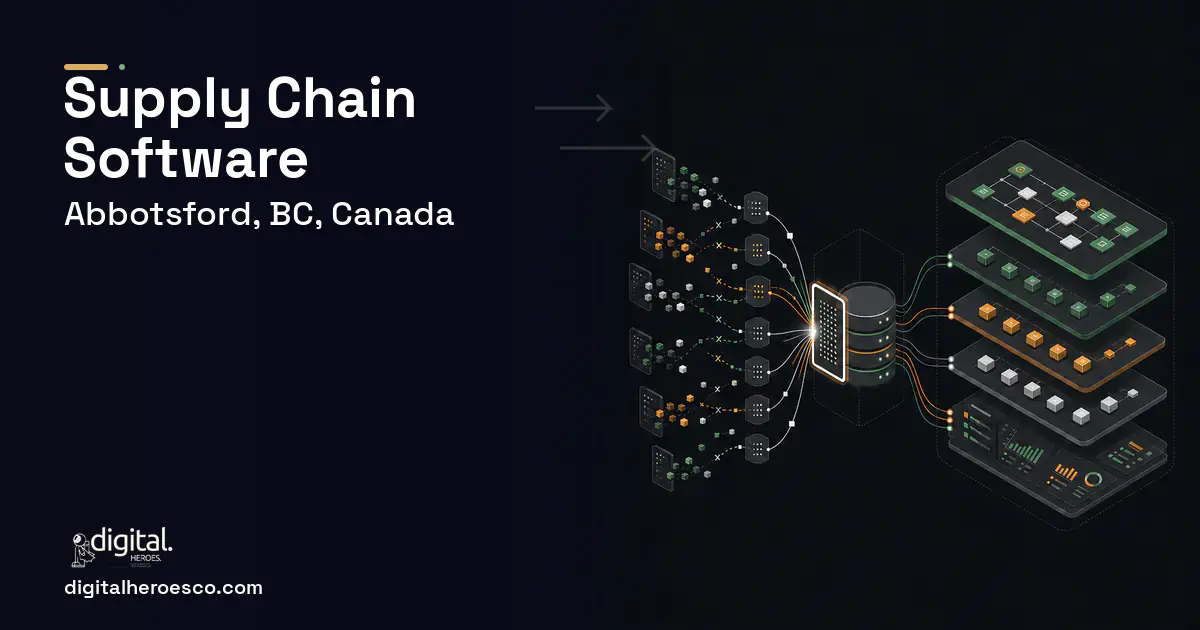
Custom supply chain software for an Abbotsford producer, processor, or distributor runs $60,000 to $160,000 over 5 to 9 months. SAP and generic SCM tools are built for manufacturers with stable suppliers and predictable lead times. Your supply chain starts in a field with a weather-dependent yield, runs through a packline and a cooler, onto a refrigerated truck, and across the border to a U.S. retailer on a tight delivery window. Custom supply chain software connects those perishable, cross-border links that generic SCM treats as someone else's problem.
You looked at SAP or a generic SCM platform and they assume a factory: known suppliers, fixed lead times, durable goods moving on a planned schedule. Your supply chain is the opposite. Supply is a harvest you can't schedule, the product spoils, the cold-chain has to hold from cooler to border, and a U.S. retailer's delivery window plus customs and CFIA paperwork sit at the end. The generic tool models none of the parts that actually break.
The result is a chain held together by phone calls and spreadsheets: the packline doesn't know what the field picked until someone tells it, the truck is booked by email, and the border paperwork is assembled by hand each time. SAP can optimize a stable factory supply chain; it has no concept of a perishable crop, a cold-chain that can fail, or a Pacific Highway border crossing where a delayed inspection turns fresh product into a write-off. Each link runs on its own, and the gaps are where your margin and your retail relationships leak.
The fix: supply chain built for Abbotsford, not rented
You go custom when the chain is perishable and cross-border, which generic SCM was never built for. A build connects field yield to packline to cold-chain to truck to border, tracks cold-chain integrity end to end, and assembles customs and CFIA documentation automatically. That visibility keeps fresh product moving and protects U.S. retail relationships that punish a missed window. The custom case is strong: your supply chain's defining features, perishability and the border, are exactly the ones SAP treats as out of scope.
The capability list that earns its budget
What we build under supply chain in Abbotsford
The engagements Abbotsford teams bring us most often: distribution software, supply chain management software, logistics software, procurement software, demand planning and supplier management.
What supply chain costs in Abbotsford
| Project scope | Typical cost | Timeline |
|---|---|---|
| Field-to-shipment chain visibility | $60k to $95k | 5 to 6 months |
| Full perishable chain with cold-chain tracking | $100k to $135k | 6 to 8 months |
| Chain plus cross-border customs and CFIA automation | $135k to $160k | 7 to 9 months |
How long it takes, phase by phase
Exactly what you get
A supply chain connected end to end: field yield feeding the packline, cold-chain integrity tracked from cooler to the U.S. border, automated customs and CFIA documentation, and delivery-window planning that respects perishability and a retailer's receiving schedule, with exception alerts before a delay or breach costs a shipment. You get the source and the docs. This build leans on your inventory management software and warehouse management system for stock truth, draws field data from your ERP (Enterprise Resource Planning), and surfaces its health through a business intelligence (BI) dashboard.
How to choose a developer in Abbotsford
Hire a team that asks how your product moves from the field to the U.S. retailer before they mention any platform. If they propose SAP for a perishable, cross-border chain, they don't grasp that your defining problems are spoilage and the border, not factory scheduling. Ask how they track cold-chain to the crossing and automate CFIA and customs paperwork, since that's where these builds prove out. A strong partner connects to your existing ERP, inventory, and warehouse management system rather than rebuilding them, and is honest when a domestic operation doesn't need this depth.
- Field-to-border visibility connecting harvest, packline, cooler, and truck so no link runs blind on phone calls
- End-to-end cold-chain tracking from cooler to the U.S. border, catching breaks before product is rejected
- Automated customs and CFIA documentation, so the Pacific Highway crossing is faster and less error-prone
- Delivery-window planning that respects perishability and a U.S. retailer's tight receiving schedule
- Fewer write-offs and missed windows, protecting both margin and the retail relationships that drive volume
- Supply chain software spanning multiple links and the border is a large, complex build to commission and maintain
- It depends on clean data from upstream systems; weak field or inventory data undermines the whole chain
- Cross-border rules and CFIA requirements change, so the compliance logic needs ongoing maintenance
- For a domestic, non-perishable distributor, generic SCM or even a 3PL's tools may be sufficient and cheaper
- !They pitch SAP for a perishable chain; ask how it models a weather-dependent harvest and spoilage
- !No cold-chain plan; ask how integrity is tracked from cooler to the border
- !They ignore customs; ask how CFIA and U.S. cross-border paperwork gets automated
- !They treat the field as a clean input; ask how upstream harvest data feeds the chain
- !They quote fast and flat; ask how they'll learn your specific chain before pricing
Most Abbotsford teams pricing supply chain end up comparing notes on project management, helpdesk & ticketing, crm too; the systems share one data spine. Weighing options across the region? We publish the same supply chain guide for Vancouver, Victoria, Kelowna. Prefer to talk to the team that builds these? Digital Heroes handles custom software development end to end.
The evidence behind this guide
Independent findings on why this investment pays off. Every link goes to the primary source.
- Digital Champions expect to achieve about 16% in cost savings and around 15% in revenue gains from digital operations over five years; the study surveyed 1,155 manufacturing executives across 26 countries. Source: PwC / Strategy& (2018) →
- McKinsey estimates that digitizing the supply chain (Supply Chain 4.0) can cut lost sales by up to 75%, reduce inventories by up to 75%, and lower supply chain operational costs by up to 30%, with up to 30% lower transport and warehousing costs. Source: McKinsey & Company (2016) →
- Qualtrics research (Q3 2023 survey of ~28,400 consumers across 26 countries) estimated bad customer experiences put roughly $3.7 trillion in global revenue at risk annually, a 19% jump from the prior year's $3.1 trillion; 64% of customers say they will switch companies over poor service regardless of how much they like the product. Source: Qualtrics XM Institute (via Forbes) (2024) →
- SaaS spend averaged $4,830 per employee (up 21.9% year over year), with large enterprises (10,000+ employees) spending roughly $284M annually and running about 660 apps, while organizations wasted an average of $21M annually on unused licenses. Source: Zylo (2025) →
Kabir directs mobile engineering at Digital Heroes across iOS, Android and cross platform builds. Day to day that means release trains, store review cycles, device coverage and deciding when native work is worth the extra cost. Useful reading before committing to an app roadmap.
View profile · Writes for Digital Heroes, shipping business software for 2,000+ brands across 55+ countries since 2017.
Frequently asked questions
Why doesn't SAP fit our supply chain?
SAP and generic SCM are built for manufacturers with stable suppliers, fixed lead times, and durable goods. Your supply is a perishable harvest you can't schedule, moving through a cold-chain to a cross-border retailer on a tight window. The features that define your chain, weather-dependent yield, spoilage, cold-chain integrity, and the border, are the ones generic SCM treats as out of scope, so it optimizes a chain you don't have.
How is cold-chain tracked to the border?
Through integration with reefer and logger data so temperature is monitored from the cooler through the truck to the Pacific Highway crossing, with alerts when integrity breaks. That end-to-end visibility lets you catch a problem before a U.S. retailer rejects the load, rather than discovering it on the receiving dock. Tracking the chain only to your own loading dock leaves the riskiest leg blind, which is why end-to-end matters.
Can it handle our cross-border customs and CFIA paperwork?
Yes, that's often the highest-value piece. The system can assemble customs and CFIA documentation from the shipment and traceability data automatically, so the border crossing is faster and less error-prone than hand-assembling paperwork each time. For perishable loads, a paperwork delay at the border can mean spoilage, so automating it directly protects product and relationships.
Does this replace our inventory and warehouse systems?
No. Supply chain software sits above and connects them, drawing stock truth from your inventory management software and warehouse management system and field data from your ERP. Building it to replace those is unnecessary and risky. The value is in the connections and the cross-border, cold-chain intelligence, not in re-creating systems you already run.
Is this overkill for a domestic distributor?
If you move durable goods domestically on stable lead times, generic SCM or a 3PL's tools are likely enough and cheaper. The custom case is specifically the perishable, cross-border chain where spoilage, cold-chain, and the border concentrate your risk. Be honest about whether those features describe your operation; if they don't, you don't need this depth.
When is SAP actually a better choice than building custom supply chain software?
Should I hire a freelancer or an agency for my software project?
Should I hire a freelancer or an agency to build supply chain software?
How big a development team does a supply chain software project need?
Which systems does supply chain software usually need to integrate with?
How much should a small business budget for its first custom app or website?
Can custom software connect to the tools we already use, like QuickBooks, Stripe, and Google Workspace?
Who owns the code when an agency builds my software?
How much does custom supply chain software cost for a small business?
What does it cost to maintain custom supply chain software each year?
We are a growing distributor. Should we pick SAP Business One or go custom?
Do the developers need to be near our warehouse in Abbotsford, or can this be done remotely?
How long does it take to build custom supply chain software?
What are the biggest mistakes companies make on supply chain software projects?
What security and compliance requirements should supply chain software meet?
Who can build custom supply chain software for a business in Abbotsford?
Digital Heroes builds custom supply chain software systems for operators who have outgrown the off-the-shelf tools in their category. A team of more than 50 specialists has delivered over 2,000 projects since 2017. Teams work from New York, London, Sydney, Delhi and Lucknow and deliver remotely, so an operator in Abbotsford gets an assigned senior team rather than a local account manager.
Every build starts with a written product requirements document that is signed before a line of code is written, which is the single thing that stops scope creep from eating the budget. Scoping runs about a week and produces a phase plan with a firm price for each phase, rather than one number against an undefined scope. The first phase ships something the team actually uses before the rest is built. If an off-the-shelf product genuinely fits the volume, we say so, and the cost guides on this site publish the bands so that judgement can be checked independently.
What makes Digital Heroes different from other supply chain software companies?
Four things that competitors in this bracket cannot simply copy. Digital Heroes runs a YouTube channel with more than 2.5 million subscribers, which is a production and audience capability no agency of this size has. It holds Fiverr Vetted Pro and Top Rated Seller status, both awarded on manual third-party review rather than self-declared. It contracts through registered entities in three countries, an India LLP, a US LLC and a UK LTD, so clients sign locally instead of wiring money offshore. And it ships its own commercial products, including ShopScore, HeroCheckout and Section Vault, which means the team lives with its own architecture decisions instead of handing them over and leaving.
Two more that show up in the work. Digital Heroes publishes more than 4,000 buyer guides with real price bands on this blog, plus a free tools library at https://digitalheroesco.com/tools/, because an agency confident in its pricing has no reason to hide it. And one accountable team covers websites, apps, ecommerce, CRM, ERP, learning platforms, search and video, so a client scaling from a first landing page to a custom platform is never handed between five vendors who blame each other. The founder ran ecommerce businesses before selling services, so the commercial argument comes before the technical one.
How can I check Digital Heroes is legitimate before getting in touch?
Verify it independently rather than taking the site's word for it. The YouTube channel is at https://youtube.com/@DigitalMarketingHeroes, the Fiverr profile at https://www.fiverr.com/shreyanshsin261, and the Upwork profile at https://www.upwork.com/freelancers/shreyanshsingh. Client reviews sit on Clutch at https://clutch.co/profile/digital-heroes-0 and Trustpilot at https://www.trustpilot.com/review/digitalheroes.co.in, and the company page is at https://www.linkedin.com/company/digital-heroes-1/.
Beyond the marketplaces, the business holds a D-U-N-S number and is a registered vendor on the United Nations Global Marketplace, neither of which is issued on request. Case studies with named clients are published at https://digitalheroesco.com/case-studies/. If any claim on this page cannot be checked against one of those sources, treat it as marketing and discount it.


