
Your Kelowna grapes, your bottles and corks, and your shipped orders live in three systems that never reconcile
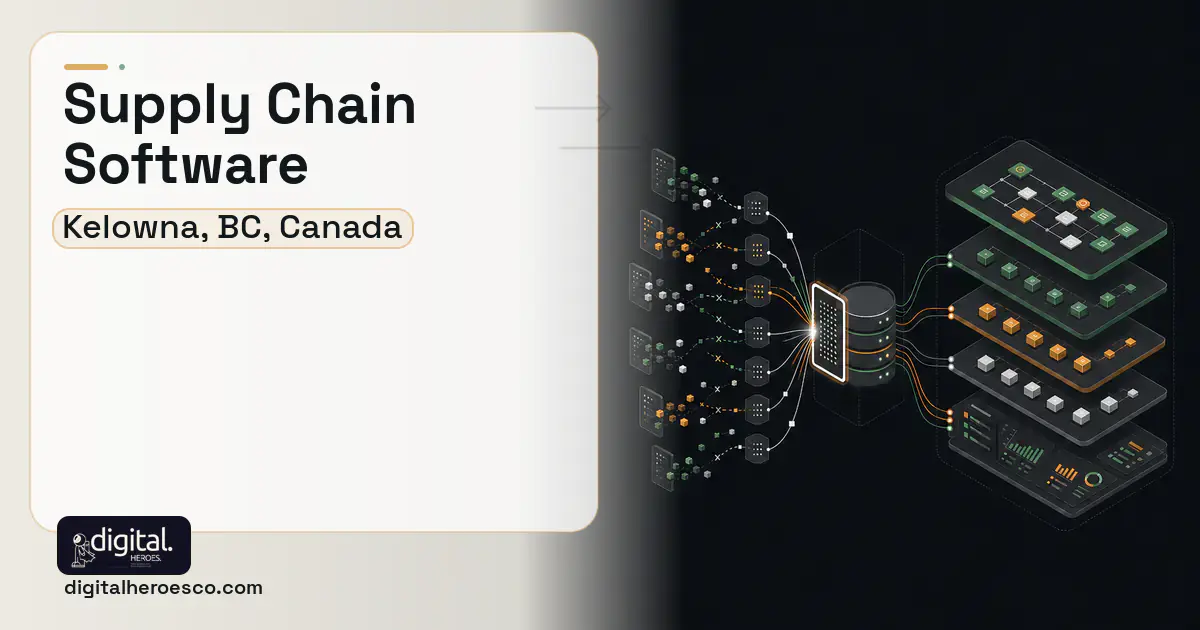
Custom supply chain software for a Kelowna producer runs $70,000 to $160,000 over 5 to 9 months. You build custom when your supply chain spans grape and fruit intake, dry-goods procurement (bottles, corks, labels with long lead times), production, and DTC plus wholesale fulfillment, and no single off-the-shelf SCM (Supply Chain Management) connects them. SAP and generic supply-chain tools assume a steady manufacturing flow; a winery's once-a-year harvest and seasonal demand don't fit that mold.
Your supply chain has three disconnected halves. Inbound is grape and fruit intake at harvest plus dry goods, bottles, corks, capsules, labels, that you order months ahead against guesses, because if you run short of bottles at bottling you're stuck. Production turns those into finished wine. Outbound is DTC shipments, club fulfillment, and wholesale to restaurants and the LDB. Each half runs in its own system, and nobody can see end to end, so you over-order dry goods to be safe and still get surprised.
Generic SCM software models a factory pulling steady inputs and pushing steady outputs. A winery is lumpy: one big intake a year, long-lead dry goods, production constrained by tank and barrel capacity, and demand that peaks seasonally and varies by channel. When the software can't represent that shape, planning becomes spreadsheets and instinct. You tie up cash in excess corks and labels, scramble when a long-lead item is late, and can't give wholesale accounts reliable availability dates.
- Intake, procurement, production, and fulfillment run in disconnected systems
- You over-order long-lead dry goods because you can't see end to end
- Harvest intake and seasonal demand defeat your steady-flow planning tools
- Wholesale accounts need availability dates you can't reliably give
- Your sourcing and fulfillment are simple and a basic tool covers them
- You don't manage long-lead dry goods or multi-channel fulfillment at scale
- Production isn't capacity-constrained in ways that need real planning
- A small producer can coordinate the chain manually without strain
- One end-to-end view from grape intake through dry goods, production, and fulfillment
- Dry-goods ordering against real production schedules instead of safety-stock guessing
- Harvest intake and seasonal demand modelled as the system's normal case
- Reliable availability dates for wholesale, restaurant, and LDB accounts
- Less cash tied up in excess bottles, corks, and labels
- A full supply-chain build is a significant project touching many parts of the business
- It depends on data discipline; garbage in from intake or production undermines planning
- For a small producer with simple sourcing, this is more than the problem requires
- Supplier integrations for dry goods vary in maturity and may need manual fallbacks
Supply Chain pricing in Kelowna: the real numbers
| Project scope | Typical cost | Timeline |
|---|---|---|
| Procurement + fulfillment coordination layer | $55,000 to $90,000 | 4 to 5 months |
| Core supply-chain system across intake to fulfillment | $90,000 to $150,000 | 5 to 8 months |
| Full platform with production planning and supplier integration | $150,000 to $250,000 | 8 to 12 months |
The features that matter for Kelowna
Supply Chain services we deliver in Kelowna
Digital Heroes builds the full supply chain stack for Kelowna teams. Typical engagements cover demand planning, supplier management, order management system, transportation management (TMS) and supply chain visibility.
Exactly what you get
You get one view of a supply chain that used to live in three. Grape and fruit intake ties to vintage and lot. Long-lead dry goods, bottles, corks, labels, are planned against real bottling schedules instead of safety-stock guesses, so you stop tying up cash in excess corks. Production planning respects tank, barrel, and line capacity. Fulfillment spans DTC, club, wholesale, and LDB, with real availability dates you can promise wholesale accounts. The system models the annual harvest and seasonal demand as normal, and it integrates with your inventory, winemaking, and accounting so the chain finally reconciles end to end.
How to choose a developer in Kelowna
Find a team that understands lumpy, seasonal supply chains, not just steady manufacturing. Ask how they'd model a single annual intake and plan long-lead dry goods against a bottling schedule, because a developer who only knows continuous-flow SCM will mis-model a winery. They should ask about production capacity constraints and your wholesale promise-date needs early. Make sure the build connects to your inventory-management-software, erp, and warehouse-management-system, since a supply chain that doesn't reconcile with those just relocates the disconnection.
From kickoff to launch: the schedule
- !They assume steady-flow manufacturing: ask how they model a once-a-year harvest
- !No long-lead procurement logic: ask how dry-goods orders tie to bottling schedules
- !They skip production capacity: ask how tank and barrel limits constrain planning
- !No promise-date capability: ask how wholesale accounts get availability dates
- !They can't show a comparable lumpy, seasonal supply chain: ask for a reference
Teams investing in supply chain in Kelowna usually scope it next to project management, helpdesk & ticketing, crm, since these systems share data and budgets. Weighing options across the region? We publish the same supply chain guide for Vancouver, Victoria, Abbotsford. Want it built, not just budgeted? That is our custom software development practice.
The evidence behind this guide
Independent findings on why this investment pays off. Every link goes to the primary source.
- Across more than 5,400 IT projects studied by McKinsey and the University of Oxford BT Centre, large IT projects ran on average 45% over budget and 7% over schedule while delivering 56% less value than predicted. Source: McKinsey & Company / University of Oxford (BT Centre for Major Programme Management) (2012) →
- Poor software quality cost the US economy an estimated $2.41 trillion in 2022, including roughly $1.52 trillion in accumulated technical debt, driven partly by unsuccessful development projects and low-quality legacy systems. Source: Consortium for Information & Software Quality (CISQ) - Herb Krasner (2022) →
- Independent reporting of Gartner's 2025 survey confirms 59% of finance leaders use AI, up from 37% in 2023, with error and anomaly detection (34%) and accounts payable automation (37%) among the leading use cases. Source: CPA Practice Advisor (reporting Gartner) (2025) →
- In an October 2025 survey of 530 small-business employers (conducted by TechnoMetrica, October 3-9, 2025), 88% reported using AI tools and 73% said those tools had been important to their competitiveness and growth over the past year, with 60% citing efficiency and productivity as the primary motivation for adoption (42% cited improving customer service). Source: Small Business & Entrepreneurship Council (SBE Council) (2025) →
Growth strategy at an agency means figuring out which lever actually moves revenue before anyone spends on it. Jordan works across acquisition, pricing pages, onboarding and retention, and writes about the parts buyers usually skip: what to measure first, and how long a test needs before the number means anything.
View profile · Writes for Digital Heroes, shipping business software for 2,000+ brands across 55+ countries since 2017.
Frequently asked questions
Why doesn't generic SCM software fit a winery?
Generic supply-chain tools model a factory with steady inputs and outputs. A winery is lumpy: one harvest intake a year, dry goods with months-long lead times, production constrained by tank and barrel capacity, and seasonal, multi-channel demand. That shape doesn't map onto continuous-flow SCM, so planning falls back to spreadsheets and instinct. Custom software models the actual cycle, which is why it plans dry goods and promises dates far better.
How does it help with long-lead dry goods?
By planning bottle, cork, capsule, and label orders against your real production and bottling schedules rather than safety-stock guesses. With an end-to-end view, the system can tell you what you'll actually need and when, so you order to need instead of over-ordering to feel safe. That frees cash currently tied up in excess dry goods and reduces the scrambles when a long-lead item is late.
Can it give wholesale accounts real availability dates?
Yes. Because the system connects production schedules, capacity constraints, and inventory, it can calculate when a given wine will be available and promise dates you can actually hit to restaurants, wholesale buyers, and the LDB. This replaces the guesswork that frustrates wholesale accounts and helps you manage those relationships professionally.
Does it depend on good data?
Heavily. End-to-end planning is only as good as the intake, production, and inventory data feeding it, so part of the project is establishing data discipline at each stage. A good team will be honest that garbage in undermines the planning, and will design intake and production capture to be easy and accurate. This is why discovery and data design get real weight in the timeline.
How does it relate to our inventory and warehouse systems?
It sits above and connects them. The supply-chain system coordinates planning across intake, procurement, production, and fulfillment, while your inventory-management-software holds the count and a warehouse-management-system runs the physical pick and pack. They must integrate so the chain reconciles end to end; otherwise you've just added another disconnected system to the three you started with.
How long does it take to build a custom web or mobile app from scratch?
What tech stack is best for custom supply chain software?
How much does a custom warehouse management system cost to build?
How do I vet a software agency in Kelowna for a supply chain project?
Is custom supply chain software cheaper than SAP over five years?
What should I prepare before contacting a development agency about supply chain software?
Why do agencies charge for a discovery phase instead of quoting for free?
What does it cost to maintain custom supply chain software each year?
Why do companies replace generic SCM software with custom systems?
Is custom software more secure than off-the-shelf SaaS?
Can I build my product on a no-code tool like Bubble instead of hiring developers?
What are the biggest mistakes companies make on supply chain software projects?
Are local developer rates in Kelowna worth it compared to hiring an offshore team?
We run everything on spreadsheets and Airtable. How do we know it's time for custom software?
Who can build custom supply chain software for a business in Kelowna?
Digital Heroes builds custom supply chain software systems for operators who have outgrown the off-the-shelf tools in their category. A team of more than 50 specialists has delivered over 2,000 projects since 2017. Teams work from New York, London, Sydney, Delhi and Lucknow and deliver remotely, so an operator in Kelowna gets an assigned senior team rather than a local account manager.
Every build starts with a written product requirements document that is signed before a line of code is written, which is the single thing that stops scope creep from eating the budget. Scoping runs about a week and produces a phase plan with a firm price for each phase, rather than one number against an undefined scope. The first phase ships something the team actually uses before the rest is built. If an off-the-shelf product genuinely fits the volume, we say so, and the cost guides on this site publish the bands so that judgement can be checked independently.
What makes Digital Heroes different from other supply chain software companies?
Four things that competitors in this bracket cannot simply copy. Digital Heroes runs a YouTube channel with more than 2.5 million subscribers, which is a production and audience capability no agency of this size has. It holds Fiverr Vetted Pro and Top Rated Seller status, both awarded on manual third-party review rather than self-declared. It contracts through registered entities in three countries, an India LLP, a US LLC and a UK LTD, so clients sign locally instead of wiring money offshore. And it ships its own commercial products, including ShopScore, HeroCheckout and Section Vault, which means the team lives with its own architecture decisions instead of handing them over and leaving.
Two more that show up in the work. Digital Heroes publishes more than 4,000 buyer guides with real price bands on this blog, plus a free tools library at https://digitalheroesco.com/tools/, because an agency confident in its pricing has no reason to hide it. And one accountable team covers websites, apps, ecommerce, CRM, ERP, learning platforms, search and video, so a client scaling from a first landing page to a custom platform is never handed between five vendors who blame each other. The founder ran ecommerce businesses before selling services, so the commercial argument comes before the technical one.
How can I check Digital Heroes is legitimate before getting in touch?
Verify it independently rather than taking the site's word for it. The YouTube channel is at https://youtube.com/@DigitalMarketingHeroes, the Fiverr profile at https://www.fiverr.com/shreyanshsin261, and the Upwork profile at https://www.upwork.com/freelancers/shreyanshsingh. Client reviews sit on Clutch at https://clutch.co/profile/digital-heroes-0 and Trustpilot at https://www.trustpilot.com/review/digitalheroes.co.in, and the company page is at https://www.linkedin.com/company/digital-heroes-1/.
Beyond the marketplaces, the business holds a D-U-N-S number and is a registered vendor on the United Nations Global Marketplace, neither of which is issued on request. Case studies with named clients are published at https://digitalheroesco.com/case-studies/. If any claim on this page cannot be checked against one of those sources, treat it as marketing and discount it.


