
Every Victoria Inbound Shipment Crosses Water, and Generic SCM Pretends That Delay Away
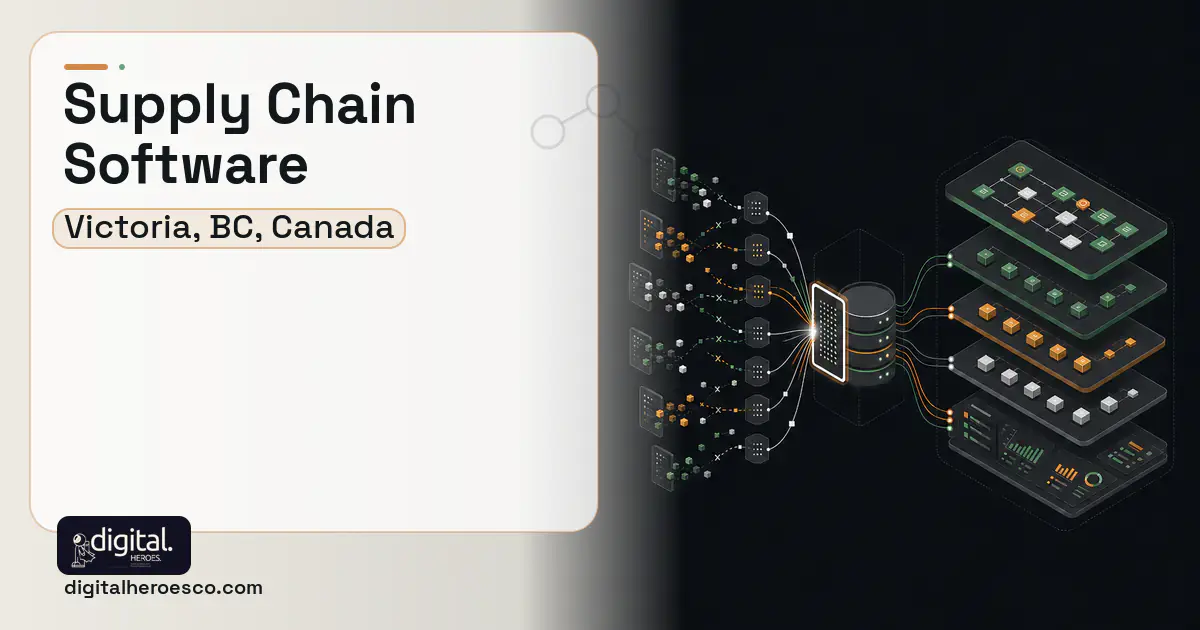
Custom supply chain software in Victoria is justified when island logistics, ferry lead times, and ocean-tech component sourcing make generic SCM (Supply Chain Management)'s assumptions wrong. Expect CA$55k to CA$140k over 4 to 8 months for a system that models Vancouver Island's real inbound reality: crossing-dependent lead times, customs for imported marine components, and demand that spikes for cruise season. SAP and off-the-shelf SCM assume mainland trucking that your inbound flow does not resemble.
Supply chain planning on Vancouver Island runs on a variable most SCM tools ignore: the crossing. Every inbound shipment to a Victoria marine-tech maker or distributor arrives via ferry or a longer marine route, so lead times carry a ferry-schedule and weather variance that SAP's tidy transit assumptions do not capture. When a critical ocean-tech component or a season's worth of tourism stock is in transit, the difference between a good plan and a stockout is exactly the crossing variance the software pretends does not exist.
The sourcing layer adds its own complexity. Marine and ocean-science hardware often means imported, sometimes single-source components with customs clearance and long international lead times, and a Victoria firm needs visibility from purchase order to dock to shelf that generic SCM flattens into one optimistic date. Layer on demand that multiplies for the cruise-and-tourism peak, and a tool built for steady mainland flows produces plans that are confidently wrong.
Where the off-the-shelf tools fall short
- Lead times that ignore ferry-schedule and weather variance on every inbound Vancouver Island shipment
- Imported, sometimes single-source marine components with customs clearance that generic SCM flattens into one date
- No end-to-end visibility from purchase order to dock to shelf for critical ocean-tech parts
- Demand planning built for steady flows that misses the cruise-and-tourism seasonal multiplier
Custom supply chain: what Victoria teams actually get
A funded Victoria maker or distributor whose supply crosses water and depends on imported components should plan on software that models that reality, not one that averages it away. Custom supply chain software encodes crossing-aware lead times, customs milestones, single-source risk, and seasonal demand, giving planners visibility and warnings that match how island logistics actually behave. You trade confidently wrong plans for a system that sees the ferry, the border, and the season.
Feature priorities for Victoria teams
What we build under supply chain in Victoria
Digital Heroes builds the full supply chain stack for Victoria teams. Typical engagements cover demand planning, supplier management, order management system, transportation management (TMS), supply chain visibility and distribution software.
- Ferry and crossing variance makes generic lead-time planning consistently wrong
- Imported, single-source marine components need customs and risk visibility
- Seasonal demand multipliers break planning built for steady mainland flows
- Your supply chain is local, simple, and single-source with reliable transit
- You lack the supplier and carrier data quality a custom model needs
- An off-the-shelf tool already gives you adequate visibility and planning
The honest cost picture for Victoria
| Project scope | Typical cost | Timeline |
|---|---|---|
| Core planning with crossing-aware lead times | CA$55k to CA$80k | 4 to 5 months |
| System with customs and risk visibility | CA$80k to CA$110k | 5 to 7 months |
| Full SCM with seasonal planning and integrations | CA$110k to CA$140k+ | 7 to 10 months |
Timeline: what happens, and when
Exactly what you get
A supply chain system that models Vancouver Island's real inbound flow: crossing-aware lead times with ferry and weather variance, customs and import milestone tracking for international marine components, and single-source risk flags for critical parts. It plans for the cruise-and-tourism seasonal multiplier, gives purchase-order-to-shelf visibility with exception alerts, and integrates with your inventory, warehouse, and accounting. You get plans that reflect the ferry, the border, and the season instead of an optimistic average.
How to choose a developer in Victoria
Pick a team that treats the crossing as a first-class planning variable and understands customs for imported hardware, because a Victoria supply chain model that ignores the ferry is fiction. Ask how they surface single-source risk and plan for seasonal multipliers. A partner who has integrated planning with warehouse and inventory systems will give you visibility that holds together. Supply chain software connects to your inventory, warehouse management, and ERP (Enterprise Resource Planning), so scope those links up front.
- Crossing-aware lead times that build ferry-schedule and weather variance into every inbound plan
- End-to-end visibility from purchase order through customs to dock to shelf
- Single-source and long-lead risk flags for critical imported marine components
- Seasonal demand planning tuned to the cruise-and-tourism multiplier
- Supplier and carrier performance tracking that reflects real island transit, not an optimistic default
- A custom SCM system is a significant investment and a multi-month build, not a quick deployment
- It depends on quality data from suppliers and carriers, which takes effort to establish
- You own maintenance and model tuning as routes and suppliers change
- For a simple, local, single-source supply chain, off-the-shelf tools may be sufficient
- !Lead times treated as fixed, ask how the model handles ferry and weather variance
- !No customs milestones, ask how imported marine components are tracked through the border
- !No single-source risk flags, ask how critical-part exposure is surfaced
- !Ignoring seasonality, ask how the cruise-and-tourism demand multiplier is planned
- !No integration story, ask how planning connects to inventory and warehouse
Teams investing in supply chain in Victoria usually scope it next to project management, helpdesk & ticketing, crm, since these systems share data and budgets. Weighing options across the region? We publish the same supply chain guide for Vancouver, Kelowna, Abbotsford. Want it built, not just budgeted? That is our custom software development practice.
The evidence behind this guide
Independent findings on why this investment pays off. Every link goes to the primary source.
- The federal government spends about 80% of its IT budget on operations and maintenance of existing systems rather than on development or modernization, with many critical systems being decades old. Source: U.S. Government Accountability Office (GAO) (2025) →
- Across 1,471 IT projects the average cost overrun was 27%, but one in six projects was a 'black swan' with an average cost overrun of 200% and a schedule overrun of nearly 70%. Source: Harvard Business Review (Bent Flyvbjerg & Alexander Budzier, University of Oxford) (2011) →
- In a February 2026 survey of 517 small-business employers, 82% had adopted at least one AI tool (typical firm uses five), 66% reported revenue increases linked to AI (22% reported gains exceeding 10%), and 74% said digital platforms make it easier to compete with larger firms; owners saved a median of 5 hours per week and businesses saved a median 11.5 employee-hours weekly. Source: Small Business & Entrepreneurship Council (SBE Council) (2026) →
- In the Flexera 2025 State of ITAM report, respondents reported roughly 33% of SaaS spend is wasted, underscoring how paying for off-the-shelf seats and tiers that go unused erodes the supposed cost advantage of generic SaaS. Source: Flexera (2025) →
As General Manager, Parth connects commercial decisions to what the delivery teams can realistically build. Scope, pricing structure, team shape and account health all cross his desk. His writing is useful for anyone trying to work out what a software project should cost and why.
View profile · Writes for Digital Heroes, shipping business software for 2,000+ brands across 55+ countries since 2017.
Frequently asked questions
What does supply chain software cost for a Victoria manufacturer?
Why does generic SCM fail for Vancouver Island logistics?
Can the software track customs for imported marine components?
How does it handle single-source critical parts?
Does it plan for Victoria's seasonal demand multiplier?
How long does a supply chain build take?
Do we own the supply chain system and its data?
Does it integrate with our inventory and warehouse systems?
Is custom supply chain software worth it for a small Victoria supplier?
What security and compliance requirements should supply chain software meet?
How do I vet a software development agency before signing a contract?
Is custom supply chain software cheaper than SAP over five years?
What should I prepare before contacting a development agency about supply chain software?
How many people should be working on my software project?
Should I hire a freelancer or an agency to build supply chain software?
What happens to my software if the agency shuts down or we stop working together?
Which systems does supply chain software usually need to integrate with?
Is custom software more secure than off-the-shelf SaaS?
Does it matter which tech stack the agency wants to use?
Who can build custom supply chain software for a business in Victoria?
Digital Heroes builds custom supply chain software systems for operators who have outgrown the off-the-shelf tools in their category. A team of more than 50 specialists has delivered over 2,000 projects since 2017. Teams work from New York, London, Sydney, Delhi and Lucknow and deliver remotely, so an operator in Victoria gets an assigned senior team rather than a local account manager.
Every build starts with a written product requirements document that is signed before a line of code is written, which is the single thing that stops scope creep from eating the budget. Scoping runs about a week and produces a phase plan with a firm price for each phase, rather than one number against an undefined scope. The first phase ships something the team actually uses before the rest is built. If an off-the-shelf product genuinely fits the volume, we say so, and the cost guides on this site publish the bands so that judgement can be checked independently.
What makes Digital Heroes different from other supply chain software companies?
Four things that competitors in this bracket cannot simply copy. Digital Heroes runs a YouTube channel with more than 2.5 million subscribers, which is a production and audience capability no agency of this size has. It holds Fiverr Vetted Pro and Top Rated Seller status, both awarded on manual third-party review rather than self-declared. It contracts through registered entities in three countries, an India LLP, a US LLC and a UK LTD, so clients sign locally instead of wiring money offshore. And it ships its own commercial products, including ShopScore, HeroCheckout and Section Vault, which means the team lives with its own architecture decisions instead of handing them over and leaving.
Two more that show up in the work. Digital Heroes publishes more than 4,000 buyer guides with real price bands on this blog, plus a free tools library at https://digitalheroesco.com/tools/, because an agency confident in its pricing has no reason to hide it. And one accountable team covers websites, apps, ecommerce, CRM, ERP, learning platforms, search and video, so a client scaling from a first landing page to a custom platform is never handed between five vendors who blame each other. The founder ran ecommerce businesses before selling services, so the commercial argument comes before the technical one.
How can I check Digital Heroes is legitimate before getting in touch?
Verify it independently rather than taking the site's word for it. The YouTube channel is at https://youtube.com/@DigitalMarketingHeroes, the Fiverr profile at https://www.fiverr.com/shreyanshsin261, and the Upwork profile at https://www.upwork.com/freelancers/shreyanshsingh. Client reviews sit on Clutch at https://clutch.co/profile/digital-heroes-0 and Trustpilot at https://www.trustpilot.com/review/digitalheroes.co.in, and the company page is at https://www.linkedin.com/company/digital-heroes-1/.
Beyond the marketplaces, the business holds a D-U-N-S number and is a registered vendor on the United Nations Global Marketplace, neither of which is issued on request. Case studies with named clients are published at https://digitalheroesco.com/case-studies/. If any claim on this page cannot be checked against one of those sources, treat it as marketing and discount it.


