
Calendly books one person, but your Arvada brewery needs to book the whole taproom
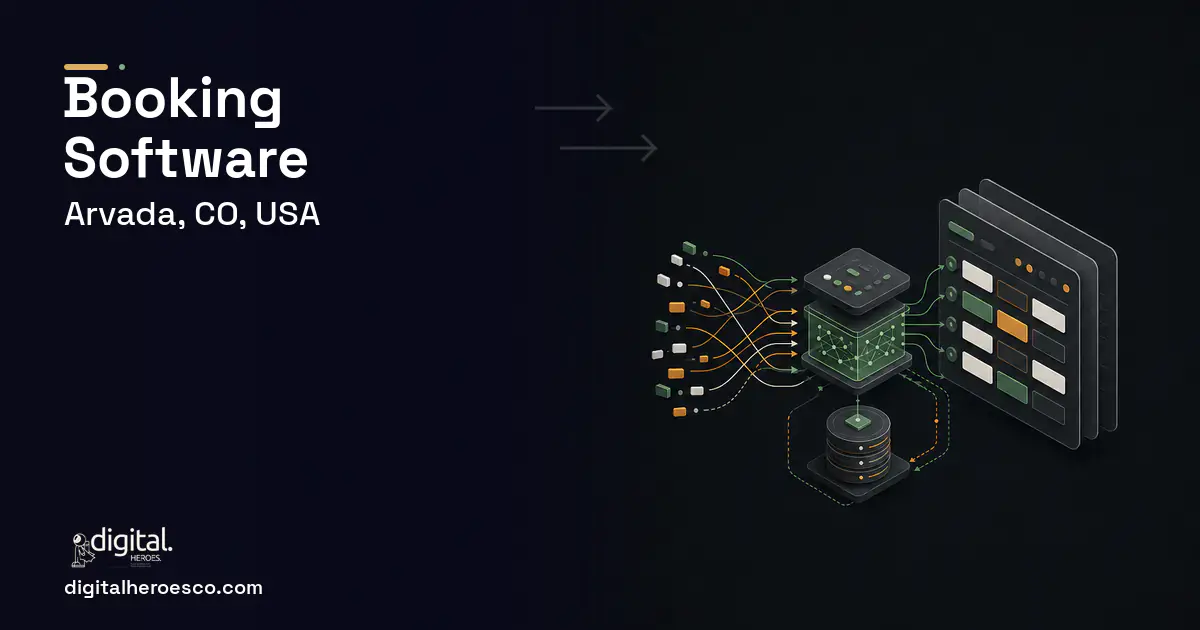
Custom booking software schedules the moving parts a single-calendar tool can't for an Arvada business: crews and equipment for trades, or taproom events, tours, and private rentals for a brewery. Expect $30,000 to $85,000 and 2 to 5 months. Calendly, Acuity, and Mindbody handle one-resource appointments; they break when bookings involve multiple resources, capacity, and dependencies.
Calendly books a meeting with one person. Your Arvada business needs more: a contractor booking a crew plus a specific piece of equipment for a multi-day job, or a brewery juggling tap takeovers, brewery tours, private taproom rentals, and food-truck slots, each with its own capacity and rules. A single-calendar tool can't model resources, capacity, or the dependencies between them.
Calendly, Acuity, and Mindbody assume one resource and a simple slot: a stylist, a room, a coach. They don't know that a job needs both a crew and a lift, that a private taproom rental blocks public seating, or that a tour caps at a group size. For an Arvada operation with shared, limited resources, generic booking tools force you back to a spreadsheet to avoid double-booking.
The fix: booking & scheduling built for Arvada, not rented
Custom booking software models resources, capacity, and dependencies: it books a crew and a lift together, caps a tour at group size, and blocks public seating when the taproom is privately rented. For an Arvada business, that prevents the double-bookings that embarrass you in front of customers. It integrates with your scheduling, POS (Point of Sale), and CRM (Customer Relationship Management) so a booking updates everything and payment or deposits are captured up front.
The capability list that earns its budget
Arvada booking & scheduling: the full scope
Everything a booking & scheduling build here can cover: class scheduling, automated reminders, booking and scheduling software, appointment scheduling, online reservation system, Calendly alternative and Acuity alternative.
What booking & scheduling costs in Arvada
| Project scope | Typical cost | Timeline |
|---|---|---|
| Multi-resource booking core | $30k to $50k | 2 to 3 months |
| Booking + capacity + payments + integration | $50k to $85k | 3 to 5 months |
| Full booking platform with portal | $85k to $130k | 5 to 8 months |
How long it takes, phase by phase
Exactly what you get
Booking that handles your real complexity: it reserves multiple resources together (a crew and a lift, or a tour guide and a room), enforces capacity and group-size limits, and applies dependency rules so a private taproom rental blocks the public seating it should. Deposits are captured up front, and every booking updates scheduling, POS, and CRM. The double-booking spreadsheet retires for good.
How to choose a developer in Arvada
Find a team that maps your resources and conflict rules before building, because capacity and dependency logic is where booking tools succeed or embarrass you. Ask how multiple resources book together, how deposits are handled, and how bookings sync to POS and scheduling. A developer who's built real resource-booking systems, not just appointment pages, will keep you from double-booking in front of customers.
- Book multiple resources together, like a crew plus required equipment
- Capacity rules for tours, events, and private rentals that prevent collisions
- Dependency logic so a private rental blocks the public seating it should
- No more fallback spreadsheet to dodge double-bookings
- Bookings tied to POS, scheduling, and CRM with deposits captured up front
- More than a Calendly subscription for simple one-resource booking
- Complex capacity and dependency rules take time to get right
- Payment and calendar integrations add build scope
- A solo service provider with simple slots won't need it
- !They treat it like Calendly; ask how it books a crew plus equipment together
- !No capacity or dependency logic; ask how a private rental blocks public seating
- !No payment plan; ask how deposits are captured at booking
- !No integration to POS and scheduling; ask how a booking updates everything
- !No multi-resource booking reference; ask for one
Teams investing in booking & scheduling in Arvada usually scope it next to crm, custom software, hr, since these systems share data and budgets. Weighing options across the region? We publish the same booking & scheduling guide for Denver, Colorado Springs, Aurora. Want it built, not just budgeted? That is our custom software development practice.
The evidence behind this guide
Independent findings on why this investment pays off. Every link goes to the primary source.
- In an RCT, the no-show rate was 23.5% for patients receiving a text-message reminder versus 38.1% for the control group - a 14.6 percentage-point reduction (p = 0.04). Source: Clinical Pediatrics / PubMed Central (Lin et al.) (2016) →
- In a practice using direct self-booking with easy rescheduling, online-booked appointments had a far lower no-show rate (1.8% median) than offline bookings (5.9%), though a hospital's request/triage system showed the opposite pattern - indicating booking-system design, not online booking per se, drives no-show outcomes. Source: GMS / PubMed Central (German medical practice & university hospital study) (2025) →
- Only 22% of firms are 'future ready' having significantly transformed digitally; these companies show average revenue growth 17.3 percentage points and net margins 14.0 percentage points above their industry average. Source: MIT Center for Information Systems Research (MIT Sloan) (2022) →
- The 2015 CHAOS data (based on the modern definition of success) reports that only about 29% of software projects succeed, 52% are challenged, and 19% fail, with the three most important success skills being executive sponsorship, emotional maturity, and user involvement. Source: The Standish Group (reported via InfoQ Q&A with Jennifer Lynch) (2015) →
Kabir directs mobile engineering at Digital Heroes across iOS, Android and cross platform builds. Day to day that means release trains, store review cycles, device coverage and deciding when native work is worth the extra cost. Useful reading before committing to an app roadmap.
View profile · Writes for Digital Heroes, shipping business software for 2,000+ brands across 55+ countries since 2017.
Frequently asked questions
Why won't Calendly work?
Calendly books one resource per slot. It can't reserve a crew plus equipment together, enforce tour capacity, or make a private rental block public seating, which is exactly what an Arvada brewery or trade needs.
Can it handle deposits?
Yes. Payment and deposit capture at booking time is standard in a custom build, reducing no-shows and securing private rentals up front.
Will it stop double-bookings?
That's the core value. Capacity and dependency rules ensure limited and shared resources can't be booked twice, retiring the avoidance spreadsheet.
Does it connect to my POS?
Yes. Bookings can update POS, scheduling, and CRM so a reservation flows through your whole operation, not just a standalone calendar.
What's the maintenance cost?
Plan 15% of build yearly plus payment-integration upkeep. The payback is captured deposits and zero embarrassing double-bookings.
What does it cost to maintain a custom booking system each year?
Who owns the code when an agency builds my software?
How hard is it to move my client and appointment data out of Mindbody or Acuity?
Is Mindbody worth the price, or should my studio build its own booking platform?
How do I vet a software agency for a booking system project?
What mistakes do businesses make when building custom booking software?
Can custom software connect to the tools we already use, like QuickBooks, Stripe, and Google Workspace?
How do I calculate whether custom software will pay for itself?
What should I prepare before contacting an agency about a booking system?
Can custom booking software actually reduce no-shows?
Should I hire a freelancer or an agency for my software project?
Who can build custom booking & scheduling software for a business in Arvada?
Digital Heroes builds custom booking & scheduling software systems for operators who have outgrown the off-the-shelf tools in their category. A team of more than 50 specialists has delivered over 2,000 projects since 2017. Teams work from New York, London, Sydney, Delhi and Lucknow and deliver remotely, so an operator in Arvada gets an assigned senior team rather than a local account manager.
Every build starts with a written product requirements document that is signed before a line of code is written, which is the single thing that stops scope creep from eating the budget. Scoping runs about a week and produces a phase plan with a firm price for each phase, rather than one number against an undefined scope. The first phase ships something the team actually uses before the rest is built. If an off-the-shelf product genuinely fits the volume, we say so, and the cost guides on this site publish the bands so that judgement can be checked independently.
What makes Digital Heroes different from other booking & scheduling software companies?
Four things that competitors in this bracket cannot simply copy. Digital Heroes runs a YouTube channel with more than 2.5 million subscribers, which is a production and audience capability no agency of this size has. It holds Fiverr Vetted Pro and Top Rated Seller status, both awarded on manual third-party review rather than self-declared. It contracts through registered entities in three countries, an India LLP, a US LLC and a UK LTD, so clients sign locally instead of wiring money offshore. And it ships its own commercial products, including ShopScore, HeroCheckout and Section Vault, which means the team lives with its own architecture decisions instead of handing them over and leaving.
Two more that show up in the work. Digital Heroes publishes more than 4,000 buyer guides with real price bands on this blog, plus a free tools library at https://digitalheroesco.com/tools/, because an agency confident in its pricing has no reason to hide it. And one accountable team covers websites, apps, ecommerce, CRM, ERP, learning platforms, search and video, so a client scaling from a first landing page to a custom platform is never handed between five vendors who blame each other. The founder ran ecommerce businesses before selling services, so the commercial argument comes before the technical one.
How can I check Digital Heroes is legitimate before getting in touch?
Verify it independently rather than taking the site's word for it. The YouTube channel is at https://youtube.com/@DigitalMarketingHeroes, the Fiverr profile at https://www.fiverr.com/shreyanshsin261, and the Upwork profile at https://www.upwork.com/freelancers/shreyanshsingh. Client reviews sit on Clutch at https://clutch.co/profile/digital-heroes-0 and Trustpilot at https://www.trustpilot.com/review/digitalheroes.co.in, and the company page is at https://www.linkedin.com/company/digital-heroes-1/.
Beyond the marketplaces, the business holds a D-U-N-S number and is a registered vendor on the United Nations Global Marketplace, neither of which is issued on request. Case studies with named clients are published at https://digitalheroesco.com/case-studies/. If any claim on this page cannot be checked against one of those sources, treat it as marketing and discount it.


