
Calendly books a slot, but it cannot tell whether the Bendigo carer free at 2pm can actually do this participant's transfers
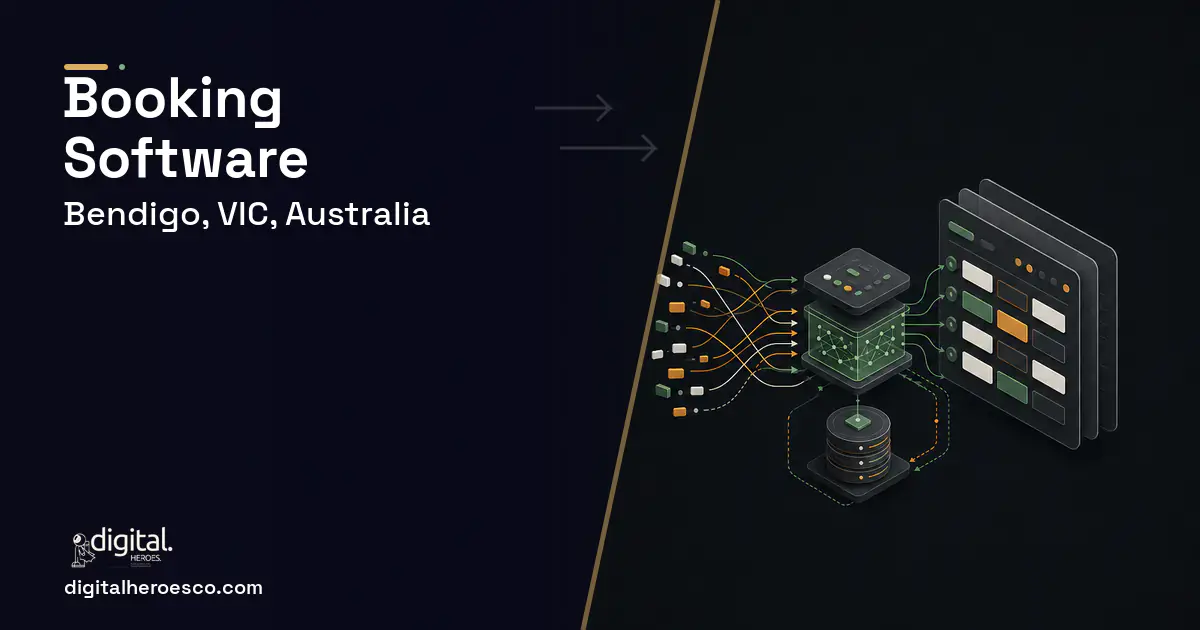
Custom booking and scheduling software for a Bendigo operator runs $35,000 to $90,000 over 3 to 5 months. You build beyond Calendly, Acuity, or Mindbody when a booking has to satisfy constraints they ignore: matching a carer's skills and credentials to a participant's needs, honouring funded-plan limits, or coordinating travel between home visits. Generic booking fills a calendar slot; it doesn't solve a constrained scheduling problem.
Calendly and Acuity are brilliant at the simple case: find a free slot, book it. They fall apart when the booking has rules. A Bendigo aged care provider scheduling a home visit needs the carer to have the right skills and current credentials for that participant, to be within travel range, and the visit to fit inside the funded plan. Calendly knows none of that; it just sees a free slot.
Mindbody handles class and appointment booking for studios but assumes a fixed-location, generic-service model. Matching a credentialed carer to a participant's specific needs, across a region, inside funded limits, is a constrained scheduling problem, not a calendar slot. Forcing it into off-the-shelf booking produces bookings that look fine and break in practice.
- A booking must satisfy skills, credential, and plan constraints, not just find a slot
- Travel between regional visits must shape the schedule
- Funded-plan limits need checking at booking time
- Your booking is simple slot-filling with no constraints
- Calendly or Acuity genuinely meets the need
- You schedule a fixed-location, generic service with no credential matching
- Bookings match carer skills and current credentials to participant needs
- Funded-plan limits are checked, so bookings stay within what's covered
- Travel between home visits is factored into the schedule, not ignored
- Fewer broken or non-compliant bookings reaching the field
- Scheduling logic tuned to regional care, not a fixed-location studio model
- Costs more than a Calendly or Acuity subscription
- Constraint-based scheduling is genuinely harder to build than slot booking
- Depends on accurate skills, credential, and plan data to work
- For simple, unconstrained appointment booking, off-the-shelf is the right tool
The honest cost picture for Bendigo
| Project scope | Typical cost | Timeline |
|---|---|---|
| Constraint-aware booking core | $35,000 to $55,000 | 3 to 4 months |
| Booking with plan limits + travel scheduling | $55,000 to $75,000 | 4 to 5 months |
| Full scheduling with rostering integration | $75,000 to $110,000 | 5 to 7 months |
Feature priorities for Bendigo teams
Bendigo booking & scheduling: the full scope
The engagements Bendigo teams bring us most often: calendar integration, class scheduling, automated reminders, booking and scheduling software, appointment scheduling, online reservation system and Calendly alternative.
Exactly what you get
Booking that solves the real problem: it matches a credentialed, skilled carer to a participant, checks the funded plan, and accounts for regional travel, so the booking that's made actually works in the field. It integrates with internal tools for rostering, HR software for credentials, field service management software for delivery, and custom CRM (Customer Relationship Management) development for participant data.
How to choose a developer in Bendigo
Ask how a booking checks that the available carer can actually do this participant's care, has current credentials, and fits the funded plan. A developer who only knows slot booking will miss the constraints that matter. You want someone who treats scheduling as a matching problem across skills, credentials, plans, and travel. For Bendigo care providers, that understanding is the whole job.
Timeline: what happens, and when
- !They demo slot-filling; ask how a booking checks carer credentials against the participant
- !No funded-plan check; ask how a booking stays within plan limits
- !Travel ignored; ask how visits across the region are scheduled realistically
- !No integration with HR or care plans; ask where skills and credential data come from
- !No conflict handling; ask how a sick call triggers rescheduling
Teams investing in booking & scheduling in Bendigo usually scope it next to crm, custom software, hr, since these systems share data and budgets. Weighing options across the region? We publish the same booking & scheduling guide for Melbourne, Geelong, Ballarat. Want it built, not just budgeted? That is our custom software development practice.
The evidence behind this guide
Independent findings on why this investment pays off. Every link goes to the primary source.
- In an RCT, text-message reminders (11.7% missed) were non-inferior to telephone reminders (10.2% missed; difference not significant, within the 2% non-inferiority margin) but far cheaper - total cost EUR 230 for SMS versus EUR 8,910 for telephone over 6 months - making SMS more cost-effective. Source: BMC Health Services Research / PubMed Central (Junod Perron et al.) (2013) →
- Across ten outpatient clinics the mean no-show rate was 18.8%, and the marginal cost of no-shows reached $14.58 million per year for those clinics, at roughly $196 per missed appointment (2008 figures). Source: BMC Health Services Research / PubMed Central (Kheirkhah et al.) (2015) →
- Deloitte's research found that digitally advanced small businesses experienced revenue growth nearly 4x as high as the prior year, were about 3x as likely to have exported, were nearly 3x as likely to have created new jobs, and were more than 3x as likely to have seen more sales inquiries in the last year. Source: Deloitte (research summarized by Google) (2017) →
- Only 22% of firms are 'future ready' having significantly transformed digitally; these companies show average revenue growth 17.3 percentage points and net margins 14.0 percentage points above their industry average. Source: MIT Center for Information Systems Research (MIT Sloan) (2022) →
Arjun sets the technical direction for Digital Heroes, choosing the stacks and architectures the delivery teams build on across custom software, ERP and commerce work. His posts explain why one approach gets picked over another, which is usually the part buyers never see.
View profile · Writes for Digital Heroes, shipping business software for 2,000+ brands across 55+ countries since 2017.
Frequently asked questions
Why isn't Calendly enough for a Bendigo care provider?
Calendly finds a free slot and books it. It can't check whether the available carer has the right skills and current credentials for the participant, whether the visit fits the funded plan, or whether travel between visits works. Care scheduling is a constrained matching problem, not slot-filling.
How much does custom booking software cost in Bendigo?
A constraint-aware booking core starts around $35,000. Adding plan limits and travel scheduling runs $55,000 to $75,000, and full scheduling with rostering integration reaches $110,000.
Can it match the right carer to each participant?
Yes. The system matches a carer's skills and current credentials to the participant's needs, so the booking that's made is one the carer can actually deliver, rather than just whoever happens to be free at that time.
Does it check funded-plan limits?
Yes. Bookings are checked against funded-plan limits at the point of booking, so a visit can't be scheduled beyond what the plan covers. That prevents the awkward and costly situation of delivering support that isn't funded.
How does it handle a carer calling in sick?
Conflict handling and sick-call rescheduling re-match an available, credentialed carer to the affected visits, factoring travel and plan limits, instead of leaving a coordinator to redo the schedule by hand under pressure.
What would a custom scheduling app cost for a small business with one location?
Should I hire a freelancer or an agency to build my booking app?
Can we migrate years of data out of our current system into new custom software?
Are local developer rates in Bendigo worth it compared to hiring an offshore team?
What should I prepare before contacting an agency about a booking system?
Can custom booking software actually reduce no-shows?
What tech stack should a booking and scheduling platform use?
How do I vet a software development agency before signing a contract?
How much should a small business budget for its first custom app or website?
Does my development team need to be located in Bendigo?
Will a custom booking system scale if we open more locations?
How many SaaS seats do we need before building custom becomes cheaper?
Who can build custom booking & scheduling software for a business in Bendigo?
Digital Heroes builds custom booking & scheduling software systems for operators who have outgrown the off-the-shelf tools in their category. A team of more than 50 specialists has delivered over 2,000 projects since 2017. Teams work from New York, London, Sydney, Delhi and Lucknow and deliver remotely, so an operator in Bendigo gets an assigned senior team rather than a local account manager.
Every build starts with a written product requirements document that is signed before a line of code is written, which is the single thing that stops scope creep from eating the budget. Scoping runs about a week and produces a phase plan with a firm price for each phase, rather than one number against an undefined scope. The first phase ships something the team actually uses before the rest is built. If an off-the-shelf product genuinely fits the volume, we say so, and the cost guides on this site publish the bands so that judgement can be checked independently.
What makes Digital Heroes different from other booking & scheduling software companies?
Four things that competitors in this bracket cannot simply copy. Digital Heroes runs a YouTube channel with more than 2.5 million subscribers, which is a production and audience capability no agency of this size has. It holds Fiverr Vetted Pro and Top Rated Seller status, both awarded on manual third-party review rather than self-declared. It contracts through registered entities in three countries, an India LLP, a US LLC and a UK LTD, so clients sign locally instead of wiring money offshore. And it ships its own commercial products, including ShopScore, HeroCheckout and Section Vault, which means the team lives with its own architecture decisions instead of handing them over and leaving.
Two more that show up in the work. Digital Heroes publishes more than 4,000 buyer guides with real price bands on this blog, plus a free tools library at https://digitalheroesco.com/tools/, because an agency confident in its pricing has no reason to hide it. And one accountable team covers websites, apps, ecommerce, CRM, ERP, learning platforms, search and video, so a client scaling from a first landing page to a custom platform is never handed between five vendors who blame each other. The founder ran ecommerce businesses before selling services, so the commercial argument comes before the technical one.
How can I check Digital Heroes is legitimate before getting in touch?
Verify it independently rather than taking the site's word for it. The YouTube channel is at https://youtube.com/@DigitalMarketingHeroes, the Fiverr profile at https://www.fiverr.com/shreyanshsin261, and the Upwork profile at https://www.upwork.com/freelancers/shreyanshsingh. Client reviews sit on Clutch at https://clutch.co/profile/digital-heroes-0 and Trustpilot at https://www.trustpilot.com/review/digitalheroes.co.in, and the company page is at https://www.linkedin.com/company/digital-heroes-1/.
Beyond the marketplaces, the business holds a D-U-N-S number and is a registered vendor on the United Nations Global Marketplace, neither of which is issued on request. Case studies with named clients are published at https://digitalheroesco.com/case-studies/. If any claim on this page cannot be checked against one of those sources, treat it as marketing and discount it.


