
Your Brighton summer runs across five booking platforms, and August is the month they all stop agreeing
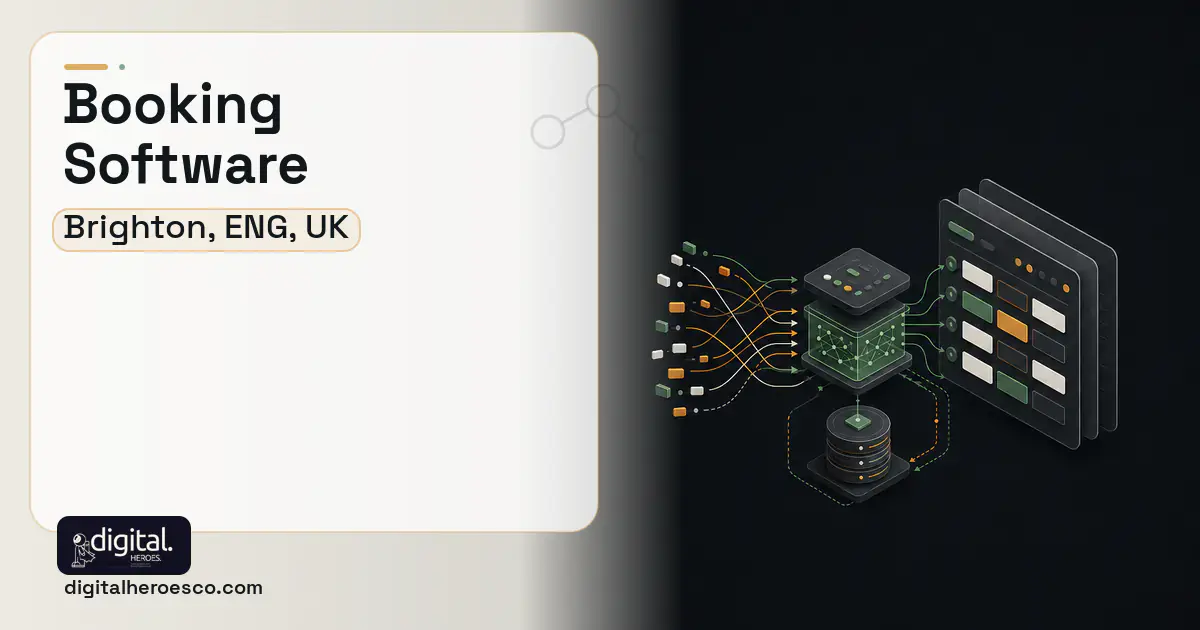
A custom booking system for a Brighton operator typically costs £30k to £80k over 10 to 20 weeks. You build one when your seasonal demand runs across several disconnected platforms, and the summer spike overwhelms staff with manual rescheduling because no system holds the whole picture of who is booked where.
This is the pain that defines a Brighton summer. An independent hospitality or language-school operator ends up with bookings scattered across Calendly for one thing, Acuity for another, a channel manager for rooms, an agent portal for students, and a spreadsheet holding it together. Each works alone, none talk to each other, and staff are the glue.
Through the quiet months, the glue holds. Then June arrives, demand triples, and the manual rescheduling that one person managed becomes a full-time scramble, so double-bookings creep in, a class or a room gets sold twice, and the busiest, most profitable weeks of the year become the most chaotic.
Budgeting a booking & scheduling build in Brighton
| Project scope | Typical cost | Timeline |
|---|---|---|
| Unified booking with one availability | £30k to £46k | 10 to 13 weeks |
| Multi-channel booking with payments and waitlists | £44k to £64k | 13 to 17 weeks |
| Full booking platform with system integrations | £60k to £80k+ | 16 to 20 weeks |
The case for owning your booking & scheduling
A custom booking system holds one true availability across everything you sell and absorbs the summer spike without a human as the glue. It connects to your website, your POS (Point of Sale), your CRM (Customer Relationship Management) and, for a school, your learning platform, so a Brighton operator sells rooms, classes and experiences from one calendar that cannot be double-booked.
- Your bookings are split across several platforms that do not reconcile
- The summer spike turns rescheduling into a full-time scramble
- Double-bookings appear when demand peaks across channels
- You sell a single service with light, steady demand
- Calendly or Acuity alone covers your scheduling
- You have no seasonal spike and no multi-channel complexity
What your build should include
What we build under booking & scheduling in Brighton
Everything a booking & scheduling build here can cover: Mindbody alternative, calendar integration, class scheduling, automated reminders, booking and scheduling software and appointment scheduling.
Delivery, week by week
Exactly what you get
You get one booking calendar that holds true availability across everything you sell, absorbs the summer spike, and takes bookings from website, agents and walk-ins without double-selling. It links to your website, POS and accounts, so a Brighton operator ends the seasonal scramble that scattered platforms create.
How to choose a developer in Brighton
Choose a developer who designs one true availability across every channel, who plans for the summer spike, and who integrates your website, payments and CRM. Ask how they would migrate live bookings without losing one, and insist you own the booking history and the code so you are never locked to a platform again.
- One true availability across rooms, classes and experiences, so nothing sells twice
- A system that absorbs the summer spike instead of a person rescheduling by hand
- Bookings from website, agents and walk-ins landing in the same calendar
- Automatic rescheduling and waitlists that ease peak-week pressure
- Booking data feeding accounts and forecasting so you plan next season
- A custom booking system is a real build, from £30k, not a monthly Acuity plan
- Migrating live bookings needs a careful, well-timed cutover
- You own maintenance and any future channel integrations
- For a single service with light demand, Calendly or Acuity is plenty
- !They rebuild one Calendly-style calendar. Ask how it unifies every channel you sell through
- !No summer-spike thinking. Ask how it absorbs tripled demand without manual rescheduling
- !No double-booking protection. Ask how one availability is enforced across channels
- !No payments or accounts link. Ask how deposits and MTD VAT are handled
- !They keep the data. Insist you own the booking history and code
If booking & scheduling is on the roadmap, crm, custom software, hr usually follow within the year. Budget them as one conversation. Weighing options across the region? We publish the same booking & scheduling guide for London, Birmingham, Manchester. Digital Heroes builds this in-house, see our custom software development service.
The evidence behind this guide
Independent findings on why this investment pays off. Every link goes to the primary source.
- Across ten outpatient clinics the mean no-show rate was 18.8%, and the marginal cost of no-shows reached $14.58 million per year for those clinics, at roughly $196 per missed appointment (2008 figures). Source: BMC Health Services Research / PubMed Central (Kheirkhah et al.) (2015) →
- In an RCT, text-message reminders (11.7% missed) were non-inferior to telephone reminders (10.2% missed; difference not significant, within the 2% non-inferiority margin) but far cheaper - total cost EUR 230 for SMS versus EUR 8,910 for telephone over 6 months - making SMS more cost-effective. Source: BMC Health Services Research / PubMed Central (Junod Perron et al.) (2013) →
- Digital Champions expect to achieve about 16% in cost savings and around 15% in revenue gains from digital operations over five years; the study surveyed 1,155 manufacturing executives across 26 countries. Source: PwC / Strategy& (2018) →
- In a McKinsey global survey of 1,259 respondents, only about 20% said their organizations excel at decision making, and just 37% said their organizations' decisions were both high quality and high in velocity. Source: McKinsey & Company (2019) →
Aarav writes backend code at Digital Heroes: endpoints, database queries, authentication and the integrations that connect a client's new system to whatever they already run. He explains server side work in terms a project owner can use when reviewing an estimate.
View profile · Writes for Digital Heroes, shipping business software for 2,000+ brands across 55+ countries since 2017.
Frequently asked questions
What does a custom booking system cost for a Brighton hospitality business?
A unified booking system with one availability starts around £30k to £46k in Brighton, while a full platform with payments, waitlists and integrations runs £60k and up. The unified availability engine and multi-channel intake are the main cost drivers.
Why do our bookings fall apart every summer?
Because your bookings live across Calendly, Acuity, a channel manager and a spreadsheet that a person keeps in sync, and when Brighton's summer demand triples that person cannot keep up, so double-bookings appear. A custom system holds one availability that absorbs the spike without manual rescheduling.
Can it stop the same room or class being sold twice?
Yes, and that is the core reason to build. A custom Brighton booking system enforces one true availability across every channel, so a room or class booked on the website cannot be sold again by an agent or over the phone. Double-bookings stop by design.
Will it handle agent and group bookings for a language school?
Yes. A custom system supports agent and group intake alongside individual bookings, so a Brighton language school's overseas agents book cohorts into the same calendar that holds every other booking. That unifies a flow usually split across separate tools.
Do deposits and payments connect to our accounts?
They should. A custom booking system takes deposits and payments and passes MTD-ready VAT to your accounts, so bookings are reconciled without manual entry. Confirm this integration is in scope before you sign off.
Do we own the booking data and code?
Yes, you should own the booking history and the source code outright, with no lock-in to the Brighton developer or a booking platform. Insist on this so you never again depend on a third-party tool that holds your calendar.
How do we migrate live bookings without losing any?
A careful, well-timed cutover migrates existing bookings and runs a short parallel period so nothing is lost, which matters most if you build mid-season. A good Brighton developer plans this migration rather than switching over on a busy weekend.
How long does a booking system take to build?
A unified booking system ships in 10 to 13 weeks, and a full platform up to 20. Brighton operators should aim to launch before the summer so the system is proven ahead of the demand spike it is meant to absorb.
Is Acuity ever enough?
Yes, for a single service with light, steady demand, Calendly or Acuity is capable and cheap. Build custom when bookings are scattered across several platforms and the summer spike turns rescheduling into a full-time scramble.
What happens to my software if the agency shuts down or we stop working together?
How hard is it to move my client and appointment data out of Mindbody or Acuity?
What should the first version of a booking app include?
What mistakes do businesses make when building custom booking software?
How long does it take to build custom booking software?
What does it cost to maintain a custom booking system each year?
How much does it cost to build a custom booking system for my business?
Who can build custom booking & scheduling software for a business in Brighton?
Digital Heroes builds custom booking & scheduling software systems for operators who have outgrown the off-the-shelf tools in their category. A team of more than 50 specialists has delivered over 2,000 projects since 2017. Teams work from New York, London, Sydney, Delhi and Lucknow and deliver remotely, so an operator in Brighton gets an assigned senior team rather than a local account manager.
Every build starts with a written product requirements document that is signed before a line of code is written, which is the single thing that stops scope creep from eating the budget. Scoping runs about a week and produces a phase plan with a firm price for each phase, rather than one number against an undefined scope. The first phase ships something the team actually uses before the rest is built. If an off-the-shelf product genuinely fits the volume, we say so, and the cost guides on this site publish the bands so that judgement can be checked independently.
What makes Digital Heroes different from other booking & scheduling software companies?
Four things that competitors in this bracket cannot simply copy. Digital Heroes runs a YouTube channel with more than 2.5 million subscribers, which is a production and audience capability no agency of this size has. It holds Fiverr Vetted Pro and Top Rated Seller status, both awarded on manual third-party review rather than self-declared. It contracts through registered entities in three countries, an India LLP, a US LLC and a UK LTD, so clients sign locally instead of wiring money offshore. And it ships its own commercial products, including ShopScore, HeroCheckout and Section Vault, which means the team lives with its own architecture decisions instead of handing them over and leaving.
Two more that show up in the work. Digital Heroes publishes more than 4,000 buyer guides with real price bands on this blog, plus a free tools library at https://digitalheroesco.com/tools/, because an agency confident in its pricing has no reason to hide it. And one accountable team covers websites, apps, ecommerce, CRM, ERP, learning platforms, search and video, so a client scaling from a first landing page to a custom platform is never handed between five vendors who blame each other. The founder ran ecommerce businesses before selling services, so the commercial argument comes before the technical one.
How can I check Digital Heroes is legitimate before getting in touch?
Verify it independently rather than taking the site's word for it. The YouTube channel is at https://youtube.com/@DigitalMarketingHeroes, the Fiverr profile at https://www.fiverr.com/shreyanshsin261, and the Upwork profile at https://www.upwork.com/freelancers/shreyanshsingh. Client reviews sit on Clutch at https://clutch.co/profile/digital-heroes-0 and Trustpilot at https://www.trustpilot.com/review/digitalheroes.co.in, and the company page is at https://www.linkedin.com/company/digital-heroes-1/.
Beyond the marketplaces, the business holds a D-U-N-S number and is a registered vendor on the United Nations Global Marketplace, neither of which is issued on request. Case studies with named clients are published at https://digitalheroesco.com/case-studies/. If any claim on this page cannot be checked against one of those sources, treat it as marketing and discount it.


