
Your Charlotte Operation's Scheduling Is Too Complex for Calendly
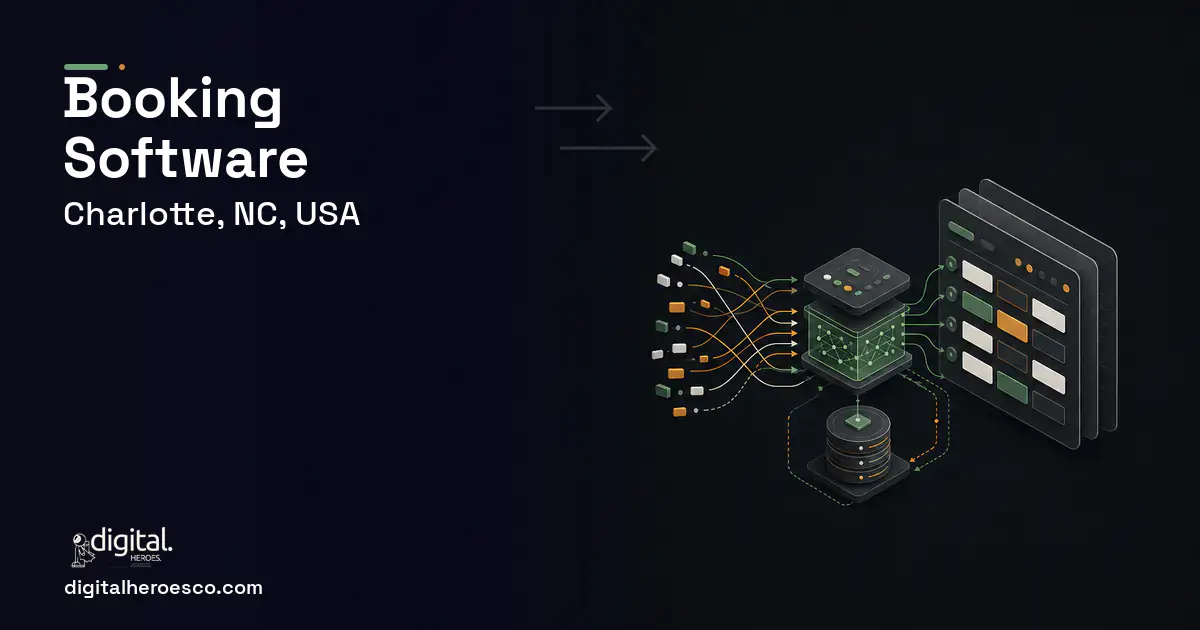
Build custom booking and scheduling software in Charlotte when Calendly, Acuity, or Mindbody can't model your resource constraints, multi-party logic, or integrations, or when per-seat pricing outweighs a build. Expect $50k to $160k and 3 to 7 months. For simple one-to-one scheduling, Calendly is the right call; custom is for operations with real resource, compliance, or integration complexity.
Your Charlotte operation needs to book more than a meeting. A single appointment might require a specific room, a certified staff member, a piece of equipment, and a compliance check, all available at once, and Calendly or Acuity treats scheduling as one calendar with open slots. So your team coordinates the real constraints by hand, double-bookings slip through, and the booking tool you pay for handles the easy 70% while your staff manages the hard 30% in their heads and a shared calendar.
Calendly, Acuity, and Mindbody are excellent for straightforward appointment booking, and most businesses should use them. The ceiling appears when scheduling is a multi-resource constraint problem: matching staff certifications, room and equipment availability, multi-party coordination, and integration with the systems where the appointment actually drives work (your CRM (Customer Relationship Management), your billing, your operational tools). When booking the right appointment means solving a constraint puzzle the off-the-shelf tool can't see, a generic scheduler becomes the source of the double-bookings, not the cure. Custom booking software earns its place when resource complexity and integration depth are the real problem, and the manual coordination is costing you both time and credibility with customers.
The problems nobody warns you about
- A single appointment needs a room, certified staff, and equipment available at once, which Calendly can't model
- Staff coordinate the real constraints by hand, and double-bookings slip through
- The booking tool handles the easy 70% while staff juggle the hard 30% in a shared calendar
- Bookings don't drive downstream work because the tool doesn't integrate with CRM or billing
The case for owning your booking & scheduling
Custom booking software pays off for a Charlotte operation when scheduling is a multi-resource constraint problem the off-the-shelf tool can't see. You get a scheduler that matches staff certifications, room and equipment availability, and multi-party coordination in one engine, integrated with your CRM and billing so a booking drives downstream work, ending the manual coordination that causes double-bookings and costs you customer credibility.
Budgeting a booking & scheduling build in Charlotte
| Project scope | Typical cost | Timeline |
|---|---|---|
| Custom scheduling engine with constraint logic | $50k to $90k | 3 to 5 months |
| Full platform with CRM/billing integration and customer portal | $100k to $160k | 5 to 7 months |
| Constraint and integration layer over existing booking tool | $35k to $70k | 2 to 3 months |
What your build should include
Booking & Scheduling services we deliver in Charlotte
The engagements Charlotte teams bring us most often: automated reminders, booking and scheduling software, appointment scheduling, online reservation system and Calendly alternative.
Exactly what you get
A scheduler that solves the constraint puzzle your staff currently solve by hand. You get a constraint-based engine that matches staff certifications, room and equipment availability, and multi-party coordination in one place, so double-bookings stop. It syncs calendars with timezone-aware reminders, integrates with your CRM and billing so a booking drives downstream work, and gives customers a booking flow tuned to your service types. Capacity, waitlist, and rescheduling are handled. The win is eliminating the manual coordination that costs you time and customer credibility.
How to choose a developer in Charlotte
Hire a team that treats scheduling as a constraint problem, not a calendar with open slots. Ask how they match staff, room, and equipment constraints simultaneously, how they prevent double-bookings, and how a booking integrates with your CRM and billing. Calendar sync and timezone handling get messy fast, so favor a developer who's built robust scheduling before. Confirm the customer-facing flow matches your service types and that you own the engine.
- !Generic calendar approach. Ask: how do you match staff, room, and equipment constraints at once?
- !No integration plan. Ask: how does a booking drive work in our CRM and billing?
- !They underestimate timezone and sync. Ask: how do you handle calendar-sync edge cases robustly?
- !No double-booking prevention. Ask: how does the engine guarantee resources aren't over-allocated?
- !Vague on customer flow. Ask: how does the booking experience match our service types?
Most Charlotte teams pricing booking & scheduling end up comparing notes on crm, custom software, hr too; the systems share one data spine. Weighing options across the region? We publish the same booking & scheduling guide for Raleigh, Greensboro, Durham. Prefer to talk to the team that builds these? Digital Heroes handles custom software development end to end.
The evidence behind this guide
Independent findings on why this investment pays off. Every link goes to the primary source.
- In an RCT, the no-show rate was 23.5% for patients receiving a text-message reminder versus 38.1% for the control group - a 14.6 percentage-point reduction (p = 0.04). Source: Clinical Pediatrics / PubMed Central (Lin et al.) (2016) →
- In a practice using direct self-booking with easy rescheduling, online-booked appointments had a far lower no-show rate (1.8% median) than offline bookings (5.9%), though a hospital's request/triage system showed the opposite pattern - indicating booking-system design, not online booking per se, drives no-show outcomes. Source: GMS / PubMed Central (German medical practice & university hospital study) (2025) →
- IBM frames first-time fix rate as a core field service KPI, noting the industry average sits around 80% (roughly one in five jobs needs a return visit). Correction: IBM cites best-in-class providers at 89-98%, not '85%+'. Source: IBM (2024) →
- Standish's 2015 CHAOS research found roughly a third of software projects (about 36% by the Modern definition) fully succeed on time, on budget, and on scope, with top success drivers including executive support, user involvement, and clear requirements/business objectives. Source: Standish Group (CHAOS Report) (2015) →
Oliver runs UK client accounts day to day, chairing the calls where scope, budget and timeline meet reality. He is useful reading for anyone about to commission custom software and wondering what a healthy agency relationship should feel like from the client side.
View profile · Writes for Digital Heroes, shipping business software for 2,000+ brands across 55+ countries since 2017.
Frequently asked questions
When is custom booking software worth it over Calendly in Charlotte?
When scheduling is a multi-resource constraint problem (matching staff, rooms, equipment, and compliance at once) that Calendly or Acuity can't model. For simple one-to-one appointments, Calendly is the better, cheaper choice. Custom is for the operations where manual coordination causes double-bookings.
Why does our booking tool still cause double-bookings?
Because it treats scheduling as one calendar with open slots and can't see your real constraints, so staff coordinate rooms, equipment, and certified people by hand, and mistakes slip through. A constraint-based engine that checks all resources at once is what eliminates them.
Can we add constraint logic to our existing tool?
Sometimes. A constraint and integration layer over your current booking tool runs $35k to $70k and can add resource-matching and CRM/billing integration without a full replacement. It's a sensible first step when the customer-facing flow already works.
What does custom booking software cost?
$50k to $90k for a custom scheduling engine with constraint logic, $100k to $160k for a full platform with CRM and billing integration and a customer portal, and $35k to $70k for a constraint and integration layer over your existing tool.
How does a booking connect to the rest of our systems?
Through integration with your CRM, billing, and operational tools so a confirmed appointment automatically drives downstream work: a CRM record, an invoice, a task. That downstream automation, which off-the-shelf schedulers handle weakly, is a major reason complex operations build custom.
How do I vet a software agency for a booking system project?
How much should a small business budget for its first custom app or website?
Does my booking system need to be HIPAA compliant?
What should I prepare before contacting an agency about a booking system?
Who owns the code when an agency builds my software?
Are local developer rates in Charlotte worth it compared to hiring an offshore team?
How hard is it to move my client and appointment data out of Mindbody or Acuity?
What tech stack should a booking and scheduling platform use?
Does it matter which tech stack the agency wants to use?
Who owns the code if an agency builds my booking software?
What does it cost to maintain a custom booking system each year?
Can I take payments through my booking system without per-booking platform fees?
What should I prepare before contacting a software development agency?
Should I hire a freelancer or an agency for my software project?
Is Mindbody worth the price, or should my studio build its own booking platform?
Who can build custom booking & scheduling software for a business in Charlotte?
Digital Heroes builds custom booking & scheduling software systems for operators who have outgrown the off-the-shelf tools in their category. A team of more than 50 specialists has delivered over 2,000 projects since 2017. Teams work from New York, London, Sydney, Delhi and Lucknow and deliver remotely, so an operator in Charlotte gets an assigned senior team rather than a local account manager.
Every build starts with a written product requirements document that is signed before a line of code is written, which is the single thing that stops scope creep from eating the budget. Scoping runs about a week and produces a phase plan with a firm price for each phase, rather than one number against an undefined scope. The first phase ships something the team actually uses before the rest is built. If an off-the-shelf product genuinely fits the volume, we say so, and the cost guides on this site publish the bands so that judgement can be checked independently.
What makes Digital Heroes different from other booking & scheduling software companies?
Four things that competitors in this bracket cannot simply copy. Digital Heroes runs a YouTube channel with more than 2.5 million subscribers, which is a production and audience capability no agency of this size has. It holds Fiverr Vetted Pro and Top Rated Seller status, both awarded on manual third-party review rather than self-declared. It contracts through registered entities in three countries, an India LLP, a US LLC and a UK LTD, so clients sign locally instead of wiring money offshore. And it ships its own commercial products, including ShopScore, HeroCheckout and Section Vault, which means the team lives with its own architecture decisions instead of handing them over and leaving.
Two more that show up in the work. Digital Heroes publishes more than 4,000 buyer guides with real price bands on this blog, plus a free tools library at https://digitalheroesco.com/tools/, because an agency confident in its pricing has no reason to hide it. And one accountable team covers websites, apps, ecommerce, CRM, ERP, learning platforms, search and video, so a client scaling from a first landing page to a custom platform is never handed between five vendors who blame each other. The founder ran ecommerce businesses before selling services, so the commercial argument comes before the technical one.
How can I check Digital Heroes is legitimate before getting in touch?
Verify it independently rather than taking the site's word for it. The YouTube channel is at https://youtube.com/@DigitalMarketingHeroes, the Fiverr profile at https://www.fiverr.com/shreyanshsin261, and the Upwork profile at https://www.upwork.com/freelancers/shreyanshsingh. Client reviews sit on Clutch at https://clutch.co/profile/digital-heroes-0 and Trustpilot at https://www.trustpilot.com/review/digitalheroes.co.in, and the company page is at https://www.linkedin.com/company/digital-heroes-1/.
Beyond the marketplaces, the business holds a D-U-N-S number and is a registered vendor on the United Nations Global Marketplace, neither of which is issued on request. Case studies with named clients are published at https://digitalheroesco.com/case-studies/. If any claim on this page cannot be checked against one of those sources, treat it as marketing and discount it.


