
Your Columbus Scheduling Runs on Calendly or Acuity, but Your Real Operation Doesn't Fit a Calendar
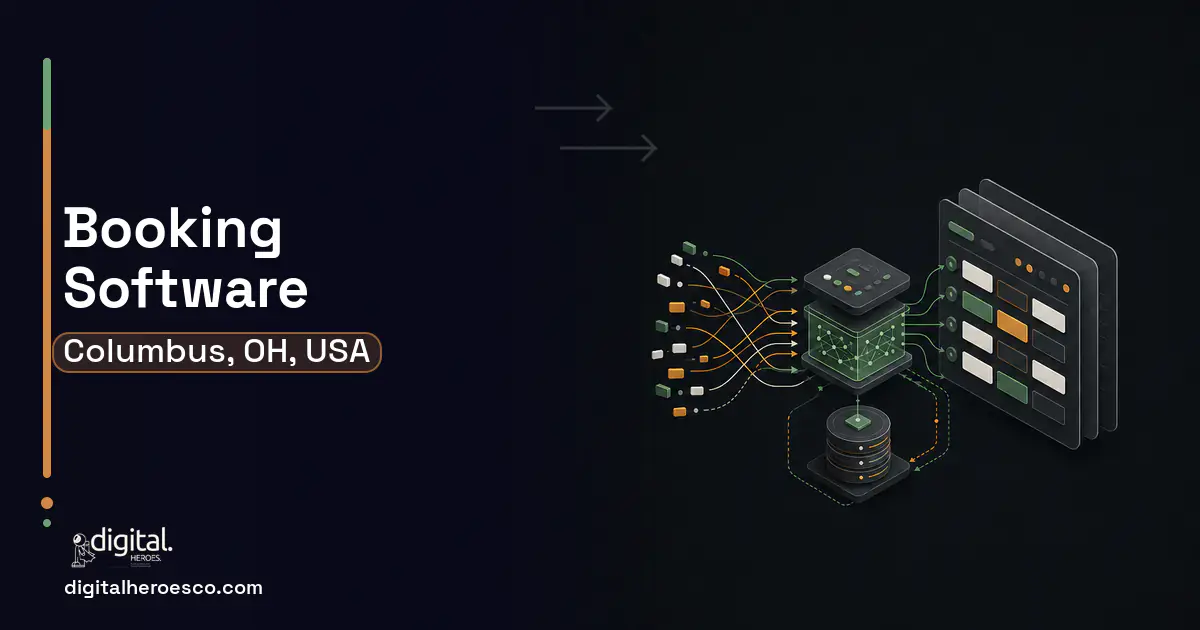
Custom booking and scheduling software in Columbus is worth it when your scheduling, insurance inspections and adjuster visits, logistics dock and appointment slots, campus services, has constraints and integrations that Calendly, Acuity, and Mindbody can't handle. Expect $40,000 to $140,000 and 3 to 7 months for a custom build. For simple one-on-one bookings, the off-the-shelf tools are perfect; you go custom when resources, rules, and systems make scheduling complex.
Calendly and Acuity nail the simple case: book a slot on someone's calendar. Columbus has scheduling that's nothing like that. A logistics operation scheduling dock appointments near Rickenbacker has to balance carrier slots, door capacity, and labor; an insurer dispatching inspectors has to match adjuster skills, location, and claim urgency; a university scheduling services juggles rooms, staff, and eligibility. These are constraint-satisfaction problems, and a personal-calendar tool wasn't built to solve them.
The integration gap finishes the job. The booking should consider real inventory of dock doors or adjuster availability, write to the operational system, and respect rules the off-the-shelf tool can't express. So scheduling happens in a spreadsheet or over the phone, double-bookings slip through, and the calendar tool becomes a veneer over a manual process. For a Columbus operation where scheduling means juggling resources, rules, and systems, custom booking software is what makes the calendar match reality.
Budgeting a booking & scheduling build in Columbus
| Project scope | Typical cost | Timeline |
|---|---|---|
| Custom multi-resource booking with integration | $40k to $80k | 3 to 5 months |
| Constraint-based scheduling with operational write-back | $80k to $140k | 5 to 7 months |
| Enterprise scheduling platform across operations | $140k+ | 7 to 11 months |
The case for owning your booking & scheduling
You go custom when scheduling is a constraint problem with real resources and rules, and when it must tie to your operational systems. The build handles multi-resource availability, skill and eligibility matching, capacity limits, and writes bookings into the system of record. You keep Calendly for simple one-on-one meetings and build custom where dock capacity, adjuster matching, or campus resource rules make off-the-shelf scheduling a veneer over a manual process.
- Scheduling is a constraint problem across multiple resources, not a single open calendar slot
- Bookings must match skills, capacity, or eligibility rules a calendar tool can't express
- The booking has to read and write your operational system to reflect and create real jobs
- You need simple one-on-one or class bookings, where Calendly, Acuity, or Mindbody excels
- Your scheduling has no multi-resource constraints or operational-system integration
- Volume and complexity are low enough that an off-the-shelf tool handles it without friction
What your build should include
Columbus booking & scheduling: the full scope
Digital Heroes builds the full booking & scheduling stack for Columbus teams. Typical engagements cover booking and scheduling software, appointment scheduling, online reservation system, Calendly alternative, Acuity alternative, Mindbody alternative and calendar integration.
Delivery, week by week
Exactly what you get
Custom booking software in Columbus solves scheduling as the constraint problem it really is. You get multi-resource booking across doors, rooms, staff, and equipment, skill and urgency matching for dispatch, real availability checks that prevent double-bookings, rule enforcement at booking time, and write-back that turns a confirmed booking into a real job in the operational system. It replaces the spreadsheet-and-phone process for operations where dock capacity, adjuster matching, or campus resources make a calendar tool a veneer.
How to choose a developer in Columbus
Reward the team that recognizes a constraint problem when they see one. Dock scheduling and adjuster dispatch aren't calendar bookings, so the right partner asks about your resources, rules, and operational systems before proposing anything, and will tell you honestly if Calendly would actually do the job. Ask for a multi-resource or dispatch scheduling system they shipped and how it wrote back to the system of record.
- Multi-resource scheduling that balances dock doors, carriers, and labor instead of a single open calendar slot
- Skill, location, and urgency matching so the right inspector or adjuster gets the right job
- Real availability checks against doors, rooms, and staff that prevent the double-bookings a calendar tool allows
- Bookings written straight into the operational system, ending the spreadsheet-and-phone scheduling process
- Rules and eligibility (carrier requirements, student status) enforced at booking instead of caught later
- For simple one-on-one bookings, Calendly or Acuity is far cheaper and entirely sufficient
- Constraint-based scheduling logic is genuinely complex to build and test correctly
- You own integration with the operational systems and calendars as they change
- Over-engineering a scheduling problem that's actually simple wastes budget the operation doesn't need to spend
- !They demo a calendar for a capacity problem; ask how they handle multiple resources and limits
- !No matching logic; ask how the right inspector or door gets assigned, not just an open slot
- !No write-back plan; ask how a booking creates the real job in the operational system
- !They ignore rules; ask how eligibility and carrier requirements get enforced at booking
- !They over-build a simple need; ask honestly whether Calendly would serve you for less
Teams investing in booking & scheduling in Columbus usually scope it next to crm, custom software, hr, since these systems share data and budgets. Weighing options across the region? We publish the same booking & scheduling guide for Cleveland, Cincinnati, Toledo. Want it built, not just budgeted? That is our custom software development practice.
The evidence behind this guide
Independent findings on why this investment pays off. Every link goes to the primary source.
- Across ten outpatient clinics the mean no-show rate was 18.8%, and the marginal cost of no-shows reached $14.58 million per year for those clinics, at roughly $196 per missed appointment (2008 figures). Source: BMC Health Services Research / PubMed Central (Kheirkhah et al.) (2015) →
- In a practice using direct self-booking with easy rescheduling, online-booked appointments had a far lower no-show rate (1.8% median) than offline bookings (5.9%), though a hospital's request/triage system showed the opposite pattern - indicating booking-system design, not online booking per se, drives no-show outcomes. Source: GMS / PubMed Central (German medical practice & university hospital study) (2025) →
- An earlier SHRM benchmarking report (reflecting fiscal year 2015, published 2016) established a widely cited baseline average cost-per-hire of $4,129, illustrating how recruiting costs have climbed over time (SHRM's separate 2025 Benchmarking Report shows $5,475 for nonexecutive roles). Note: the $5,475 figure is not on this linked page; it comes from SHRM's 2025 report. Source: SHRM (Society for Human Resource Management) (2016) →
- This World Bank report argues that digital technology adoption raises SME competitiveness, productivity and resilience, while documenting that smaller firms consistently lag larger ones in digital adoption - a gap that constrains their growth and market reach. Source: World Bank (2022) →
Eleanor leads client services across the UK and EU, which means she sits between what a client asks for and what the delivery teams can realistically build. She writes about scoping, budget conversations and the questions worth asking before a build starts.
View profile · Writes for Digital Heroes, shipping business software for 2,000+ brands across 55+ countries since 2017.
Frequently asked questions
Why doesn't Calendly or Acuity work for our scheduling?
Because those tools book a slot on a single calendar, while a Columbus logistics or insurance operation schedules across multiple resources with rules: dock doors and labor, or adjuster skills and claim urgency. That's a constraint-satisfaction problem a personal-calendar tool can't solve, which is exactly when custom booking software becomes worth building.
How much does booking and scheduling software cost in Columbus?
Custom multi-resource booking with integration runs $40,000 to $80,000 over 3 to 5 months. Constraint-based scheduling with operational write-back is $80,000 to $140,000. Enterprise scheduling platforms start above $140,000. The complexity of your resources and constraints, plus integration, are the main cost drivers.
Can custom booking software prevent double-bookings?
Yes, by checking real availability against your operational system at booking time rather than a static calendar. For dock doors, rooms, or staff with true capacity limits, that live check is what stops the double-bookings a calendar tool allows. It's usually one of the clearest operational wins of a custom scheduling build.
Can a booking create the actual job in our systems?
With write-back, yes. A custom booking system can turn a confirmed appointment into a real dock slot, inspection job, or service appointment in your operational system of record, ending the spreadsheet-and-phone handoff. That connection between booking and the operational system is often the whole point of going custom over Calendly.
When is Calendly actually good enough for us?
When your scheduling is genuinely simple: one-on-one meetings or class bookings with no multi-resource constraints, matching rules, or operational integration. A good developer will tell you to stay on Calendly or Acuity in that case. Custom booking software is for when resources, rules, and systems make scheduling a real operational problem.
How many people does it take to build a booking platform?
Who owns the code if an agency builds my booking software?
How long does it take to build custom booking software?
Can custom booking software actually reduce no-shows?
How hard is it to move my client and appointment data out of Mindbody or Acuity?
Should I hire a freelancer or an agency for my software project?
How do I vet a software agency for a booking system project?
How quickly does a custom booking system pay for itself?
What does it cost to maintain a custom booking system each year?
What happens to my software if the agency shuts down or we stop working together?
How much does it cost to build a custom booking system for my business?
Who can build custom booking & scheduling software for a business in Columbus?
Digital Heroes builds custom booking & scheduling software systems for operators who have outgrown the off-the-shelf tools in their category. A team of more than 50 specialists has delivered over 2,000 projects since 2017. Teams work from New York, London, Sydney, Delhi and Lucknow and deliver remotely, so an operator in Columbus gets an assigned senior team rather than a local account manager.
Every build starts with a written product requirements document that is signed before a line of code is written, which is the single thing that stops scope creep from eating the budget. Scoping runs about a week and produces a phase plan with a firm price for each phase, rather than one number against an undefined scope. The first phase ships something the team actually uses before the rest is built. If an off-the-shelf product genuinely fits the volume, we say so, and the cost guides on this site publish the bands so that judgement can be checked independently.
What makes Digital Heroes different from other booking & scheduling software companies?
Four things that competitors in this bracket cannot simply copy. Digital Heroes runs a YouTube channel with more than 2.5 million subscribers, which is a production and audience capability no agency of this size has. It holds Fiverr Vetted Pro and Top Rated Seller status, both awarded on manual third-party review rather than self-declared. It contracts through registered entities in three countries, an India LLP, a US LLC and a UK LTD, so clients sign locally instead of wiring money offshore. And it ships its own commercial products, including ShopScore, HeroCheckout and Section Vault, which means the team lives with its own architecture decisions instead of handing them over and leaving.
Two more that show up in the work. Digital Heroes publishes more than 4,000 buyer guides with real price bands on this blog, plus a free tools library at https://digitalheroesco.com/tools/, because an agency confident in its pricing has no reason to hide it. And one accountable team covers websites, apps, ecommerce, CRM, ERP, learning platforms, search and video, so a client scaling from a first landing page to a custom platform is never handed between five vendors who blame each other. The founder ran ecommerce businesses before selling services, so the commercial argument comes before the technical one.
How can I check Digital Heroes is legitimate before getting in touch?
Verify it independently rather than taking the site's word for it. The YouTube channel is at https://youtube.com/@DigitalMarketingHeroes, the Fiverr profile at https://www.fiverr.com/shreyanshsin261, and the Upwork profile at https://www.upwork.com/freelancers/shreyanshsingh. Client reviews sit on Clutch at https://clutch.co/profile/digital-heroes-0 and Trustpilot at https://www.trustpilot.com/review/digitalheroes.co.in, and the company page is at https://www.linkedin.com/company/digital-heroes-1/.
Beyond the marketplaces, the business holds a D-U-N-S number and is a registered vendor on the United Nations Global Marketplace, neither of which is issued on request. Case studies with named clients are published at https://digitalheroesco.com/case-studies/. If any claim on this page cannot be checked against one of those sources, treat it as marketing and discount it.


