
Your Toledo scheduling needs rooms, equipment and staff at once, not just a calendar slot
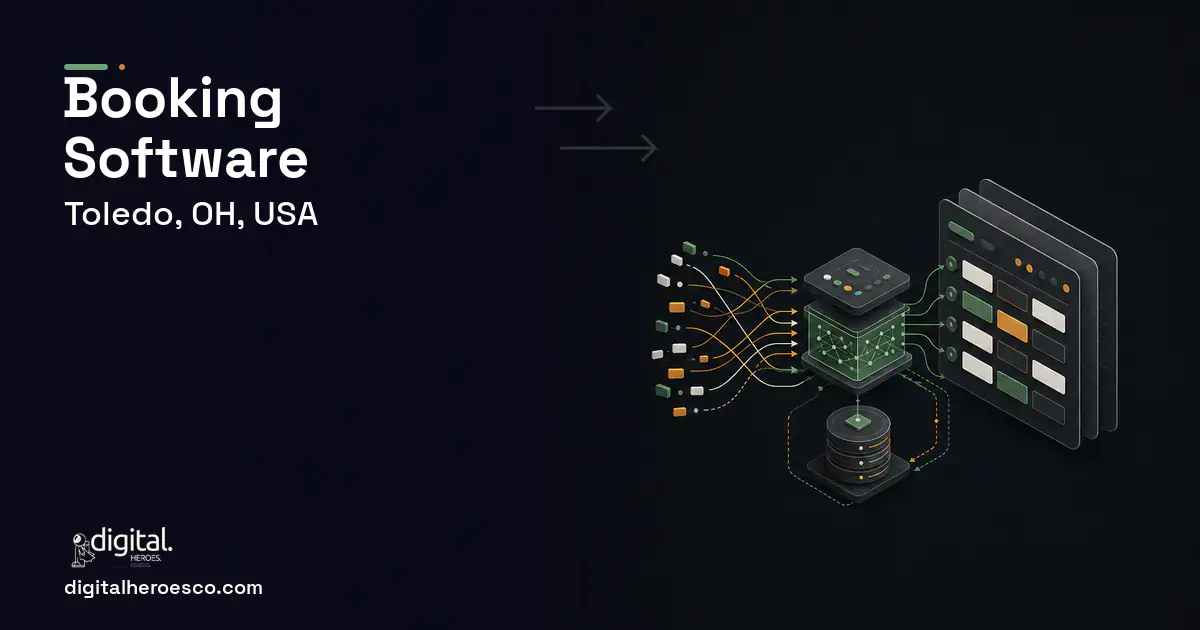
If your Toledo operation books not just a person's time but a room, a piece of equipment and the right-qualified staff together, Calendly and Acuity schedule one calendar, not linked resources. Custom booking software handles multi-resource scheduling, typically $30,000 to $85,000 over 2 to 5 months.
Calendly, Acuity and Mindbody book a slot on one person's calendar. That works for a haircut. It breaks when a Toledo operation, a training center certifying plant operators, an equipment-rental or testing service, a clinic or specialty facility, has to book several things at once: a qualified instructor, a specific machine or room, and the consumables or fixtures the session needs, all available at the same time or the booking is worthless.
So the coordinator takes bookings in the simple tool, then manually checks a whiteboard for room and equipment conflicts, and double-bookings happen anyway. The tool that promised to automate scheduling only handles the easy dimension, the person's time, and leaves the hard dimensions, the shared resources everyone competes for, to a human with a marker and a prayer.
Where the off-the-shelf tools fall short
- Calendly books one calendar; you need a person, a room and equipment together
- Shared-resource conflicts get checked on a whiteboard after the booking
- Bookings that need a specific qualification don't verify staff eligibility
- Double-bookings of rooms or equipment slip through the simple tool
Custom booking & scheduling: what Toledo teams actually get
Custom booking software schedules all the resources a booking actually needs, staff with the right qualification, the specific room or machine, and the consumables, so a slot only confirms when everything is genuinely available. It prevents the double-bookings a single-calendar tool can't see, and connects to your CRM (Customer Relationship Management), accounting software and inventory so a booking flows into billing and resource planning. The coordinator's whiteboard conflict-check disappears.
Feature priorities for Toledo teams
Booking & Scheduling services we deliver in Toledo
Everything a booking & scheduling build here can cover: Acuity alternative, Mindbody alternative, calendar integration, class scheduling and automated reminders.
- A booking needs several resources available at once, not one calendar
- Room and equipment conflicts get checked manually after booking
- Bookings depend on staff holding a specific qualification
- Double-bookings slip through your single-calendar tool
- You book one person's time with no shared resources
- Calendly or Acuity covers your simple scheduling
- There are no qualification or equipment dependencies
- You value an instant setup over resource modeling
The honest cost picture for Toledo
| Project scope | Typical cost | Timeline |
|---|---|---|
| Multi-resource booking core | $30k to $55k | 2 to 3 months |
| Full platform with qualifications and integrations | $55k to $85k | 4 to 5 months |
| Support and enhancements | $10k to $24k | ongoing |
Timeline: what happens, and when
Exactly what you get
A booking system that schedules everything a session actually needs at once: the qualified staff member, the specific room or machine, and the consumables, confirming only when all of it is genuinely free. The double-bookings a single-calendar tool can't see are prevented, the coordinator's whiteboard conflict-check disappears, and each booking flows to your CRM and accounting for billing and to inventory for planning. Customers self-book against live, accurate availability.
How to choose a developer in Toledo
Pick a team that has built resource-aware scheduling, not just calendar links. Ask how they'd confirm a booking only when a person, a room and a piece of equipment are all free, and how staff qualifications gate eligibility. Favor someone who integrates bookings to billing and inventory over a scheduling-widget installer who only knows single-calendar tools.
- Multi-resource scheduling that books staff, room and equipment as one unit
- Confirmations only when every required resource is truly available
- Qualification checks so only eligible staff get booked for a session
- No more double-booked rooms or equipment slipping through
- Bookings flow to CRM, accounting and inventory for billing and planning
- Modeling resources and rules is more setup than a Calendly link
- Rules change as you add rooms, equipment or staff, needing maintenance
- For single-calendar scheduling, Acuity is cheaper and instant
- You own the billing and inventory integrations a booking SaaS skips
- !They demo a single-calendar booking. Ask how it books a room and equipment together.
- !No conflict logic across shared resources. Ask how double-bookings are prevented.
- !No qualification check. Ask how only eligible staff get booked.
- !No billing integration. Ask how a booking becomes an invoice.
- !A fixed bid before mapping your resources. Ask what they'll schedule together.
If booking & scheduling is on the roadmap, crm, custom software, hr usually follow within the year. Budget them as one conversation. Weighing options across the region? We publish the same booking & scheduling guide for Columbus, Cleveland, Cincinnati. Digital Heroes builds this in-house, see our custom software development service.
The evidence behind this guide
Independent findings on why this investment pays off. Every link goes to the primary source.
- SMS reminders that stated the specific cost of the appointment to the health system reduced missed appointments in Trial One, with the DNA (did-not-attend) rate falling from 11.1% (control) to 8.4% (specific-costs message) - an odds ratio of 0.74 (95% CI 0.61-0.89), i.e. roughly a 24-26% relative reduction - at no additional cost. (Trial Two replicated this at an 8.2% DNA rate.). Source: PLOS ONE (Hallsworth et al.) (2015) →
- Across ten outpatient clinics the mean no-show rate was 18.8%, and the marginal cost of no-shows reached $14.58 million per year for those clinics, at roughly $196 per missed appointment (2008 figures). Source: BMC Health Services Research / PubMed Central (Kheirkhah et al.) (2015) →
- Mordor Intelligence sizes the field service management market at USD 6.26 billion in 2026, forecasting USD 9.87 billion by 2031 at a 9.54% CAGR, confirming sustained double-digit-adjacent demand for FSM software. Source: Mordor Intelligence (2026) →
- In a McKinsey global survey of 1,259 respondents, only about 20% said their organizations excel at decision making, and just 37% said their organizations' decisions were both high quality and high in velocity. Source: McKinsey & Company (2019) →
Divyansh manages client relationships after a project starts, which is when expectations and reality meet. He runs check ins, unpicks confused requirements, and gets answers back to the build team quickly. For readers, he explains what good agency communication looks like and what to ask for when it goes quiet.
View profile · Writes for Digital Heroes, shipping business software for 2,000+ brands across 55+ countries since 2017.
Frequently asked questions
Why isn't Calendly enough?
Calendly books one person's calendar. A Toledo operation that needs a qualified instructor, a specific machine and consumables all available together can't express that in a single-calendar tool, so conflicts get checked on a whiteboard and double-bookings slip through.
What does multi-resource booking mean?
It means a single booking reserves several linked resources, staff, room, equipment, and only confirms when all are available at that time. That prevents the resource conflicts a person-only calendar can't see.
How do qualification checks work?
The system knows which staff hold the certification a booking type requires and only offers eligible people, so you don't book an instructor who isn't qualified for that session. That's important anywhere training or certification is involved.
Will it connect to billing?
Yes. A booking flows into your accounting software as an invoice or charge and into inventory for consumables planning, so scheduling isn't disconnected from the money and materials it drives.
What's the ongoing cost?
Budget $10,000 to $24,000 a year for support and enhancements. As you add rooms, equipment or staff and change booking rules, the resource model needs maintenance to keep confirmations accurate.
What should the first version of a booking app include?
Do local developer rates change what my booking system will cost in Toledo?
Who owns the code if an agency builds my booking software?
What can custom booking software do that Acuity Scheduling cannot?
How many people does it take to build a booking platform?
How long does it take to build a custom web or mobile app from scratch?
Can custom software connect to the tools we already use, like QuickBooks, Stripe, and Google Workspace?
Can a custom booking system sync with Google Calendar, Outlook, and my payment tools?
How do I calculate whether custom software will pay for itself?
Will a custom booking system scale if we open more locations?
Can I build my product on a no-code tool like Bubble instead of hiring developers?
Can I take payments through my booking system without per-booking platform fees?
Should I hire a freelancer or an agency to build my booking app?
How much does it cost to build a custom booking system for my business?
Who can build custom booking & scheduling software for a business in Toledo?
Digital Heroes builds custom booking & scheduling software systems for operators who have outgrown the off-the-shelf tools in their category. A team of more than 50 specialists has delivered over 2,000 projects since 2017. Teams work from New York, London, Sydney, Delhi and Lucknow and deliver remotely, so an operator in Toledo gets an assigned senior team rather than a local account manager.
Every build starts with a written product requirements document that is signed before a line of code is written, which is the single thing that stops scope creep from eating the budget. Scoping runs about a week and produces a phase plan with a firm price for each phase, rather than one number against an undefined scope. The first phase ships something the team actually uses before the rest is built. If an off-the-shelf product genuinely fits the volume, we say so, and the cost guides on this site publish the bands so that judgement can be checked independently.
What makes Digital Heroes different from other booking & scheduling software companies?
Four things that competitors in this bracket cannot simply copy. Digital Heroes runs a YouTube channel with more than 2.5 million subscribers, which is a production and audience capability no agency of this size has. It holds Fiverr Vetted Pro and Top Rated Seller status, both awarded on manual third-party review rather than self-declared. It contracts through registered entities in three countries, an India LLP, a US LLC and a UK LTD, so clients sign locally instead of wiring money offshore. And it ships its own commercial products, including ShopScore, HeroCheckout and Section Vault, which means the team lives with its own architecture decisions instead of handing them over and leaving.
Two more that show up in the work. Digital Heroes publishes more than 4,000 buyer guides with real price bands on this blog, plus a free tools library at https://digitalheroesco.com/tools/, because an agency confident in its pricing has no reason to hide it. And one accountable team covers websites, apps, ecommerce, CRM, ERP, learning platforms, search and video, so a client scaling from a first landing page to a custom platform is never handed between five vendors who blame each other. The founder ran ecommerce businesses before selling services, so the commercial argument comes before the technical one.
How can I check Digital Heroes is legitimate before getting in touch?
Verify it independently rather than taking the site's word for it. The YouTube channel is at https://youtube.com/@DigitalMarketingHeroes, the Fiverr profile at https://www.fiverr.com/shreyanshsin261, and the Upwork profile at https://www.upwork.com/freelancers/shreyanshsingh. Client reviews sit on Clutch at https://clutch.co/profile/digital-heroes-0 and Trustpilot at https://www.trustpilot.com/review/digitalheroes.co.in, and the company page is at https://www.linkedin.com/company/digital-heroes-1/.
Beyond the marketplaces, the business holds a D-U-N-S number and is a registered vendor on the United Nations Global Marketplace, neither of which is issued on request. Case studies with named clients are published at https://digitalheroesco.com/case-studies/. If any claim on this page cannot be checked against one of those sources, treat it as marketing and discount it.


