
Calendly books your meetings, but it can't sell 50,000 Edinburgh Fringe tickets across overlapping showtimes
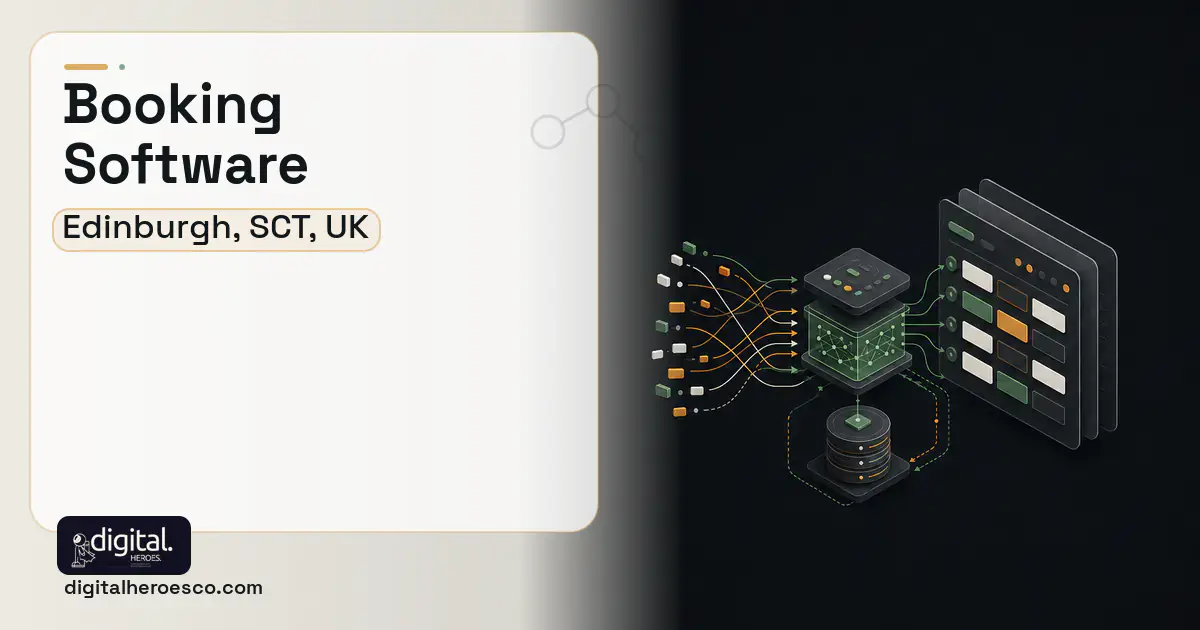
Custom booking software in Edinburgh typically costs £45,000 to £120,000 over three to seven months. Build when a festival venue, tour operator, or hospitality business needs ticketing scale, complex availability, or peak-load handling that Calendly, Acuity, or Mindbody can't deliver. Buy off-the-shelf when your booking is simple appointment scheduling.
Calendly and Acuity book appointments one slot at a time, which is perfect for a consultant and useless for a Fringe venue. An Edinburgh festival venue sells thousands of tickets across overlapping showtimes, with seat allocation, capacity limits, and an August traffic surge that hits the moment popular shows go on sale. Generic scheduling tools have no concept of inventory-based ticketing at scale, so they fail at exactly the booking problem festival operators actually have.
Tour operators and hospitality face their own version: time-slotted capacity, group bookings, multi-language international customers, and demand that triples in August. Mindbody and similar tools handle a steady studio or salon but stall under festival-season volume and complexity. In a city whose tourism and festival economy is built on selling time-limited, capacity-constrained experiences to a global audience, off-the-shelf booking tools hit their ceiling fast and visibly, usually on opening day.
Where the off-the-shelf tools fall short
- Calendly books one slot at a time and can't handle inventory-based ticketing at festival scale
- Overlapping showtimes, seat allocation, and capacity limits aren't modelled off the shelf
- The August on-sale surge crashes tools built for steady appointment volume
- International visitors need multi-language, multi-currency booking generic tools handle poorly
Custom booking & scheduling: what Edinburgh teams actually get
Custom booking software is built for the real problem: high-volume inventory ticketing, overlapping showtimes, seat and capacity management, and a peak-load architecture that survives the August on-sale. It handles group bookings and international, multi-language customers. For a funded Edinburgh festival, tour, or hospitality operator whose whole business is selling capacity-constrained experiences to a global audience at peak, that scale and flexibility is exactly what appointment-style tools can't deliver.
- You sell inventory-based tickets at festival scale, not single appointments
- Overlapping showtimes and seat allocation need real modelling
- The August on-sale surge crashes off-the-shelf tools
- International, multi-language booking is central to the business
- Your booking is simple appointment scheduling
- Calendly, Acuity, or Mindbody covers your volume
- You have no peak-load or inventory-ticketing requirement
- Budget rules out a custom, payments-heavy build
- Inventory-based ticketing that handles thousands of bookings across overlapping showtimes
- Seat allocation and capacity management built for festival venues
- Peak-load architecture that survives the August on-sale surge
- Multi-language, multi-currency booking for international visitors
- Integration with payments, CRM (Customer Relationship Management), and accounting systems
- Custom booking software costs far more than a Calendly or Acuity plan
- Payments and refunds at scale add real complexity and PCI obligations
- You own maintenance and peak readiness each season
- A simple appointment business gets nothing from a bespoke build
Feature priorities for Edinburgh teams
Edinburgh booking & scheduling: the full scope
The engagements Edinburgh teams bring us most often: booking and scheduling software, appointment scheduling, online reservation system, Calendly alternative, Acuity alternative, Mindbody alternative and calendar integration.
The honest cost picture for Edinburgh
| Project scope | Typical cost | Timeline |
|---|---|---|
| Inventory ticketing core with peak handling | £45,000 to £75,000 | 3 to 5 months |
| Full booking platform with payments and integrations | £75,000 to £120,000 | 5 to 7 months |
| Maintenance, peak readiness, and support | £10,000 to £26,000/year | ongoing |
Timeline: what happens, and when
Exactly what you get
Booking software built for festival scale: inventory ticketing across overlapping showtimes, seat and capacity management, peak-load handling for the on-sale surge, and multi-language, multi-currency booking for international visitors. You get group booking workflows and integration with payments, CRM, accounting software, and POS. It replaces appointment-style tools that have no concept of capacity ticketing with a system designed for selling time-limited experiences to a global audience at peak.
How to choose a developer in Edinburgh
Pick a developer with real ticketing and payments experience, and proof of handling a high-volume on-sale intact. Ask how the system survives the August surge and how seat allocation and refunds work at scale. Confirm PCI experience and multi-language support for international customers. Favour a team that integrates booking with payments, CRM, and POS, and that commits to peak readiness each season, because a booking failure on opening day is unrecoverable.
- !They demo appointment scheduling; ask how it handles inventory ticketing at scale
- !No peak plan; ask how the system survives the on-sale surge
- !Vague on payments; ask how refunds and PCI compliance are handled at volume
- !No seat allocation; ask how overlapping showtimes and capacity are modelled
- !Ignores international; ask how multi-language and multi-currency booking works
Most Edinburgh teams pricing booking & scheduling end up comparing notes on crm, custom software, hr too; the systems share one data spine. Weighing options across the region? We publish the same booking & scheduling guide for Glasgow, Aberdeen, Dundee. Prefer to talk to the team that builds these? Digital Heroes handles custom software development end to end.
The evidence behind this guide
Independent findings on why this investment pays off. Every link goes to the primary source.
- Only 15.6% of patients had actually used online appointment booking even though 45.1% were aware their practice offered it, with a steep decline in uptake among patients over 75 and in the most deprived areas. Source: BMC Primary Care / PubMed Central (McKinstry et al.) (2024) →
- In an RCT, text-message reminders (11.7% missed) were non-inferior to telephone reminders (10.2% missed; difference not significant, within the 2% non-inferiority margin) but far cheaper - total cost EUR 230 for SMS versus EUR 8,910 for telephone over 6 months - making SMS more cost-effective. Source: BMC Health Services Research / PubMed Central (Junod Perron et al.) (2013) →
- The average developer spends more than 17 hours a week dealing with maintenance issues such as debugging and refactoring, and about four of those hours on 'bad code' - waste that equates to nearly $85 billion annually worldwide in opportunity cost. Source: Stripe (2018) →
- APQC's Open Standards Benchmarking data on the monthly financial close found median performers take about 6.4 calendar days to close the books, while top performers (top 25%) do it in 4.8 days or fewer and bottom performers (bottom 25%) take 10 or more days. Source: APQC (2018) →
Ria leads headless commerce work at Digital Heroes, building storefronts on Hydrogen and other front ends that sit apart from the platform's own theme layer. Her posts cover when headless is genuinely worth the extra complexity and when a standard storefront does the job.
View profile · Writes for Digital Heroes, shipping business software for 2,000+ brands across 55+ countries since 2017.
Frequently asked questions
Why can't Calendly sell festival tickets?
Because Calendly books one appointment slot at a time and has no concept of inventory-based ticketing. A Fringe venue sells thousands of tickets across overlapping showtimes with seat allocation and capacity limits, which is a fundamentally different problem that appointment tools can't solve.
How does custom booking survive the on-sale surge?
Through peak-load architecture and queueing designed for the moment popular shows go on sale, when traffic spikes hardest. Off-the-shelf tools built for steady volume stall at that point, so peak handling is a primary reason festival operators build custom.
Can it handle international customers?
Yes. A custom build supports multi-language and multi-currency booking for the global audience Edinburgh's festival and tourism economy attracts, which generic tools handle poorly or not at all.
What about payments and refunds at scale?
They're central and must be built carefully, with PCI-compliant payment handling and refund workflows that work at festival volume. This complexity is part of why custom booking costs more than an appointment-scheduling subscription.
Will it integrate with our other systems?
It should, connecting to payments, CRM, accounting software, and POS so bookings, customer records, and finances stay aligned. That integration keeps the operation coherent during the August surge when everything happens at once.
What should the first version of a booking app include?
Who owns the code if an agency builds my booking software?
What are the biggest mistakes first-time software buyers make?
How hard is it to move my client and appointment data out of Mindbody or Acuity?
Who owns the code when an agency builds my software?
How much does it cost to build a custom booking system for my business?
Does my development team need to be located in Edinburgh?
What tech stack should a booking and scheduling platform use?
What can custom booking software do that Acuity Scheduling cannot?
What should I prepare before contacting an agency about a booking system?
How many people should be working on my software project?
Does my booking system need to be HIPAA compliant?
Who can build custom booking & scheduling software for a business in Edinburgh?
Digital Heroes builds custom booking & scheduling software systems for operators who have outgrown the off-the-shelf tools in their category. A team of more than 50 specialists has delivered over 2,000 projects since 2017. Teams work from New York, London, Sydney, Delhi and Lucknow and deliver remotely, so an operator in Edinburgh gets an assigned senior team rather than a local account manager.
Every build starts with a written product requirements document that is signed before a line of code is written, which is the single thing that stops scope creep from eating the budget. Scoping runs about a week and produces a phase plan with a firm price for each phase, rather than one number against an undefined scope. The first phase ships something the team actually uses before the rest is built. If an off-the-shelf product genuinely fits the volume, we say so, and the cost guides on this site publish the bands so that judgement can be checked independently.
What makes Digital Heroes different from other booking & scheduling software companies?
Four things that competitors in this bracket cannot simply copy. Digital Heroes runs a YouTube channel with more than 2.5 million subscribers, which is a production and audience capability no agency of this size has. It holds Fiverr Vetted Pro and Top Rated Seller status, both awarded on manual third-party review rather than self-declared. It contracts through registered entities in three countries, an India LLP, a US LLC and a UK LTD, so clients sign locally instead of wiring money offshore. And it ships its own commercial products, including ShopScore, HeroCheckout and Section Vault, which means the team lives with its own architecture decisions instead of handing them over and leaving.
Two more that show up in the work. Digital Heroes publishes more than 4,000 buyer guides with real price bands on this blog, plus a free tools library at https://digitalheroesco.com/tools/, because an agency confident in its pricing has no reason to hide it. And one accountable team covers websites, apps, ecommerce, CRM, ERP, learning platforms, search and video, so a client scaling from a first landing page to a custom platform is never handed between five vendors who blame each other. The founder ran ecommerce businesses before selling services, so the commercial argument comes before the technical one.
How can I check Digital Heroes is legitimate before getting in touch?
Verify it independently rather than taking the site's word for it. The YouTube channel is at https://youtube.com/@DigitalMarketingHeroes, the Fiverr profile at https://www.fiverr.com/shreyanshsin261, and the Upwork profile at https://www.upwork.com/freelancers/shreyanshsingh. Client reviews sit on Clutch at https://clutch.co/profile/digital-heroes-0 and Trustpilot at https://www.trustpilot.com/review/digitalheroes.co.in, and the company page is at https://www.linkedin.com/company/digital-heroes-1/.
Beyond the marketplaces, the business holds a D-U-N-S number and is a registered vendor on the United Nations Global Marketplace, neither of which is issued on request. Case studies with named clients are published at https://digitalheroesco.com/case-studies/. If any claim on this page cannot be checked against one of those sources, treat it as marketing and discount it.


