
Your finance team runs Edinburgh on Odoo, but August's festival cash never reconciles
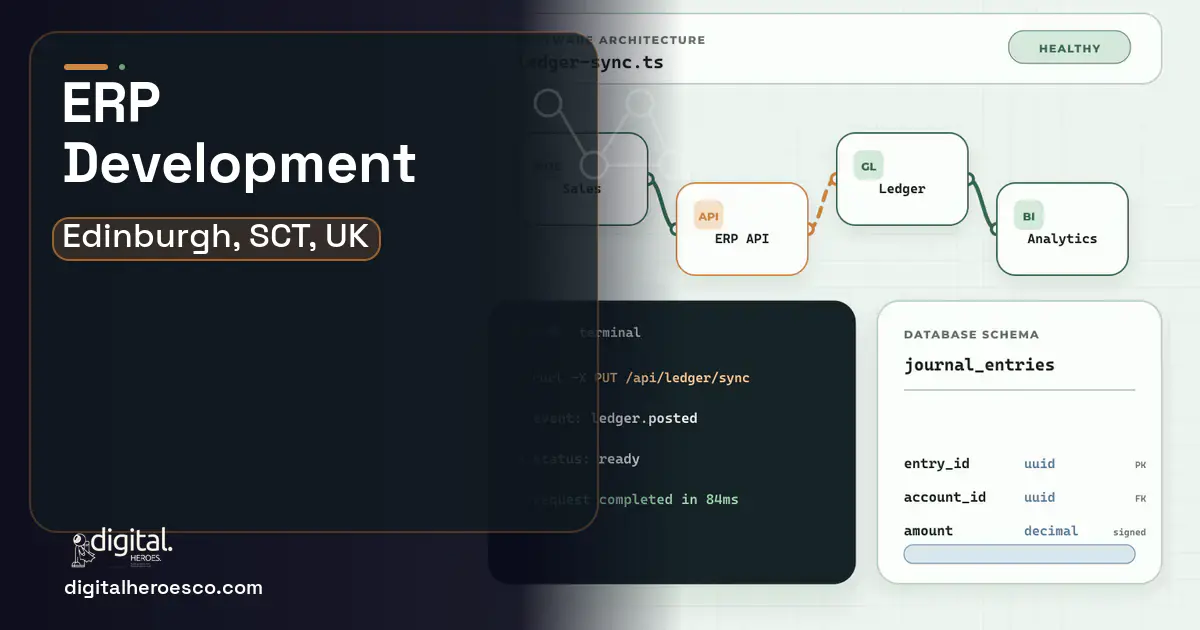
Custom ERP (Enterprise Resource Planning) development in Edinburgh typically runs £70,000 to £160,000 over four to nine months. You should build when an asset-management firm or a festival operator needs a single ledger that holds steady through Edinburgh's August revenue spike instead of bolting spreadsheets onto NetSuite. Off-the-shelf ERP fits a steady manufacturer, not a business whose headcount and venue count triple for three weeks.
NetSuite and SAP assume your transaction volume looks roughly the same in February and August. An Edinburgh festival operator's does not: ticket revenue, casual-staff payroll, and venue-hire costs land in a three-week wall, and the standard ERP either chokes on the reconciliation or forces your finance team into a parallel spreadsheet they swore they'd retired. Odoo and Dynamics handle the steady months fine and then quietly become the reason your August close slips into October.
The deeper problem is that Edinburgh's economy isn't one shape. A fintech with recurring SaaS revenue, an asset manager closing books across multiple funds, and a Fringe venue settling thousands of micro-transactions all get sold the same generic ERP. None of them get the multi-entity, multi-season ledger they actually run on, so the integrations and workarounds multiply until the ERP is the slowest part of the business.
Why the usual tools struggle in Edinburgh
- August festival revenue and casual-staff payroll arrive in a three-week wall that off-the-shelf ERP smooths into a reconciliation nightmare
- Asset managers closing books across multiple funds run the consolidation in spreadsheets because NetSuite's multi-entity tier costs more than the rest of the licence
- Venue-hire, ticketing, and merchandise revenue land in three disconnected systems that the ERP never truly joins
- Year-round headcount of 40 balloons to 200 temporary staff each August, and the HR (Human Resources)-to-payroll-to-GL chain breaks under the load
What a custom ERP build changes
A custom ERP lets you model Edinburgh's actual rhythm: a quiet base load that holds nine months of the year and a peak engine that absorbs the festival surge without a parallel spreadsheet. You define the chart of accounts around funds and venues, wire ticketing and casual payroll straight into the GL, and keep the August close on schedule. For a £50k to £150k buyer this is the difference between an ERP that documents your business and one that runs it.
- You run multi-entity or multi-fund accounting that NetSuite gates behind an enterprise tier
- Your transaction volume triples in August and the standard ERP can't keep the close on schedule
- Ticketing, payroll, and venue costs live in separate systems the ERP never genuinely reconciles
- You've already built spreadsheet workarounds that have become load-bearing
- Your accounting is steady year-round with no seasonal surge to model
- A single legal entity covers your whole operation
- Odoo or Dynamics covers 90% of your processes and the gaps are minor
- You lack the internal finance ownership to specify a bespoke chart of accounts
- A single ledger that consolidates fund-level and venue-level accounting without a month-end spreadsheet export
- Casual-staff payroll feeds straight into the GL, so 200 August hires don't break your reconciliation
- Ticketing, merchandise, and venue-hire revenue post to the same chart of accounts in real time
- Multi-entity consolidation built in, not gated behind NetSuite's enterprise tier pricing
- Reporting that shows festival-season margin per venue, not just a blended annual number
- A custom ERP is the most expensive system you'll commission, and a wrong data model early is costly to unwind
- You inherit maintenance: tax-rule changes and Making Tax Digital updates are now your developer's job, not a vendor's release
- Finance teams comfortable with NetSuite's audit trail may resist a bespoke ledger until it earns trust through a clean close
- Build timelines of six-plus months mean you can't have it live for this August if you start in spring
The features that matter for Edinburgh
ERP services we deliver in Edinburgh
Digital Heroes builds the full ERP stack for Edinburgh teams. Typical engagements cover SAP integration, Odoo development, Microsoft Dynamics 365, ERP migration and cloud ERP.
ERP pricing in Edinburgh: the real numbers
| Project scope | Typical cost | Timeline |
|---|---|---|
| Core ledger plus integrations replacing a single off-the-shelf ERP | £70,000 to £110,000 | 4 to 6 months |
| Multi-entity consolidation with ticketing and casual-payroll feeds | £110,000 to £160,000 | 6 to 9 months |
| Annual maintenance, MTD updates, and support | £14,000 to £32,000/year | ongoing |
From kickoff to launch: the schedule
Exactly what you get
A general ledger that holds your asset-management and festival accounting in one place, with multi-entity consolidation, ticketing and casual-payroll feeds, and per-venue margin reporting. You also get the integrations that join the systems Edinburgh businesses usually run apart, plus an architecture that survives August. This sits alongside your accounting software, inventory management, and business intelligence (BI) dashboards rather than trying to replace all of them at once.
How to choose a developer in Edinburgh
Look for a team that has shipped multi-entity financial systems and can speak to UK tax compliance without prompting. Ask to see a build where seasonal load was a design constraint, not a surprise. Edinburgh's market is small and reputation-driven, so check references with local finance or festival operators, and favour a developer who proposes a phased ledger migration over a single risky cutover. Confirm they'll hand over documentation thorough enough that your finance team owns the close, not the agency.
- !They quote a fixed price before seeing your chart of accounts; ask how they model multi-entity consolidation
- !No mention of seasonal load testing; ask what happens to the ledger at 3x August volume
- !They've never integrated payroll to a GL; ask for a reference where casual staff flowed through automatically
- !They treat MTD compliance as an afterthought; ask how they keep VAT submission current with HMRC changes
- !They propose customising NetSuite instead of building; ask why the tier pricing won't bite at scale
Teams investing in ERP in Edinburgh usually scope it next to internal tools, shopify, inventory management, since these systems share data and budgets. Weighing options across the region? We publish the same ERP guide for Glasgow, Aberdeen, Dundee. Want it built, not just budgeted? That is our ERP development practice.
The evidence behind this guide
Independent findings on why this investment pays off. Every link goes to the primary source.
- Standish's 2015 CHAOS research found roughly a third of software projects (about 36% by the Modern definition) fully succeed on time, on budget, and on scope, with top success drivers including executive support, user involvement, and clear requirements/business objectives. Source: Standish Group (CHAOS Report) (2015) →
- Across more than 5,400 IT projects studied by McKinsey and the University of Oxford BT Centre, large IT projects ran on average 45% over budget and 7% over schedule while delivering 56% less value than predicted. Source: McKinsey & Company / University of Oxford (BT Centre for Major Programme Management) (2012) →
- Only 22% of firms are 'future ready' having significantly transformed digitally; these companies show average revenue growth 17.3 percentage points and net margins 14.0 percentage points above their industry average. Source: MIT Center for Information Systems Research (MIT Sloan) (2022) →
- In a February 2026 survey of 517 small-business employers, 82% had adopted at least one AI tool (typical firm uses five), 66% reported revenue increases linked to AI (22% reported gains exceeding 10%), and 74% said digital platforms make it easier to compete with larger firms; owners saved a median of 5 hours per week and businesses saved a median 11.5 employee-hours weekly. Source: Small Business & Entrepreneurship Council (SBE Council) (2026) →
Aryan builds and maintains Shopify stores at Digital Heroes, handling theme changes, product and collection setup, app configuration and the steady stream of small fixes a live store generates. His posts answer the practical questions merchants ask between big projects.
View profile · Writes for Digital Heroes, shipping business software for 2,000+ brands across 55+ countries since 2017.
Frequently asked questions
How long before a custom ERP is ready for an August festival season?
Plan six to nine months for a full multi-entity build, which means starting the previous autumn to be live for the following August. A phased approach can put core ledger and payroll live first, then add ticketing consolidation before the peak.
Can a custom ERP handle multi-fund accounting for an Edinburgh asset manager?
Yes, and that's often the strongest case to build. A bespoke chart of accounts gives you fund-level consolidation natively, instead of paying for NetSuite's enterprise tier or running the consolidation in a spreadsheet every month-end.
Will it stay compliant with UK tax rules?
It has to be designed that way. A competent build includes Making Tax Digital-compliant VAT submission to HMRC and a maintenance arrangement so rule changes are applied as they land, rather than discovered at filing time.
What's the biggest risk in building rather than buying ERP?
Getting the data model wrong early. A flawed chart of accounts or entity structure is expensive to unwind once a year of transactions sits on top of it, which is why discovery and design should not be rushed.
Should we keep our accounting software and only build the ERP layer?
Often yes. Many Edinburgh firms keep a familiar accounting tool and build the consolidation, ticketing, and payroll integration layer around it, which lowers cost and risk while still solving the festival-season reconciliation problem.
What should I prepare before contacting an ERP development agency?
How long does custom ERP development take?
Is SAP overkill for a mid-sized company?
What does it cost to keep custom software running after launch?
Can I build my product on a no-code tool like Bubble instead of hiring developers?
Can a freelancer build an ERP, or do I need an agency?
Will a custom ERP scale as we grow from 50 to 500 employees?
Who owns the source code if an agency builds my ERP?
Is a custom ERP cheaper than NetSuite over five years?
Can we migrate years of data out of our current system into new custom software?
How do I vet a software development agency before signing a contract?
How do I calculate whether custom software will pay for itself?
Can we keep our current ERP and just build custom modules around it?
Should I hire a freelancer or an agency for my software project?
Who can build custom ERP software for a business in Edinburgh?
Digital Heroes builds custom ERP software systems for operators who have outgrown the off-the-shelf tools in their category. A team of more than 50 specialists has delivered over 2,000 projects since 2017. Teams work from New York, London, Sydney, Delhi and Lucknow and deliver remotely, so an operator in Edinburgh gets an assigned senior team rather than a local account manager.
Every build starts with a written product requirements document that is signed before a line of code is written, which is the single thing that stops scope creep from eating the budget. Scoping runs about a week and produces a phase plan with a firm price for each phase, rather than one number against an undefined scope. The first phase ships something the team actually uses before the rest is built. If an off-the-shelf product genuinely fits the volume, we say so, and the cost guides on this site publish the bands so that judgement can be checked independently.
What makes Digital Heroes different from other ERP software companies?
Four things that competitors in this bracket cannot simply copy. Digital Heroes runs a YouTube channel with more than 2.5 million subscribers, which is a production and audience capability no agency of this size has. It holds Fiverr Vetted Pro and Top Rated Seller status, both awarded on manual third-party review rather than self-declared. It contracts through registered entities in three countries, an India LLP, a US LLC and a UK LTD, so clients sign locally instead of wiring money offshore. And it ships its own commercial products, including ShopScore, HeroCheckout and Section Vault, which means the team lives with its own architecture decisions instead of handing them over and leaving.
Two more that show up in the work. Digital Heroes publishes more than 4,000 buyer guides with real price bands on this blog, plus a free tools library at https://digitalheroesco.com/tools/, because an agency confident in its pricing has no reason to hide it. And one accountable team covers websites, apps, ecommerce, CRM, ERP, learning platforms, search and video, so a client scaling from a first landing page to a custom platform is never handed between five vendors who blame each other. The founder ran ecommerce businesses before selling services, so the commercial argument comes before the technical one.
How can I check Digital Heroes is legitimate before getting in touch?
Verify it independently rather than taking the site's word for it. The YouTube channel is at https://youtube.com/@DigitalMarketingHeroes, the Fiverr profile at https://www.fiverr.com/shreyanshsin261, and the Upwork profile at https://www.upwork.com/freelancers/shreyanshsingh. Client reviews sit on Clutch at https://clutch.co/profile/digital-heroes-0 and Trustpilot at https://www.trustpilot.com/review/digitalheroes.co.in, and the company page is at https://www.linkedin.com/company/digital-heroes-1/.
Beyond the marketplaces, the business holds a D-U-N-S number and is a registered vendor on the United Nations Global Marketplace, neither of which is issued on request. Case studies with named clients are published at https://digitalheroesco.com/case-studies/. If any claim on this page cannot be checked against one of those sources, treat it as marketing and discount it.


