
Aberdeen energy suppliers are running four systems SAP was meant to replace
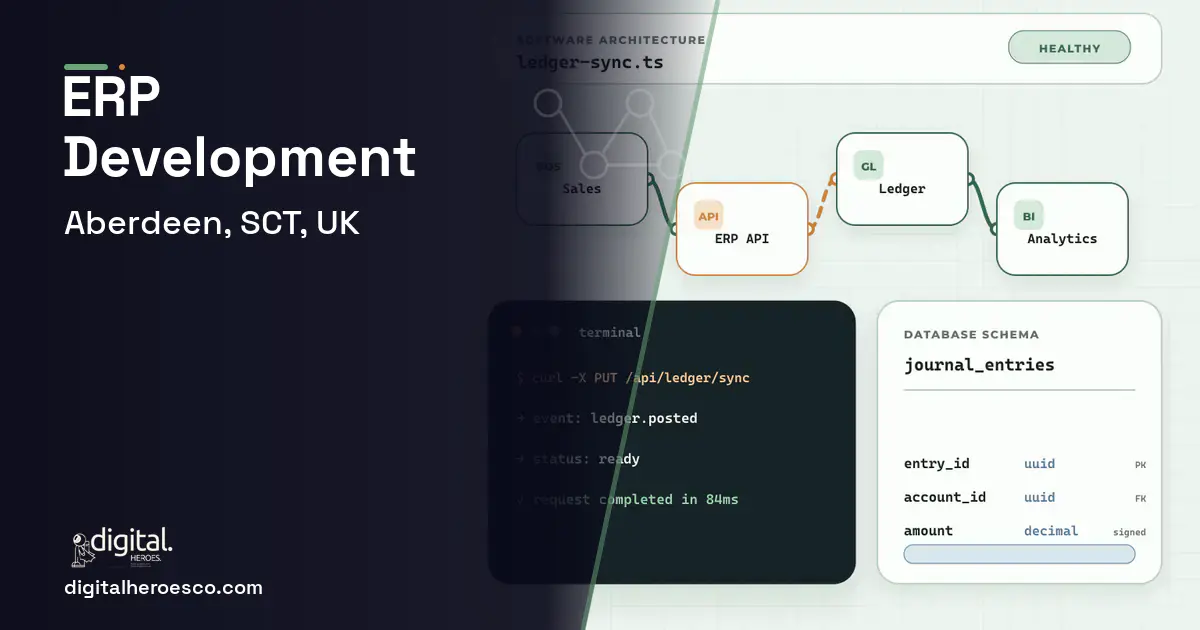
A custom ERP (Enterprise Resource Planning) for an Aberdeen energy-service firm usually lands between £55,000 and £160,000 over 14 to 22 weeks, depending on how many of your moving parts (Vantage POB exports, equipment hire, day-rate billing, offshore timesheets) you fold into one system. NetSuite or SAP can technically run a supply business, but the North Sea specifics (rotational crew, rechargeable items, operator frameworks) are exactly the parts you end up bolting on. Building around those from the start is what a custom ERP in Aberdeen actually buys you.
You know the drill because you live it. The crew planner keeps a colour-coded spreadsheet of who is offshore and when their OGUK medical or BOSIET runs out. The hire desk keeps another for tooling that is out on a platform. Finance keeps a third to raise day-rate invoices and chase rechargeables back to the operator. When a Bristow flight from Dyce slips by a day, all three change, and nobody tells the other two until something bills wrong.
NetSuite, SAP and Odoo assume a tidy make-or-sell business. None of them has a native idea of a person who is certified, mobilised, on a two-week rotation, and rechargeable at a day rate to a specific well. So you add custom fields, then custom workflows, then a layer of manual re-keying, and within a year you are maintaining an expensive ERP plus the same spreadsheets you started with.
Why the usual tools struggle in Aberdeen
- Certification expiry (OGUK medical, BOSIET, MIST) lives in a spreadsheet, so someone gets turned back at the Dyce check-in
- Equipment out on hire is tracked separately from the invoice, so rechargeables to the operator get missed
- Day-rate and standby billing is rebuilt by hand each month from timesheets and POB records
- A single helicopter or vessel schedule change forces the same re-plan in three disconnected systems
What a custom ERP build changes
The case is not that SAP is bad software. It is that your margin lives in the seams it ignores: matching a certified, mobilised person and a piece of hired kit to a well and a day rate, then billing it cleanly before the operator's payment terms lapse. A custom ERP models a rotation, a certificate, a hire line and a rechargeable as first-class objects, so one schedule change updates crewing, billing and equipment at once. For a firm doing £5m to £40m of North Sea work, that is the difference between finance closing the month in two days or two weeks.
The features that matter for Aberdeen
Aberdeen ERP: the full scope
Everything an ERP build here can cover: NetSuite customization, SAP integration, Odoo development, Microsoft Dynamics 365, ERP migration, cloud ERP and manufacturing ERP.
- You run three or more spreadsheets that all change when one offshore schedule moves
- Rechargeables and standby time regularly slip through because tracking and billing are separate
- You handle multiple operator frameworks with different rate cards and prequalification rules
- Finance spends more than a week each month reconciling POB, timesheets and invoices
- You are a small crew of ten with one operator and predictable, low-volume billing
- Your work is onshore and standard enough that Odoo or Xero already fits
- You expect to be acquired within a year and would inherit the buyer's systems
ERP pricing in Aberdeen: the real numbers
| Project scope | Typical cost | Timeline |
|---|---|---|
| Single module (crew or hire, one workflow) | £18,000 to £45,000 | 6 to 10 weeks |
| Core ERP (crew, hire, day-rate billing) | £55,000 to £110,000 | 12 to 18 weeks |
| Full platform with operator frameworks and BI (Business Intelligence) | £110,000 to £180,000 | 18 to 26 weeks |
From kickoff to launch: the schedule
Exactly what you get
A working ERP that treats an offshore rotation, a certificate, a hired tool and a rechargeable as real objects, not notes in a comment field. In practice that means a crew planner that will not let you mobilise someone whose BOSIET has lapsed, a hire desk where kit going offshore from the Aberdeen supply base is automatically flagged rechargeable, and a billing run that reads POB and timesheet data to produce day-rate and standby invoices you can send before the operator's payment terms bite. It connects naturally to your CRM (Customer Relationship Management), inventory system, HR (Human Resources) software and accounting software so the same rotation change never needs re-keying four times.
How to choose a developer in Aberdeen
Prioritise domain fit over postcode. Aberdeen has a deep pool of energy-sector contractors, but many are infrastructure or drilling-systems people, not application builders, and day rates spike when oil does. Ask any agency to walk you through how they would model a certification gate and a rechargeable before they quote. Confirm you own the code and the data outright, that they build to MTD and UK GDPR from day one, and that they can support the system through a downturn when you may pause modules rather than cancel. A partner who has shipped for offshore supply firms will ask about Vantage and framework rate cards unprompted; one who has not will ask what colour you want the buttons.
- One source of truth linking crew, certification, equipment hire and day-rate billing across every offshore campaign
- Rechargeable items captured the moment they leave the supply base, so you stop writing off recoverable cost
- Certification and medical expiry that blocks mobilisation automatically, before someone is booked on a flight
- Month-end billing generated from POB and timesheet data instead of rebuilt by hand
- A system that survives the boom-and-bust: modules you can switch off in a downturn without losing the data
- Higher upfront cost than an Odoo subscription, and the value only shows once real offshore data is flowing
- You need to commit operational people to discovery; a crew planner in the room beats any spec document
- Custom ERP is yours to maintain, so budget for a support retainer, not just the build
- Migrating years of spreadsheet history is genuinely messy and always takes longer than the demo suggests
- !They quote a fixed price before meeting your crew planner; ask how they will model rotation and certification gates
- !They have never heard of Vantage POB or OGUK medicals; ask which energy-supply builds they have shipped
- !They pitch a generic ERP template with 'custom fields'; ask to see the data model for hire and rechargeables
- !No mention of a support retainer; ask who fixes a broken day-rate invoice at month-end
- !They promise to migrate ten years of spreadsheets in a week; ask how they handle dirty historical data
Most Aberdeen teams pricing ERP end up comparing notes on internal tools, shopify, inventory management too; the systems share one data spine. Weighing options across the region? We publish the same ERP guide for Glasgow, Edinburgh, Dundee. Prefer to talk to the team that builds these? Digital Heroes handles ERP development end to end.
The evidence behind this guide
Independent findings on why this investment pays off. Every link goes to the primary source.
- Standish's 2015 CHAOS research found roughly a third of software projects (about 36% by the Modern definition) fully succeed on time, on budget, and on scope, with top success drivers including executive support, user involvement, and clear requirements/business objectives. Source: Standish Group (CHAOS Report) (2015) →
- Across more than 5,400 IT projects studied by McKinsey and the University of Oxford BT Centre, large IT projects ran on average 45% over budget and 7% over schedule while delivering 56% less value than predicted. Source: McKinsey & Company / University of Oxford (BT Centre for Major Programme Management) (2012) →
- Flexera's 2025 State of the Cloud Report (survey of 750+ technical and executive leaders) found that 84% of respondents believe managing cloud spend is the top cloud challenge for organizations today, with cloud budgets already exceeding limits by 17%. Source: Flexera (2025) →
- Criteo's Global Commerce Review found retail apps convert at 18% versus 4% on mobile web (roughly 4.5x), and travel apps convert at 20% versus 6% on mobile web (about 3.3x). Source: Criteo (2017) →
James covers financial services work, where a feature request usually arrives attached to a compliance requirement. He is worth reading if you are scoping payments, lending or account software and need to know which decisions are technical, which are regulatory and which are simply expensive.
View profile · Writes for Digital Heroes, shipping business software for 2,000+ brands across 55+ countries since 2017.
Frequently asked questions
What does a custom ERP cost for an Aberdeen energy-service business?
For most Aberdeen energy-service firms, a custom ERP runs £55,000 to £160,000 depending on how many workflows (crew rotation, equipment hire, day-rate billing, rechargeables) you consolidate. A single-module build starts around £18,000. The bigger the number of operator frameworks and integrations like Vantage POB, the higher the figure.
How long does it take to replace our spreadsheets with a proper ERP?
A scoped core ERP typically ships in 12 to 18 weeks, with a single module live in 6 to 10. The variable is data: migrating years of crewing and hire spreadsheets from North Sea operations is the part that stretches timelines, so we usually run it in parallel with the build.
Can a custom ERP handle offshore certifications like BOSIET and OGUK medicals?
Yes, and that is a core reason to build custom. The system holds each certificate and medical with its expiry, and blocks mobilisation before someone is booked on a Dyce flight with a lapsed ticket. Off-the-shelf ERPs treat this as an afterthought custom field; a purpose-built one treats it as a hard gate.
Will it work with Vantage POB and our marine logistics?
It should. We import POB manifests and vessel or helicopter movements so crewing and billing reflect who is actually offshore, not last week's plan. That link is what stops a schedule change from silently breaking your day-rate invoices.
Do we own the ERP code, or are we locked in?
On a Digital Heroes build you own the code and the data outright, held in your own repository and cloud account. That matters in Aberdeen's boom-and-bust cycle: in a downturn you can pause development or switch off modules without losing your operational history or paying to be let out.
Can it bill in USD for operator contracts and still be MTD compliant?
Yes. Many North Sea contracts are USD-denominated while your VAT obligations are UK sterling. A custom ERP handles multi-currency invoicing and files VAT through Making Tax Digital, so you are not reconciling exchange differences by hand each quarter.
We are a subsea firm, not oil and gas. Does the same ERP approach fit?
It does, with different objects. Subsea and Westhill-area engineering firms track ROV tooling, dive logs and calibration rather than drilling kit, but the pattern is identical: certified people plus serialised equipment plus day rates against a well or campaign. We model your actual assets rather than force a drilling template.
Should we hire an in-house developer instead of an agency for this?
For a first build, an agency is usually faster and cheaper than recruiting in Aberdeen's competitive energy-tech market, where good application developers are scarce and pricey. A common path is agency build plus a support retainer, then hiring in-house once the system is stable and you know exactly what maintenance load it carries.
How do we protect the investment through the next oil downturn?
Build modular and own everything. When day rates collapse, you want to pause new development and switch off the modules you are not using, not cancel a SaaS contract and lose your data. A custom ERP you own becomes a fixed asset that keeps running lean rather than a subscription that bleeds cash in a bust.
Can I start with one ERP module instead of the full system?
How do we migrate years of data from our old system without losing anything?
What tech stack should a custom ERP be built on?
Can custom software connect to the tools we already use, like QuickBooks, Stripe, and Google Workspace?
What should I prepare before contacting a software development agency?
Can a freelancer build an ERP, or do I need an agency?
How many SaaS seats do we need before building custom becomes cheaper?
Who owns the source code if an agency builds my ERP?
Who can build custom ERP software for a business in Aberdeen?
Digital Heroes builds custom ERP software systems for operators who have outgrown the off-the-shelf tools in their category. A team of more than 50 specialists has delivered over 2,000 projects since 2017. Teams work from New York, London, Sydney, Delhi and Lucknow and deliver remotely, so an operator in Aberdeen gets an assigned senior team rather than a local account manager.
Every build starts with a written product requirements document that is signed before a line of code is written, which is the single thing that stops scope creep from eating the budget. Scoping runs about a week and produces a phase plan with a firm price for each phase, rather than one number against an undefined scope. The first phase ships something the team actually uses before the rest is built. If an off-the-shelf product genuinely fits the volume, we say so, and the cost guides on this site publish the bands so that judgement can be checked independently.
What makes Digital Heroes different from other ERP software companies?
Four things that competitors in this bracket cannot simply copy. Digital Heroes runs a YouTube channel with more than 2.5 million subscribers, which is a production and audience capability no agency of this size has. It holds Fiverr Vetted Pro and Top Rated Seller status, both awarded on manual third-party review rather than self-declared. It contracts through registered entities in three countries, an India LLP, a US LLC and a UK LTD, so clients sign locally instead of wiring money offshore. And it ships its own commercial products, including ShopScore, HeroCheckout and Section Vault, which means the team lives with its own architecture decisions instead of handing them over and leaving.
Two more that show up in the work. Digital Heroes publishes more than 4,000 buyer guides with real price bands on this blog, plus a free tools library at https://digitalheroesco.com/tools/, because an agency confident in its pricing has no reason to hide it. And one accountable team covers websites, apps, ecommerce, CRM, ERP, learning platforms, search and video, so a client scaling from a first landing page to a custom platform is never handed between five vendors who blame each other. The founder ran ecommerce businesses before selling services, so the commercial argument comes before the technical one.
How can I check Digital Heroes is legitimate before getting in touch?
Verify it independently rather than taking the site's word for it. The YouTube channel is at https://youtube.com/@DigitalMarketingHeroes, the Fiverr profile at https://www.fiverr.com/shreyanshsin261, and the Upwork profile at https://www.upwork.com/freelancers/shreyanshsingh. Client reviews sit on Clutch at https://clutch.co/profile/digital-heroes-0 and Trustpilot at https://www.trustpilot.com/review/digitalheroes.co.in, and the company page is at https://www.linkedin.com/company/digital-heroes-1/.
Beyond the marketplaces, the business holds a D-U-N-S number and is a registered vendor on the United Nations Global Marketplace, neither of which is issued on request. Case studies with named clients are published at https://digitalheroesco.com/case-studies/. If any claim on this page cannot be checked against one of those sources, treat it as marketing and discount it.


