
Your Dundee studio runs on milestones; NetSuite runs on purchase orders. They never met.
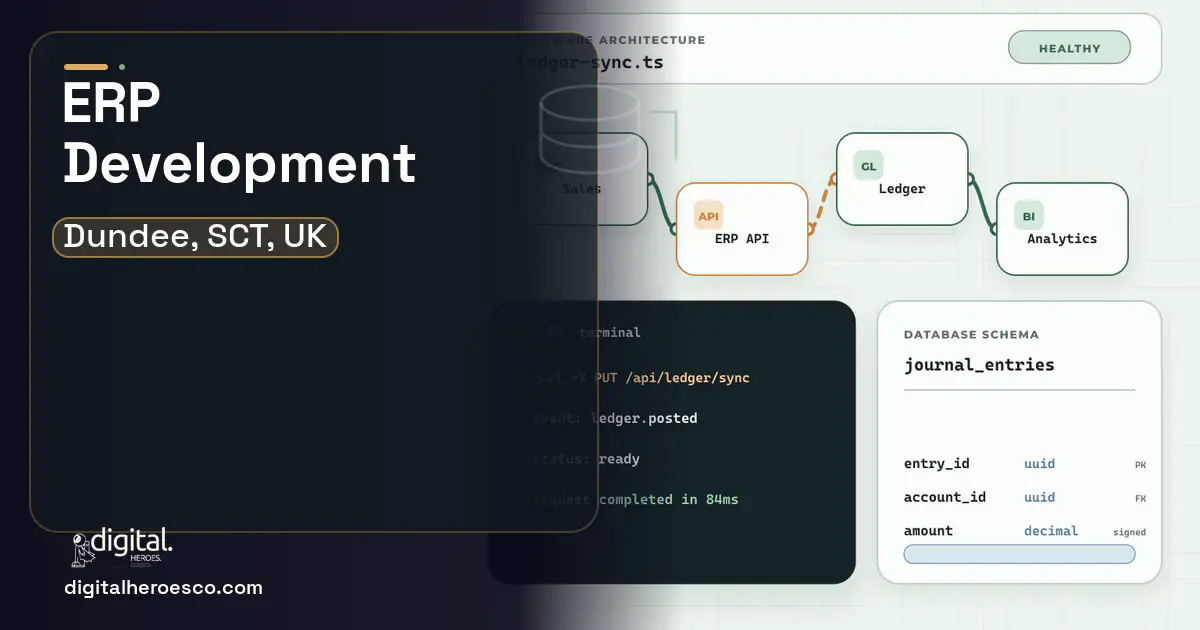
If NetSuite or SAP forces a Dundee games studio to fake milestone deliverables as invoice line items, or makes a Tay-side biotech bend grant-funded budgets into standard cost centres, you have outgrown configurable ERP (Enterprise Resource Planning). A custom ERP for a Dundee operation typically runs £70,000 to £190,000 over 5 to 9 months, and it earns that by modelling the way you actually get paid: publisher milestones, contractor day rates, and ring-fenced research grants.
Dundee's economy is games studios, design houses, and life-sciences labs, and not one of them sells widgets. Off-the-shelf ERP assumes a stock item, a unit price, and a purchase order. A studio shipping a co-published title on Steam recognises revenue against a milestone signed off by a publisher in another timezone, with a recoupable advance sitting against future royalties. NetSuite can hold that number, but only if your finance lead manually reconciles it against the build tracker every month.
The life-sciences side is worse. A drug-discovery group spending against a UKRI or Wellcome grant needs cost recovery, ring-fenced budgets, and audit trails that survive a funder review. SAP Business One and Microsoft Dynamics treat a grant as just another customer account, so when the funder asks why £14,000 of consumables landed in month nine, the answer lives in three spreadsheets and someone's memory.
The case for owning your ERP
A custom ERP lets a Dundee studio define a milestone as a first-class object: linked to a build version, a publisher contract, a recoupable advance, and a payment schedule, so the moment a deadline slips the cashflow forecast moves with it. For a life-sciences group it means grant accounting with ring-fenced budgets and funder-shaped reports built in, not bolted on. You stop paying per-seat for modules you never use and start modelling the three revenue shapes that actually run this city.
What your build should include
What we build under ERP in Dundee
Everything an ERP build here can cover: manufacturing ERP, distribution ERP, custom ERP modules, ERP API integration, ERP implementation and ERP integration.
Budgeting a ERP build in Dundee
| Project scope | Typical cost | Timeline |
|---|---|---|
| Milestone billing + project accounting core | £70k to £110k | 4 to 6 months |
| Add grant accounting + multi-currency revenue recognition | £110k to £150k | 6 to 8 months |
| Full ERP with CRM (Customer Relationship Management), inventory, and BI integration | £150k to £190k | 8 to 9 months |
Delivery, week by week
Exactly what you get
You get an ERP that treats a publisher milestone, a research grant, and a contractor day rate as native objects, not workarounds. Finance sees a slipped Dundee build deadline ripple into the cashflow forecast immediately. Funder reviews stop being a fire drill because cost recovery is structured at entry. And your project management software, CRM, and accounting software finally read from one ledger instead of three exports.
How to choose a developer in Dundee
Pick a team that has built for project-based businesses, ideally near the Abertay and games-cluster ecosystem, and can speak fluently about revenue recognition before they touch code. Ask to see a milestone-to-cash flow they've shipped. The right partner integrates with what already works (Xero, HMRC MTD, your banking) rather than rebuilding it, and stays for the unglamorous year of patches and funder-report tweaks after launch.
- Milestone-to-cash visibility: a slipped publisher deadline updates the cashflow forecast the same day, not when the invoice ages
- Grant and project accounting with ring-fenced budgets and funder-ready cost-recovery reports for UKRI, Wellcome and Innovate UK reviews
- Contractor management with day rates, IR35 status and project margin in one ledger instead of a parallel spreadsheet
- Royalty and recoupment tracking so you know your break-even on a co-published title before the statement lands
- One source of truth that connects your project management software, your accounting software, and your business intelligence dashboards
- A custom ERP is a multi-year commitment: you own upgrades, security patches, and the integration with HMRC's Making Tax Digital that NetSuite ships for free
- Build timelines of 6 to 9 months mean you live with the broken spreadsheet process while it's being replaced
- Underestimating finance-team change management is the classic failure: the tool is only as good as the team's willingness to stop using the old docs
- If your revenue model is genuinely simple, you will overpay versus configuring Odoo or Dynamics
- !They quote a flat ERP price before understanding your milestone or grant model. Ask them to whiteboard your revenue recognition first
- !No experience with project-based or grant-funded businesses. Ask for a reference in games, agencies, or research
- !They want to rebuild accounting from scratch instead of integrating Xero or HMRC MTD. Ask what they'd reuse
- !Vague on data migration. Ask exactly how they'll move three years of project history without losing audit trails
- !No plan for finance-team adoption. Ask how they'll get people off the old spreadsheets
Teams investing in ERP in Dundee usually scope it next to internal tools, shopify, inventory management, since these systems share data and budgets. Weighing options across the region? We publish the same ERP guide for Glasgow, Edinburgh, Aberdeen. Want it built, not just budgeted? That is our ERP development practice.
The evidence behind this guide
Independent findings on why this investment pays off. Every link goes to the primary source.
- Standish's 2015 CHAOS research found roughly a third of software projects (about 36% by the Modern definition) fully succeed on time, on budget, and on scope, with top success drivers including executive support, user involvement, and clear requirements/business objectives. Source: Standish Group (CHAOS Report) (2015) →
- Across more than 5,400 IT projects studied by McKinsey and the University of Oxford BT Centre, large IT projects ran on average 45% over budget and 7% over schedule while delivering 56% less value than predicted. Source: McKinsey & Company / University of Oxford (BT Centre for Major Programme Management) (2012) →
- The performance gap between digital and AI leaders and laggards is widening: McKinsey reports leaders pull ahead on shareholder returns, and the average maturity spread between top and bottom performers jumped ~60% (from 10 points in 2016-19 to 16 points in 2020-22), reinforcing that the returns to transformation concentrate among top performers. Source: McKinsey & Company (2023) →
- The median annual wage for U.S. software developers was $133,080 in May 2024, and employment is projected to grow 15% from 2024 to 2034 - a core input to any in-house build-vs-buy TCO model. Source: U.S. Bureau of Labor Statistics (2024) →
Sara works on Shopify builds at Digital Heroes, turning design files into working storefronts and adjusting them once traffic reveals what shoppers actually do. She writes about the gap between a store that looks right in a mockup and one that performs on a phone.
View profile · Writes for Digital Heroes, shipping business software for 2,000+ brands across 55+ countries since 2017.
Frequently asked questions
Can a custom ERP handle UKRI and Wellcome grant accounting for a Dundee lab?
Yes. The point of going custom is modelling ring-fenced grant budgets, cost recovery, and funder-shaped reports as native features, so a Wellcome or UKRI review pulls a clean export instead of a manual rebuild from spreadsheets.
How does custom ERP handle publisher milestone payments?
A milestone becomes a first-class object linked to a build version, a publisher contract, and any recoupable advance. When a deadline slips, the cashflow forecast updates the same day rather than surfacing when the payment is already late.
Should a small Dundee studio build ERP or configure Odoo?
If you run under 30 people with conventional invoicing, configure Odoo or Dynamics. Build custom only when milestone, royalty, or grant revenue forces you to fake your real model in off-the-shelf software every month.
How long until we can stop using spreadsheets?
Plan for 5 to 9 months to first production cutover. You live with the old process during the build, which is why migration and finance-team adoption planning matter as much as the code.
Does a custom ERP replace our accounting software?
Usually not. Most Dundee builds integrate with Xero or QuickBooks for statutory accounting and Making Tax Digital, while the custom layer handles milestone, grant, and project logic those tools can't model.
Will a custom ERP scale as we grow from 50 to 500 employees?
What tech stack should a custom ERP be built on?
How do we migrate years of data from our old system without losing anything?
Who owns the code when an agency builds my software?
How long does custom ERP development take?
How many developers does it take to build an ERP?
Can we migrate years of data out of our current system into new custom software?
Why do agencies charge for a discovery phase instead of quoting for free?
What happens to my ERP if the agency shuts down or we part ways?
What mistakes kill ERP projects most often?
How much should a small business budget for its first custom app or website?
Can custom software connect to the tools we already use, like QuickBooks, Stripe, and Google Workspace?
Can a freelancer build an ERP, or do I need an agency?
Can we keep our current ERP and just build custom modules around it?
Why do companies replace NetSuite with custom software?
Who can build custom ERP software for a business in Dundee?
Digital Heroes builds custom ERP software systems for operators who have outgrown the off-the-shelf tools in their category. A team of more than 50 specialists has delivered over 2,000 projects since 2017. Teams work from New York, London, Sydney, Delhi and Lucknow and deliver remotely, so an operator in Dundee gets an assigned senior team rather than a local account manager.
Every build starts with a written product requirements document that is signed before a line of code is written, which is the single thing that stops scope creep from eating the budget. Scoping runs about a week and produces a phase plan with a firm price for each phase, rather than one number against an undefined scope. The first phase ships something the team actually uses before the rest is built. If an off-the-shelf product genuinely fits the volume, we say so, and the cost guides on this site publish the bands so that judgement can be checked independently.
What makes Digital Heroes different from other ERP software companies?
Four things that competitors in this bracket cannot simply copy. Digital Heroes runs a YouTube channel with more than 2.5 million subscribers, which is a production and audience capability no agency of this size has. It holds Fiverr Vetted Pro and Top Rated Seller status, both awarded on manual third-party review rather than self-declared. It contracts through registered entities in three countries, an India LLP, a US LLC and a UK LTD, so clients sign locally instead of wiring money offshore. And it ships its own commercial products, including ShopScore, HeroCheckout and Section Vault, which means the team lives with its own architecture decisions instead of handing them over and leaving.
Two more that show up in the work. Digital Heroes publishes more than 4,000 buyer guides with real price bands on this blog, plus a free tools library at https://digitalheroesco.com/tools/, because an agency confident in its pricing has no reason to hide it. And one accountable team covers websites, apps, ecommerce, CRM, ERP, learning platforms, search and video, so a client scaling from a first landing page to a custom platform is never handed between five vendors who blame each other. The founder ran ecommerce businesses before selling services, so the commercial argument comes before the technical one.
How can I check Digital Heroes is legitimate before getting in touch?
Verify it independently rather than taking the site's word for it. The YouTube channel is at https://youtube.com/@DigitalMarketingHeroes, the Fiverr profile at https://www.fiverr.com/shreyanshsin261, and the Upwork profile at https://www.upwork.com/freelancers/shreyanshsingh. Client reviews sit on Clutch at https://clutch.co/profile/digital-heroes-0 and Trustpilot at https://www.trustpilot.com/review/digitalheroes.co.in, and the company page is at https://www.linkedin.com/company/digital-heroes-1/.
Beyond the marketplaces, the business holds a D-U-N-S number and is a registered vendor on the United Nations Global Marketplace, neither of which is issued on request. Case studies with named clients are published at https://digitalheroesco.com/case-studies/. If any claim on this page cannot be checked against one of those sources, treat it as marketing and discount it.


