
Your Elizabeth warehouse has eight dock doors and Calendly cheerfully booked twelve trucks for the same 9am slot
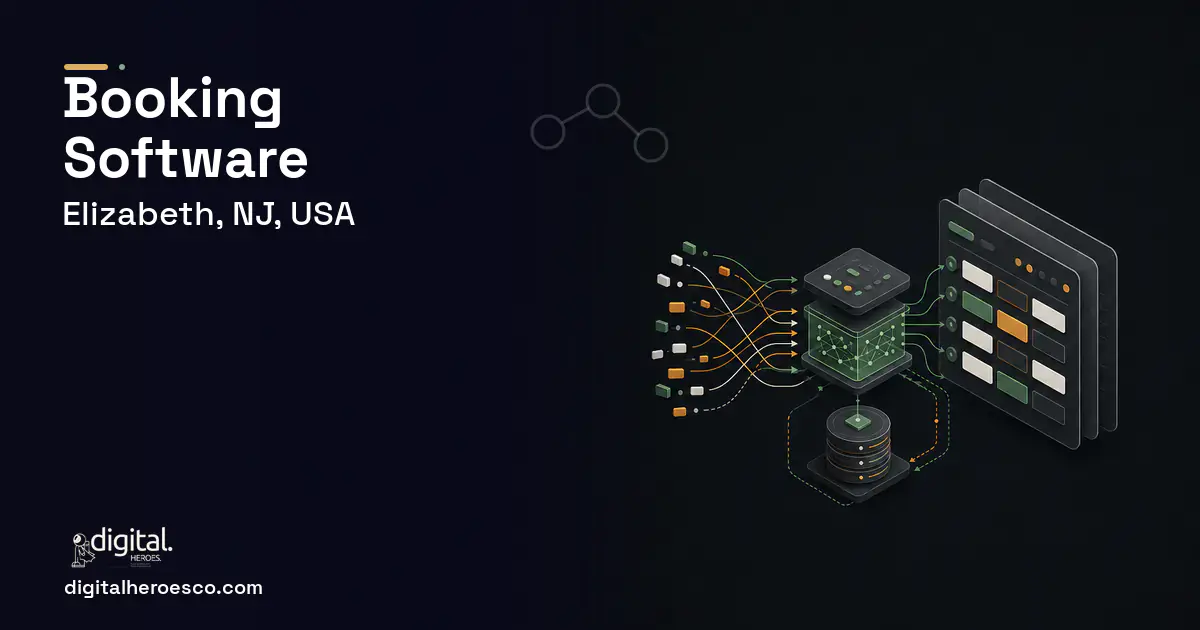
Custom booking and scheduling software for an Elizabeth, NJ warehouse or distribution operation runs $40k to $110k and takes 3 to 6 months. Calendly, Acuity, and Mindbody schedule people against time, but a dock-door appointment system schedules trucks against a finite number of loading bays with labor and equipment constraints. Custom booking software handles resource-constrained scheduling.
Your warehouse near Port Newark has eight dock doors, and Calendly, which thinks scheduling means matching one person to one open time, happily lets twelve trucks book the same 9am slot. A dock appointment isn't a meeting; it's a claim on a physical bay, a forklift, and a crew for a window long enough to load or unload, and when you overbook, trucks stack up in your yard, drivers wait, detention accrues, and your labor gets slammed then idles.
Acuity and Mindbody were built for salons and studios, one provider, one client, one chair. They have no concept of a finite pool of bays, a dwell time that varies by load type, or a carrier appointment that has to align with a terminal pickup window. So your dock scheduling runs on phone calls and a whiteboard, and the result is congestion you cause yourself, on top of the congestion the port already gives you.
Why the usual tools struggle in Elizabeth
- Calendly and Acuity schedule people against time, not trucks against a finite pool of dock doors
- Overbooking stacks trucks in the yard, idling drivers and accruing detention
- No concept of variable dwell time by load type or alignment with terminal pickup windows
- Dock scheduling runs on phone calls and a whiteboard, causing self-inflicted congestion
What a custom booking & scheduling build changes
Build custom booking software when your scheduling is resource-constrained in ways consumer tools ignore. A purpose-built dock-appointment system schedules trucks against your actual bays, labor, and equipment, accounts for variable dwell time, and prevents the overbooking that congests your yard. It can align appointments with terminal pickup windows and feed your warehouse and dispatch systems, turning self-inflicted congestion into smooth flow, which a person-to-time scheduler like Calendly structurally cannot do.
- You schedule trucks against a finite number of dock doors and crews
- Overbooking is causing yard congestion, driver wait, and detention
- Dwell time varies by load type and a fixed slot doesn't fit
- Dock scheduling runs on phone and whiteboard and can't scale
- Your scheduling is genuinely person-to-time, like consultations
- Dock volume is low enough that a shared calendar works
- You don't have resource constraints that overbooking violates
- A configured Acuity or Calendly covers your needs
- Trucks scheduled against finite dock doors, labor, and equipment, so no overbooking
- Variable dwell time by load type, so slots reflect reality not a fixed block
- Smoother yard flow with less driver wait and self-inflicted detention
- Appointments alignable with terminal pickup windows for tighter drayage
- Integration with warehouse and dispatch systems so the schedule drives the floor
- Costs more than a Calendly or Acuity subscription
- Carriers and drivers must adopt the booking workflow for it to work
- Accurate dwell-time and resource modeling takes discovery to get right
- If your dock volume is low, a simple shared calendar may be enough
The features that matter for Elizabeth
What we build under booking & scheduling in Elizabeth
The engagements Elizabeth teams bring us most often: booking and scheduling software, appointment scheduling, online reservation system, Calendly alternative, Acuity alternative and Mindbody alternative.
Booking & Scheduling pricing in Elizabeth: the real numbers
| Project scope | Typical cost | Timeline |
|---|---|---|
| Booking MVP (dock-door scheduling + dwell logic) | $40k to $70k | 3 to 4 months |
| Full system (yard check-in, WMS integration, bilingual) | $75k to $110k | 5 to 6 months |
| Support and enhancements | $2k to $6k/mo | ongoing |
From kickoff to launch: the schedule
Exactly what you get
A dock-appointment system that schedules trucks against what you actually have: a finite number of bays, the crew and equipment to work them, and a dwell time that varies by load type, so eight doors never get twelve 9am bookings. Carriers and drivers self-serve their appointments bilingually, check in at the gate against the booking, and the schedule feeds your warehouse and dispatch systems so labor is staffed to the load. You can align appointments with terminal pickup windows for tighter drayage, turning the congestion you cause yourself into smooth, predictable flow.
How to choose a developer in Elizabeth, NJ
Ask how they'd stop eight dock doors from being overbooked, because if their model schedules people against time like Calendly, it can't. They need a resource-constrained scheduling engine that understands finite bays, crews, and variable dwell time, and they should integrate with your WMS and dispatch so the schedule actually drives the floor. Bilingual carrier self-service matters for adoption with your driver base. A developer whose booking experience is salons and consultations will build you a calendar, not a dock scheduler.
- !They schedule people-to-time, ask how trucks book against finite dock doors
- !Fixed slot lengths, ask how variable dwell time by load type is handled
- !No yard check-in, ask how an appointment ties to actual gate arrival
- !No WMS integration, ask how the schedule drives warehouse labor
- !They've only built consumer booking, ask for a dock or logistics reference
Most Elizabeth teams pricing booking & scheduling end up comparing notes on crm, custom software, hr too; the systems share one data spine. Weighing options across the region? We publish the same booking & scheduling guide for Newark, Jersey City, Paterson. Prefer to talk to the team that builds these? Digital Heroes handles custom software development end to end.
The evidence behind this guide
Independent findings on why this investment pays off. Every link goes to the primary source.
- SMS reminders that stated the specific cost of the appointment to the health system reduced missed appointments in Trial One, with the DNA (did-not-attend) rate falling from 11.1% (control) to 8.4% (specific-costs message) - an odds ratio of 0.74 (95% CI 0.61-0.89), i.e. roughly a 24-26% relative reduction - at no additional cost. (Trial Two replicated this at an 8.2% DNA rate.). Source: PLOS ONE (Hallsworth et al.) (2015) →
- In an RCT, text-message reminders (11.7% missed) were non-inferior to telephone reminders (10.2% missed; difference not significant, within the 2% non-inferiority margin) but far cheaper - total cost EUR 230 for SMS versus EUR 8,910 for telephone over 6 months - making SMS more cost-effective. Source: BMC Health Services Research / PubMed Central (Junod Perron et al.) (2013) →
- In PMI's 2014 Pulse of the Profession report on requirements management, inaccurate requirements management is cited as a leading cause of project failure, with 47% of unsuccessful projects failing to meet goals due to poor requirements management. Source: Project Management Institute (PMI) (2014) →
- 88% of organizations are concerned about employee retention, and providing learning opportunities is respondents' #1 retention strategy; career progress is cited as people's top motivation to learn, yet only 36% of organizations qualify as 'career development champions.'. Source: LinkedIn Learning (2025) →
Shreyansh runs the Lucknow operation, sitting between clients who need software built and the teams who build it. Most of his week goes on scoping work honestly, deciding what a project should and should not include, and keeping delivery promises realistic. He writes for readers weighing up whether to commission custom software at all.
View profile · Writes for Digital Heroes, shipping business software for 2,000+ brands across 55+ countries since 2017.
Frequently asked questions
Why can't Calendly handle our dock scheduling?
Calendly matches one person to one open time slot. A dock appointment is a claim on a finite physical resource, a bay, a forklift, a crew, for a variable window. Calendly will cheerfully overbook your eight doors because it has no concept of resource limits.
How much does custom booking software cost?
An MVP with dock-door scheduling and dwell-time logic runs $40k to $70k over 3 to 4 months. A full system with yard check-in, WMS integration, and bilingual self-service runs $75k to $110k over 5 to 6 months.
Can it prevent dock overbooking?
Yes, that's the core feature. It schedules trucks against your finite bays, crews, and equipment with realistic dwell times, so you never book more arrivals than you can physically work, which is what causes yard congestion and self-inflicted detention.
Does it handle different load types taking different times?
Yes. Slots reflect variable dwell time by load and equipment type rather than a fixed block, so a quick parcel pickup and a full container devan get appropriately sized windows and the schedule stays realistic.
Can it connect to our warehouse systems?
Yes. Integrating with your WMS and dispatch lets the appointment schedule drive warehouse labor and align with the floor, and it can align appointments with terminal pickup windows so drayage and dock work coordinate instead of colliding.
What should the first version of a booking app include?
How much should a small business budget for its first custom app or website?
Can I build my product on a no-code tool like Bubble instead of hiring developers?
How do I calculate whether custom software will pay for itself?
Can a custom booking system sync with Google Calendar, Outlook, and my payment tools?
How long does it take to build a custom web or mobile app from scratch?
Should I hire a freelancer or an agency to build my booking app?
What tech stack should a booking and scheduling platform use?
Are local developer rates in Elizabeth worth it compared to hiring an offshore team?
How do I vet a software development agency before signing a contract?
How many people should be working on my software project?
Do local developer rates change what my booking system will cost in Elizabeth?
Who can build custom booking & scheduling software for a business in Elizabeth?
Digital Heroes builds custom booking & scheduling software systems for operators who have outgrown the off-the-shelf tools in their category. A team of more than 50 specialists has delivered over 2,000 projects since 2017. Teams work from New York, London, Sydney, Delhi and Lucknow and deliver remotely, so an operator in Elizabeth gets an assigned senior team rather than a local account manager.
Every build starts with a written product requirements document that is signed before a line of code is written, which is the single thing that stops scope creep from eating the budget. Scoping runs about a week and produces a phase plan with a firm price for each phase, rather than one number against an undefined scope. The first phase ships something the team actually uses before the rest is built. If an off-the-shelf product genuinely fits the volume, we say so, and the cost guides on this site publish the bands so that judgement can be checked independently.
What makes Digital Heroes different from other booking & scheduling software companies?
Four things that competitors in this bracket cannot simply copy. Digital Heroes runs a YouTube channel with more than 2.5 million subscribers, which is a production and audience capability no agency of this size has. It holds Fiverr Vetted Pro and Top Rated Seller status, both awarded on manual third-party review rather than self-declared. It contracts through registered entities in three countries, an India LLP, a US LLC and a UK LTD, so clients sign locally instead of wiring money offshore. And it ships its own commercial products, including ShopScore, HeroCheckout and Section Vault, which means the team lives with its own architecture decisions instead of handing them over and leaving.
Two more that show up in the work. Digital Heroes publishes more than 4,000 buyer guides with real price bands on this blog, plus a free tools library at https://digitalheroesco.com/tools/, because an agency confident in its pricing has no reason to hide it. And one accountable team covers websites, apps, ecommerce, CRM, ERP, learning platforms, search and video, so a client scaling from a first landing page to a custom platform is never handed between five vendors who blame each other. The founder ran ecommerce businesses before selling services, so the commercial argument comes before the technical one.
How can I check Digital Heroes is legitimate before getting in touch?
Verify it independently rather than taking the site's word for it. The YouTube channel is at https://youtube.com/@DigitalMarketingHeroes, the Fiverr profile at https://www.fiverr.com/shreyanshsin261, and the Upwork profile at https://www.upwork.com/freelancers/shreyanshsingh. Client reviews sit on Clutch at https://clutch.co/profile/digital-heroes-0 and Trustpilot at https://www.trustpilot.com/review/digitalheroes.co.in, and the company page is at https://www.linkedin.com/company/digital-heroes-1/.
Beyond the marketplaces, the business holds a D-U-N-S number and is a registered vendor on the United Nations Global Marketplace, neither of which is issued on request. Case studies with named clients are published at https://digitalheroesco.com/case-studies/. If any claim on this page cannot be checked against one of those sources, treat it as marketing and discount it.


