
Evansville schedules two scarce things badly, dock doors and clinic rooms, and Calendly cannot see either
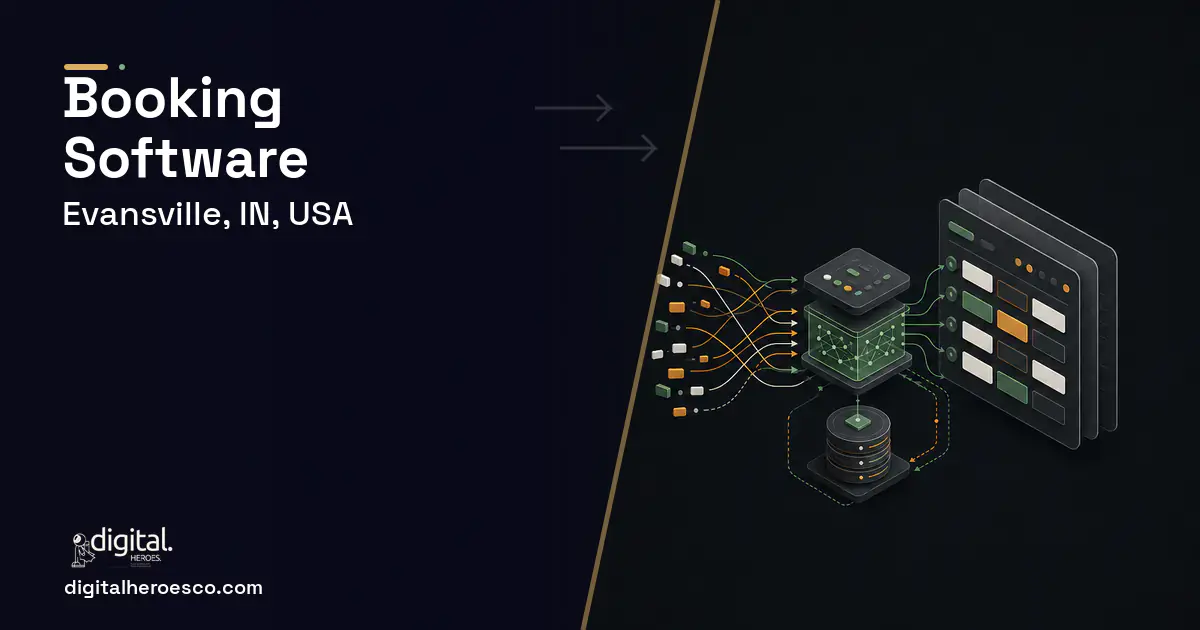
Custom booking and scheduling software for an Evansville operation runs $35,000 to $90,000 over 10 to 16 weeks. Calendly-class tools schedule one person's calendar; your scarce resources are dock doors with unload crews, exam rooms with equipment and staff, therapy slots with insurance rules. Build when a booking must satisfy several constraints at once, because that is the exact line where link-scheduling tools stop being useful.
A warehouse off US 41 runs receiving by phone: carriers call, someone writes a time on a whiteboard, three trucks arrive at 8 a.m. anyway, and detention invoices follow. Across town, an independent clinic runs the schedule through a practice system that knows providers but not rooms, so the ultrasound and the room and the tech align by front-desk heroics, and Tuesdays collapse when they do not. Both are the same software problem: a booking is not a calendar event, it is a claim on several scarce things at once.
Calendly and Acuity solved link-scheduling for consultants, one calendar, one attendee, and their success created a trap: operations adopt them, discover they cannot express a dock door plus a crew plus a forklift, and retreat to the phone. Mindbody-class verticals fit their niche and bend badly outside it. The gap between one-calendar tools and enterprise scheduling suites is where most Tri-State booking pain actually lives, and it is a gap you can own instead of rent.
Why the usual tools struggle in Evansville
- Dock scheduling by phone and whiteboard produces 8 a.m. pileups and detention bills
- Clinic slots depend on room, equipment, and staff aligning, and only the front desk's memory does the aligning
- No-shows and late carriers cost real money and nothing recaptures the slot
- Seasonal surges, harvest trucks, festival weeks, sports tournaments, break the manual system exactly when volume peaks
What a custom booking & scheduling build changes
Custom booking software models the booking as a claim on multiple resources with rules: this appointment needs a door, a crew, and forty-five minutes; this visit needs a room, the ultrasound, and a tech certified on it. Availability computes from all constraints at once, so what gets offered is only what can actually happen. Carriers self-book against published windows and get confirmations with gate instructions; patients book against slots that already reserved the room and equipment. Cancellations trigger waitlist recapture automatically. Feed arrivals into warehouse workflows or the practice's day sheet, push reminders that cut no-shows, and let dashboards show utilization by door, room, and hour, the number that justifies the next hire or the next door.
- Every booking claims two or more scarce resources with rules
- Phone-and-whiteboard scheduling is producing pileups, detention, or collapsed days
- No-show and empty-slot costs are measurable and material
- Utilization data would change staffing or capital decisions if it existed
- One calendar, one attendee: link-scheduling tools are the right answer
- A vertical SaaS matches your exact niche workflow well enough
- Volume is low and the front desk genuinely has capacity
- Budget belongs to fixing intake volume first, not scheduling mechanics
- Offered slots are physically possible by construction, ending the double-booked Tuesday collapse
- Carrier self-scheduling flattens the 8 a.m. pileup and cuts detention exposure
- Waitlist recapture turns cancellations into filled slots instead of dead air
- Reminder flows drop no-shows without front-desk phone marathons
- Utilization by resource and hour becomes a number, informing hires, hours, and capital
- Resource rules must be defined honestly, including the unwritten ones, before they can be encoded
- External users, carriers, patients, need a rollout push before self-booking becomes habit
- Payment, insurance, and EHR integrations add scope fast and deserve phased treatment
- A solo practitioner with one calendar should just use Calendly and keep the money
The features that matter for Evansville
What we build under booking & scheduling in Evansville
The engagements Evansville teams bring us most often: automated reminders, booking and scheduling software, appointment scheduling, online reservation system, Calendly alternative and Acuity alternative.
Booking & Scheduling pricing in Evansville: the real numbers
| Project scope | Typical cost | Timeline |
|---|---|---|
| Multi-resource engine + self-booking portal | $35k to $55k | 10 to 12 weeks |
| Above + waitlists, reminders, check-in | $55k to $72k | 12 to 14 weeks |
| Full platform + integrations + reporting | $72k to $90k | 14 to 16 weeks |
From kickoff to launch: the schedule
Exactly what you get
Discovery extracts the real rules, including the unwritten ones the whiteboard keeper carries: reefer trucks to doors three and four only, the swing room that becomes overflow on Mondays, the tech who cannot run two machines at once. Those rules become the availability engine, and from then on the system only offers slots that can physically happen.
External users get a portal that respects their time: carriers pick windows and receive gate instructions; patients book, confirm, and get reminded without a phone tree. Cancellations ping the waitlist automatically. Check-in stamps arrivals, so dwell and turn times become reports rather than arguments. Integrations land in phase two: arrivals feeding the warehouse floor, schedules syncing with practice systems, and history flowing to utilization dashboards. For service contractors, the same engine schedules crews and equipment; that flavor lives under field service management.
How to choose a developer in Evansville
Give candidates your gnarliest real Tuesday and ask them to model it aloud: two reefers, a flatbed with an oversize load, the crew short one person after lunch. Builders who think in constraints will sketch the resource model on the spot; calendar decorators will promise configurability and discover your rules on your invoice. Ask specifically how their engine prevents offering a slot that requires a resource already claimed, because that guarantee is the entire product.
For clinic work, add the compliance question: where does patient-identifying data live, and what never touches the booking layer? The right architecture keeps protected information minimal and segregated. Then the standard structure: fixed bid after discovery, your code and accounts, a pilot on one resource pool, one dock, one provider group, before the whole operation swings over, and support hours in writing for the season when volume tests everything.
- !They demo a calendar widget when you describe doors, crews, and equipment
- !No discovery of the unwritten rules, which trucks cannot share a wall, which rooms swing between uses
- !Waitlist and no-show recapture treated as future enhancements instead of core economics
- !EHR or WMS integration promised casually without naming the specific system
- !Per-booking transaction fees on software you are paying to own
Teams investing in booking & scheduling in Evansville usually scope it next to crm, custom software, hr, since these systems share data and budgets. Weighing options across the region? We publish the same booking & scheduling guide for Indianapolis, Fort Wayne. Want it built, not just budgeted? That is our custom software development practice.
The evidence behind this guide
Independent findings on why this investment pays off. Every link goes to the primary source.
- SMS reminders that stated the specific cost of the appointment to the health system reduced missed appointments in Trial One, with the DNA (did-not-attend) rate falling from 11.1% (control) to 8.4% (specific-costs message) - an odds ratio of 0.74 (95% CI 0.61-0.89), i.e. roughly a 24-26% relative reduction - at no additional cost. (Trial Two replicated this at an 8.2% DNA rate.). Source: PLOS ONE (Hallsworth et al.) (2015) →
- In an RCT, the no-show rate was 23.5% for patients receiving a text-message reminder versus 38.1% for the control group - a 14.6 percentage-point reduction (p = 0.04). Source: Clinical Pediatrics / PubMed Central (Lin et al.) (2016) →
- The median annual wage for U.S. software developers was $133,080 in May 2024, and employment is projected to grow 15% from 2024 to 2034 - a core input to any in-house build-vs-buy TCO model. Source: U.S. Bureau of Labor Statistics (2024) →
- 48% of private companies cite integration with legacy systems or technical debt as a top obstacle to realizing the full value of their digital and AI investments (behind data quality/availability at 72% and gaps in AI fluency or technology talent/leadership at 53%). Source: Deloitte (2026) →
Janhvi runs HR for the Lucknow office: hiring developers and designers, onboarding them properly, and handling the people side of a team that ships client work under deadline. Readers considering an agency partner get a rare look at how delivery teams are actually staffed and kept stable.
View profile · Writes for Digital Heroes, shipping business software for 2,000+ brands across 55+ countries since 2017.
Frequently asked questions
What does a custom booking system cost for an Evansville warehouse or clinic?
The multi-resource engine with a self-booking portal runs $35k to $55k; waitlists, reminders, and check-in bring $55k to $72k; integrations and reporting reach $90k. The payback shows up in detention avoided, slots recaptured, and front-desk hours returned, usually within the first year.
Why will Calendly or Acuity not work for our dock or clinic?
They schedule one calendar for one attendee, and your booking claims several things at once: a door plus a crew, a room plus a machine plus a tech. The moment two resources must align, link-schedulers offer slots that cannot happen, and the phone takes over again. The constraint engine is the product you are actually missing.
Can carriers really be pushed to self-schedule dock appointments?
Yes, with the standard adoption sequence: publish windows, make self-booking faster than calling, and hold a phone fallback during transition. Carriers adopt quickly because confirmed windows cut their driver dwell too. The 8 a.m. pileup flattens within weeks once windows carry consequences.
How does it handle our seasonal surges?
Surge weeks are a design input: window lengths, crew calendars, and overflow rules flex by season, and the engine recomputes availability accordingly. Harvest-truck season at a river terminal and festival-week traffic downtown both reward scheduling most exactly when the whiteboard fails hardest.
Can it cut our clinic no-show rate?
Reminder sequences by text and email, easy rescheduling, and waitlist recapture attack no-shows from three sides: fewer people forget, fewer cancel into dead air, and cancelled slots refill automatically. Clients see the front desk stop spending mornings on confirmation calls, which is its own payback.
Does it integrate with our EHR or practice management system?
Integration depends on the specific system's interfaces, which is why we name and scope it during discovery rather than promise it casually. Where direct integration is limited, we design clean day-sheet syncs and keep patient-identifying data minimal in the booking layer by architecture.
Can the same system schedule equipment and crews, not just spaces?
Yes, resources are general: doors, rooms, forklifts, ultrasounds, certified techs, and crews all model the same way, with rules connecting them. A booking claims its full set or is not offered. That generality is what lets one engine serve a terminal, a clinic, and a rental yard.
How long from kickoff to taking real bookings?
Ten to sixteen weeks, piloted on one resource pool first, one dock or one provider group, while the old process runs beside it. Full cutover follows a clean pilot month. Going live ahead of your surge season is the scheduling constraint we plan the project around.
Who owns the system and the booking history?
You do: code, database, and every booking record, in your accounts from day one, with no per-booking fees ever. Utilization history is the data that justifies your next door, room, or hire; it should accumulate in an asset you own, not a subscription you rent.
What would a custom scheduling app cost for a small business with one location?
How long does it take to build custom booking software?
We have outgrown Calendly. When is it actually worth building our own booking system?
Does it matter which tech stack the agency wants to use?
How quickly does a custom booking system pay for itself?
How many people should be working on my software project?
Who owns the code when an agency builds my software?
Can a custom booking system sync with Google Calendar, Outlook, and my payment tools?
Who can build custom booking & scheduling software for a business in Evansville?
Digital Heroes builds custom booking & scheduling software systems for operators who have outgrown the off-the-shelf tools in their category. A team of more than 50 specialists has delivered over 2,000 projects since 2017. Teams work from New York, London, Sydney, Delhi and Lucknow and deliver remotely, so an operator in Evansville gets an assigned senior team rather than a local account manager.
Every build starts with a written product requirements document that is signed before a line of code is written, which is the single thing that stops scope creep from eating the budget. Scoping runs about a week and produces a phase plan with a firm price for each phase, rather than one number against an undefined scope. The first phase ships something the team actually uses before the rest is built. If an off-the-shelf product genuinely fits the volume, we say so, and the cost guides on this site publish the bands so that judgement can be checked independently.
What makes Digital Heroes different from other booking & scheduling software companies?
Four things that competitors in this bracket cannot simply copy. Digital Heroes runs a YouTube channel with more than 2.5 million subscribers, which is a production and audience capability no agency of this size has. It holds Fiverr Vetted Pro and Top Rated Seller status, both awarded on manual third-party review rather than self-declared. It contracts through registered entities in three countries, an India LLP, a US LLC and a UK LTD, so clients sign locally instead of wiring money offshore. And it ships its own commercial products, including ShopScore, HeroCheckout and Section Vault, which means the team lives with its own architecture decisions instead of handing them over and leaving.
Two more that show up in the work. Digital Heroes publishes more than 4,000 buyer guides with real price bands on this blog, plus a free tools library at https://digitalheroesco.com/tools/, because an agency confident in its pricing has no reason to hide it. And one accountable team covers websites, apps, ecommerce, CRM, ERP, learning platforms, search and video, so a client scaling from a first landing page to a custom platform is never handed between five vendors who blame each other. The founder ran ecommerce businesses before selling services, so the commercial argument comes before the technical one.
How can I check Digital Heroes is legitimate before getting in touch?
Verify it independently rather than taking the site's word for it. The YouTube channel is at https://youtube.com/@DigitalMarketingHeroes, the Fiverr profile at https://www.fiverr.com/shreyanshsin261, and the Upwork profile at https://www.upwork.com/freelancers/shreyanshsingh. Client reviews sit on Clutch at https://clutch.co/profile/digital-heroes-0 and Trustpilot at https://www.trustpilot.com/review/digitalheroes.co.in, and the company page is at https://www.linkedin.com/company/digital-heroes-1/.
Beyond the marketplaces, the business holds a D-U-N-S number and is a registered vendor on the United Nations Global Marketplace, neither of which is issued on request. Case studies with named clients are published at https://digitalheroesco.com/case-studies/. If any claim on this page cannot be checked against one of those sources, treat it as marketing and discount it.


