
Calendly books a meeting, but it can't allocate a Hull berth, a crane and a pilot to one vessel call
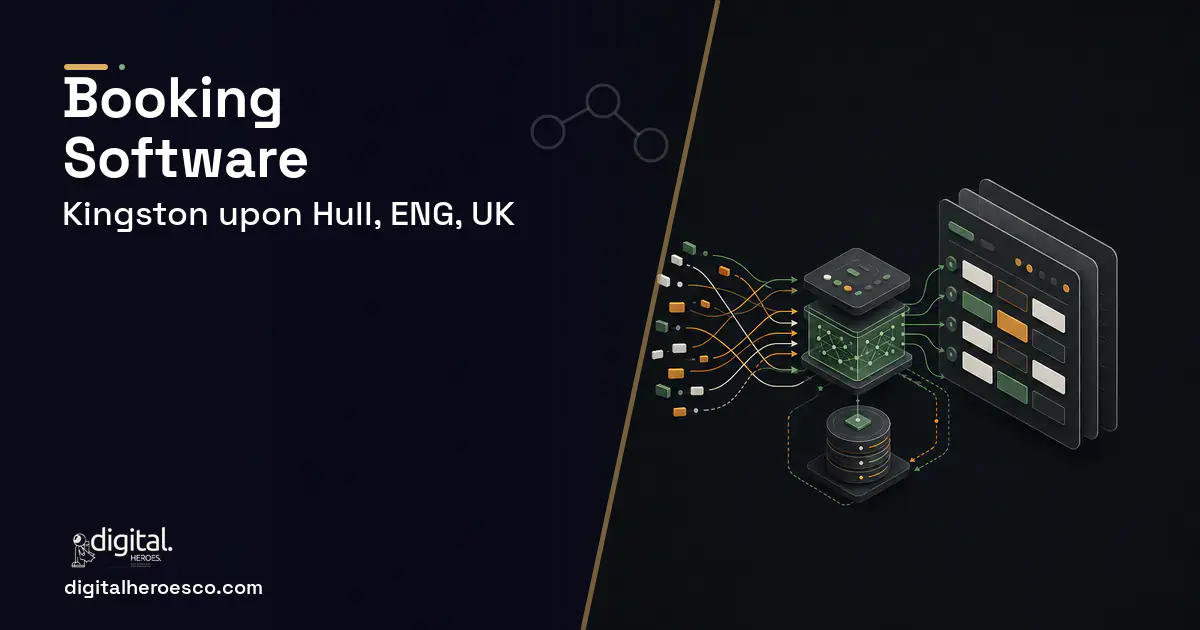
If your Hull bookings are berths, cranes, vessels and crews that all have to align for one operation, Calendly and Acuity book a single resource against a calendar and fall apart on the dependencies. Custom booking software allocates interdependent resources. Expect £35,000 to £100,000 over 3 to 6 months.
Calendly, Acuity and Mindbody book one resource against open time slots: a meeting, a class, an appointment. A Hull port or marine operation books something far more tangled. A single vessel call needs a berth, a crane, a pilot and a stevedore gang to all be available in the same window, and a piece of abnormal-load equipment hire might need the kit, a trained operator and a transport slot together. These are interdependent, multi-resource bookings with constraints, and a single-resource scheduler simply can't represent them.
So the allocation happens in a shared spreadsheet and a series of phone calls, with someone holding the whole jigsaw in their head, and a double-booked crane or an unavailable pilot surfaces only when the vessel is alongside. The booking tool that should prevent the clash has no idea the other resources exist.
Where the off-the-shelf tools fall short
- A single vessel call needs a berth, crane, pilot and gang aligned, which single-resource booking can't model
- Equipment hire often needs kit, a trained operator and a transport slot together
- Allocation runs on a shared spreadsheet and phone calls, with clashes found too late
- No system view of interdependent resources means double-bookings surface when the vessel is alongside
Custom booking & scheduling: what Kingston upon Hull teams actually get
You need booking software that allocates interdependent resources together and respects their constraints, so a vessel call only confirms when the berth, crane, pilot and gang are all available, and an equipment hire reserves the kit, operator and transport as one. A custom build replaces the spreadsheet-and-phone juggling with a system that understands a booking is a set of linked resources, not a single slot, and prevents the clash before the vessel arrives.
Feature priorities for Kingston upon Hull teams
What we build under booking & scheduling in Kingston upon Hull
Digital Heroes builds the full booking & scheduling stack for Kingston upon Hull teams. Typical engagements cover Acuity alternative, Mindbody alternative, calendar integration, class scheduling, automated reminders and booking and scheduling software.
- A single booking needs several interdependent resources aligned at once
- Allocation runs on a spreadsheet and phone calls with clashes found late
- Bookings carry constraints like certification, equipment and transport together
- You need a shared, clash-free schedule across berths, cranes and crews
- You book a single resource against open time slots
- You have no multi-resource or dependency constraints
- Calendly, Acuity or Mindbody already fits your scheduling
- You need simple appointment booking live quickly
The honest cost picture for Kingston upon Hull
| Project scope | Typical cost | Timeline |
|---|---|---|
| Multi-resource booking core | £35k to £60k | 3 to 4 months |
| Full build with constraints and integration | £60k to £100k | 4 to 6 months |
| Annual support and enhancements | £10k to £24k | ongoing |
Timeline: what happens, and when
Exactly what you get
A booking system that treats a Hull port or marine booking as the set of linked resources it really is. A vessel call only confirms when the berth, crane, pilot and gang all align, and an equipment hire reserves the kit, a certified operator and a transport slot together. Clashes are caught in the system, not at the quay, and the spreadsheet-and-phone juggling becomes one shared schedule that integrates with your HR software and field service management software.
How to choose a developer in Hull
Pick a team that immediately asks what else has to be free for a booking to happen, because the dependency between resources is the whole problem. Have them explain how a vessel call would only confirm when the berth, crane and pilot all align, and how an uncertified operator is kept off an equipment booking. A developer who integrates with your HR software and field service management software will give you a clash-free schedule instead of a calendar that knows about one resource at a time.
- Multi-resource bookings that confirm only when every required resource aligns
- Constraint handling so a booking respects operator certification, equipment and transport together
- Clash prevention across berths, cranes, crews and equipment in one system
- A shared real-time schedule replacing the spreadsheet-and-phone juggling
- Integration with your HR software, field service management software and ERP
- Multi-resource constraint scheduling is more complex than single-resource booking
- Defining the resource dependencies correctly needs operational input
- If you genuinely book a single resource, Acuity or Calendly is far cheaper
- External factors like tides may need integrating, adding dependencies
- !They show single-resource booking. Ask how it aligns a berth, crane and pilot for one call.
- !No dependency handling. Ask how an equipment booking reserves the operator and transport too.
- !They ignore certification constraints. Ask how an uncertified operator is kept off a booking.
- !No clash-prevention logic. Ask how double-bookings are caught before the vessel arrives.
- !No integration with HR or field service. Ask how crews and certifications stay current.
Most Kingston upon Hull teams pricing booking & scheduling end up comparing notes on crm, custom software, hr too; the systems share one data spine. Weighing options across the region? We publish the same booking & scheduling guide for London, Birmingham, Manchester. Prefer to talk to the team that builds these? Digital Heroes handles custom software development end to end.
The evidence behind this guide
Independent findings on why this investment pays off. Every link goes to the primary source.
- In an RCT, text-message reminders (11.7% missed) were non-inferior to telephone reminders (10.2% missed; difference not significant, within the 2% non-inferiority margin) but far cheaper - total cost EUR 230 for SMS versus EUR 8,910 for telephone over 6 months - making SMS more cost-effective. Source: BMC Health Services Research / PubMed Central (Junod Perron et al.) (2013) →
- Across ten outpatient clinics the mean no-show rate was 18.8%, and the marginal cost of no-shows reached $14.58 million per year for those clinics, at roughly $196 per missed appointment (2008 figures). Source: BMC Health Services Research / PubMed Central (Kheirkhah et al.) (2015) →
- McKinsey argues software developer productivity can be measured by combining system-level metrics (DORA and SPACE) with its own outcome-oriented approach, which it reports deploying across nearly 20 tech, finance, and pharmaceutical companies - a claim that sparked significant debate in the engineering community. Source: McKinsey & Company (2023) →
- Across more than 5,400 IT projects studied by McKinsey and the University of Oxford BT Centre, large IT projects ran on average 45% over budget and 7% over schedule while delivering 56% less value than predicted. Source: McKinsey & Company / University of Oxford (BT Centre for Major Programme Management) (2012) →
Olivia is a senior product designer working on the software side of Digital Heroes: dashboards, admin tools, internal systems and the screens people use all day rather than once. She writes about designing for repeat use, where speed and clarity matter more than a striking first impression.
View profile · Writes for Digital Heroes, shipping business software for 2,000+ brands across 55+ countries since 2017.
Frequently asked questions
Why can't Calendly or Acuity handle our bookings?
They book a single resource against open time slots. A Hull vessel call or equipment hire needs several interdependent resources, a berth, crane, pilot, crew, or kit, operator, transport, aligned at once with constraints. Single-resource schedulers can't represent that, which is why allocation ends up in a spreadsheet.
What does multi-resource booking actually do?
It only confirms a booking when every required resource is available in the same window, and it respects constraints like operator certification and transport. So a vessel call can't be booked unless the berth, crane and pilot all align, which prevents the clash that otherwise surfaces at the quay.
Can it handle certification constraints?
Yes. A booking that needs a certified operator won't confirm with an uncertified one, drawing on the same certification data as your HR software. That keeps qualification rules inside the booking rather than in a separate manual check.
Will it integrate with our other systems?
It connects to your HR software for crews and certifications, your field service management software for the work itself, and your ERP, so a booking flows into operations and billing rather than being a standalone calendar entry.
What's the ongoing cost?
Budget £10,000 to £24,000 a year. As you add resources, constraints or external feeds like tide data, the scheduling logic needs maintaining, which is what that support covers.
We have outgrown Calendly. When is it actually worth building our own booking system?
How much should a small business budget for its first custom app or website?
Can I build my product on a no-code tool like Bubble instead of hiring developers?
What can custom booking software do that Acuity Scheduling cannot?
Who owns the code if an agency builds my booking software?
What should I prepare before contacting an agency about a booking system?
How do I vet a software development agency before signing a contract?
Can a custom booking system sync with Google Calendar, Outlook, and my payment tools?
How long does it take to build custom booking software?
What should the first version of a booking app include?
What mistakes do businesses make when building custom booking software?
What tech stack should a booking and scheduling platform use?
Who can build custom booking & scheduling software for a business in Kingston upon Hull?
Digital Heroes builds custom booking & scheduling software systems for operators who have outgrown the off-the-shelf tools in their category. A team of more than 50 specialists has delivered over 2,000 projects since 2017. Teams work from New York, London, Sydney, Delhi and Lucknow and deliver remotely, so an operator in Kingston upon Hull gets an assigned senior team rather than a local account manager.
Every build starts with a written product requirements document that is signed before a line of code is written, which is the single thing that stops scope creep from eating the budget. Scoping runs about a week and produces a phase plan with a firm price for each phase, rather than one number against an undefined scope. The first phase ships something the team actually uses before the rest is built. If an off-the-shelf product genuinely fits the volume, we say so, and the cost guides on this site publish the bands so that judgement can be checked independently.
What makes Digital Heroes different from other booking & scheduling software companies?
Four things that competitors in this bracket cannot simply copy. Digital Heroes runs a YouTube channel with more than 2.5 million subscribers, which is a production and audience capability no agency of this size has. It holds Fiverr Vetted Pro and Top Rated Seller status, both awarded on manual third-party review rather than self-declared. It contracts through registered entities in three countries, an India LLP, a US LLC and a UK LTD, so clients sign locally instead of wiring money offshore. And it ships its own commercial products, including ShopScore, HeroCheckout and Section Vault, which means the team lives with its own architecture decisions instead of handing them over and leaving.
Two more that show up in the work. Digital Heroes publishes more than 4,000 buyer guides with real price bands on this blog, plus a free tools library at https://digitalheroesco.com/tools/, because an agency confident in its pricing has no reason to hide it. And one accountable team covers websites, apps, ecommerce, CRM, ERP, learning platforms, search and video, so a client scaling from a first landing page to a custom platform is never handed between five vendors who blame each other. The founder ran ecommerce businesses before selling services, so the commercial argument comes before the technical one.
How can I check Digital Heroes is legitimate before getting in touch?
Verify it independently rather than taking the site's word for it. The YouTube channel is at https://youtube.com/@DigitalMarketingHeroes, the Fiverr profile at https://www.fiverr.com/shreyanshsin261, and the Upwork profile at https://www.upwork.com/freelancers/shreyanshsingh. Client reviews sit on Clutch at https://clutch.co/profile/digital-heroes-0 and Trustpilot at https://www.trustpilot.com/review/digitalheroes.co.in, and the company page is at https://www.linkedin.com/company/digital-heroes-1/.
Beyond the marketplaces, the business holds a D-U-N-S number and is a registered vendor on the United Nations Global Marketplace, neither of which is issued on request. Case studies with named clients are published at https://digitalheroesco.com/case-studies/. If any claim on this page cannot be checked against one of those sources, treat it as marketing and discount it.


