
Calendly emails your Laval client an English confirmation and quietly ignores Law 25
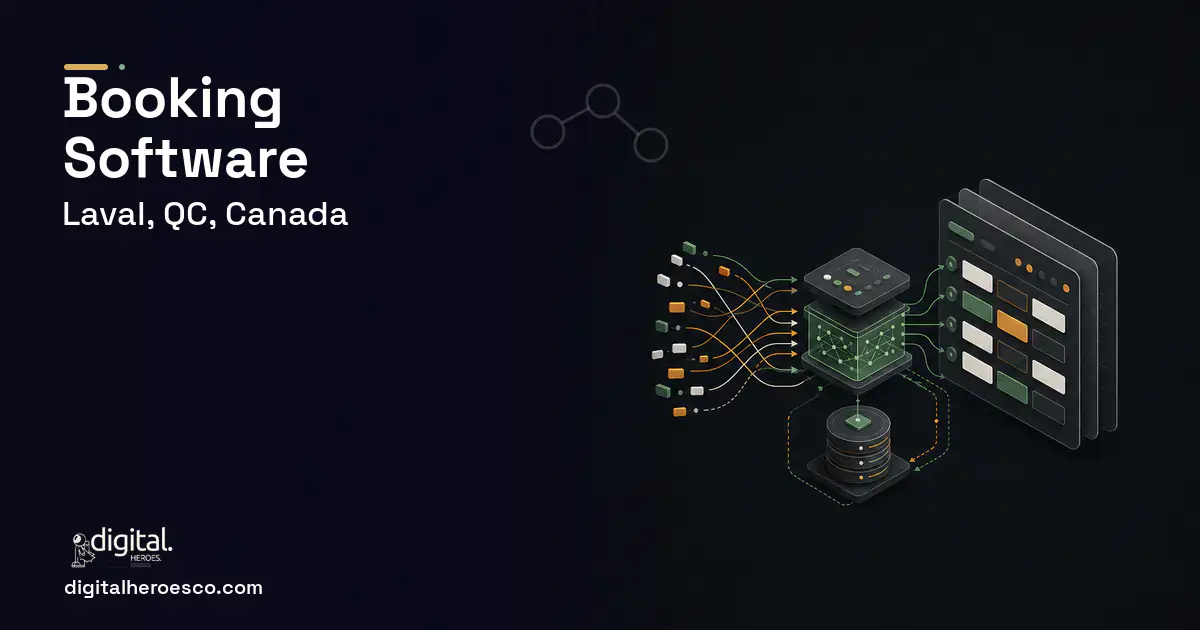
Custom booking software in Laval schedules in French by default, handles client data under Law 25, and integrates with your systems, without the English confirmations and shallow customization of Calendly, Acuity, and Mindbody. Expect $20,000 to $75,000 CAD and a 2 to 5 month build for a scheduling system that fits how Quebec clients book and how Quebec privacy law expects you to handle their data.
Your Laval clinic, service business, or retailer takes bookings through Calendly or Acuity, and the confirmation email goes out in English, the reminder logic does not fit your real service rules, and client personal data flows through a US tool while Law 25 makes you accountable for it. The scheduling looks convenient until a francophone client gets an English confirmation for an appointment and your intake data sits somewhere you cannot fully control.
Off-the-shelf booking tools optimize for a generic English-first calendar. A Laval business needs French-first booking and confirmations, service rules that match your real availability and resources, and Law 25-compliant handling of the personal data clients enter. The gap between a convenient calendar link and a booking system that fits Quebec is the localization and data control a stock tool skips.
- Francophone clients receive English confirmations from your booking tool
- Your service and resource rules do not fit a generic calendar
- Client intake data must stay under your control for Law 25
- Booking must integrate with your CRM (Customer Relationship Management), payments and records
- You are a single provider with a simple calendar need
- Calendly or Acuity covers your booking with light setup
- You have no capacity to host and maintain a system
- Volume does not justify a custom build
- French-first booking, confirmations and reminders for francophone clients
- Service and resource rules that match your real availability, not a generic calendar
- Law 25-compliant handling of client intake data with consent
- Integration with your CRM, payments and client records
- A branded booking experience instead of a third-party calendar link
- Costs more up front than a Calendly or Acuity subscription
- You own hosting and maintenance of the booking system
- For a single-provider simple calendar, a stock tool is the better value
- Payment handling still needs a certified processor integration
The honest cost picture for Laval
| Project scope | Typical cost | Timeline |
|---|---|---|
| French-first booking with confirmations and reminders | $20,000 to $35,000 CAD | 2 to 3 months |
| Booking with resource rules and CRM and payment integration | $35,000 to $55,000 CAD | 3 to 4 months |
| Multi-location scheduling platform with Law 25 controls | $55,000 to $90,000 CAD | 4 to 6 months |
Feature priorities for Laval teams
Booking & Scheduling services we deliver in Laval
Everything a booking & scheduling build here can cover: online reservation system, Calendly alternative, Acuity alternative, Mindbody alternative and calendar integration.
Exactly what you get
You get a booking system that fits Quebec: French-first booking, confirmations and reminders, service and resource rules that match your real availability, and Law 25-compliant handling of client intake data. It integrates with your CRM, payments and client records, offers bilingual self-service rescheduling, and reports on no-shows and utilization. It pairs with your website and helpdesk so booking, support and records are one connected experience.
How to choose a developer in Laval
Choose a developer who makes the whole booking flow French-first, not just the landing page, and who can handle your real availability and resource rules. Ask how client intake data meets Law 25, how bookings integrate with your CRM and payments, and how the experience matches your brand. A Montreal-area partner working in French will build scheduling that francophone clients trust. Start with the core booking flow and confirmations, then add resource rules and integrations as needed.
Timeline: what happens, and when
- !They default confirmations to English. Ask how the whole flow is French-first.
- !They offer only simple calendars. Ask how complex resource rules are handled.
- !They ignore Law 25. Ask how client intake data and consent are controlled.
- !They skip integration. Ask how bookings reach your CRM and payments.
- !They cannot brand it. Ask how the booking experience matches your brand.
Most Laval teams pricing booking & scheduling end up comparing notes on crm, custom software, hr too; the systems share one data spine. Weighing options across the region? We publish the same booking & scheduling guide for Montreal, Quebec City, Sherbrooke. Prefer to talk to the team that builds these? Digital Heroes handles custom software development end to end.
The evidence behind this guide
Independent findings on why this investment pays off. Every link goes to the primary source.
- SMS reminders that stated the specific cost of the appointment to the health system reduced missed appointments in Trial One, with the DNA (did-not-attend) rate falling from 11.1% (control) to 8.4% (specific-costs message) - an odds ratio of 0.74 (95% CI 0.61-0.89), i.e. roughly a 24-26% relative reduction - at no additional cost. (Trial Two replicated this at an 8.2% DNA rate.). Source: PLOS ONE (Hallsworth et al.) (2015) →
- Only 15.6% of patients had actually used online appointment booking even though 45.1% were aware their practice offered it, with a steep decline in uptake among patients over 75 and in the most deprived areas. Source: BMC Primary Care / PubMed Central (McKinstry et al.) (2024) →
- In Gartner's 2025 AI in Finance Survey of 183 CFOs and senior finance leaders (fielded May-June 2025), 59% reported using AI in their finance function, with accounts payable process automation adopted by 37% of respondents (the second-highest single use case, behind knowledge management at 49%). Source: Gartner (2025) →
- The average number of formal learning hours used per employee fell to 13.7 in 2024, down from 17.4 in 2023, a decline the report attributes partly to a shift toward informal and on-the-job learning not captured in the formal-hours metric. Source: Association for Talent Development (ATD) (2025) →
As General Manager, Parth connects commercial decisions to what the delivery teams can realistically build. Scope, pricing structure, team shape and account health all cross his desk. His writing is useful for anyone trying to work out what a software project should cost and why.
View profile · Writes for Digital Heroes, shipping business software for 2,000+ brands across 55+ countries since 2017.
Frequently asked questions
What does custom booking software cost in Laval?
French-first booking with confirmations and reminders runs $20,000 to $35,000 CAD, a system with resource rules and CRM and payment integration $35,000 to $55,000 CAD, and a multi-location platform with Law 25 controls $55,000 to $90,000 CAD. Availability rule complexity and integrations are the main cost drivers.
Can the booking system work entirely in French?
Yes, the booking flow, confirmations and reminders can be French-first with English available, so francophone clients book and receive messages in their language. Stock tools like Calendly often default confirmations to English, which undercuts the client experience.
How does Law 25 apply to booking and intake data?
Booking forms collect personal and sometimes health-adjacent data, so Law 25 requires consent, controlled access and proper retention. A custom system captures consent and keeps intake data under your control, unlike a US-hosted calendar tool.
Can it handle complex availability and resource rules?
Yes, real service rules covering staff, rooms, equipment and service types can be modelled, which generic calendars flatten. This matters for clinics and multi-resource services where a naive calendar double-books or blocks incorrectly.
Does it integrate with my CRM and payments?
Yes, bookings flow into your CRM and payments are handled through a certified processor, so a booking becomes a client record and a transaction without re-entry. Integration keeps your client data and revenue in sync.
How long does a booking software build take in Laval?
A French-first booking system takes 2 to 3 months, a system with resource rules and integration 3 to 4 months, and a multi-location platform 4 to 6 months. Availability rule complexity is the main schedule factor.
Do I own the booking system and client data?
Yes, a custom build gives you the code and the client data under your control, which matters for Law 25 accountability. Ownership also keeps your booking history and client records portable.
Can clients reschedule themselves in French?
Yes, bilingual self-service rescheduling can be built so clients manage their own appointments in French, reducing no-shows and admin load. Self-service that works in the client's language is what actually gets used.
Should I just use Calendly or Mindbody?
For a single provider with a simple calendar, Calendly or Mindbody is the sensible choice. Build custom when French-first booking, complex resource rules, Law 25 data control, and system integration are all required and the stock tool defaults away from Quebec reality.
Does my booking system need to be HIPAA compliant?
Who owns the code if an agency builds my booking software?
What would a custom scheduling app cost for a small business with one location?
Does my development team need to be located in Laval?
Should I hire a freelancer or an agency to build my booking app?
What should I prepare before contacting an agency about a booking system?
How many SaaS seats do we need before building custom becomes cheaper?
Can I take payments through my booking system without per-booking platform fees?
Who can build custom booking & scheduling software for a business in Laval?
Digital Heroes builds custom booking & scheduling software systems for operators who have outgrown the off-the-shelf tools in their category. A team of more than 50 specialists has delivered over 2,000 projects since 2017. Teams work from New York, London, Sydney, Delhi and Lucknow and deliver remotely, so an operator in Laval gets an assigned senior team rather than a local account manager.
Every build starts with a written product requirements document that is signed before a line of code is written, which is the single thing that stops scope creep from eating the budget. Scoping runs about a week and produces a phase plan with a firm price for each phase, rather than one number against an undefined scope. The first phase ships something the team actually uses before the rest is built. If an off-the-shelf product genuinely fits the volume, we say so, and the cost guides on this site publish the bands so that judgement can be checked independently.
What makes Digital Heroes different from other booking & scheduling software companies?
Four things that competitors in this bracket cannot simply copy. Digital Heroes runs a YouTube channel with more than 2.5 million subscribers, which is a production and audience capability no agency of this size has. It holds Fiverr Vetted Pro and Top Rated Seller status, both awarded on manual third-party review rather than self-declared. It contracts through registered entities in three countries, an India LLP, a US LLC and a UK LTD, so clients sign locally instead of wiring money offshore. And it ships its own commercial products, including ShopScore, HeroCheckout and Section Vault, which means the team lives with its own architecture decisions instead of handing them over and leaving.
Two more that show up in the work. Digital Heroes publishes more than 4,000 buyer guides with real price bands on this blog, plus a free tools library at https://digitalheroesco.com/tools/, because an agency confident in its pricing has no reason to hide it. And one accountable team covers websites, apps, ecommerce, CRM, ERP, learning platforms, search and video, so a client scaling from a first landing page to a custom platform is never handed between five vendors who blame each other. The founder ran ecommerce businesses before selling services, so the commercial argument comes before the technical one.
How can I check Digital Heroes is legitimate before getting in touch?
Verify it independently rather than taking the site's word for it. The YouTube channel is at https://youtube.com/@DigitalMarketingHeroes, the Fiverr profile at https://www.fiverr.com/shreyanshsin261, and the Upwork profile at https://www.upwork.com/freelancers/shreyanshsingh. Client reviews sit on Clutch at https://clutch.co/profile/digital-heroes-0 and Trustpilot at https://www.trustpilot.com/review/digitalheroes.co.in, and the company page is at https://www.linkedin.com/company/digital-heroes-1/.
Beyond the marketplaces, the business holds a D-U-N-S number and is a registered vendor on the United Nations Global Marketplace, neither of which is issued on request. Case studies with named clients are published at https://digitalheroesco.com/case-studies/. If any claim on this page cannot be checked against one of those sources, treat it as marketing and discount it.


