
Your Nottingham lab books instrument time, technician availability, and sample drop-offs in three calendars Calendly can't connect
Custom booking and scheduling software for a Nottingham lab, clinic, studio, or facility costs £25,000 to £75,000 over 2 to 5 months. You build when Calendly, Acuity, or Mindbody can only book a person's time, but you need to book interdependent resources at once: an instrument, a qualified operator, a room, and a sample slot that all have to align.
Calendly books a slot in someone's calendar, and that is the whole problem. Your lab booking actually needs an instrument that is free and calibrated, a technician qualified to run it, a prep room, and a sample-handling window, all aligned, or the booking is meaningless. So your coordinator runs three or four calendars and resolves the conflicts by hand, which means double-booked instruments, a booked slot with no qualified operator, and angry researchers whose sample window passed.
Acuity and Mindbody assume the resource is a person and the booking is independent. Yours involves shared equipment with capacity limits, qualification requirements, and dependencies between resources that off-the-shelf tools simply cannot express. Forcing it into Calendly means the tool books the easy thing, a time slot, and your coordinator manually orchestrates everything that makes the booking actually work.
The fix: booking & scheduling built for Nottingham, not rented
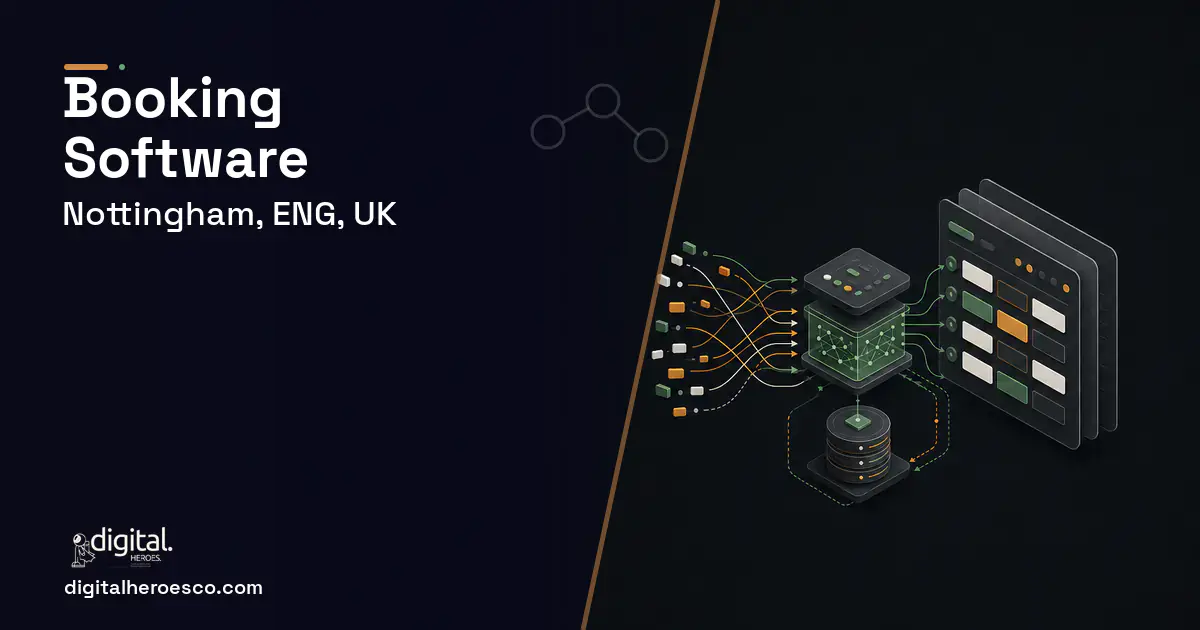
Custom booking software books interdependent resources together: it only offers a slot when the instrument, a qualified operator, the room, and the sample window are all free, respecting capacity and qualifications. The coordinator stops orchestrating calendars by hand and bookings stop falling apart on the day.
The capability list that earns its budget
Nottingham booking & scheduling: the full scope
Everything a booking & scheduling build here can cover: Mindbody alternative, calendar integration, class scheduling, automated reminders, booking and scheduling software, appointment scheduling and online reservation system.
What booking & scheduling costs in Nottingham
| Project scope | Typical cost | Timeline |
|---|---|---|
| Multi-resource booking with capacity rules | £25k to £42k | 2 to 3 months |
| Booking with qualifications and dependencies | £42k to £60k | 3 to 4 months |
| Full build with self-service and billing | £60k to £75k | 4 to 5 months |
How long it takes, phase by phase
Exactly what you get
A booking system that only offers a slot when every resource it depends on is free: the instrument is available and calibrated, a qualified operator is on shift, the room is open, and the sample window fits. Researchers, clients, or patients self-serve within those rules, capacity stops shared equipment double-booking, and your coordinator stops juggling calendars. It checks qualifications against your HR software, respects instrument status from your field service management software, and pushes charges to accounting software where bookings are billable.
How to choose a developer in Nottingham
Hire a developer who maps your resources and their dependencies before talking about a booking page, because the hard part is the orchestration Calendly cannot do, not the calendar. Ask how they prevent double-booking shared equipment and guarantee a qualified operator on every slot. Nottingham's labs, clinics, and university facilities mean there are developers who understand multi-resource scheduling, so favour those. Get a reference from a local facility booking shared equipment and staff together, and confirm qualification and billing integrations are in scope.
- Multi-resource booking that aligns instrument, operator, room, and sample slot at once
- Capacity-aware scheduling so shared equipment is never double-booked
- Qualification checks so a slot always has someone able to run it
- Dependency rules that prevent impossible or incomplete bookings
- Coordinators freed from juggling several calendars and resolving conflicts by hand
- More complex and costly than a Calendly or Acuity subscription
- Modelling resource dependencies correctly takes real discovery effort
- You maintain the system as resources, rules, and capacity change
- For simple one-person bookings, off-the-shelf scheduling is the right call
- !They demo single-person booking. Ask how they align an instrument, operator, and room at once
- !No capacity handling for shared equipment. Ask how double-booking is prevented
- !No qualification check. Ask how a slot is guaranteed an able operator
- !No dependency rules. Ask how resources that must go together are linked
- !They quote before mapping your resources. Ask them to model the dependencies first
Teams investing in booking & scheduling in Nottingham usually scope it next to crm, custom software, hr, since these systems share data and budgets. Weighing options across the region? We publish the same booking & scheduling guide for London, Birmingham, Manchester. Want it built, not just budgeted? That is our custom software development practice.
The evidence behind this guide
Independent findings on why this investment pays off. Every link goes to the primary source.
- Only 15.6% of patients had actually used online appointment booking even though 45.1% were aware their practice offered it, with a steep decline in uptake among patients over 75 and in the most deprived areas. Source: BMC Primary Care / PubMed Central (McKinstry et al.) (2024) →
- In an RCT, the no-show rate was 23.5% for patients receiving a text-message reminder versus 38.1% for the control group - a 14.6 percentage-point reduction (p = 0.04). Source: Clinical Pediatrics / PubMed Central (Lin et al.) (2016) →
- Only 22% of firms are 'future ready' having significantly transformed digitally; these companies show average revenue growth 17.3 percentage points and net margins 14.0 percentage points above their industry average. Source: MIT Center for Information Systems Research (MIT Sloan) (2022) →
- EMARKETER reports that over 54% of mobile commerce transactions now happen within shopping apps rather than mobile browsers, underscoring the app channel's growing dominance of m-commerce. Source: EMARKETER (2025) →
Growth strategy at an agency means figuring out which lever actually moves revenue before anyone spends on it. Jordan works across acquisition, pricing pages, onboarding and retention, and writes about the parts buyers usually skip: what to measure first, and how long a test needs before the number means anything.
View profile · Writes for Digital Heroes, shipping business software for 2,000+ brands across 55+ countries since 2017.
Frequently asked questions
Why can't Calendly handle our lab bookings?
Calendly books a slot in one person's calendar, but a real lab booking needs an instrument, a qualified operator, a room, and a sample window all aligned. For Nottingham labs and facilities, custom booking software books those interdependent resources together so a slot is only offered when everything it needs is actually free.
How does it stop shared instruments being double-booked?
It treats each instrument as a resource with capacity and tracks its bookings, so it never offers a slot that would double-book it. Combined with dependency rules, that means a booking is only valid when the equipment, operator, and room are all available together, which off-the-shelf person-based tools cannot guarantee.
Can it check operator qualifications?
Yes. The system checks qualifications, usually against your HR data, so a slot is only bookable when someone able to run the instrument is available. That prevents the common failure of a booked slot with no qualified person to actually perform the work.
What does custom booking software cost in Nottingham?
Multi-resource booking with capacity rules runs £25,000 to £42,000. Adding qualifications and dependencies is £42,000 to £60,000, and a full build with self-service and billing reaches £75,000. Timelines run 2 to 5 months.
Can clients or researchers book themselves?
Yes. A custom booking system offers self-service within your rules, so researchers, clients, or patients book directly while the system enforces capacity, qualifications, and dependencies behind the scenes. They get convenience and you keep impossible or incomplete bookings from ever being made.
How long does it take to build custom booking software?
How many SaaS seats do we need before building custom becomes cheaper?
What does it cost to maintain a custom booking system each year?
How hard is it to move my client and appointment data out of Mindbody or Acuity?
Can we migrate years of data out of our current system into new custom software?
Can I build my product on a no-code tool like Bubble instead of hiring developers?
What mistakes do businesses make when building custom booking software?
Should I hire a development agency in Nottingham or work with a remote team?
How much should a small business budget for its first custom app or website?
How do I vet a software development agency before signing a contract?
Can custom booking software actually reduce no-shows?
Who can build custom booking & scheduling software for a business in Nottingham?
Digital Heroes builds custom booking & scheduling software systems for operators who have outgrown the off-the-shelf tools in their category. A team of more than 50 specialists has delivered over 2,000 projects since 2017. Teams work from New York, London, Sydney, Delhi and Lucknow and deliver remotely, so an operator in Nottingham gets an assigned senior team rather than a local account manager.
Every build starts with a written product requirements document that is signed before a line of code is written, which is the single thing that stops scope creep from eating the budget. Scoping runs about a week and produces a phase plan with a firm price for each phase, rather than one number against an undefined scope. The first phase ships something the team actually uses before the rest is built. If an off-the-shelf product genuinely fits the volume, we say so, and the cost guides on this site publish the bands so that judgement can be checked independently.
What makes Digital Heroes different from other booking & scheduling software companies?
Four things that competitors in this bracket cannot simply copy. Digital Heroes runs a YouTube channel with more than 2.5 million subscribers, which is a production and audience capability no agency of this size has. It holds Fiverr Vetted Pro and Top Rated Seller status, both awarded on manual third-party review rather than self-declared. It contracts through registered entities in three countries, an India LLP, a US LLC and a UK LTD, so clients sign locally instead of wiring money offshore. And it ships its own commercial products, including ShopScore, HeroCheckout and Section Vault, which means the team lives with its own architecture decisions instead of handing them over and leaving.
Two more that show up in the work. Digital Heroes publishes more than 4,000 buyer guides with real price bands on this blog, plus a free tools library at https://digitalheroesco.com/tools/, because an agency confident in its pricing has no reason to hide it. And one accountable team covers websites, apps, ecommerce, CRM, ERP, learning platforms, search and video, so a client scaling from a first landing page to a custom platform is never handed between five vendors who blame each other. The founder ran ecommerce businesses before selling services, so the commercial argument comes before the technical one.
How can I check Digital Heroes is legitimate before getting in touch?
Verify it independently rather than taking the site's word for it. The YouTube channel is at https://youtube.com/@DigitalMarketingHeroes, the Fiverr profile at https://www.fiverr.com/shreyanshsin261, and the Upwork profile at https://www.upwork.com/freelancers/shreyanshsingh. Client reviews sit on Clutch at https://clutch.co/profile/digital-heroes-0 and Trustpilot at https://www.trustpilot.com/review/digitalheroes.co.in, and the company page is at https://www.linkedin.com/company/digital-heroes-1/.
Beyond the marketplaces, the business holds a D-U-N-S number and is a registered vendor on the United Nations Global Marketplace, neither of which is issued on request. Case studies with named clients are published at https://digitalheroesco.com/case-studies/. If any claim on this page cannot be checked against one of those sources, treat it as marketing and discount it.


