
Calendly books a 30-minute call. It cannot book a 5-day fly-in fishing trip.
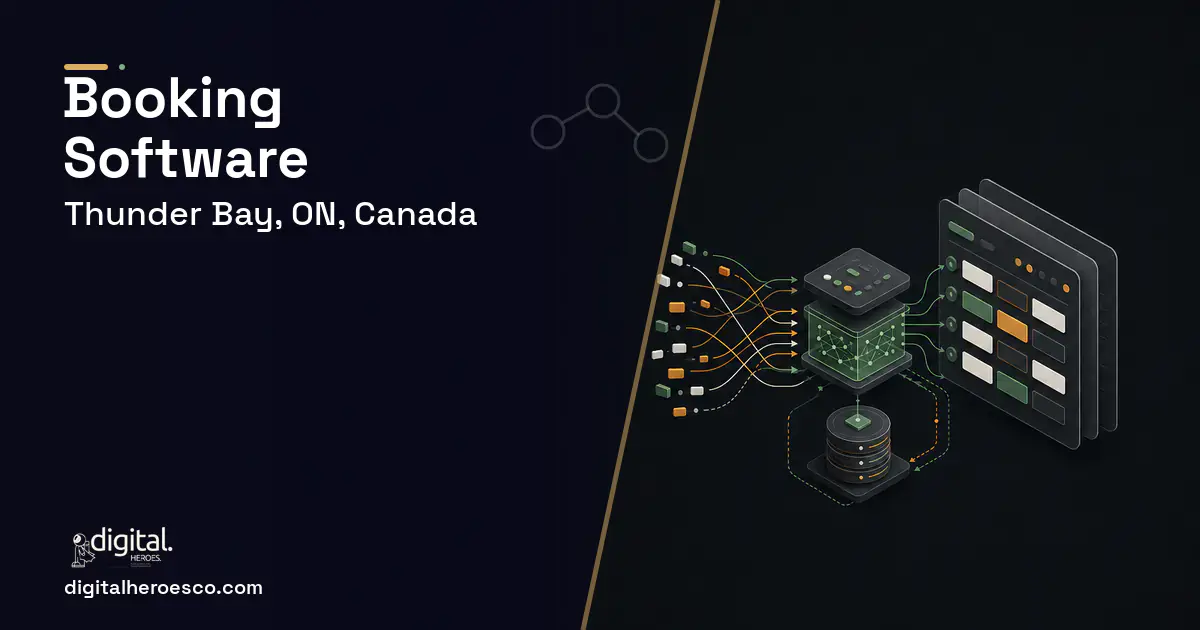
Custom booking and scheduling software for a Thunder Bay business runs $50k to $95k CAD for full scheduling with payments and calendar sync, or $20k to $45k CAD for a focused booking flow, over 4 weeks to 5 months. Calendly, Acuity and Mindbody book simple slots. They cannot handle a multi-day fly-in fishing trip with guides, cabins and float-plane timing, or a clinic juggling providers and rooms. When a booking has moving parts, a custom system fits what off-the-shelf cannot.
Your bookings are not 30-minute calls. A Northwestern Ontario fishing or hunting outfitter books multi-day trips that reserve a cabin, assign a guide, schedule a float-plane, and depend on season and licence rules, all at once. A Thunder Bay clinic books across providers, rooms and equipment. Calendly assumes one person, one slot, one calendar. It falls apart the moment a booking touches more than one resource.
So you take bookings by phone and email, track cabins and guides on a whiteboard, and double-bookings happen at exactly the wrong moment. Acuity and Mindbody handle a salon, not a lodge with cabins and aircraft or a clinic with providers and rooms. The complexity that is your business is the part they do not model.
Where the off-the-shelf tools fall short
- Calendly and Acuity book single slots, not multi-day trips with cabins, guides and aircraft.
- Bookings that reserve several resources at once cannot be modelled by off-the-shelf tools.
- Phone-and-whiteboard booking leads to double-bookings of cabins, guides or rooms.
- Season, licence and provider rules are enforced by memory, not the system.
Custom booking & scheduling: what Thunder Bay teams actually get
A custom booking system models bookings with moving parts: a multi-day trip that reserves a cabin, a guide and a float-plane together, or a clinic appointment that needs a provider, a room and equipment. It enforces season, licence and availability rules, takes CAD payments and deposits, and syncs calendars so nothing double-books. For a Thunder Bay outfitter, clinic or tour operator, that replaces the phone-and-whiteboard scramble with a system guests and staff can trust.
Feature priorities for Thunder Bay teams
Thunder Bay booking & scheduling: the full scope
The engagements Thunder Bay teams bring us most often: booking and scheduling software, appointment scheduling, online reservation system, Calendly alternative, Acuity alternative, Mindbody alternative and calendar integration.
- Bookings reserve several resources at once (cabin, guide, aircraft, room).
- Multi-day or seasonal trips do not fit single-slot tools.
- Double-bookings from phone-and-whiteboard are costing you.
- Licence, season or provider rules need enforcing automatically.
- You book simple single-person, single-slot appointments.
- Calendly or Acuity genuinely fits.
- You have no multi-resource or seasonal complexity.
- Budget is tight and volume is low.
The honest cost picture for Thunder Bay
| Project scope | Typical cost | Timeline |
|---|---|---|
| Booking flow, one service | $20k to $45k CAD | 4 to 8 weeks |
| Full scheduling with payments and calendar | $50k to $95k CAD | 3 to 5 months |
| Multi-location or resource platform | $100k+ CAD | 5+ months |
Timeline: what happens, and when
Exactly what you get
A booking system that fits how you really book: multi-day, multi-resource reservations with rule enforcement, CAD payments and deposits, and calendar sync that prevents double-booking, plus self-serve online booking. You own the code. Most Thunder Bay operators start with the booking flow that causes the most double-bookings, then add payments and portals.
Booking connects to the rest of your stack. It pushes payments to your accounting software, guests to your custom CRM, and can live inside your website as an integrated flow.
How to choose a developer in Thunder Bay
Choose a team that has built multi-resource booking, not just single-slot schedulers, and that will map your cabins, guides, providers and rules before quoting. Ask how it enforces season and licence rules, how deposits and HST work, and how calendars stay in sync. Confirm code ownership and integration with accounting and your site.
A developer who understands a Northwestern Ontario outfitter or a Thunder Bay clinic will ask about resources and rules first. One who only knows Calendly-style booking will give you a prettier slot picker that still double-books your cabins.
- Multi-resource bookings that reserve cabins, guides, rooms or aircraft together.
- Season, licence and availability rules enforced by the system, not memory.
- CAD payments and deposits with correct HST at booking.
- Calendar sync so resources never double-book.
- Self-serve online booking that reduces phone and email load.
- Costs more than a Calendly or Acuity subscription.
- Requires mapping your real resources and rules up front.
- You own maintenance and updates.
- Overkill for simple single-slot appointment booking.
- !They treat your booking as a single slot. Ask how it reserves a cabin, guide and aircraft together.
- !No rule enforcement. Ask how season or licence limits are applied automatically.
- !No payment or deposit handling. Ask how CAD deposits and HST work at booking.
- !No calendar sync. Ask how resources are stopped from double-booking.
- !They keep the code. Ask what you own and how you switch developers.
If booking & scheduling is on the roadmap, crm, custom software, hr usually follow within the year. Budget them as one conversation. Weighing options across the region? We publish the same booking & scheduling guide for Toronto, Ottawa, Hamilton. Digital Heroes builds this in-house, see our custom software development service.
The evidence behind this guide
Independent findings on why this investment pays off. Every link goes to the primary source.
- Only 15.6% of patients had actually used online appointment booking even though 45.1% were aware their practice offered it, with a steep decline in uptake among patients over 75 and in the most deprived areas. Source: BMC Primary Care / PubMed Central (McKinstry et al.) (2024) →
- In a practice using direct self-booking with easy rescheduling, online-booked appointments had a far lower no-show rate (1.8% median) than offline bookings (5.9%), though a hospital's request/triage system showed the opposite pattern - indicating booking-system design, not online booking per se, drives no-show outcomes. Source: GMS / PubMed Central (German medical practice & university hospital study) (2025) →
- The average developer spends more than 17 hours a week dealing with maintenance issues such as debugging and refactoring, and about four of those hours on 'bad code' - waste that equates to nearly $85 billion annually worldwide in opportunity cost. Source: Stripe (2018) →
- Nucleus Research's analysis of published analytics deployment case studies found business intelligence and analytics returned an average of $13.01 in benefits for every dollar spent, up from $10.66 three years earlier. Source: Nucleus Research (2014) →
Olivia is a senior product designer working on the software side of Digital Heroes: dashboards, admin tools, internal systems and the screens people use all day rather than once. She writes about designing for repeat use, where speed and clarity matter more than a striking first impression.
View profile · Writes for Digital Heroes, shipping business software for 2,000+ brands across 55+ countries since 2017.
Frequently asked questions
What does custom booking software cost for a Thunder Bay outfitter?
A focused booking flow runs about $20k to $45k CAD, while full scheduling with payments and calendar sync lands at $50k to $95k CAD for a Thunder Bay business. Multi-location or resource platforms pass $100k. Multi-resource booking logic drives cost most.
Why can't we use Calendly, Acuity or Mindbody?
Calendly, Acuity and Mindbody book single slots for one person and one calendar. They cannot handle a multi-day fly-in trip reserving a cabin, guide and float-plane, or a clinic across providers and rooms. For a Thunder Bay outfitter or clinic, custom booking models that complexity.
Can it book multi-day trips with cabins, guides and aircraft?
Yes. Custom booking reserves several resources together, a cabin, a guide, a float-plane, for a multi-day trip, and enforces season and licence rules. For a Northwestern Ontario outfitter this is exactly what off-the-shelf tools cannot do.
Does it take CAD deposits and handle HST?
Yes. The system takes CAD payments and deposits with correct 13% Ontario HST at booking, and handles cancellations, so a guest secures a trip online rather than by phone tag. Payments can flow to your accounting automatically.
Can it stop double-booking a cabin or guide?
Yes. Resource calendars stay in sync so a cabin, guide, room or aircraft cannot be double-booked, ending the whiteboard errors that happen at the worst moment. This is a core reason Thunder Bay operators build.
Can it enforce season and licence rules?
Yes. The system applies season windows, licence requirements and availability rules automatically, so a booking that breaks a rule is prevented rather than caught later. We tailor the rules to your Thunder Bay operation.
How long does a booking build take?
A focused booking flow ships in 4 to 8 weeks, while full scheduling with payments and calendar sync runs 3 to 5 months for a Thunder Bay business. We launch the core booking flow first and add payments and portals after.
Do we own the booking system?
Yes. You own the code and data, and can change developers, unlike a Calendly or Mindbody subscription. For Thunder Bay clients we put ownership in the contract so your booking logic and guest data stay yours.
Can we hire booking-software developers in Thunder Bay?
Simple booking work can be done by local developers through the Thunder Bay community. For multi-resource, rule-enforced booking with payments and integrations, most operators use a specialist team with that experience, local or remote.
What should I prepare before contacting an agency about a booking system?
Can custom software connect to the tools we already use, like QuickBooks, Stripe, and Google Workspace?
How quickly does a custom booking system pay for itself?
Can custom booking software actually reduce no-shows?
What are the biggest mistakes first-time software buyers make?
Does my development team need to be located in Thunder Bay?
We have outgrown Calendly. When is it actually worth building our own booking system?
How long does it take to build a custom web or mobile app from scratch?
Who owns the code when an agency builds my software?
What should the first version of a booking app include?
Who can build custom booking & scheduling software for a business in Thunder Bay?
Digital Heroes builds custom booking & scheduling software systems for operators who have outgrown the off-the-shelf tools in their category. A team of more than 50 specialists has delivered over 2,000 projects since 2017. Teams work from New York, London, Sydney, Delhi and Lucknow and deliver remotely, so an operator in Thunder Bay gets an assigned senior team rather than a local account manager.
Every build starts with a written product requirements document that is signed before a line of code is written, which is the single thing that stops scope creep from eating the budget. Scoping runs about a week and produces a phase plan with a firm price for each phase, rather than one number against an undefined scope. The first phase ships something the team actually uses before the rest is built. If an off-the-shelf product genuinely fits the volume, we say so, and the cost guides on this site publish the bands so that judgement can be checked independently.
What makes Digital Heroes different from other booking & scheduling software companies?
Four things that competitors in this bracket cannot simply copy. Digital Heroes runs a YouTube channel with more than 2.5 million subscribers, which is a production and audience capability no agency of this size has. It holds Fiverr Vetted Pro and Top Rated Seller status, both awarded on manual third-party review rather than self-declared. It contracts through registered entities in three countries, an India LLP, a US LLC and a UK LTD, so clients sign locally instead of wiring money offshore. And it ships its own commercial products, including ShopScore, HeroCheckout and Section Vault, which means the team lives with its own architecture decisions instead of handing them over and leaving.
Two more that show up in the work. Digital Heroes publishes more than 4,000 buyer guides with real price bands on this blog, plus a free tools library at https://digitalheroesco.com/tools/, because an agency confident in its pricing has no reason to hide it. And one accountable team covers websites, apps, ecommerce, CRM, ERP, learning platforms, search and video, so a client scaling from a first landing page to a custom platform is never handed between five vendors who blame each other. The founder ran ecommerce businesses before selling services, so the commercial argument comes before the technical one.
How can I check Digital Heroes is legitimate before getting in touch?
Verify it independently rather than taking the site's word for it. The YouTube channel is at https://youtube.com/@DigitalMarketingHeroes, the Fiverr profile at https://www.fiverr.com/shreyanshsin261, and the Upwork profile at https://www.upwork.com/freelancers/shreyanshsingh. Client reviews sit on Clutch at https://clutch.co/profile/digital-heroes-0 and Trustpilot at https://www.trustpilot.com/review/digitalheroes.co.in, and the company page is at https://www.linkedin.com/company/digital-heroes-1/.
Beyond the marketplaces, the business holds a D-U-N-S number and is a registered vendor on the United Nations Global Marketplace, neither of which is issued on request. Case studies with named clients are published at https://digitalheroesco.com/case-studies/. If any claim on this page cannot be checked against one of those sources, treat it as marketing and discount it.


