
QuickBooks tells you the company made money. It cannot tell you which contract lost it.
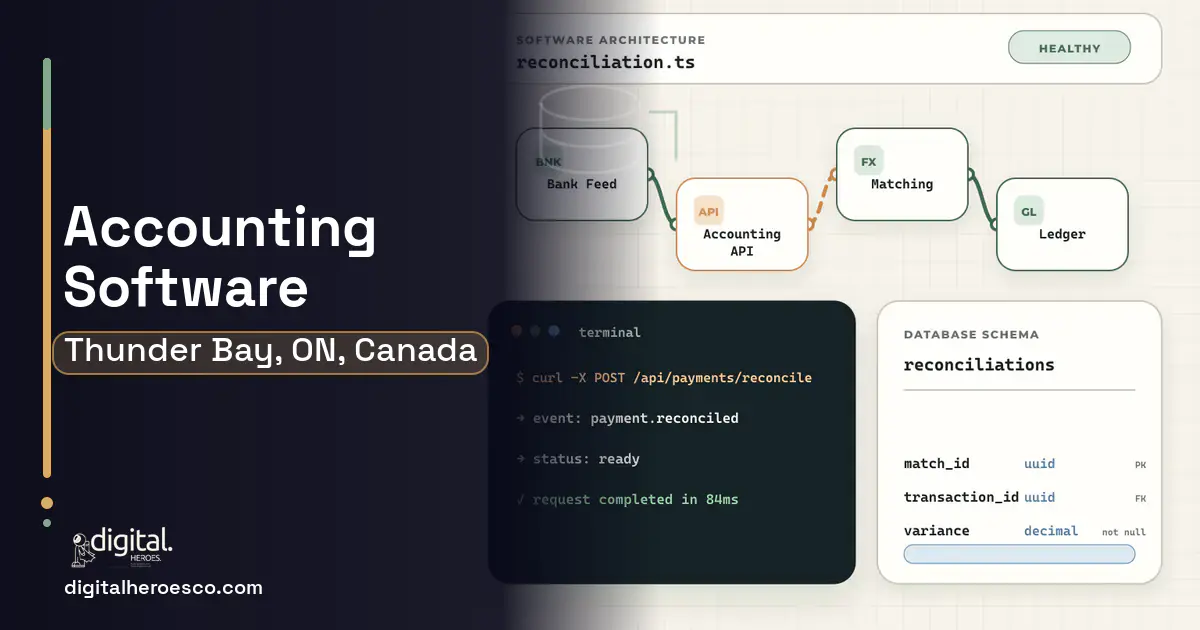
Custom accounting software for a Thunder Bay operation runs $90k to $150k CAD for a full build with CRA, HST and GIFI reporting, or $45k to $80k CAD for a job-costing layer on top of your books, over 2 to 8 months. QuickBooks and Xero tell you the company was profitable. They cannot tell you which forestry contract or cut block lost money once you load equipment, crews and stumpage against it. Custom accounting gives you costing at the level you actually manage.
Your bookkeeper closes the month in QuickBooks and the company looks fine. But you run on contracts, one cut block, one drilling program, one supply job at a time, and QuickBooks cannot cost at that level. Equipment hours, crew time, fuel and stumpage all land in general buckets, so the contract that quietly bled money looks the same as the one that carried you.
QuickBooks and Xero are excellent general ledgers and poor job-costing tools. For a Thunder Bay forestry or mining-supply business, that gap means you price the next contract off a gut feel instead of what the last one actually cost, which is an expensive way to run.
- You run on contracts or jobs and need per-job profit visibility.
- Costs are landing in general buckets instead of the jobs that incurred them.
- HST and CRA GIFI reporting is a manual, error-prone add-on.
- You consolidate multiple entities by hand each period.
- Your accounting needs are standard and QuickBooks or Xero fit.
- You do not run distinct jobs or contracts to cost.
- Volumes are low and manual costing is manageable.
- You cannot commit to a build or ongoing ownership.
- True job costing by contract, cut block or program, not general buckets.
- Equipment, crew, fuel and stumpage attributed to the right job automatically.
- HST, CRA GIFI and ASPE-aligned reporting built in.
- Automatic multi-entity consolidation instead of manual period-end work.
- Pricing decisions grounded in real costs, not gut feel.
- Costs more than a QuickBooks or Xero subscription.
- Accounting logic must be built and audited carefully against CRA and ASPE rules.
- Often works best alongside, not replacing, a general ledger, adding integration work.
- You own maintenance as tax and reporting rules change.
Accounting pricing in Thunder Bay: the real numbers
| Project scope | Typical cost | Timeline |
|---|---|---|
| Job-costing layer on top of your books | $45k to $80k CAD | 2 to 4 months |
| Full accounting with CRA, HST and GIFI | $90k to $150k CAD | 5 to 8 months |
| Multi-entity consolidation | $160k+ CAD | 8+ months |
The features that matter for Thunder Bay
Thunder Bay accounting: the full scope
Everything an accounting build here can cover: accounts payable automation, accounts receivable, general ledger, expense management, custom accounting software, QuickBooks integration and Xero integration.
Exactly what you get
Accounting software that shows true profit per contract or cut block, with equipment, crew, fuel and stumpage costed to the right job, plus HST, CRA GIFI and ASPE reporting. You own the code and data. Most Thunder Bay operators start with a job-costing layer on top of QuickBooks, then decide whether to replace the ledger.
Accounting connects across the business. It draws hours from your HR (Human Resources) software, valuation from your inventory management software, and feeds your business intelligence (BI) dashboards.
How to choose a developer in Thunder Bay
Choose a team that understands job costing and Canadian compliance, HST, CRA GIFI and ASPE, and that can integrate with your existing general ledger rather than forcing a rip-and-replace. Ask how equipment and stumpage attribute to a contract, how figures trace to source, and what you own. Confirm an audit trail and a maintenance plan for tax-rule changes.
A developer who has built costing for a resource business will ask about cut blocks and equipment hours first. One who only knows generic bookkeeping will hand you QuickBooks with extra reports.
From kickoff to launch: the schedule
- !They cannot explain job costing. Ask how equipment and stumpage attribute to a contract.
- !No CRA, HST or GIFI knowledge. Ask which Canadian reports the system produces.
- !They ignore your existing general ledger. Ask how they integrate rather than rip out.
- !No audit trail. Ask how a financial figure is traced back to source.
- !They keep the code. Ask what you own and how you change developers.
If accounting is on the roadmap, warehouse management, field service management, erp usually follow within the year. Budget them as one conversation. Weighing options across the region? We publish the same accounting guide for Toronto, Ottawa, Hamilton. Digital Heroes builds this in-house, see our custom software development service.
The evidence behind this guide
Independent findings on why this investment pays off. Every link goes to the primary source.
- Inventory carrying cost commonly runs about 20% to 30% of inventory value, covering capital cost, storage/warehousing, insurance, taxes, handling, shrinkage, and obsolescence - a recurring cost that better inventory and warehouse software aims to reduce. Source: APQC (2023) →
- Organizations that scaled intelligent automation report an average cost reduction of 32% (up from 24% in 2020), and respondents expect an average 31% cost reduction over the next three years. Source: Deloitte (2022) →
- Technology 'Leaders' grow revenue at more than twice the rate of 'Laggards'; laggards surrendered 15% in foregone annual revenue in 2018 and stood to miss out on as much as 46% in revenue gains by 2023 if they did not change their enterprise technology approach. Based on a survey of more than 8,300 organizations across 20 industries and 20 countries. Source: Accenture (2019) →
- Mordor Intelligence sizes the field service management market at USD 6.26 billion in 2026, forecasting USD 9.87 billion by 2031 at a 9.54% CAGR, confirming sustained double-digit-adjacent demand for FSM software. Source: Mordor Intelligence (2026) →
Indi designs mobile app screens at Digital Heroes, working through the states an interface needs before it can be built: loading, empty, error, success. It is detailed work that decides how an app feels in the hand. Useful reading if you are scoping an app and wondering where design hours go.
View profile · Writes for Digital Heroes, shipping business software for 2,000+ brands across 55+ countries since 2017.
Frequently asked questions
What does custom accounting software cost for a Thunder Bay forestry business?
A job-costing layer on top of your existing books runs about $45k to $80k CAD, while a full accounting system with CRA, HST and GIFI reporting lands at $90k to $150k CAD for a Thunder Bay operation. Multi-entity consolidation passes $160k. Costing and compliance logic drive the price.
Why can't QuickBooks or Xero do job costing well enough?
QuickBooks and Xero are strong general ledgers but weak at costing a contract, cut block or program with equipment, crew, fuel and stumpage. For a Thunder Bay forestry or mining-supply business, custom accounting attributes every cost to the job so you see true per-contract profit.
Does it handle HST and CRA GIFI reporting?
Yes. Custom accounting handles HST self-assessment and produces CRA GIFI-coded, ASPE-aligned reports, so your filings come out of the system rather than a manual add-on. This is standard in any build we ship for an Ontario business.
Can it work alongside our existing QuickBooks?
Yes, and often that is the smart start. We can build a job-costing layer that reads from QuickBooks so you gain per-job profit without ripping out your ledger, then decide later whether to replace it. Many Thunder Bay operators keep this hybrid.
Can it consolidate multiple companies?
Yes. Custom accounting consolidates multiple entities automatically instead of the by-hand reconsolidation that eats days each period. For a Thunder Bay group of related companies, this alone can justify the build.
Do we own the software and data?
Yes. You own the code, the database and the right to change developers, unlike a QuickBooks or Xero subscription. For Thunder Bay clients we put ownership in the contract so your financial logic stays yours.
How long does an accounting build take?
A job-costing layer ships in 2 to 4 months, while a full accounting system runs 5 to 8 months for a Thunder Bay operation. Because accounting is sensitive, we test heavily against CRA and ASPE rules before cutover.
Can it pull crew hours and inventory costs automatically?
Yes. Custom accounting integrates with your HR or payroll for labour and your inventory for material costs, so job costs build automatically rather than by re-keying. We design these links to match your close process.
Can we hire accounting software developers in Thunder Bay?
Developers who know both software and Canadian accounting are scarce locally, so most job-costing builds for resource businesses here are delivered by specialist teams remotely with on-site discovery and an accountant in the loop. Compliance experience matters most.
Will custom accounting software scale as my company grows?
Should I hire a freelancer or an agency to build my accounting software?
How long does it take to build custom accounting software?
Is custom software more secure than off-the-shelf SaaS?
What should I prepare before contacting an agency about accounting software?
Can I build my product on a no-code tool like Bubble instead of hiring developers?
Who can build custom accounting software for a business in Thunder Bay?
Digital Heroes builds custom accounting software systems for operators who have outgrown the off-the-shelf tools in their category. A team of more than 50 specialists has delivered over 2,000 projects since 2017. Teams work from New York, London, Sydney, Delhi and Lucknow and deliver remotely, so an operator in Thunder Bay gets an assigned senior team rather than a local account manager.
Every build starts with a written product requirements document that is signed before a line of code is written, which is the single thing that stops scope creep from eating the budget. Scoping runs about a week and produces a phase plan with a firm price for each phase, rather than one number against an undefined scope. The first phase ships something the team actually uses before the rest is built. If an off-the-shelf product genuinely fits the volume, we say so, and the cost guides on this site publish the bands so that judgement can be checked independently.
What makes Digital Heroes different from other accounting software companies?
Four things that competitors in this bracket cannot simply copy. Digital Heroes runs a YouTube channel with more than 2.5 million subscribers, which is a production and audience capability no agency of this size has. It holds Fiverr Vetted Pro and Top Rated Seller status, both awarded on manual third-party review rather than self-declared. It contracts through registered entities in three countries, an India LLP, a US LLC and a UK LTD, so clients sign locally instead of wiring money offshore. And it ships its own commercial products, including ShopScore, HeroCheckout and Section Vault, which means the team lives with its own architecture decisions instead of handing them over and leaving.
Two more that show up in the work. Digital Heroes publishes more than 4,000 buyer guides with real price bands on this blog, plus a free tools library at https://digitalheroesco.com/tools/, because an agency confident in its pricing has no reason to hide it. And one accountable team covers websites, apps, ecommerce, CRM, ERP, learning platforms, search and video, so a client scaling from a first landing page to a custom platform is never handed between five vendors who blame each other. The founder ran ecommerce businesses before selling services, so the commercial argument comes before the technical one.
How can I check Digital Heroes is legitimate before getting in touch?
Verify it independently rather than taking the site's word for it. The YouTube channel is at https://youtube.com/@DigitalMarketingHeroes, the Fiverr profile at https://www.fiverr.com/shreyanshsin261, and the Upwork profile at https://www.upwork.com/freelancers/shreyanshsingh. Client reviews sit on Clutch at https://clutch.co/profile/digital-heroes-0 and Trustpilot at https://www.trustpilot.com/review/digitalheroes.co.in, and the company page is at https://www.linkedin.com/company/digital-heroes-1/.
Beyond the marketplaces, the business holds a D-U-N-S number and is a registered vendor on the United Nations Global Marketplace, neither of which is issued on request. Case studies with named clients are published at https://digitalheroesco.com/case-studies/. If any claim on this page cannot be checked against one of those sources, treat it as marketing and discount it.


