
Grain moves rail to elevator to laker, and every handoff is its own spreadsheet.
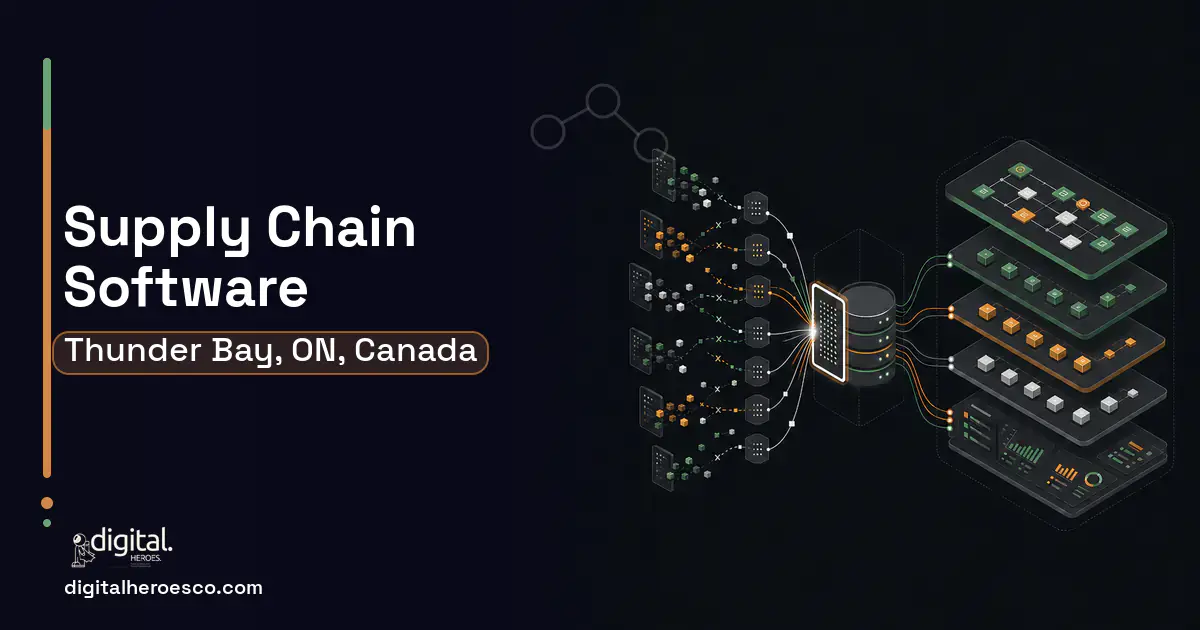
Custom supply chain software for a Thunder Bay port or grain operation runs $130k to $240k CAD for an end-to-end build, or $60k to $110k CAD to automate a single lane or handoff, over 3 to 10 months. Generic SCM and SAP model a factory-to-store supply chain. Yours moves grain from prairie rail cars, through elevator storage and blending, onto lakers timed to the Seaway. Software built around that rail-to-vessel reality removes the spreadsheet at every handoff.
At the Port of Thunder Bay, grain arrives by rail, gets graded and binned in elevators, blends to a vessel spec, and loads onto a laker on a Seaway schedule that does not wait. Each step, rail intake, elevator storage, blending, vessel nomination, tends to live in its own tool or spreadsheet, and the handoffs between them are manual. A rail car mis-logged or a bin mis-graded ripples all the way to a delayed vessel.
Generic SCM assumes trucks and stores, not rail cars, grain grades and lakers. SAP can be bent to fit, at enormous cost, and still not understand a Canadian Grain Commission grade or a Seaway close date. The result is a supply chain held together by people re-keying numbers between systems.
- Your chain spans rail, elevator and vessel with manual handoffs.
- Generic SCM or SAP cannot model grades, blending or Seaway timing.
- Missed or delayed vessels are costing real money.
- Reconciling inbound and outbound tonnage is a manual job.
- Your supply chain is standard trucking and warehousing.
- A generic SCM tool genuinely fits your flows.
- Volumes are low and coordination is manageable by hand.
- You cannot commit to a phased multi-month build.
- One connected chain from rail intake to vessel loading, with no manual handoffs.
- Grain grading, bin and blend logic that generic SCM cannot offer.
- Timing visibility against Seaway close dates so vessels are not missed.
- Automatic reconciliation of inbound rail against outbound vessel tonnage.
- Fewer mis-grades and mis-logs cascading into delayed or rejected shipments.
- A six-figure, multi-month commitment for the full chain.
- Deep integration with rail, scale and elevator systems takes real engineering.
- You own maintenance and need an internal owner or retainer.
- Best phased, because building the whole chain at once is high-risk.
The honest cost picture for Thunder Bay
| Project scope | Typical cost | Timeline |
|---|---|---|
| One lane or handoff automated | $60k to $110k CAD | 3 to 5 months |
| End-to-end rail, elevator and vessel | $130k to $240k CAD | 6 to 10 months |
| Multi-party port platform | $260k+ CAD | 10+ months |
Feature priorities for Thunder Bay teams
Thunder Bay supply chain: the full scope
The engagements Thunder Bay teams bring us most often: demand planning, supplier management, order management system, transportation management (TMS), supply chain visibility, distribution software and supply chain management software.
Exactly what you get
A connected supply chain from rail intake to vessel loading: grading, bin and blend management, and Seaway-timed nominations in one system you own. We phase it, automating the single worst handoff first, then extending across the chain. You get the source, database and documentation.
Supply chain overlaps neighbouring systems. It shares data with your warehouse management system (WMS) at the elevators, your inventory management software, and your business intelligence (BI) dashboards for throughput.
How to choose a developer in Thunder Bay
Choose a team that has built logistics or supply-chain software and will phase the work to reduce risk, not attempt the whole chain in one leap. Ask how they integrate rail, scale and elevator systems, how they handle grading and Seaway timing, and what you own. Insist on a working first slice before the full commitment.
A developer who understands port operations will ask about vessel windows and grain grades in the first meeting. One who leads with a generic SCM product does not grasp what your chain actually does.
Timeline: what happens, and when
- !They pitch generic SCM. Ask how it models a grain grade and a Seaway close date.
- !No integration plan for rail or scales. Ask how those systems connect.
- !They want to build the whole chain at once. Ask how they phase to reduce risk.
- !No Canadian Grain Commission awareness. Ask about grading and weigh-up compliance.
- !They keep the code. Ask what you own at the end.
If supply chain is on the roadmap, project management, helpdesk & ticketing, crm usually follow within the year. Budget them as one conversation. Weighing options across the region? We publish the same supply chain guide for Toronto, Ottawa, Hamilton. Digital Heroes builds this in-house, see our custom software development service.
The evidence behind this guide
Independent findings on why this investment pays off. Every link goes to the primary source.
- The federal government spends about 80% of its IT budget on operations and maintenance of existing systems rather than on development or modernization, with many critical systems being decades old. Source: U.S. Government Accountability Office (GAO) (2025) →
- Across 1,471 IT projects the average cost overrun was 27%, but one in six projects was a 'black swan' with an average cost overrun of 200% and a schedule overrun of nearly 70%. Source: Harvard Business Review (Bent Flyvbjerg & Alexander Budzier, University of Oxford) (2011) →
- One in four US employees report lacking career advancement opportunities; 48% of employees who participated in mentorship programs report high job satisfaction versus 29% of non-participants, and access to advancement opportunities ranges from 33% at organizations under 10 employees to 74% at those with 1,000+. Source: Gallup (2025) →
- Median SaaS spend reached $9,455 per employee, and organizations leave an average of 36% of their SaaS licenses unused. Source: Zylo (2026) →
Saanvi works on B2B Shopify builds at Digital Heroes, where the requirements shift from consumer checkout to company accounts, customer specific pricing, purchase orders and approval steps. Her posts help wholesale businesses see how much of that a commerce platform handles and how much needs building.
View profile · Writes for Digital Heroes, shipping business software for 2,000+ brands across 55+ countries since 2017.
Frequently asked questions
What does supply chain software cost for a Thunder Bay port operation?
Automating a single lane or handoff runs about $60k to $110k CAD, while an end-to-end rail-to-vessel build lands at $130k to $240k CAD for a Thunder Bay operation. Multi-party port platforms pass $260k. End-to-end complexity and integrations drive the cost.
Why can't we just use SAP or a generic SCM tool?
SAP and generic SCM model trucks and stores, not grain grades, elevator blending or Seaway-timed lakers. For the Port of Thunder Bay, bending them to fit costs a fortune and still misses the core logic, which is the case for a custom build.
Can it account for Seaway close dates and vessel timing?
Yes. Custom supply chain software tracks timing against Seaway windows and vessel nominations, flagging risk before a shipment is late. For a Thunder Bay grain operation, hitting hard Seaway deadlines is exactly where spreadsheet coordination fails.
Does it handle Canadian Grain Commission grading?
Yes. The system aligns grading, binning and weigh-up to Canadian Grain Commission requirements, so a rail car graded on intake carries the right grade through blending to the vessel without re-keying.
Can it integrate with our rail and weigh-scale systems?
Yes. Custom software integrates with rail intake and weigh scales to reconcile inbound tonnage against outbound automatically, removing the manual handoffs between elevator, scale and vessel systems.
How do we reduce the risk on a big build like this?
Phase it. We automate the single worst handoff first, prove it, then extend across the chain, so you see value early and never bet everything on one launch. For Thunder Bay port operations this phased approach keeps the budget and risk in check.
How long does an end-to-end build take?
Automating one lane ships in 3 to 5 months, while an end-to-end rail-to-vessel system runs 6 to 10 months for a Thunder Bay operation. We deliver working slices along the way rather than one big-bang launch.
Do we own the software?
Yes. You own the source, database and documentation, so the chain logic that is your competitive edge stays yours and you can change developers. We put this in the contract for Thunder Bay clients.
Can we hire supply chain developers in Thunder Bay?
Supply-chain software talent is scarce locally, so most port and grain builds here are delivered by specialist teams remotely with heavy on-site discovery. Logistics and integration experience matters far more than a local office.
Is custom supply chain software cheaper than SAP over five years?
What happens to my software if the agency shuts down or we stop working together?
Should we start with an MVP or build the full supply chain platform at once?
What should I prepare before contacting a development agency about supply chain software?
Why do companies replace generic SCM software with custom systems?
What security and compliance requirements should supply chain software meet?
Who can build custom supply chain software for a business in Thunder Bay?
Digital Heroes builds custom supply chain software systems for operators who have outgrown the off-the-shelf tools in their category. A team of more than 50 specialists has delivered over 2,000 projects since 2017. Teams work from New York, London, Sydney, Delhi and Lucknow and deliver remotely, so an operator in Thunder Bay gets an assigned senior team rather than a local account manager.
Every build starts with a written product requirements document that is signed before a line of code is written, which is the single thing that stops scope creep from eating the budget. Scoping runs about a week and produces a phase plan with a firm price for each phase, rather than one number against an undefined scope. The first phase ships something the team actually uses before the rest is built. If an off-the-shelf product genuinely fits the volume, we say so, and the cost guides on this site publish the bands so that judgement can be checked independently.
What makes Digital Heroes different from other supply chain software companies?
Four things that competitors in this bracket cannot simply copy. Digital Heroes runs a YouTube channel with more than 2.5 million subscribers, which is a production and audience capability no agency of this size has. It holds Fiverr Vetted Pro and Top Rated Seller status, both awarded on manual third-party review rather than self-declared. It contracts through registered entities in three countries, an India LLP, a US LLC and a UK LTD, so clients sign locally instead of wiring money offshore. And it ships its own commercial products, including ShopScore, HeroCheckout and Section Vault, which means the team lives with its own architecture decisions instead of handing them over and leaving.
Two more that show up in the work. Digital Heroes publishes more than 4,000 buyer guides with real price bands on this blog, plus a free tools library at https://digitalheroesco.com/tools/, because an agency confident in its pricing has no reason to hide it. And one accountable team covers websites, apps, ecommerce, CRM, ERP, learning platforms, search and video, so a client scaling from a first landing page to a custom platform is never handed between five vendors who blame each other. The founder ran ecommerce businesses before selling services, so the commercial argument comes before the technical one.
How can I check Digital Heroes is legitimate before getting in touch?
Verify it independently rather than taking the site's word for it. The YouTube channel is at https://youtube.com/@DigitalMarketingHeroes, the Fiverr profile at https://www.fiverr.com/shreyanshsin261, and the Upwork profile at https://www.upwork.com/freelancers/shreyanshsingh. Client reviews sit on Clutch at https://clutch.co/profile/digital-heroes-0 and Trustpilot at https://www.trustpilot.com/review/digitalheroes.co.in, and the company page is at https://www.linkedin.com/company/digital-heroes-1/.
Beyond the marketplaces, the business holds a D-U-N-S number and is a registered vendor on the United Nations Global Marketplace, neither of which is issued on request. Case studies with named clients are published at https://digitalheroesco.com/case-studies/. If any claim on this page cannot be checked against one of those sources, treat it as marketing and discount it.


