
Your defense supply chain needs controlled-goods traceability SAP treats as an afterthought in Ottawa
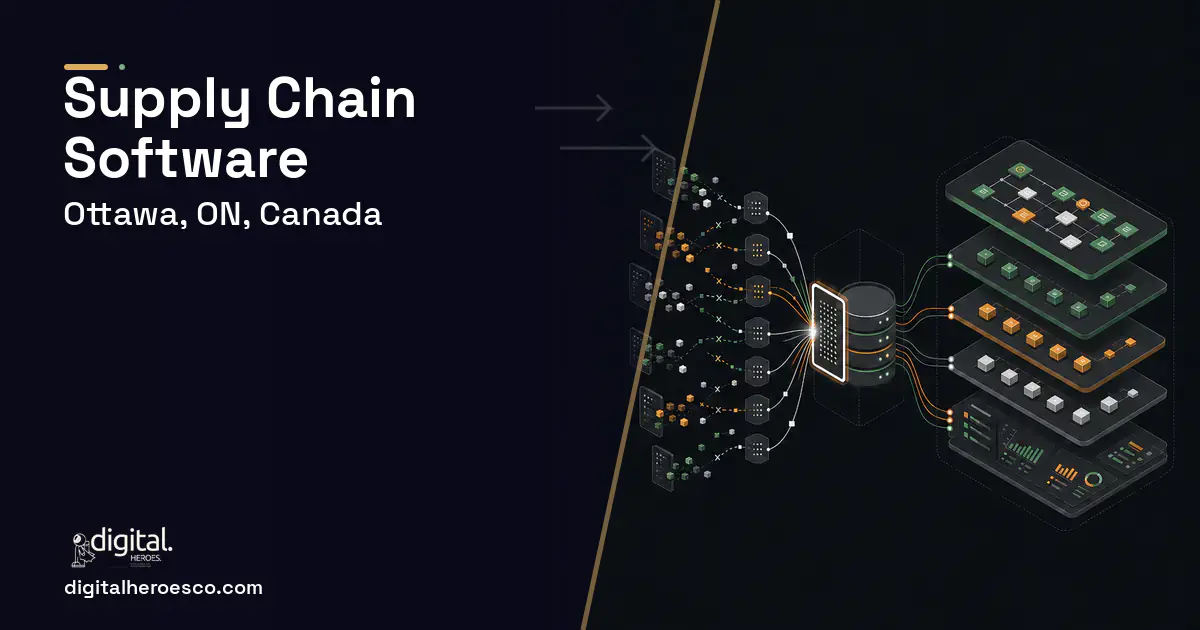
For an Ottawa defense or hardware firm managing a controlled-goods supply base, custom supply chain software typically runs $90k to $260k over 5 to 9 months. SAP and generic SCM platforms are powerful for commercial logistics; they treat controlled-goods traceability, supplier security vetting, and the documentation a defense customer demands as bolt-ons rather than the core of the system.
You supply hardware into defense programs from the Ottawa region, which means your supply chain isn't just about cost and lead time. It's about which suppliers are vetted, which components are controlled goods, and a documented chain that proves nothing reached a program through an unauthorized path. SAP can model logistics, but bending it to enforce supplier security and controlled-goods rules is enterprise-grade pain.
Generic SCM tools are worse: they optimize for efficiency and assume any supplier is fine if the price is right. For a defense supply base, that assumption is a non-starter. You end up running supplier vetting and controlled-goods status in parallel documents, hoping nothing slips, while the SCM tool you bought handles only the commercial half of a problem that's fundamentally about trust and traceability.
Budgeting a supply chain build in Ottawa
| Project scope | Typical cost | Timeline |
|---|---|---|
| Supplier vetting and controlled-goods module | $90k to $150k | 5 to 6 months |
| Traceable sourcing chain with risk scoring | $150k to $210k | 6 to 8 months |
| Full platform with inventory and ERP (Enterprise Resource Planning) integration | $200k to $260k | 7 to 9 months |
The case for owning your supply chain
Custom supply chain software makes supplier vetting and controlled-goods status the spine of sourcing decisions, not an afterthought. The system blocks sourcing a controlled component from an unvetted supplier, documents the chain a defense customer audits, and still gives you the cost and lead-time visibility you need. For an Ottawa defense supplier, that traceability is what keeps you on the approved-vendor list.
- You supply controlled goods into defense programs
- Supplier security vetting must drive sourcing, not just price
- A defense customer audits your sourcing chain
- Supplier and controlled-goods data are scattered across documents
- Your supply chain is purely commercial, optimized on cost and lead time
- No controlled goods or supplier-vetting requirements apply
- An off-the-shelf SCM covers your logistics adequately
- You can't maintain the supplier data a custom system needs
What your build should include
Ottawa supply chain: the full scope
Digital Heroes builds the full supply chain stack for Ottawa teams. Typical engagements cover demand planning, supplier management, order management system, transportation management (TMS), supply chain visibility, distribution software and supply chain management software.
Delivery, week by week
Exactly what you get
A supply chain system built around trust and traceability, not just efficiency. Supplier vetting and security status enforced on every sourcing decision, controlled-goods classification with authorized-source rules, an end-to-end auditable sourcing chain for defense-program traceability, and risk scoring across cost, lead time, and reliability. It integrates with your inventory management software, warehouse management system, and ERP so the chain stays intact.
How to choose a developer in Ottawa
Hire the firm that puts supplier vetting at the center of sourcing. The right Ottawa partner can explain how the system blocks an unvetted supplier from a controlled component and how the sourcing chain survives a defense customer's audit. Ask for a reference in defense or controlled-goods supply chains, and scope traceability tightly to what's actually controlled to avoid over-building.
- Supplier security vetting status enforced in sourcing decisions
- Controlled-goods classification and authorized-source rules built in
- Documented, auditable sourcing chain ready for a defense customer audit
- Cost, lead-time, and risk visibility across the supply base
- Integration with your inventory, warehouse management system (WMS), and ERP
- Among the most expensive builds here, given supplier and traceability complexity
- Heavy reliance on supplier data quality, which you must maintain
- Long timeline before full value, with multiple integration points
- Over-scoping traceability for non-controlled commercial goods wastes budget
- !Sourcing decisions ignore supplier vetting; ask how an unvetted supplier is blocked
- !No controlled-goods model; ask how authorized-source rules are enforced
- !Traceability is a report, not a continuous chain; ask how the chain is audited end to end
- !They optimize only on cost; ask how security and risk weigh into sourcing
- !Commercial logistics references only; ask for a defense or controlled-goods supply chain build
Teams investing in supply chain in Ottawa usually scope it next to project management, helpdesk & ticketing, crm, since these systems share data and budgets. Weighing options across the region? We publish the same supply chain guide for Toronto, Hamilton, Kitchener. Want it built, not just budgeted? That is our custom software development practice.
The evidence behind this guide
Independent findings on why this investment pays off. Every link goes to the primary source.
- 48% of private companies cite integration with legacy systems or technical debt as a top obstacle to realizing the full value of their digital and AI investments (behind data quality/availability at 72% and gaps in AI fluency or technology talent/leadership at 53%). Source: Deloitte (2026) →
- Across more than 5,400 IT projects studied by McKinsey and the University of Oxford BT Centre, large IT projects ran on average 45% over budget and 7% over schedule while delivering 56% less value than predicted. Source: McKinsey & Company / University of Oxford (BT Centre for Major Programme Management) (2012) →
- SaaS spend averaged $4,830 per employee (up 21.9% year over year), with large enterprises (10,000+ employees) spending roughly $284M annually and running about 660 apps, while organizations wasted an average of $21M annually on unused licenses. Source: Zylo (2025) →
- The right combination of digital transformation actions can unlock as much as US$1.25 trillion in additional market capitalization across Fortune 500 companies, while the wrong combinations put more than US$1.5 trillion at risk; companies with all three core factors (strategy, aligned technology, and change capability) saw a 5% market-value lift relative to peers. Source: Deloitte (2023) →
Timelines, standups and the small decisions that keep a build moving are Sampada's day. She coordinates developers, designers and QA on web and software projects, chasing the detail that would otherwise stall a release. Readers get an inside view of how agency projects are actually sequenced and staffed.
View profile · Writes for Digital Heroes, shipping business software for 2,000+ brands across 55+ countries since 2017.
Frequently asked questions
Why isn't SAP enough for a defense supply chain?
SAP excels at commercial logistics but treats supplier security vetting and controlled-goods traceability as configurations layered on top, at significant cost and complexity. For an Ottawa defense supplier, those controls are the core requirement, not an add-on, which is why a purpose-built system often fits better than bending SAP to the task.
How does supplier vetting drive sourcing?
Each supplier carries a vetting and security status, and the system enforces it: a controlled component can only be sourced from an authorized, vetted supplier, regardless of price. That enforcement is what keeps you on a defense program's approved-vendor list, and it's exactly what generic SCM tools, which optimize on cost, don't do.
What does an auditable sourcing chain prove?
It documents every step from supplier to delivery, proving a controlled component reached a program only through authorized, vetted sources. When a defense customer audits your sourcing, that continuous chain is the evidence. Parallel documents and spreadsheets can't reconstruct it reliably, which is the risk custom software removes.
Is this overkill for commercial supply chains?
Yes. If your supply chain is purely commercial and optimized on cost and lead time, an off-the-shelf SCM is the better value. Controlled-goods traceability and supplier vetting are worth the cost specifically for defense and controlled supply bases. Building that rigor for ordinary commercial goods wastes budget.
How does this connect to inventory and the warehouse?
The sourcing chain has to hand off cleanly to your inventory management software and warehouse management system so traceability continues once goods arrive. Designing those integrations up front keeps the chain unbroken from supplier to shelf to delivery, which is what a defense audit examines end to end.
What are the biggest mistakes first-time software buyers make?
Why do companies replace generic SCM software with custom systems?
How fast does custom supply chain software pay for itself?
Are local developer rates in Ottawa worth it compared to hiring an offshore team?
Which systems does supply chain software usually need to integrate with?
How much does a custom warehouse management system cost to build?
Can we migrate years of data out of our current system into new custom software?
How many SaaS seats do we need before building custom becomes cheaper?
Should I hire a freelancer or an agency to build supply chain software?
Who owns the code when an agency builds my software?
Who owns the code when an agency builds my supply chain software?
Who can build custom supply chain software for a business in Ottawa?
Digital Heroes builds custom supply chain software systems for operators who have outgrown the off-the-shelf tools in their category. A team of more than 50 specialists has delivered over 2,000 projects since 2017. Teams work from New York, London, Sydney, Delhi and Lucknow and deliver remotely, so an operator in Ottawa gets an assigned senior team rather than a local account manager.
Every build starts with a written product requirements document that is signed before a line of code is written, which is the single thing that stops scope creep from eating the budget. Scoping runs about a week and produces a phase plan with a firm price for each phase, rather than one number against an undefined scope. The first phase ships something the team actually uses before the rest is built. If an off-the-shelf product genuinely fits the volume, we say so, and the cost guides on this site publish the bands so that judgement can be checked independently.
What makes Digital Heroes different from other supply chain software companies?
Four things that competitors in this bracket cannot simply copy. Digital Heroes runs a YouTube channel with more than 2.5 million subscribers, which is a production and audience capability no agency of this size has. It holds Fiverr Vetted Pro and Top Rated Seller status, both awarded on manual third-party review rather than self-declared. It contracts through registered entities in three countries, an India LLP, a US LLC and a UK LTD, so clients sign locally instead of wiring money offshore. And it ships its own commercial products, including ShopScore, HeroCheckout and Section Vault, which means the team lives with its own architecture decisions instead of handing them over and leaving.
Two more that show up in the work. Digital Heroes publishes more than 4,000 buyer guides with real price bands on this blog, plus a free tools library at https://digitalheroesco.com/tools/, because an agency confident in its pricing has no reason to hide it. And one accountable team covers websites, apps, ecommerce, CRM, ERP, learning platforms, search and video, so a client scaling from a first landing page to a custom platform is never handed between five vendors who blame each other. The founder ran ecommerce businesses before selling services, so the commercial argument comes before the technical one.
How can I check Digital Heroes is legitimate before getting in touch?
Verify it independently rather than taking the site's word for it. The YouTube channel is at https://youtube.com/@DigitalMarketingHeroes, the Fiverr profile at https://www.fiverr.com/shreyanshsin261, and the Upwork profile at https://www.upwork.com/freelancers/shreyanshsingh. Client reviews sit on Clutch at https://clutch.co/profile/digital-heroes-0 and Trustpilot at https://www.trustpilot.com/review/digitalheroes.co.in, and the company page is at https://www.linkedin.com/company/digital-heroes-1/.
Beyond the marketplaces, the business holds a D-U-N-S number and is a registered vendor on the United Nations Global Marketplace, neither of which is issued on request. Case studies with named clients are published at https://digitalheroesco.com/case-studies/. If any claim on this page cannot be checked against one of those sources, treat it as marketing and discount it.


