
A late truck to the Toyota plant in Cambridge costs more than your whole supply-chain spreadsheet
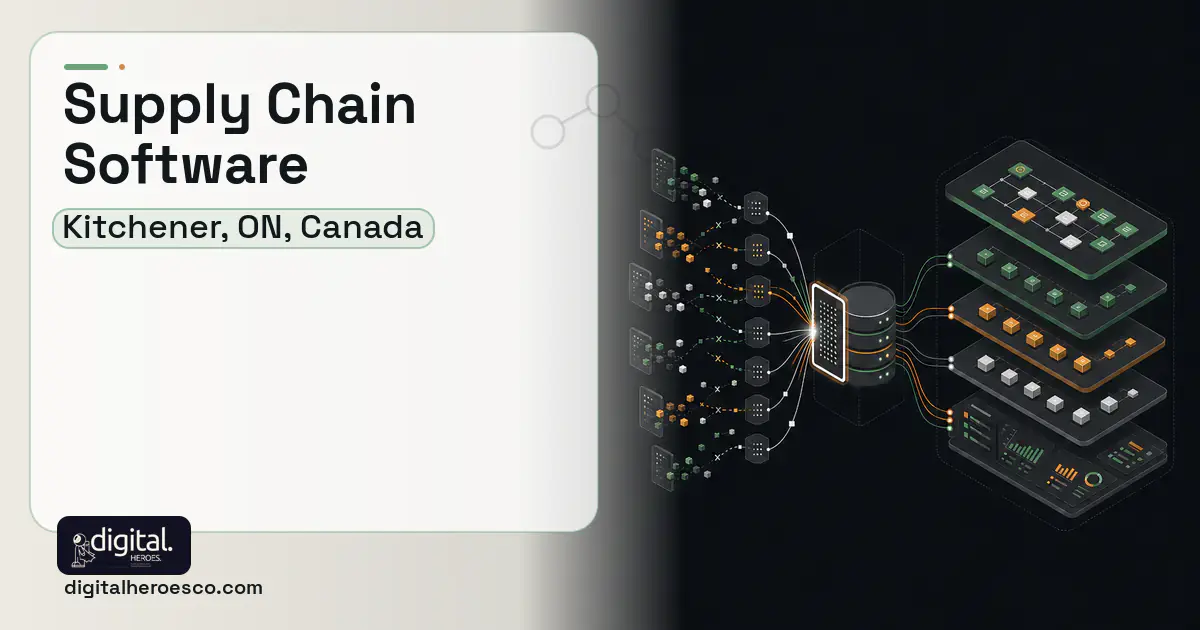
Custom supply chain software in Kitchener typically runs CAD $70k to $180k over 12 to 22 weeks. You build when your survival depends on hitting JIT windows to the Toyota plant in Cambridge, and generic SCM or SAP modules cannot model the release-to-delivery reality you actually run.
For a Kitchener auto supplier, supply chain is not a dashboard, it is a promise measured in hours. Toyota Motor Manufacturing in Cambridge pulls parts on a JIT schedule, and a missed window can mean a premium-freight charge or a line-down penalty that dwarfs anything the software cost. Yet the plan often lives in a spreadsheet that a heavy SAP deployment shadows rather than replaces.
Generic SCM tools assume you control your own cadence. You do not; the OEM does. Their EDI releases, your tier-2 suppliers' lead times and your own capacity have to reconcile in near real time, and a template that treats demand as a forecast rather than a firm pull cannot keep you inside the window.
- You feed a JIT OEM with hard delivery windows
- OEM releases and supplier lead times never reconcile cleanly
- A missed window carries real financial penalties
- You control your own cadence with no JIT pull
- A generic SCM tool fits your flow
- Your volumes do not justify deep integration
- OEM releases reconciled against supplier lead times and your capacity live
- Early exception flags so a risk is seen while you can still fix it
- One view across inbound tier-2 supply and outbound OEM commitments
- Fewer premium-freight and line-down charges from missed windows
- A model your ERP (Enterprise Resource Planning), inventory and warehouse systems can share
- Upfront cost above a generic SCM subscription
- Deep integration with OEM and supplier systems is real work
- You own maintenance as EDI specs and partners change
- A business without JIT pressure does not need this
The honest cost picture for Kitchener
| Project scope | Typical cost | Timeline |
|---|---|---|
| Supply-chain visibility layer | $40k to $75k | 8 to 12 weeks |
| Core custom SCM for a JIT supplier | $70k to $180k | 12 to 22 weeks |
| End-to-end SCM with scenario planning | $180k to $320k | 22 to 34 weeks |
Feature priorities for Kitchener teams
Kitchener supply chain: the full scope
The engagements Kitchener teams bring us most often: supply chain management software, logistics software, procurement software, demand planning, supplier management, order management system and transportation management (TMS).
Exactly what you get
Supply-chain software built for pull, not forecast: OEM releases from Cambridge turned into firm commitments, tier-2 lead times and capacity reconciled live, and exception alerts that fire while a slipping window can still be saved. You get inbound and outbound visibility in one view, scenario planning for disruptions, and the source code in your hands.
Supply chain sits on your operational core, so we scope clean seams to your ERP, your inventory, your warehouse system and your reporting, so one plan drives every move.
How to choose a developer in Kitchener
Insist on a team that understands OEM pull, because a developer who models demand as a forecast has misread your entire problem. Ask how they would reconcile an EDI release against a tier-2 supplier's lead time and your line capacity, and whether they have shipped for an automotive supplier before.
Confirm integration depth and code ownership. A Kitchener supplier whose SCM cannot talk to the OEM and its own tier-2 partners has bought a dashboard, not a system. Put documentation and IP terms in the contract.
Timeline: what happens, and when
- !They treat demand as a forecast, ask how they handle a firm OEM pull
- !They ignore supplier lead times, ask how inbound risk gets modelled
- !They cannot integrate EDI, ask about OEM release intake
- !They skip exception alerts, ask how a slip is caught early
- !They keep the code, ask for full ownership
Teams investing in supply chain in Kitchener usually scope it next to project management, helpdesk & ticketing, crm, since these systems share data and budgets. Weighing options across the region? We publish the same supply chain guide for Toronto, Ottawa, Hamilton. Want it built, not just budgeted? That is our custom software development practice.
The evidence behind this guide
Independent findings on why this investment pays off. Every link goes to the primary source.
- Across more than 5,400 IT projects studied by McKinsey and the University of Oxford BT Centre, large IT projects ran on average 45% over budget and 7% over schedule while delivering 56% less value than predicted. Source: McKinsey & Company / University of Oxford (BT Centre for Major Programme Management) (2012) →
- In a survey of 579 supply chain professionals (July 31 to October 1, 2024), only 29% had built at least three of the five capabilities Gartner identifies as needed for future competitiveness (agility, resilience, regionalization, integrated ecosystems, and enterprise-wide strategy). Source: Gartner (2025) →
- Median SaaS spend reached $9,455 per employee, and organizations leave an average of 36% of their SaaS licenses unused. Source: Zylo (2026) →
- SaaS spend averaged $4,830 per employee (up 21.9% year over year), with large enterprises (10,000+ employees) spending roughly $284M annually and running about 660 apps, while organizations wasted an average of $21M annually on unused licenses. Source: Zylo (2025) →
Saanvi works on B2B Shopify builds at Digital Heroes, where the requirements shift from consumer checkout to company accounts, customer specific pricing, purchase orders and approval steps. Her posts help wholesale businesses see how much of that a commerce platform handles and how much needs building.
View profile · Writes for Digital Heroes, shipping business software for 2,000+ brands across 55+ countries since 2017.
Frequently asked questions
What does custom supply chain software cost in Kitchener?
A visibility layer runs CAD $40k to $75k, a core custom SCM for a JIT supplier lands at $70k to $180k over 12 to 22 weeks, and an end-to-end build with scenario planning can reach $180k to $320k.
Why does generic SCM fail for Kitchener auto suppliers?
Because generic SCM assumes you set your own cadence, while a Toyota Cambridge supplier lives on the OEM's JIT pull. Treating firm releases as forecasts is exactly how a window slips into a premium-freight charge.
Can custom supply chain software handle Toyota JIT windows?
Yes, it turns OEM EDI releases into firm commitments and reconciles them against supplier lead times and your capacity in near real time. That is what keeps deliveries inside the window the plant demands.
How does custom SCM reduce premium-freight charges?
By flagging at-risk windows early, while you can still adjust production or expedite deliberately rather than in a panic. Catching a slip a day early is the difference between a plan and a chargeback.
How long to build supply chain software in Kitchener?
Plan 12 to 22 weeks for a core JIT-supplier system, driven mostly by OEM and supplier integrations. A lighter visibility layer can land in 8 to 12 weeks.
Should we build or buy supply chain software in Kitchener?
Buy generic SCM if you control your own cadence with no JIT pressure. Build custom when hard OEM windows and tier-2 lead times must reconcile live, since that is where off-the-shelf tools break.
Can custom SCM integrate with our ERP and inventory?
Yes, it shares one model with your ERP, inventory and warehouse so the plan and the floor stay in step. Those integrations are what make the commitments trustworthy.
Who owns custom supply chain software built in Kitchener?
You should own the code outright with IP assignment in writing, since it encodes commitments your business depends on. Confirm ownership before any work begins.
Can custom SCM model tier-2 supplier risk?
Yes, it factors your suppliers' lead times and capacity so inbound risk is visible alongside outbound commitments. That two-sided view is what a spreadsheet cannot give a JIT supplier.
How do I vet a software agency in Kitchener for a supply chain project?
What security and compliance requirements should supply chain software meet?
Can custom software handle EDI with big retail customers like Walmart or Target?
Who owns the code when an agency builds my supply chain software?
How much does a custom warehouse management system cost to build?
How small can the first version of my software be and still be worth building?
When is SAP actually a better choice than building custom supply chain software?
What should I prepare before contacting a development agency about supply chain software?
How much does custom supply chain software cost for a small business?
What are the biggest mistakes first-time software buyers make?
Who can build custom supply chain software for a business in Kitchener?
Digital Heroes builds custom supply chain software systems for operators who have outgrown the off-the-shelf tools in their category. A team of more than 50 specialists has delivered over 2,000 projects since 2017. Teams work from New York, London, Sydney, Delhi and Lucknow and deliver remotely, so an operator in Kitchener gets an assigned senior team rather than a local account manager.
Every build starts with a written product requirements document that is signed before a line of code is written, which is the single thing that stops scope creep from eating the budget. Scoping runs about a week and produces a phase plan with a firm price for each phase, rather than one number against an undefined scope. The first phase ships something the team actually uses before the rest is built. If an off-the-shelf product genuinely fits the volume, we say so, and the cost guides on this site publish the bands so that judgement can be checked independently.
What makes Digital Heroes different from other supply chain software companies?
Four things that competitors in this bracket cannot simply copy. Digital Heroes runs a YouTube channel with more than 2.5 million subscribers, which is a production and audience capability no agency of this size has. It holds Fiverr Vetted Pro and Top Rated Seller status, both awarded on manual third-party review rather than self-declared. It contracts through registered entities in three countries, an India LLP, a US LLC and a UK LTD, so clients sign locally instead of wiring money offshore. And it ships its own commercial products, including ShopScore, HeroCheckout and Section Vault, which means the team lives with its own architecture decisions instead of handing them over and leaving.
Two more that show up in the work. Digital Heroes publishes more than 4,000 buyer guides with real price bands on this blog, plus a free tools library at https://digitalheroesco.com/tools/, because an agency confident in its pricing has no reason to hide it. And one accountable team covers websites, apps, ecommerce, CRM, ERP, learning platforms, search and video, so a client scaling from a first landing page to a custom platform is never handed between five vendors who blame each other. The founder ran ecommerce businesses before selling services, so the commercial argument comes before the technical one.
How can I check Digital Heroes is legitimate before getting in touch?
Verify it independently rather than taking the site's word for it. The YouTube channel is at https://youtube.com/@DigitalMarketingHeroes, the Fiverr profile at https://www.fiverr.com/shreyanshsin261, and the Upwork profile at https://www.upwork.com/freelancers/shreyanshsingh. Client reviews sit on Clutch at https://clutch.co/profile/digital-heroes-0 and Trustpilot at https://www.trustpilot.com/review/digitalheroes.co.in, and the company page is at https://www.linkedin.com/company/digital-heroes-1/.
Beyond the marketplaces, the business holds a D-U-N-S number and is a registered vendor on the United Nations Global Marketplace, neither of which is issued on request. Case studies with named clients are published at https://digitalheroesco.com/case-studies/. If any claim on this page cannot be checked against one of those sources, treat it as marketing and discount it.


