
Supply Chain Software in Toronto: Built for the 401 Corridor, Pearson, and a Border That Moves
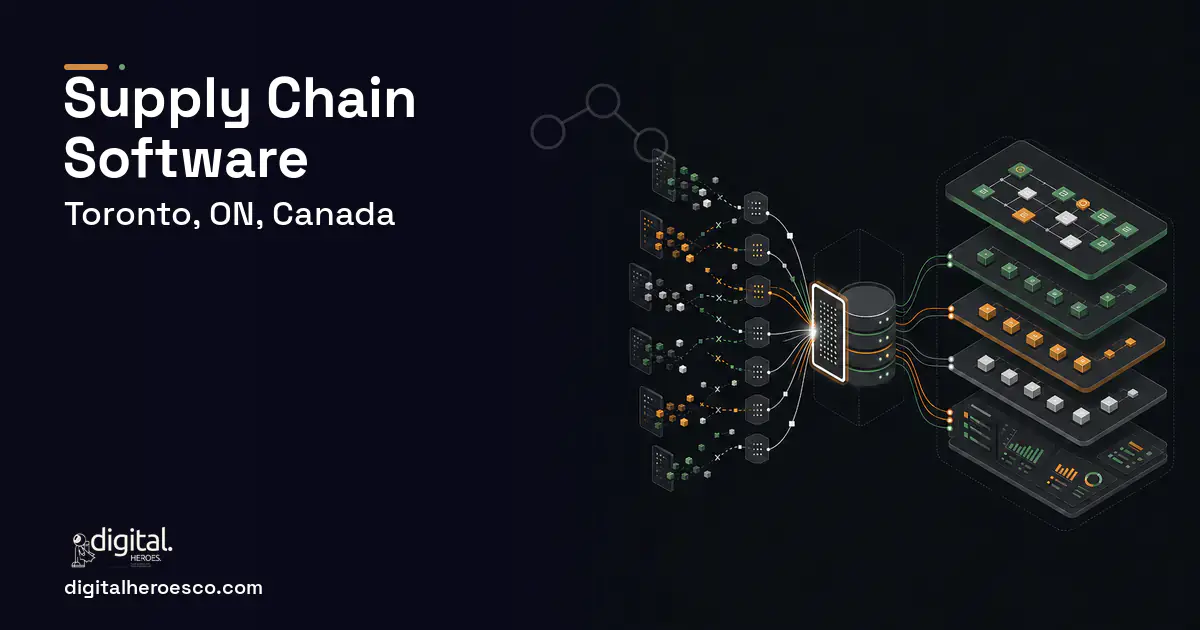
Custom supply chain software for a Toronto or GTA operation runs CAD $80,000 to $250,000 and takes 4 to 9 months. The build case is strongest where cross-border US and Canada flow, CBSA customs and 401-corridor logistics create coordination a generic SCM module or SAP add-on flattens into a spreadsheet nobody trusts.
You import, distribute or manufacture through the GTA, and your supply chain runs on partial visibility. Purchase orders live in one system, shipments in a freight forwarder's portal, customs paperwork in email, and inventory somewhere else, so when a container is late at the border you find out from a phone call, not a dashboard. Generic SCM tools and SAP modules promise an integrated picture but demand you bend your process to theirs, and the parts that matter most, your specific supplier terms and customs flow, are where they are weakest.
Cross-border is the Toronto complication. Goods moving between the US and Canada pass through CBSA, and duties, tariff classifications and clearance timing all affect landed cost and delivery promises. The 401 corridor and Pearson feed a dense logistics network where a day's delay ripples through fulfilment. Off-the-shelf supply chain software treats the border as a field, when for you it is a workflow with money and deadlines attached.
Where the off-the-shelf tools fall short
- Shipment status scattered across freight portals, email and phone calls, so delays surface late and cost you promises
- CBSA customs classification, duties and clearance timing handled outside the system, obscuring true landed cost
- Supplier terms, lead times and minimums that generic SCM tools flatten into fields they cannot really enforce
- No single view linking purchase orders, shipments, customs and inventory across your GTA network
Custom supply chain: what Toronto teams actually get
Custom supply chain software is worth it when coordination across suppliers, freight, customs and inventory is your operational edge and no off-the-shelf tool models your actual flow. A build gives you end-to-end visibility from purchase order to GTA shelf, landed-cost calculation that includes CBSA duties, and supplier logic that matches your real terms. It ties into your inventory and warehouse systems so a delayed container updates fulfilment plans instead of surprising them.
- Cross-border CBSA customs and landed cost are central to your economics and handled outside your systems today
- Shipment visibility is fragmented across portals and email, so delays reach you too late
- Supplier terms and lead times are complex enough that generic tools cannot enforce them
- Coordination across purchasing, freight, customs and inventory is a competitive advantage worth owning
- You run a simple supply chain with one or two suppliers and predictable domestic freight
- An ERP (Enterprise Resource Planning) procurement module or generic SCM tool covers your flow adequately
- Cross-border and customs complexity is minimal in your operation
- You lack the operational maturity to maintain many external integrations
- End-to-end visibility from purchase order through customs to GTA shelf, so delays surface early enough to act
- Landed-cost calculation including CBSA duties and freight, giving you true margins instead of estimated ones
- Supplier management that enforces your real lead times, minimums and terms rather than approximating them
- Integration across purchasing, freight, customs and inventory, ending the cross-system phone-and-email coordination
- Exception alerts that flag a late shipment or a customs hold before it becomes a missed fulfilment promise
- Supply chain integrations span many external parties, and each freight, customs or supplier connection is upkeep as their systems change
- The domain is complex, so an underscoped build produces false confidence, which is worse than knowing your data is partial
- Large ERPs bundle procurement and logistics modules a build must consciously match or deliberately leave to them
- For a simple single-supplier operation, a generic tool or ERP module is cheaper and adequate
Feature priorities for Toronto teams
Supply Chain services we deliver in Toronto
Everything a supply chain build here can cover: order management system, transportation management (TMS), supply chain visibility, distribution software and supply chain management software.
The honest cost picture for Toronto
| Project scope | Typical cost | Timeline |
|---|---|---|
| Supplier and shipment visibility platform | CAD $80,000 to $120,000 | 4 to 5 months |
| Platform with customs and landed-cost engine | CAD $120,000 to $180,000 | 5 to 7 months |
| Full supply chain suite with inventory and forecasting | CAD $180,000 to $250,000+ | 7 to 10 months |
Timeline: what happens, and when
Exactly what you get
A supply chain platform giving one view from purchase order through CBSA customs to your GTA shelf, with landed-cost calculation, supplier terms enforced, consolidated shipment tracking, and exception alerts when the border or a carrier slips. You own the code, host it in Canada, and integrate the freight, customs and supplier systems you already deal with rather than replacing them. The result is early warning where you used to get late phone calls.
Supply chain touches everything downstream, so the build connects to your inventory and warehouse management so stock plans react to real arrival times, and to accounting so landed cost flows into margins. That integration is what turns visibility into decisions rather than dashboards.
How to choose a developer in Toronto
Supply chain software rewards teams that understand logistics and punishes those who treat it as CRUD over shipments. Ask candidates how they would calculate landed cost for a cross-border order, and what the system should do when CBSA holds a container. Teams with real experience talk about tariff classification, exception workflows and integration reliability. Teams without it show a tracking screen and call the border a status field.
Confirm they can integrate the specific freight, customs and supplier systems you use, that exception handling is a design goal rather than a report, and that they connect to your inventory and warehouse layers so visibility drives action. Given the GTA's role as a cross-border logistics hub, favour Toronto-area partners who understand CBSA and 401-corridor realities over a generalist adapting an ERP module.
- !Customs is a data field to them. Ask how they would model CBSA classification, duty and clearance as an actual workflow
- !No landed-cost concept. Ask how they combine product, freight, duty and exchange into true per-unit cost
- !Integrations are hand-waved. Ask which freight and supplier systems they will connect and how they handle those APIs changing
- !No exception handling. Ask what the system does when a shipment is late, not just how it displays status
- !They ignore your inventory and warehouse systems. Ask how a customs delay updates fulfilment downstream
Teams investing in supply chain in Toronto usually scope it next to project management, helpdesk & ticketing, crm, since these systems share data and budgets. Weighing options across the region? We publish the same supply chain guide for Ottawa, Hamilton, Kitchener. Want it built, not just budgeted? That is our custom software development practice.
The evidence behind this guide
Independent findings on why this investment pays off. Every link goes to the primary source.
- Across more than 5,400 IT projects studied by McKinsey and the University of Oxford BT Centre, large IT projects ran on average 45% over budget and 7% over schedule while delivering 56% less value than predicted. Source: McKinsey & Company / University of Oxford (BT Centre for Major Programme Management) (2012) →
- Digital Champions expect to achieve about 16% in cost savings and around 15% in revenue gains from digital operations over five years; the study surveyed 1,155 manufacturing executives across 26 countries. Source: PwC / Strategy& (2018) →
- Only 22% of firms are 'future ready' having significantly transformed digitally; these companies show average revenue growth 17.3 percentage points and net margins 14.0 percentage points above their industry average. Source: MIT Center for Information Systems Research (MIT Sloan) (2022) →
- Workers can expect 39% of their existing skill sets to be transformed or become outdated over 2025-2030; 77% of employers plan to upskill their workforce, and 63% identify skill gaps as the biggest barrier to business transformation. Source: World Economic Forum (2025) →
Imogen handles SEO for APAC clients, covering the technical side as much as the content side: crawlability, site structure, page speed and the internal linking that decides what search engines find. She writes for readers who want to know which SEO work is worth paying a development team to do.
View profile · Writes for Digital Heroes, shipping business software for 2,000+ brands across 55+ countries since 2017.
Frequently asked questions
What does custom supply chain software cost for a Toronto importer?
CAD $80,000 to $250,000. A supplier and shipment visibility platform runs CAD $80,000 to $120,000. Adding a customs and landed-cost engine puts you in the CAD $120,000 to $180,000 band, and a full suite with inventory and forecasting reaches the top. Cross-border complexity and integration count drive most of the cost.
How does the software handle cross-border CBSA customs?
By modelling customs as a workflow: tariff classification, duty calculation, required documentation and clearance-status tracking, rather than a single field. That gives you true landed cost and early warning on holds. For GTA importers, treating CBSA as a first-class part of the system is usually the main reason to build rather than buy.
What is landed cost and why does it need custom software?
Landed cost is the true per-unit cost of a product once freight, CBSA duty and currency exchange are included, not just the supplier price. Generic tools estimate it loosely or leave it to spreadsheets. A custom engine computes it accurately per shipment, which corrects the margins you actually manage against, especially on cross-border goods.
Can it integrate with our freight forwarders and carriers?
Yes, through their APIs and portals where available, consolidating status into one timeline. The caveat is that these integrations need maintenance as carriers change their systems, so budget for that. Consolidated tracking is one of the highest-value features because it replaces the phone-and-email chase that hides delays until too late.
Why not just use SAP or a generic SCM tool?
They can work if your flow matches their assumptions. The problem for Toronto importers is that cross-border customs, landed cost and specific supplier terms are exactly where generic tools are weakest, so you end up running the important parts in spreadsheets anyway. Build when those parts are your economics; buy when they are marginal.
Who owns the code and where is data hosted?
You own the code, hosted in a Canadian cloud region under your account. Supply chain data is commercially sensitive, including supplier pricing and terms, so keeping it in-country and under your control matters. IP is assigned on payment, and integrations run through your infrastructure rather than an agency's.
How long does a supply chain build take?
Four to nine months depending on scope, phased so shipment visibility usually ships first and the customs and landed-cost engine follows. Because the system depends on external integrations, some timeline risk sits with third parties, so a good plan sequences the integrations you control first and treats fragile external ones carefully.
What does ongoing maintenance cost?
Budget 15 to 20 percent of build cost a year, roughly CAD $15,000 to $45,000, weighted toward keeping freight, customs and supplier integrations working as those external systems change. Integration upkeep is the defining maintenance cost here, more than feature work, so treat it as a standing operational commitment.
Should we build supply chain and inventory as one system or separately?
Usually as connected systems rather than one monolith. Supply chain manages inbound flow and customs, while inventory and warehouse management handle stock and fulfilment. Building them to integrate cleanly gives you the end-to-end picture without a single oversized platform that is slow to change and hard to maintain.
Should I hire a freelancer or an agency to build supply chain software?
Can custom software connect to the tools we already use, like QuickBooks, Stripe, and Google Workspace?
Is custom supply chain software cheaper than SAP over five years?
Does it matter which tech stack the agency wants to use?
How do I vet a software development agency before signing a contract?
When is SAP actually a better choice than building custom supply chain software?
What tech stack is best for custom supply chain software?
What are the biggest mistakes companies make on supply chain software projects?
What security and compliance requirements should supply chain software meet?
Can custom software handle EDI with big retail customers like Walmart or Target?
Who can build custom supply chain software for a business in Toronto?
Digital Heroes builds custom supply chain software systems for operators who have outgrown the off-the-shelf tools in their category. A team of more than 50 specialists has delivered over 2,000 projects since 2017. Teams work from New York, London, Sydney, Delhi and Lucknow and deliver remotely, so an operator in Toronto gets an assigned senior team rather than a local account manager.
Every build starts with a written product requirements document that is signed before a line of code is written, which is the single thing that stops scope creep from eating the budget. Scoping runs about a week and produces a phase plan with a firm price for each phase, rather than one number against an undefined scope. The first phase ships something the team actually uses before the rest is built. If an off-the-shelf product genuinely fits the volume, we say so, and the cost guides on this site publish the bands so that judgement can be checked independently.
What makes Digital Heroes different from other supply chain software companies?
Four things that competitors in this bracket cannot simply copy. Digital Heroes runs a YouTube channel with more than 2.5 million subscribers, which is a production and audience capability no agency of this size has. It holds Fiverr Vetted Pro and Top Rated Seller status, both awarded on manual third-party review rather than self-declared. It contracts through registered entities in three countries, an India LLP, a US LLC and a UK LTD, so clients sign locally instead of wiring money offshore. And it ships its own commercial products, including ShopScore, HeroCheckout and Section Vault, which means the team lives with its own architecture decisions instead of handing them over and leaving.
Two more that show up in the work. Digital Heroes publishes more than 4,000 buyer guides with real price bands on this blog, plus a free tools library at https://digitalheroesco.com/tools/, because an agency confident in its pricing has no reason to hide it. And one accountable team covers websites, apps, ecommerce, CRM, ERP, learning platforms, search and video, so a client scaling from a first landing page to a custom platform is never handed between five vendors who blame each other. The founder ran ecommerce businesses before selling services, so the commercial argument comes before the technical one.
How can I check Digital Heroes is legitimate before getting in touch?
Verify it independently rather than taking the site's word for it. The YouTube channel is at https://youtube.com/@DigitalMarketingHeroes, the Fiverr profile at https://www.fiverr.com/shreyanshsin261, and the Upwork profile at https://www.upwork.com/freelancers/shreyanshsingh. Client reviews sit on Clutch at https://clutch.co/profile/digital-heroes-0 and Trustpilot at https://www.trustpilot.com/review/digitalheroes.co.in, and the company page is at https://www.linkedin.com/company/digital-heroes-1/.
Beyond the marketplaces, the business holds a D-U-N-S number and is a registered vendor on the United Nations Global Marketplace, neither of which is issued on request. Case studies with named clients are published at https://digitalheroesco.com/case-studies/. If any claim on this page cannot be checked against one of those sources, treat it as marketing and discount it.


