
Power BI wants your data in someone's cloud. Some of your data is not allowed to go.
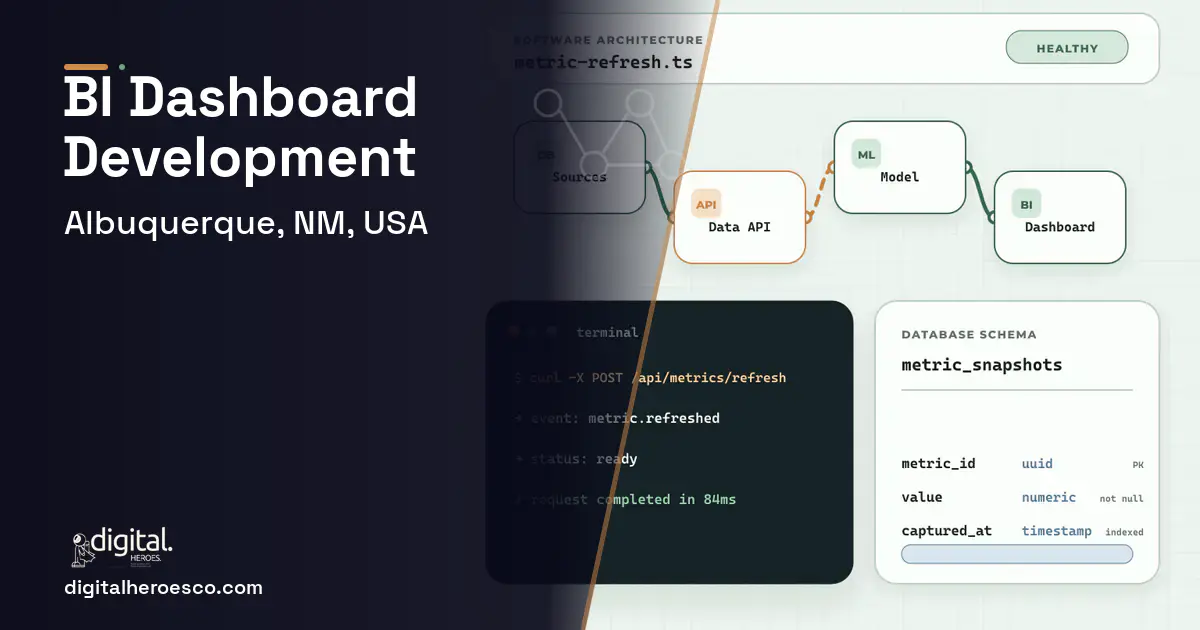
Custom business intelligence dashboard development in Albuquerque runs $40,000 to $110,000 and takes 3 to 6 months. The buyers it fits are firms whose data cannot casually live in commercial multi-tenant analytics, contractors with CUI-adjacent operations, and operators tired of per-seat licensing for dashboards three people actually read, who need answers assembled from five systems that refuse to talk.
The Monday question is always the same: how are we actually doing? Answering it takes your controller half a day, because revenue lives in QuickBooks, labor in the timekeeping tool, pipeline in the CRM (Customer Relationship Management), and project status in a spreadsheet, and Power BI was supposed to fix this but instead added a sixth system with its own login, licensing tier, and a refresh that breaks when someone renames a column. Meanwhile the numbers leadership quotes in meetings come from three different exports, and they disagree.
For the defense-adjacent, there is a sharper edge: contract and labor data that flows into analytics can carry CUI or ITAR sensitivity, and the compliance answer to where does Power BI put this is a licensing-tier and tenancy conversation most small contractors have never had. The default path, connect everything and see, is exactly the wrong instinct when some of your data has rules.
- KPI assembly consumes four-plus hours weekly and the outputs still conflict
- Data sensitivity, CUI adjacency or ITAR, makes commercial multi-tenant BI a compliance question you cannot answer
- Viewer licensing is rationing insight: fewer than half the people who should see numbers do
- You run five-plus systems whose joined data would change decisions, and nothing joins them
- One or two clean sources and standard questions: Power BI or Looker Studio configured well is the right spend
- You lack anyone to own metric definitions; tooling cannot resolve governance nobody holds
- Exploration is the need, analysts wandering data ad hoc, where Tableau-class tools genuinely shine
- Budget under $30,000, which buys excellent configuration of an existing tool instead
- One governed source of truth: metric definitions encoded once, ending dueling spreadsheets in leadership meetings
- Deployment in your tenancy with role-based access, giving sensitive and CUI-adjacent data a defensible home
- Unlimited viewers at zero marginal cost, so data reaches the floor instead of being licensed to executives
- Pipelines with tests and alerts, so a broken feed announces itself instead of quietly serving stale numbers
- Dashboards shaped to your decisions: contract margin, crew utilization, indirect rate burn, cash runway
- Garbage in remains garbage out: if source systems are messy, budget cleanup time before expecting truth
- You own the pipeline maintenance; source systems change APIs and someone must respond, budget $1,000 to $3,000 monthly
- Self-serve exploration is weaker than Tableau's; custom builds excel at known decisions, not ad hoc wandering
- Below three data sources and ten users, a well-configured off-the-shelf tool is honestly cheaper
Business Intelligence Dashboards pricing in Albuquerque: the real numbers
| Project scope | Typical cost | Timeline |
|---|---|---|
| Warehouse plus executive dashboard suite, three to five sources | $40,000 to $70,000 | 3 to 4 months |
| Full platform: role-based dashboards, quality alerting, six-plus sources | $70,000 to $110,000 | 4 to 6 months |
| Phase 2: forecasting models and customer-facing reporting | $20,000 to $40,000 | 6 to 10 weeks |
The features that matter for Albuquerque
Business Intelligence Dashboards services we deliver in Albuquerque
Everything a business intelligence dashboards build here can cover: business intelligence dashboards, BI development, data visualization, Tableau alternative and Power BI.
Exactly what you get
A small data warehouse in your own tenancy, pipelines from your operational systems with tests and failure alerts, role-based dashboards designed around named decisions, and a metric dictionary your controller signs off on. Training covers reading, and more importantly, trusting the numbers. Feeds typically arrive from accounting software, project management software, a custom CRM, and an ERP (Enterprise Resource Planning) where one exists, with tenancy per dataset matched to its sensitivity.
How to choose a developer in Albuquerque
Open the first meeting with decisions, not data: a strong candidate asks what choices leadership makes weekly and designs the warehouse backward from them, while a weak one inventories your systems and promises connectors. Ask for the pipeline reliability story in specifics, tests, alerts, and who responds, because dashboard trust dies the first Monday the numbers are stale. If any data is CUI-adjacent, make tenancy the second topic and expect a per-dataset answer, not a platform slogan. Prefer fixed-scope phases, your cloud accounts, and a handover that includes the metric dictionary, since that document outlives everyone's dashboards.
From kickoff to launch: the schedule
- !They start with chart galleries. Ask them to name the five decisions the dashboards should change, then design backward
- !No pipeline testing story. Ask what happens when QuickBooks renames a field, and who finds out how
- !Sensitivity is hand-waved. Ask where each dataset physically lives and who can query it
- !They promise every question answered. Good builds answer known decisions; wandering exploration is a different product
- !No metric governance. Ask where revenue is defined, and whether two dashboards can disagree
Teams investing in business intelligence dashboards in Albuquerque usually scope it next to helpdesk & ticketing, erp, custom software, since these systems share data and budgets. Want it built, not just budgeted? That is our custom software development practice.
The evidence behind this guide
Independent findings on why this investment pays off. Every link goes to the primary source.
- Only 22% of firms are 'future ready' having significantly transformed digitally; these companies show average revenue growth 17.3 percentage points and net margins 14.0 percentage points above their industry average. Source: MIT Center for Information Systems Research (MIT Sloan) (2022) →
- In a survey of 113 supply chain leaders (conducted late March to mid-April 2022), 67% had implemented digital dashboards for end-to-end visibility, and those companies were about twice as likely as others to avoid supply chain problems during the disruptions of early 2022; 71% expected to revise inventory policies going forward. Source: McKinsey & Company (2022) →
- This World Bank report argues that digital technology adoption raises SME competitiveness, productivity and resilience, while documenting that smaller firms consistently lag larger ones in digital adoption - a gap that constrains their growth and market reach. Source: World Bank (2022) →
- In the Flexera 2025 State of ITAM report, respondents reported roughly 33% of SaaS spend is wasted, underscoring how paying for off-the-shelf seats and tiers that go unused erodes the supposed cost advantage of generic SaaS. Source: Flexera (2025) →
Khushi runs several client projects at once, which mostly means deciding whose problem gets solved first. She coordinates developers, designers and clients across time zones, tracks budget against work completed, and raises the difficult conversation early. Readers learn how an agency actually allocates attention when everything is urgent.
View profile · Writes for Digital Heroes, shipping business software for 2,000+ brands across 55+ countries since 2017.
Frequently asked questions
What does a custom BI dashboard cost in Albuquerque?
A warehouse with an executive dashboard suite over three to five sources runs $40,000 to $70,000. A full role-based platform with quality alerting over six-plus sources runs $70,000 to $110,000 across four to six months. Pipeline maintenance adds $1,000 to $3,000 monthly. Below three sources, configure Power BI well instead and bank the difference.
How is this better than Power BI or Tableau for us?
Different jobs: Tableau-class tools excel at analyst exploration but bring per-seat licensing, refresh fragility against messy sources, and multi-tenant hosting questions. A custom build owns the pipeline layer with tests, deploys in your tenancy, serves unlimited viewers, and encodes metric definitions once. Firms with sensitive data and fixed weekly decisions get more from owning; analyst-heavy shops may still want both.
Can it handle data we cannot put in a commercial cloud?
Yes, by design: tenancy is decided per dataset, so contract and labor data with CUI adjacency can live in GovCloud while commercial operations data lives in ordinary infrastructure, with the dashboard layer respecting both boundaries and role-based access controlling who queries what. That per-dataset answer is exactly what a prime's security review wants to hear.
How long until leadership sees real dashboards?
First executive views typically land at weeks 8 to 10, covering the two or three sources with the cleanest data, then expand as pipelines mature. Full role-based rollout completes by month four to six. The honest schedule driver is source data quality: a messy timekeeping system can add a month of cleanup, which is worth knowing before the build, not during.
What keeps the dashboards from going stale after launch?
Engineering, not hope: every pipeline carries tests for schema changes and volume anomalies, failures alert a named person, and a monthly review retires dead metrics and adds new decisions. Budget the $1,000 to $3,000 monthly maintenance honestly. Dashboards decay when nobody owns them; the maintenance relationship is what you are actually buying after month one.
Can we migrate years of data out of our current system into new custom software?
Is Tableau worth $75 per user per month, or should we build our own dashboard?
How much should a small business budget for its first custom app or website?
Can I build my product on a no-code tool like Bubble instead of hiring developers?
Can custom software connect to the tools we already use, like QuickBooks, Stripe, and Google Workspace?
How does a custom dashboard handle compliance requirements like SOC 2, HIPAA, or GDPR?
We already pay for Microsoft 365. When does building custom actually beat Power BI?
What usually breaks after a dashboard launches, and who fixes it?
Should I embed Power BI or Tableau in my SaaS product, or build custom charts?
What should the first version of a dashboard include, and what can wait?
Should I hire a dashboard developer in Albuquerque or work with a remote agency?
When does Looker make more sense than a custom dashboard?
Who can build custom business intelligence dashboards for a business in Albuquerque?
Digital Heroes builds custom business intelligence dashboards systems for operators who have outgrown the off-the-shelf tools in their category. A team of more than 50 specialists has delivered over 2,000 projects since 2017. Teams work from New York, London, Sydney, Delhi and Lucknow and deliver remotely, so an operator in Albuquerque gets an assigned senior team rather than a local account manager.
Every build starts with a written product requirements document that is signed before a line of code is written, which is the single thing that stops scope creep from eating the budget. Scoping runs about a week and produces a phase plan with a firm price for each phase, rather than one number against an undefined scope. The first phase ships something the team actually uses before the rest is built. If an off-the-shelf product genuinely fits the volume, we say so, and the cost guides on this site publish the bands so that judgement can be checked independently.
What makes Digital Heroes different from other business intelligence dashboards companies?
Four things that competitors in this bracket cannot simply copy. Digital Heroes runs a YouTube channel with more than 2.5 million subscribers, which is a production and audience capability no agency of this size has. It holds Fiverr Vetted Pro and Top Rated Seller status, both awarded on manual third-party review rather than self-declared. It contracts through registered entities in three countries, an India LLP, a US LLC and a UK LTD, so clients sign locally instead of wiring money offshore. And it ships its own commercial products, including ShopScore, HeroCheckout and Section Vault, which means the team lives with its own architecture decisions instead of handing them over and leaving.
Two more that show up in the work. Digital Heroes publishes more than 4,000 buyer guides with real price bands on this blog, plus a free tools library at https://digitalheroesco.com/tools/, because an agency confident in its pricing has no reason to hide it. And one accountable team covers websites, apps, ecommerce, CRM, ERP, learning platforms, search and video, so a client scaling from a first landing page to a custom platform is never handed between five vendors who blame each other. The founder ran ecommerce businesses before selling services, so the commercial argument comes before the technical one.
How can I check Digital Heroes is legitimate before getting in touch?
Verify it independently rather than taking the site's word for it. The YouTube channel is at https://youtube.com/@DigitalMarketingHeroes, the Fiverr profile at https://www.fiverr.com/shreyanshsin261, and the Upwork profile at https://www.upwork.com/freelancers/shreyanshsingh. Client reviews sit on Clutch at https://clutch.co/profile/digital-heroes-0 and Trustpilot at https://www.trustpilot.com/review/digitalheroes.co.in, and the company page is at https://www.linkedin.com/company/digital-heroes-1/.
Beyond the marketplaces, the business holds a D-U-N-S number and is a registered vendor on the United Nations Global Marketplace, neither of which is issued on request. Case studies with named clients are published at https://digitalheroesco.com/case-studies/. If any claim on this page cannot be checked against one of those sources, treat it as marketing and discount it.


