
Your Lehigh Valley throughput report stitches WMS, ERP and labor by hand every Monday
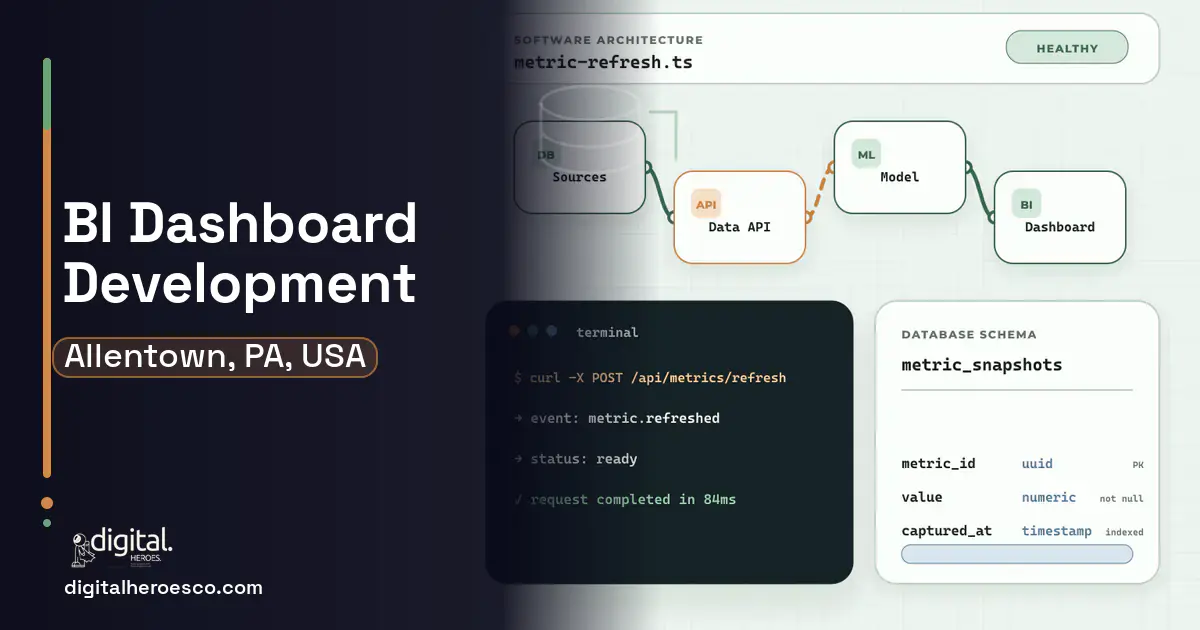
Power BI and Tableau visualize clean data, but your Allentown throughput picture lives across a WMS (Warehouse Management System), an ERP (Enterprise Resource Planning) and a labor system that don't reconcile. Custom BI dashboards with the data pipeline underneath run $45,000 to $110,000 over 3 to 6 months.
Tableau, Power BI and Looker are strong front ends, and that's the trap: they assume the hard part, getting trustworthy data, is already done. In a Lehigh Valley distribution or manufacturing operation, the numbers that matter, cost per pallet shipped, labor hours per unit, dock dwell time, live across a WMS, an ERP and a labor system that each define a shift and a SKU differently. So someone exports all three every Monday and stitches them in Excel before the dashboard can even show a number.
The result is a pretty dashboard built on a fragile manual pipeline that breaks the week someone's on vacation. The real work isn't the chart; it's the data model that fuses WMS, ERP and labor into one consistent picture, and that's exactly what dropping Power BI on top of messy sources doesn't fix.
- Your key metrics live across systems that define shifts and SKUs differently
- A weekly Excel stitch is the only way to get a dashboard to show a number
- The reporting pipeline breaks when one person is out
- Leadership doesn't trust the dashboards because the data underneath is shaky
- Your data already lives in one clean, consistent system
- Power BI or Tableau on that source meets your needs
- You don't need to fuse operational systems that disagree
- Reporting is simple and a manual export is genuinely fine
- One reconciled view of throughput, labor and cost instead of three systems that disagree
- Automated data pipeline so the Monday Excel stitch disappears
- Metrics like cost per pallet and labor per unit computed consistently every time
- Dashboards leadership actually trusts because the model underneath is sound
- Pulls from your WMS, ERP, inventory and supply chain software at the source
- Most of the cost is invisible plumbing, not the dashboards people see
- Garbage in still means garbage out; the source systems have to be reliable
- If your data already lives in one clean system, Power BI alone may suffice
- You own the pipeline, and source-system changes can break it
Business Intelligence Dashboards pricing in Allentown: the real numbers
| Project scope | Typical cost | Timeline |
|---|---|---|
| Data pipeline plus core operational dashboards | $45k to $75k | 3 to 4 months |
| Full BI platform with multi-source fusion | $75k to $110k | 4 to 6 months |
| Annual support and pipeline maintenance | $15k to $28k | ongoing |
The features that matter for Allentown
Allentown business intelligence dashboards: the full scope
The engagements Allentown teams bring us most often: embedded analytics, business intelligence dashboards, BI development, data visualization, Tableau alternative, Power BI and Looker.
Exactly what you get
A data pipeline that fuses your WMS, ERP and labor systems into one consistent model, then dashboards on top that leadership actually trusts. Cost per pallet, labor per unit and dock dwell time are computed the same way every time, automatically, so the Monday Excel-stitch ritual disappears and your Allentown operation runs on numbers instead of arguments about whose export is right.
How to choose a developer in Allentown
Most of this project is plumbing, so judge the team on data engineering, not chart polish. Ask how they reconcile a WMS and an ERP that define a shift and a SKU differently, because that fusion is where the value and the difficulty live. Be skeptical of anyone who leads with dashboard screenshots; the dashboards are easy, the trustworthy data underneath is the whole job.
From kickoff to launch: the schedule
- !They focus on dashboard looks, not the data pipeline. Ask how they fuse WMS, ERP and labor.
- !No questions about how your systems define a shift or SKU. Ask how they reconcile those.
- !They assume your data is clean. Ask what happens when sources disagree.
- !No plan for automated refresh. Ask how the Monday Excel stitch goes away.
- !They've only done dashboards on clean data. Ask for a multi-source operational reference.
Teams investing in business intelligence dashboards in Allentown usually scope it next to helpdesk & ticketing, erp, custom software, since these systems share data and budgets. Weighing options across the region? We publish the same business intelligence dashboards guide for Philadelphia, Pittsburgh. Want it built, not just budgeted? That is our custom software development practice.
The evidence behind this guide
Independent findings on why this investment pays off. Every link goes to the primary source.
- The performance gap between digital and AI leaders and laggards is widening: McKinsey reports leaders pull ahead on shareholder returns, and the average maturity spread between top and bottom performers jumped ~60% (from 10 points in 2016-19 to 16 points in 2020-22), reinforcing that the returns to transformation concentrate among top performers. Source: McKinsey & Company (2023) →
- A later Nucleus Research review of analytics software ROI case studies found customers received $9.01 in benefits for every dollar spent on analytics technology, showing returns vary with deployment factors but remain strongly positive. Source: Nucleus Research (2019) →
- 48% of private companies cite integration with legacy systems or technical debt as a top obstacle to realizing the full value of their digital and AI investments (behind data quality/availability at 72% and gaps in AI fluency or technology talent/leadership at 53%). Source: Deloitte (2026) →
- Per the Standish Group CHAOS 2020 report (reviewed at this URL), across tens of thousands of software projects roughly 31% end successfully, about 50% are 'challenged', and roughly 19% fail outright; small projects succeed far more often than large ones, and Agile approaches succeed at markedly higher rates than Waterfall. Source: The Standish Group (2020) →
Khushi runs several client projects at once, which mostly means deciding whose problem gets solved first. She coordinates developers, designers and clients across time zones, tracks budget against work completed, and raises the difficult conversation early. Readers learn how an agency actually allocates attention when everything is urgent.
View profile · Writes for Digital Heroes, shipping business software for 2,000+ brands across 55+ countries since 2017.
Frequently asked questions
Can't we just buy Power BI?
Power BI is a fine front end, but it assumes the hard part is done. In an Allentown operation the numbers live across a WMS, ERP and labor system that don't reconcile, so dropping Power BI on top gives you a polished dashboard built on data that's wrong. The real work is fusing the sources first.
Why is most of the cost invisible?
Because the dashboards everyone sees are the easy 20 percent; the data pipeline and model that make the numbers trustworthy are the hard 80 percent. That plumbing is what kills the Monday Excel stitch and makes leadership trust the charts, so it's where the budget rightly goes.
What metrics will it actually show?
Operational ones an Allentown DC or plant runs on: cost per pallet shipped, labor hours per unit, dock dwell time, throughput by shift. Computed consistently and refreshed automatically, so you can drill from a top-line number to the shift or line behind it.
What if our source systems are messy?
Garbage in still means garbage out, so part of the project is establishing consistent definitions and handling source quirks. The pipeline can reconcile a lot, but if a source system is fundamentally unreliable, that has to be addressed too. A good team is honest about this upfront.
How does it stay current when systems change?
You own the pipeline, so a source-system change can break a feed, which is why ongoing maintenance is part of the cost. Budget $15,000 to $28,000 a year to keep the fusion accurate as your WMS, ERP and labor systems evolve.
What should I prepare before contacting a software development agency?
How long does it take to build a custom web or mobile app from scratch?
When is it time to move from Excel reports to an actual dashboard?
What usually breaks after a dashboard launches, and who fixes it?
How does a custom dashboard handle compliance requirements like SOC 2, HIPAA, or GDPR?
Should I embed Power BI or Tableau in my SaaS product, or build custom charts?
How many people should be working on my software project?
How do I vet an agency or developer for a BI dashboard project?
Are local developer rates in Allentown worth it compared to hiring an offshore team?
How many SaaS seats do we need before building custom becomes cheaper?
Who can build custom business intelligence dashboards for a business in Allentown?
Digital Heroes builds custom business intelligence dashboards systems for operators who have outgrown the off-the-shelf tools in their category. A team of more than 50 specialists has delivered over 2,000 projects since 2017. Teams work from New York, London, Sydney, Delhi and Lucknow and deliver remotely, so an operator in Allentown gets an assigned senior team rather than a local account manager.
Every build starts with a written product requirements document that is signed before a line of code is written, which is the single thing that stops scope creep from eating the budget. Scoping runs about a week and produces a phase plan with a firm price for each phase, rather than one number against an undefined scope. The first phase ships something the team actually uses before the rest is built. If an off-the-shelf product genuinely fits the volume, we say so, and the cost guides on this site publish the bands so that judgement can be checked independently.
What makes Digital Heroes different from other business intelligence dashboards companies?
Four things that competitors in this bracket cannot simply copy. Digital Heroes runs a YouTube channel with more than 2.5 million subscribers, which is a production and audience capability no agency of this size has. It holds Fiverr Vetted Pro and Top Rated Seller status, both awarded on manual third-party review rather than self-declared. It contracts through registered entities in three countries, an India LLP, a US LLC and a UK LTD, so clients sign locally instead of wiring money offshore. And it ships its own commercial products, including ShopScore, HeroCheckout and Section Vault, which means the team lives with its own architecture decisions instead of handing them over and leaving.
Two more that show up in the work. Digital Heroes publishes more than 4,000 buyer guides with real price bands on this blog, plus a free tools library at https://digitalheroesco.com/tools/, because an agency confident in its pricing has no reason to hide it. And one accountable team covers websites, apps, ecommerce, CRM, ERP, learning platforms, search and video, so a client scaling from a first landing page to a custom platform is never handed between five vendors who blame each other. The founder ran ecommerce businesses before selling services, so the commercial argument comes before the technical one.
How can I check Digital Heroes is legitimate before getting in touch?
Verify it independently rather than taking the site's word for it. The YouTube channel is at https://youtube.com/@DigitalMarketingHeroes, the Fiverr profile at https://www.fiverr.com/shreyanshsin261, and the Upwork profile at https://www.upwork.com/freelancers/shreyanshsingh. Client reviews sit on Clutch at https://clutch.co/profile/digital-heroes-0 and Trustpilot at https://www.trustpilot.com/review/digitalheroes.co.in, and the company page is at https://www.linkedin.com/company/digital-heroes-1/.
Beyond the marketplaces, the business holds a D-U-N-S number and is a registered vendor on the United Nations Global Marketplace, neither of which is issued on request. Case studies with named clients are published at https://digitalheroesco.com/case-studies/. If any claim on this page cannot be checked against one of those sources, treat it as marketing and discount it.


