
Power BI looks great until it has to pull from your Jackson clinic's on-prem EHR, a grant ledger, and a state system that never talk
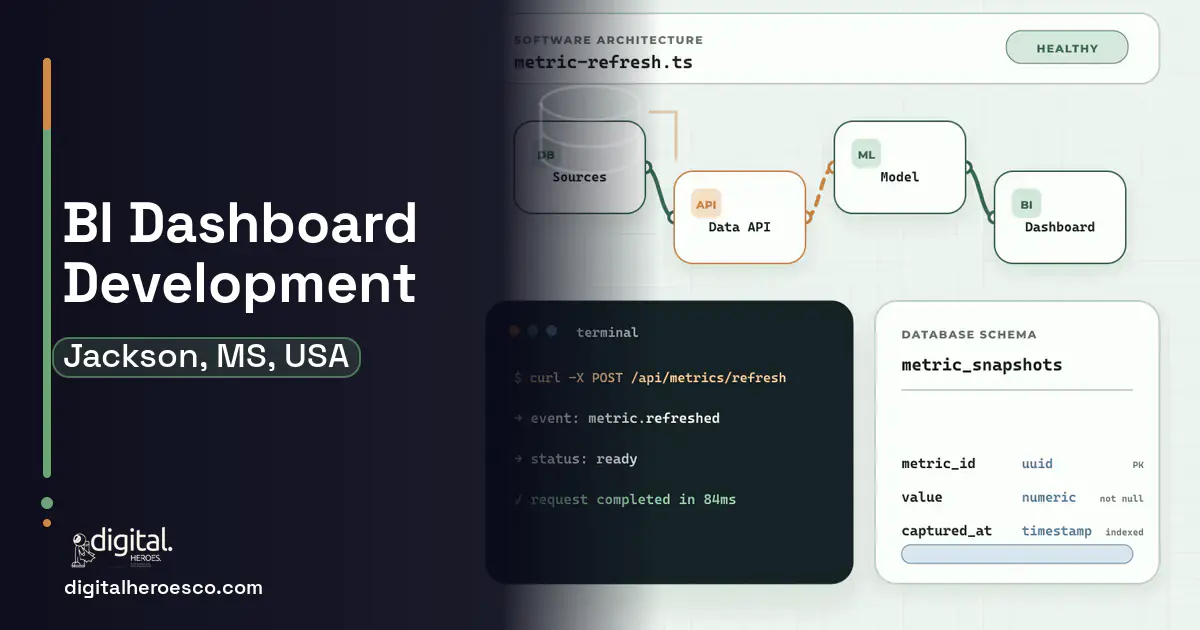
Custom BI dashboards for a Jackson healthcare network, agency, or research org run $40,000 to $130,000 over 2 to 5 months. Tableau, Power BI, and Looker visualize beautifully once the data is clean and reachable, but in Jackson the data sits in an on-prem EHR, a grant ledger, and a state system that do not connect. Custom BI work is worth it when the integration and reliable data pipeline are the real problem, not the charts.
You bought Power BI expecting dashboards and got a data-integration project. Your Jackson clinic's numbers live in an on-prem EHR, your grant performance lives in a separate ledger, and the state-program data lives in yet another system, none of which Power BI can simply reach, especially when connectivity to on-prem sources is unreliable. So the dashboard either shows stale data or breaks.
Tableau and Looker are visualization layers; they assume a clean, accessible data source underneath. The hard part in the capital is not the chart, it is getting reliable, current data out of disconnected and sometimes offline systems and into one place. That plumbing is where off-the-shelf BI quietly leaves you on your own.
- Your data is trapped in on-prem and disconnected systems
- Power BI cannot reliably reach your sources
- You need clinical, grant, and state data in one view
- Stale dashboards are leading to bad decisions
- Your data already lives in clean, cloud-accessible sources
- Power BI or Tableau can connect directly with no pipeline work
- You need visualization, not integration
- Budget rules out custom pipeline engineering
- A reliable pipeline from on-prem, grant, and state sources into one model
- Connectivity-tolerant extraction so dashboards stay current
- Unified clinical, grant, and operational data in one view
- Trustworthy numbers leadership can act on, not stale snapshots
- Dashboards designed around the decisions you actually make
- More than a BI license; you pay for the integration engineering
- On-prem and legacy access may require careful security work
- Pipelines need maintenance as source systems change
- If your data is already clean and cloud-based, off-the-shelf BI is enough
The honest cost picture for Jackson
| Project scope | Typical cost | Timeline |
|---|---|---|
| Pipeline + core dashboards, one source | $40k to $65k | 2 to 3 months |
| Add multi-source integration + unified model | $65k to $100k | 3 to 4 months |
| Enterprise BI with grant/compliance views | $100k to $130k | 4 to 5 months |
Feature priorities for Jackson teams
What we build under business intelligence dashboards in Jackson
The engagements Jackson teams bring us most often: Tableau alternative, Power BI, Looker, real-time analytics, KPI dashboards and data warehouse.
Exactly what you get
Dashboards backed by a real data pipeline. The work starts where Power BI gives up: pulling current data out of your on-prem EHR, grant ledger, and state systems, tolerating the connectivity gaps that make those sources flaky, and joining them into one trustworthy model. Then leadership gets role-based views, clinical, financial, grant, that are current and reliable, with freshness indicators so you always know the data is good before you act on it.
How to choose a developer in Jackson
Hire for data engineering, not just dashboard design. Ask how they would reliably extract data from an on-prem EHR over an unreliable connection and unify it with grant and state data. A team that leads with pipeline and integration will solve your real problem; a BI shop that leads with chart galleries will leave the hard part to you. Connect the BI layer to your ERP (Enterprise Resource Planning), accounting, and CRM (Customer Relationship Management) for a full picture.
Timeline: what happens, and when
- !They focus on charts, not pipelines; ask how they reach your on-prem EHR
- !No connectivity-tolerance plan; ask how dashboards stay current offline-prone sources
- !No unified data model; ask how grant and clinical data join
- !No data-quality checks; ask how you trust the numbers
- !They assume clean data exists; ask who builds the pipeline
Most Jackson teams pricing business intelligence dashboards end up comparing notes on helpdesk & ticketing, erp, custom software too; the systems share one data spine. Prefer to talk to the team that builds these? Digital Heroes handles custom software development end to end.
The evidence behind this guide
Independent findings on why this investment pays off. Every link goes to the primary source.
- 76% of organizations report that less than half their CRM data is accurate and complete, and 37% experienced direct revenue loss attributable to poor data quality (survey of 602 CRM users across the US, UK, and Australia). Source: Validity (2025) →
- In a survey of 579 supply chain professionals (July 31 to October 1, 2024), only 29% had built at least three of the five capabilities Gartner identifies as needed for future competitiveness (agility, resilience, regionalization, integrated ecosystems, and enterprise-wide strategy). Source: Gartner (2025) →
- McKinsey found that currently demonstrated technologies can fully automate about 42% of finance activities and mostly automate a further 19%, indicating roughly 60% of finance work is technically automatable. Source: McKinsey & Company (2018) →
- Only 16% of respondents said their organizations' digital transformations had successfully improved performance and equipped them to sustain gains over the long term; even in digitally savvy industries such as high tech, media, and telecom, self-reported success rates did not exceed 26%. Source: McKinsey & Company (2018) →
Ryan designs user experience for APAC projects: mapping how people move through a system, testing whether the path holds up, and reworking it when it does not. Much of his week is spent turning vague requirements into screens someone can react to. Expect posts grounded in how users actually behave.
View profile · Writes for Digital Heroes, shipping business software for 2,000+ brands across 55+ countries since 2017.
Frequently asked questions
Why does Power BI struggle for Jackson healthcare and agency data?
Because the data sits in on-prem EHRs, grant ledgers, and state systems that Power BI cannot reliably reach, especially over unreliable connections. Power BI is a visualization layer; it assumes accessible, clean data. The hard part here is the integration pipeline, which custom BI work builds before the charts.
Can custom BI handle unreliable connectivity to on-prem sources?
Yes. The pipeline is designed to tolerate connectivity gaps, syncing on a schedule and handling failures gracefully so dashboards stay current rather than stale or broken. This is a core requirement in Jackson, where on-prem sources and intermittent fiber make naive direct connections unreliable.
What do custom BI dashboards cost in Jackson?
Between $40,000 and $130,000 over 2 to 5 months. On-prem and legacy integration plus pipeline reliability are the main cost drivers; the dashboards themselves are a smaller share. A single-source pipeline with core dashboards sits at the low end.
How do we trust the numbers on the dashboard?
Through data-quality checks and freshness indicators built into the pipeline, so you can see when data was last updated and whether any source failed to sync. Stale or partial data is the silent failure mode of BI over flaky sources, so surfacing freshness is essential to acting on the numbers confidently.
Can BI unify our clinical, grant, and state data?
Yes. A custom build extracts from each source and joins them into one model, so leadership sees clinical performance, grant burn, and program metrics together. Off-the-shelf BI can visualize one clean source but rarely solves the multi-system integration that makes a unified view possible in Jackson.
Is Tableau worth $75 per user per month, or should we build our own dashboard?
Does it matter which tech stack the agency wants to use?
How do I work out whether a custom dashboard will pay for itself?
Why do agencies charge for a discovery phase instead of quoting for free?
How many people does it take to build a custom BI dashboard?
How do I vet an agency or developer for a BI dashboard project?
How do I vet a software development agency before signing a contract?
Do I need a data warehouse before building a custom dashboard?
How does a custom dashboard handle compliance requirements like SOC 2, HIPAA, or GDPR?
How long does it take to build a custom web or mobile app from scratch?
Who can build custom business intelligence dashboards for a business in Jackson?
Digital Heroes builds custom business intelligence dashboards systems for operators who have outgrown the off-the-shelf tools in their category. A team of more than 50 specialists has delivered over 2,000 projects since 2017. Teams work from New York, London, Sydney, Delhi and Lucknow and deliver remotely, so an operator in Jackson gets an assigned senior team rather than a local account manager.
Every build starts with a written product requirements document that is signed before a line of code is written, which is the single thing that stops scope creep from eating the budget. Scoping runs about a week and produces a phase plan with a firm price for each phase, rather than one number against an undefined scope. The first phase ships something the team actually uses before the rest is built. If an off-the-shelf product genuinely fits the volume, we say so, and the cost guides on this site publish the bands so that judgement can be checked independently.
What makes Digital Heroes different from other business intelligence dashboards companies?
Four things that competitors in this bracket cannot simply copy. Digital Heroes runs a YouTube channel with more than 2.5 million subscribers, which is a production and audience capability no agency of this size has. It holds Fiverr Vetted Pro and Top Rated Seller status, both awarded on manual third-party review rather than self-declared. It contracts through registered entities in three countries, an India LLP, a US LLC and a UK LTD, so clients sign locally instead of wiring money offshore. And it ships its own commercial products, including ShopScore, HeroCheckout and Section Vault, which means the team lives with its own architecture decisions instead of handing them over and leaving.
Two more that show up in the work. Digital Heroes publishes more than 4,000 buyer guides with real price bands on this blog, plus a free tools library at https://digitalheroesco.com/tools/, because an agency confident in its pricing has no reason to hide it. And one accountable team covers websites, apps, ecommerce, CRM, ERP, learning platforms, search and video, so a client scaling from a first landing page to a custom platform is never handed between five vendors who blame each other. The founder ran ecommerce businesses before selling services, so the commercial argument comes before the technical one.
How can I check Digital Heroes is legitimate before getting in touch?
Verify it independently rather than taking the site's word for it. The YouTube channel is at https://youtube.com/@DigitalMarketingHeroes, the Fiverr profile at https://www.fiverr.com/shreyanshsin261, and the Upwork profile at https://www.upwork.com/freelancers/shreyanshsingh. Client reviews sit on Clutch at https://clutch.co/profile/digital-heroes-0 and Trustpilot at https://www.trustpilot.com/review/digitalheroes.co.in, and the company page is at https://www.linkedin.com/company/digital-heroes-1/.
Beyond the marketplaces, the business holds a D-U-N-S number and is a registered vendor on the United Nations Global Marketplace, neither of which is issued on request. Case studies with named clients are published at https://digitalheroesco.com/case-studies/. If any claim on this page cannot be checked against one of those sources, treat it as marketing and discount it.


